PUBLISHER: Mordor Intelligence | PRODUCT CODE: 2065431

PUBLISHER: Mordor Intelligence | PRODUCT CODE: 2065431
Europe Discrete GPU - Market Share Analysis, Industry Trends & Statistics, Growth Forecasts (2026 - 2031)
According to Mordor Intelligence, the discrete GPU market size is projected to expand from USD 16.22 billion in 2026 to USD 36.31 billion by 2031, registering a CAGR of 17.49% over 2026-2031.
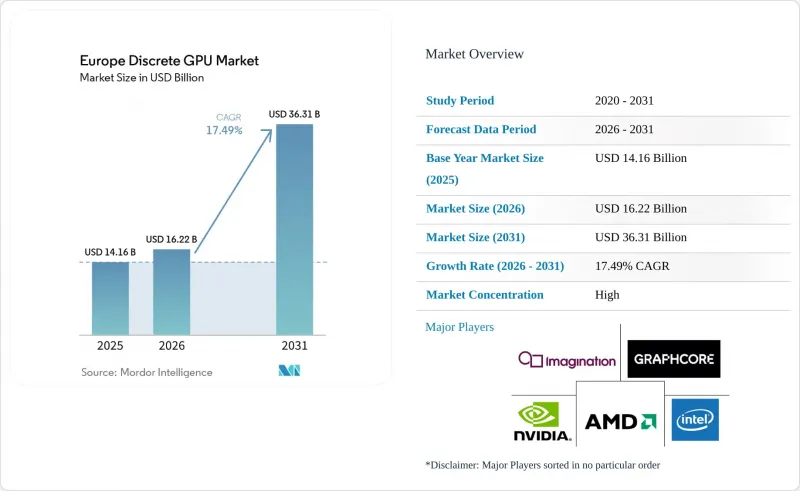
This report is Segmented by Device Application (Mobile Devices and Tablets, Pcs and Workstations, Servers and Datacenter Accelerators, and More), Memory Type (GDDR-Based GPUs and HBM-Based GPUs), Performance Tier (Low-Cost GPUs, Mainstream GPUs, High-Performance Consumer GPUs, and More), and Country (Germany, United Kingdom, France, and More). The Market Forecasts are Provided in Terms of Value (USD).
Europe Discrete GPU Market Trends and Insights
Rising Adoption of Generative AI Workloads in European Data Centers
European hyperscalers and sovereign cloud providers are deploying discrete GPUs at unprecedented scale to meet privacy-centric AI inference and training mandates. Deutsche Telekom's Munich AI Factory came online in early 2026 with 10,000 Blackwell GPUs, demonstrating the need for localized compute sovereignty. Fragmented regulatory regimes prevent cross-border pooling, inflating per-unit GPU requirements and lengthening purchase commitments. Even U.S. platforms such as Meta now provision 6 gigawatts of MI450 capacity in Europe to meet localization rules.A forthcoming AI liability directive will further push enterprises toward on-premises inference stacks, reinforcing multiyear demand visibility.
EU Climate Targets Accelerating EV and ADAS Compute Requirements
Strict net-zero and internal-combustion-phase-out timelines compel automakers to embed discrete GPUs for Level 3-4 autonomy. NVIDIA's DRIVE Thor system-on-chip samples in 2025, but tier-one suppliers still pair it with discrete Ada-generation GPUs to manage real-time sensor fusion. German plants have already retrofitted their digital twin production lines with Omniverse RTX 6000 Ada boards, while French OEMs continue to rely on GPU-accelerated model retraining for over-the-air updates. Expected Euro 7 particulate rules will push discrete GPUs into mass-market vehicles within two model cycles.
Supply Chain Volatility in Advanced Node Foundries
Europe relies heavily on a single Asian foundry for sub-5-nanometer capacity. TSMC, prioritizing 2-nanometer orders for smartphones and hyperscaler ASICs, risks quarterly cutbacks to discrete GPU allocations. Meanwhile, Samsung's struggles with yields at the 3-nanometer node have dissuaded dual sourcing. Additionally, while advanced CoWoS packaging sees high demand, it is currently oversubscribed. Looking ahead, Intel Foundry Services aims for 18-angstrom production by 2027. However, their lack of expertise in HBM integration poses challenges, restricting immediate supply diversification for GPU vendors in Europe.
Other drivers and restraints analyzed in the detailed report include:
- Subsidies Under the EU Chips Act for Local GPU Manufacturing
- Proliferation of Real-Time Ray Tracing in AAA Games
- Escalating HBM Pricing Pressures on Board OEM Margins
For complete list of drivers and restraints, kindly check the Table Of Contents.
Segment Analysis
Servers and datacenter accelerators captured 39.61% of the discrete GPU market share in 2025 and will rise at an 18.11% CAGR through 2031. This expansion mirrors hyperscaler and sovereign-cloud commitments such as Mistral AI's EUR 830 million (USD 888.1 million) Paris cluster. Meanwhile, consumer PCs offload routine tasks to integrated graphics, pushing discrete GPUs into specialized content-creation niches. Automotive and ADAS demand, although smaller, records double-digit growth as Mercedes-Benz and BMW embed discrete GPUs for Level-3 autonomy validation.
Gaming consoles remain flat because PlayStation 5 and Xbox Series X hardware cycles run until 2028. Mobile devices rely on integrated GPUs, limiting discrete penetration to niche gaming tablets. Industrial vision and medical-imaging systems contribute steady but modest revenue, slowed by lengthy certification timelines.
List of Companies Covered in this Report:
- NVIDIA Corporation
- Advanced Micro Devices Inc.
- Intel Corporation
- Imagination Technologies Ltd.
- Graphcore Ltd.
- Kalray SA
- ASUStek Computer Inc.
- Micro-Star International Co. Ltd.
- GIGABYTE Technology Co. Ltd.
- Sapphire Technology Ltd.
- Palit Microsystems Ltd.
- ZOTAC Technology Ltd.
- Colorful Technology Co. Ltd.
- PNY Technologies Inc.
- ASRock Inc.
- Leadtek Research Inc.
- KFA2 (Galaxy Microsystems)
Additional Benefits:
- The market estimate (ME) sheet in Excel format
- 3 months of analyst support
TABLE OF CONTENTS
1 INTRODUCTION
- 1.1 Study Assumptions and Market Definition
- 1.2 Scope of the Study
2 RESEARCH METHODOLOGY
3 EXECUTIVE SUMMARY
4 MARKET LANDSCAPE
- 4.1 Market Overview
- 4.2 Market Drivers
- 4.2.1 CPU-GPU Integration Constrains Adds Stand-Alone GPU Demand
- 4.2.2 Rising Adoption of Generative AI Workloads in European Data Centers
- 4.2.2.1 Europe Discrete GPU Market
- 4.2.3 Proliferation of Real-Time Ray Tracing in AAA Games
- 4.2.4 EU Climate Targets Accelerating EV and ADAS Compute Requirements
- 4.2.5 Open-Source GPU Driver Maturity Lowering Total Cost of Ownership
- 4.2.6 Subsidies Under EU Chips Act for Local GPU Manufacturing
- 4.3 Market Restraints
- 4.3.1 Supply Chain Volatility in Advanced Node Foundries
- 4.3.2 Channel Inventory Gluts Post-Crypto Down-Cycles
- 4.3.3 Tightened EU Energy-Efficiency Regulations on Data Centers
- 4.3.4 Escalating HBM Pricing Pressures on Board OEM Margins
- 4.4 Industry Value-Chain Analysis
- 4.5 Regulatory Landscape
- 4.6 Technological Outlook
- 4.7 Impact of Macroeconomic Factors on the Market
- 4.8 Porter's Five Forces Analysis
- 4.8.1 Threat of New Entrants
- 4.8.2 Bargaining Power of Suppliers
- 4.8.3 Bargaining Power of Buyers
- 4.8.4 Threat of Substitutes
- 4.8.5 Competitive Rivalry
5 MARKET SIZE AND GROWTH FORECASTS (VALUE)
- 5.1 By Device Application
- 5.1.1 Mobile Devices and Tablets
- 5.1.2 PCs and Workstations
- 5.1.3 Servers and Datacenter Accelerators
- 5.1.4 Gaming Consoles and Handhelds
- 5.1.5 Automotive / ADAS
- 5.1.6 Other Embedded and Edge Devices
- 5.2 By Memory Type
- 5.2.1 GDDR-based GPUs
- 5.2.2 HBM-based GPUs
- 5.3 By Performance Tier
- 5.3.1 Low-Cost GPUs (Less than USD 100)
- 5.3.2 Mainstream GPUs (USD 100-USD 400)
- 5.3.3 High-Performance Consumer GPUs (USD 400-USD 1,200)
- 5.3.4 Data Center / AI Accelerator GPUs (Greater than USD 1,200)
- 5.4 By Geography
- 5.4.1 Germany
- 5.4.2 United Kingdom
- 5.4.3 France
- 5.4.4 Italy
- 5.4.5 Rest of Europe
6 COMPETITIVE LANDSCAPE
- 6.1 Market Concentration
- 6.2 Strategic Moves
- 6.3 Market Share Analysis
- 6.4 Company Profiles (includes Global Level Overview, Market Level Overview, Core Segments, Financials as available, Strategic Information, Market Rank/Share, Products and Services, Recent Developments)
- 6.4.1 NVIDIA Corporation
- 6.4.2 Advanced Micro Devices Inc.
- 6.4.3 Intel Corporation
- 6.4.4 Imagination Technologies Ltd.
- 6.4.5 Graphcore Ltd.
- 6.4.6 Kalray SA
- 6.4.7 ASUStek Computer Inc.
- 6.4.8 Micro-Star International Co. Ltd.
- 6.4.9 GIGABYTE Technology Co. Ltd.
- 6.4.10 Sapphire Technology Ltd.
- 6.4.11 Palit Microsystems Ltd.
- 6.4.12 ZOTAC Technology Ltd.
- 6.4.13 Colorful Technology Co. Ltd.
- 6.4.14 PNY Technologies Inc.
- 6.4.15 ASRock Inc.
- 6.4.16 Leadtek Research Inc.
- 6.4.17 KFA2 (Galaxy Microsystems)
7 MARKET OPPORTUNITIES AND FUTURE OUTLOOK
- 7.1 White-Space and Unmet-Need Assessment

