PUBLISHER: Mordor Intelligence | PRODUCT CODE: 2065742

PUBLISHER: Mordor Intelligence | PRODUCT CODE: 2065742
Antibiotic Resistance - Market Share Analysis, Industry Trends & Statistics, Growth Forecasts (2026 - 2031)
According to Mordor Intelligence, the antibiotic resistance market size in 2026 is estimated at USD 9.78 billion, growing from 2025 value of USD 9.28 billion with 2031 projections showing USD 12.72 billion, growing at 5.40% CAGR over 2026-2031.
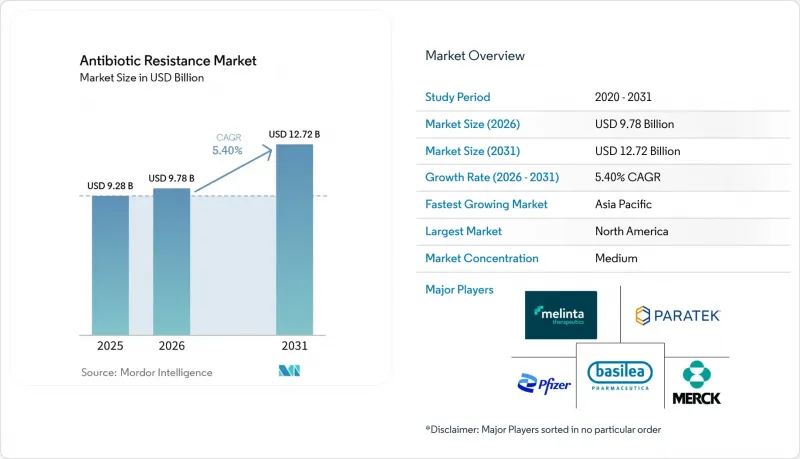
This report is Segmented by Disease (CDI, CIAI, and More), Pathogen (A. Baumannii, P. Aeruginosa, and More), Drug Class (Tetracyclines, and More), Mechanism of Action (Cell-Wall Synthesis Inhibitors, and More), Distribution Channel (Hospital Pharmacies, and More), and Geography (North America, Europe, Asia Pacific, and More). The Market Sizes and Forecasts are Provided in Terms of Value (USD).
Global Antibiotic Resistance Market Trends and Insights
High Burden of Antibiotic-Resistant Infections
Antimicrobial resistance caused 4.71 million deaths in 2021 and threatens to reach 10 million annually by 2050 unless decisive action is taken. Surveillance indicates plateauing resistance in many European states, yet low- and middle-income countries continue to see rising rates due to weak monitoring and limited access to new antibiotics. The economic drag could total USD 855 billion in annual losses by 2030, intensifying payer interest in value-based procurement. Demand, therefore, concentrates on agents that align with WHO priority-pathogen guidance and preserve future treatment options. Hospitals are increasingly favoring narrow-spectrum or pathogen-targeted products that mitigate collateral resistance. This environment sustains long-run uptake of novel therapies and keeps the antibiotic resistance market on a steady growth arc.
Escalating Global AMR Funding Initiatives
More than USD 500 million has flowed into CARB-X, backing 100+ early-stage projects worldwide. The UK's subscription purchase model, launched in August 2024, decouples developer revenue from volume and offers a reproducible template for other payers. Corporate pledges are rising, exemplified by GSK's GBP 45 million (USD 61 million) commitment to the Fleming Initiative and Eli Lilly's USD 100 million injection into the AMR Action Fund. Blended finance vehicles, social-impact bonds, and BARDA's decade-long USD 300 million earmark collectively reduce the funding cliff that once stymied late-stage programs. Together, these mechanisms strengthen the pipeline and improve visibility for investors weighing entry into the antibiotic resistance industry.
Stringent Clinical Safety & Superiority Requirements
Regulators increasingly require superiority over legacy comparators, inflating trial sizes, timelines, and budgets. Complete Response Letters, such as the one issued for cefepime-taniborbactam, underscore the heightened bar. Enrollment proves difficult when target patients are critically ill yet scarce, forcing complex global studies that challenge smaller sponsors. Real-world evidence is slowly gaining acceptance but remains uneven across jurisdictions, prolonging the route to market for many candidates and tempering the growth rate of the antibiotic resistance market.
Other drivers and restraints analyzed in the detailed report include:
- Expedited Regulatory Incentives for Priority Antibiotics
- Hospital Stewardship Mandates Boosting Novel Uptake
- Unfavourable Cost-to-Return Profile for Big-Pharma
For complete list of drivers and restraints, kindly check the Table Of Contents.
Segment Analysis
Community-Acquired Bacterial Pneumonia (CABP) retained 27.85% of 2025 revenue, underlining its ubiquitous burden across community and hospital settings. Within this spectrum, HABP/VABP exhibits the fastest 8.55% CAGR, fueled by prolonged ICU ventilation and the density of multidrug-resistant organisms in critical care wards. During 2025, the antibiotic resistance market size for HABP/VABP is set to widen further as clinicians gravitate toward pathogen-targeted combinations able to navigate complex resistance phenotypes.
Pipeline progress illustrates the trend. Aztreonam/avibactam won FDA clearance for cIAI yet shows cross-utility in high-risk pulmonary infections, while adaptive designs are enabling expedited HABP/VABP approvals. CDI advances such as ibezapolstat point to parallel momentum in severe colitis, reinforcing breadth across infection sites. Outpatient-oriented ABSSSI products like lipoglycopeptides sustain growth in ambulatory care, giving manufacturers multiple entry points into the antibiotic resistance market.
MRSA kept its 22.14% share in 2025, but growth is shifting toward Gram-negative challenges. P. aeruginosa's projected 9.28% CAGR exemplifies this pull, driven by intrinsic resistance traits and biofilm proficiency that complicate device-associated infections. Carbapenem-resistant A. baumannii is likewise climbing, with Phase 3 trials for zosurabalpin targeting this WHO-listed urgent threat.
E. coli maintains relevance through rising ESBL prevalence, while surveillance from China flags alarming gains in carbapenem-resistant K. pneumoniae. These data validate the pursuit of broad-spectrum combinations and encourage adaptive regimens leveraging rapid diagnostics. Consequently, pathogen-centric R&D underpins the steady evolution of the antibiotic resistance market.
Geography Analysis
Asia Pacific generated 46.50% of global revenue in 2025, reflecting high infection prevalence, widening insurance coverage, and proactive governmental investment. Singapore advances rapid diagnostics and bacteriophage research, while Japan has revived domestic API production to buffer against overseas supply disruptions. China's anti-espionage law raises procurement uncertainty, prompting multinationals to diversify sourcing and invest in redundancy.
North America combines sophisticated stewardship frameworks with strong funding pipelines. The FDA's alignment with BARDA grants and QIDP incentives streamlines late-stage development, though the region remains vulnerable to ingredient shortages concentrated in India and China. Europe's coordinated surveillance has stabilized resistance rates across 29 EEA countries, yet policymakers continue to debate manufacturing profitability versus environmental stewardship. The UK's subscription model offers a potential corrective to the traditional volume-linked revenue barrier.
South America leads growth at 7.55% CAGR, driven by improved diagnostics, rising healthcare spend, and heightened awareness of resistance costs. Brazil's antibiotic consumption climbed 30% from 2014-2019, signalling both stewardship gaps and commercial opportunity. The Middle East & Africa displays incremental progress, hampered by financing constraints but aided by multilateral grant programs aimed at laboratory capacity and supply-chain integrity. Together, these patterns underscore the global interconnectedness of the antibiotic resistance market.
- Abbott Laboratories
- Abbvie
- AstraZeneca
- Basilea Pharmaceutica
- GlaxoSmithKline
- Johnson & Johnson
- Melinta Therapeutics
- Merck
- Novartis
- Paratek Pharmaceuticals
- Pfizer
- Acurx Pharmaceuticals
- Iterum Therapeutics
- Shionogi & Co., Ltd.
- Spero Therapeutics
- Summit Therapeutics
- Theravance Biopharma
- Venatorx Pharmaceuticals
- Wockhardt
- Zai Lab
Additional Benefits:
- The market estimate (ME) sheet in Excel format
- 3 months of analyst support
TABLE OF CONTENTS
1 Introduction
- 1.1 Study Assumptions & Market Definition
- 1.2 Scope of the Study
2 Research Methodology
3 Executive Summary
4 Market Landscape
- 4.1 Market Overview
- 4.2 Market Drivers
- 4.2.1 High Burden Of Antibiotic-Resistant Infections
- 4.2.2 Escalating Global AMR Funding Initiatives
- 4.2.3 Expedited Regulatory Incentives For Priority Antibiotics
- 4.2.4 Hospital Stewardship Mandates Boosting Novel Uptake
- 4.2.5 AI/ML-Based Ultra-Rapid Compound Discovery
- 4.2.6 Nanoparticle-Enabled Targeted Delivery Vs. Biofilms
- 4.3 Market Restraints
- 4.3.1 Stringent Clinical Safety & Superiority Requirements
- 4.3.2 Unfavourable Cost-To-Return Profile For Big-Pharma
- 4.3.3 Slow Reimbursement Of Rapid Diagnostics
- 4.3.4 Fragile API Fermentation Supply Chains
- 4.4 Supply-Chain Analysis
- 4.5 Regulatory Landscape
- 4.6 Technological Outlook
- 4.7 Innovation Pipeline Analysis
- 4.8 Porter's Five Forces Analysis
- 4.8.1 Bargaining Power of Buyers
- 4.8.2 Bargaining Power of Suppliers
- 4.8.3 Threat of New Entrants
- 4.8.4 Threat of Substitutes
- 4.8.5 Intensity of Competitive Rivalry
5 Market Size & Growth Forecasts (Value, USD)
- 5.1 By Disease
- 5.1.1 Clostridioides difficile Infection (CDI)
- 5.1.2 Complicated Intra-Abdominal Infection (cIAI)
- 5.1.3 Acute Bacterial Skin & Skin-Structure Infections (ABSSSI)
- 5.1.4 Hospital- & Ventilator-Acquired Pneumonias (HABP/VABP)
- 5.1.5 Complicated Urinary Tract Infection (cUTI)
- 5.1.6 Community-Acquired Bacterial Pneumonia (CABP)
- 5.1.7 Bloodstream Infection (BSI)
- 5.2 By Pathogen
- 5.2.1 Acinetobacter baumannii
- 5.2.2 Staphylococcus aureus (incl. MRSA)
- 5.2.3 Pseudomonas aeruginosa
- 5.2.4 Haemophilus influenzae
- 5.2.5 Escherichia coli
- 5.2.6 Other Priority Pathogens
- 5.3 By Drug Class
- 5.3.1 Tetracyclines
- 5.3.2 Oxazolidinones
- 5.3.3 Cephalosporins
- 5.3.4 Lipoglycopeptides
- 5.3.5 Combination Therapies
- 5.3.6 Other Classes
- 5.4 By Mechanism of Action
- 5.4.1 Cell-Wall Synthesis Inhibitors
- 5.4.2 Protein-Synthesis Inhibitors
- 5.4.3 DNA-Synthesis Inhibitors
- 5.4.4 RNA-Synthesis Inhibitors
- 5.4.5 Other Mechanisms
- 5.5 By Distribution Channel
- 5.5.1 Hospital Pharmacies
- 5.5.2 Retail Pharmacies
- 5.5.3 Online Pharmacies
- 5.6 Geography
- 5.6.1 North America
- 5.6.1.1 United States
- 5.6.1.2 Canada
- 5.6.1.3 Mexico
- 5.6.2 Europe
- 5.6.2.1 Germany
- 5.6.2.2 United Kingdom
- 5.6.2.3 France
- 5.6.2.4 Italy
- 5.6.2.5 Spain
- 5.6.2.6 Rest of Europe
- 5.6.3 Asia Pacific
- 5.6.3.1 China
- 5.6.3.2 Japan
- 5.6.3.3 India
- 5.6.3.4 South Korea
- 5.6.3.5 Australia
- 5.6.3.6 Rest of Asia Pacific
- 5.6.4 Middle East & Africa
- 5.6.4.1 GCC
- 5.6.4.2 South Africa
- 5.6.4.3 Rest of MEA
- 5.6.5 South America
- 5.6.5.1 Brazil
- 5.6.5.2 Argentina
- 5.6.5.3 Rest of South America
- 5.6.1 North America
6 Competitive Landscape
- 6.1 Market Concentration
- 6.2 Market Share Analysis
- 6.3 Company Profiles (includes Global level Overview, Market level overview, Core Segments, Financials as available, Strategic Information, Market Rank/Share, Products & Services, Recent Developments)
- 6.3.1 Abbott
- 6.3.2 AbbVie
- 6.3.3 AstraZeneca
- 6.3.4 Basilea Pharmaceutica Ltd
- 6.3.5 GSK plc
- 6.3.6 Johnson & Johnson
- 6.3.7 Melinta Therapeutics
- 6.3.8 Merck & Co., Inc.
- 6.3.9 Novartis AG
- 6.3.10 Paratek Pharmaceuticals
- 6.3.11 Pfizer Inc.
- 6.3.12 Acurx Pharmaceuticals
- 6.3.13 Iterum Therapeutics
- 6.3.14 Shionogi & Co., Ltd.
- 6.3.15 Spero Therapeutics
- 6.3.16 Summit Therapeutics
- 6.3.17 Theravance Biopharma
- 6.3.18 Venatorx Pharmaceuticals
- 6.3.19 Wockhardt Ltd
- 6.3.20 Zai Lab
7 Market Opportunities & Future Outlook
- 7.1 White-space & Unmet-Need Assessment

