PUBLISHER: Mordor Intelligence | PRODUCT CODE: 2065750

PUBLISHER: Mordor Intelligence | PRODUCT CODE: 2065750
Singapore OOH And DOOH - Market Share Analysis, Industry Trends & Statistics, Growth Forecasts (2026 - 2031)
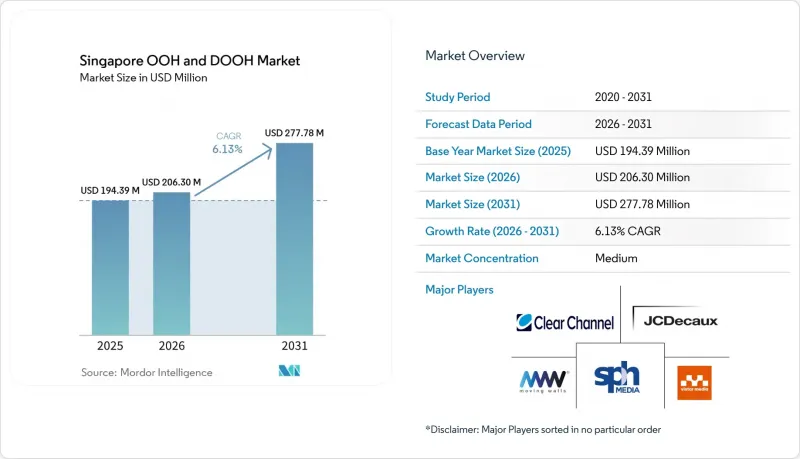
According to Mordor Intelligence, the singapore OOH And DOOH market size was valued at USD 194.39 million in 2025 and is estimated to grow from USD 206.30 million in 2026 to reach USD 277.78 million by 2031, at a CAGR of 6.13% during the forecast period (2026-2031).
This report is Segmented by Type (Static OOH, Digital OOH [Programmatic DOOH, Interactive OOH]), Format (Billboards, Transportation, and More), Location Environment (Outdoor, Indoor), End-User Industry (Retail and Consumer Goods, Automotive, and More). The Market Forecasts are Provided in Terms of Value (USD).
Singapore OOH And DOOH Market Trends and Insights
Rapid build-out of premium LED facades
Orchard Road is being repositioned as a lifestyle precinct, and property owners are investing in high-resolution screens that bring cinematic quality to street-level media. The URA's incentive scheme encourages facade upgrades that will add multiple digital canvases from 2025 onward. Marina Bay Sands will add a new tower and a 15,000-seat arena that together create fresh exterior and interior media zones. These sites attract premium CPMs because they marry high footfall with affluent audiences. Advertisers gain dynamic scheduling, real-time creative swaps, and audience impression guarantees. As a result, DOOH budgets move steadily from static posters into these data-rich premium screens, propelling the Singapore OOH and DOOH market toward higher digital penetration.
Singapore Changi Airport Jewel & T5 expansion
Jewel Changi Airport has matured into a lifestyle destination that blends retail, attractions, and transport, giving brands an immersive platform that reaches residents and travelers alike. Terminal 5, sized for 50 million annual passengers, will launch a wave of transit inventory when operations begin in the next decade. JCDecaux extended its concession through 2034, guaranteeing advertisers a coordinated airport network of 100 digital screens, including the 14-meter-tall Digital Chandelier. The consistent global traveler mix supports long dwell times and high conversion rates, making Changi a core pillar of the Singapore OOH and DOOH market.
Stringent URA cap on large-format sites
Singapore protects visual corridors and heritage skylines by limiting billboard approvals in conservation areas. The Advertising Licensing System now requires digital plan submissions and restricts creatives that impede building aesthetics. This curtails inventory growth, especially in high-traffic zones like Chinatown and Little India. Supply scarcity sustains price premiums and can deter price-sensitive sectors, slowing the expansion of the Singapore OOH and DOOH market.
Other drivers and restraints analyzed in the detailed report include:
- Smart-Nation push for programmatic DOOH
- MAS open-banking policy catalysing fintech OOH spend
- High median CPM versus regional peers
For complete list of drivers and restraints, kindly check the Table Of Contents.
Segment Analysis
The Singapore OOH and DOOH market size for Digital OOH reached USD 76.99 million in 2025 and is forecast to climb at an 8.55% CAGR through 2031. Programmatic trading already accounts for 20% of digital screen revenue, and JCDecaux expects that share to hit 30% by 2025. Dynamic creative optimization allows advertisers to align messaging with weather, traffic, and retail promotions in real time. Static inventory, while still holding 60.40% of the Singapore OOH and DOOH market share in 2025, sees slower 3.85% annual growth thanks to lower CPMs and longer booking cycles. Many static faces in suburban town centers remain attractive for long-term brand presence, yet landlords plan phased LED retrofits that will continue to tilt revenue toward digital formats.
In the Singapore OOH and DOOH market, media owners bundle static posters with digital panels to offer tiered packages that protect legacy assets while promoting high-margin screens. Brands in FMCG and entertainment embrace full-motion video because it yields recall uplifts of up to 30% compared with static. Improved measurement tools, such as audience impression modeling validated by telecom location data, provide advertisers with confidence in the incremental reach delivered by digital. These advances reinforce Digital OOH as the primary driver of incremental spend over the next five years.
Transit placements generated USD 49.19 million, equal to 25.30% of the Singapore OOH and DOOH market size in 2025, and exhibit the fastest trajectory at a 9.12% CAGR. MRT stations like Raffles Place and Dhoby Ghaut record weekday gate counts above 180,000, offering dense commuter impressions. The Straits Times reports that the Land Transport Authority will appoint a single concessionaire for bus advertising in 2025, allowing package sales across 5,800 buses and 100 terminals. This scale creates cross-line frequency and data-driven route planning, raising the appeal of transit media to national brands.
Billboards remain the largest individual format at 34.10% market share, yet growth lags due to site caps. Street furniture enjoys moderate expansion as Housing and Development Board (HDB) digital screens penetrate residential estates, delivering hyper-local reach at mid-range CPMs. Airport media enjoys premium pricing, and JCDecaux's global programmatic airport network lets advertisers geofence flight destinations inside one trading console. Collectively, these innovations intensify advertiser interest and sustain the upward curve of the Singapore OOH and DOOH market.
List of Companies Covered in this Report:
- JCDecaux Singapore Pte Ltd
- Clear Channel Singapore Pte Ltd
- Moving Walls Pte Ltd
- Talon Outdoor Ltd
- Moove Media
- Vistar Media
- Gleamedia
- SPH Media Ltd
- Hivestack Inc.
- Broadsign International LLC
- Asiaray Media Group Ltd
- Mediacorp Pte Ltd
- oOh!Media Singapore
- VGI Public Company Ltd (SG office)
- Stroer SE and Co. KGaA
- Pixel Media Mania Pte Ltd
- Ads On Cab Pte Ltd
- SY Media Advertising
- Scala Asia-Pacific Pte Ltd
- Stellar Ace
Additional Benefits:
- The market estimate (ME) sheet in Excel format
- 3 months of analyst support
TABLE OF CONTENTS
1 INTRODUCTION
- 1.1 Study Assumptions and Market Definition
- 1.2 Scope of the Study
2 RESEARCH METHODOLOGY
3 EXECUTIVE SUMMARY
4 MARKET LANDSCAPE
- 4.1 Market Overview
- 4.2 Market Drivers
- 4.2.1 Rapid build-out of premium LED facades along Orchard Road and Marina Bay Sands
- 4.2.2 Singapore Changi Airport's Jewel and T5 expansion boosting transit inventory
- 4.2.3 Smart-nation push accelerating programmatic-DOOH adoption by local SMEs
- 4.2.4 MAS open-banking policy catalysing fintech OOH spend
- 4.2.5 Data-mingled commuter insights from SBS Transit/SMRT mobile apps
- 4.3 Market Restraints
- 4.3.1 Stringent Urban Redevelopment Authority cap on large-format sites
- 4.3.2 High median media-buy CPM versus regional peers (Bangkok, Kuala Lumpur)
- 4.3.3 Advertising exclusion zones near heritage districts
- 4.4 Regulatory Outlook
- 4.5 Porter's Five Forces Analysis
- 4.5.1 Bargaining Power of Suppliers
- 4.5.2 Bargaining Power of Consumers
- 4.5.3 Threat of New Entrants
- 4.5.4 Competitive Rivalry within the Industry
- 4.5.5 Threat of Substitutes
- 4.6 Industry Ecosystem Analysis
5 MARKET SIZE AND GROWTH FORECASTS (VALUE)
- 5.1 By Type
- 5.1.1 Static (Traditional) OOH
- 5.1.2 Digital OOH
- 5.1.2.1 Programmatic-OOH
- 5.1.2.2 Other DOOH Types
- 5.2 By Format
- 5.2.1 Billboard
- 5.2.2 Street Furniture
- 5.2.3 Transportation (Transit)
- 5.2.3.1 Airports
- 5.2.3.2 Other Transit (MRT, buses, taxis)
- 5.2.4 Place-based Media
- 5.3 By Location Environment
- 5.3.1 Outdoor
- 5.3.2 Indoor
- 5.4 By End-User Industry
- 5.4.1 Automotive
- 5.4.2 Retail and Consumer Goods
- 5.4.3 Healthcare
- 5.4.4 BFSI
- 5.4.5 Other End Users
6 COMPETITIVE LANDSCAPE
- 6.1 Strategic Moves
- 6.2 Vendor Positioning Analysis
- 6.3 Company Profiles (includes Market-level Overview, Core Segments, Financials as available, Strategic Information, Products and Services, and Recent Developments)
- 6.3.1 JCDecaux Singapore Pte Ltd
- 6.3.2 Clear Channel Singapore Pte Ltd
- 6.3.3 Moving Walls Pte Ltd
- 6.3.4 Talon Outdoor Ltd
- 6.3.5 Moove Media
- 6.3.6 Vistar Media
- 6.3.7 Gleamedia
- 6.3.8 SPH Media Ltd
- 6.3.9 Hivestack Inc.
- 6.3.10 Broadsign International LLC
- 6.3.11 Asiaray Media Group Ltd
- 6.3.12 Mediacorp Pte Ltd
- 6.3.13 oOh!Media Singapore
- 6.3.14 VGI Public Company Ltd (SG office)
- 6.3.15 Stroer SE and Co. KGaA
- 6.3.16 Pixel Media Mania Pte Ltd
- 6.3.17 Ads On Cab Pte Ltd
- 6.3.18 SY Media Advertising
- 6.3.19 Scala Asia-Pacific Pte Ltd
- 6.3.20 Stellar Ace
7 MARKET OPPORTUNITIES AND FUTURE OUTLOOK
- 7.1 White-space and Unmet-Need Assessment

