PUBLISHER: Mordor Intelligence | PRODUCT CODE: 2066498

PUBLISHER: Mordor Intelligence | PRODUCT CODE: 2066498
Centrifugal Pumps - Market Share Analysis, Industry Trends & Statistics, Growth Forecasts (2026 - 2031)
According to Mordor Intelligence, the centrifugal pumps market size is projected to be USD 38.89 billion in 2025, USD 40.46 billion in 2026, and reach USD 54.14 billion by 2031, growing at a CAGR of 6% from 2026 to 2031.
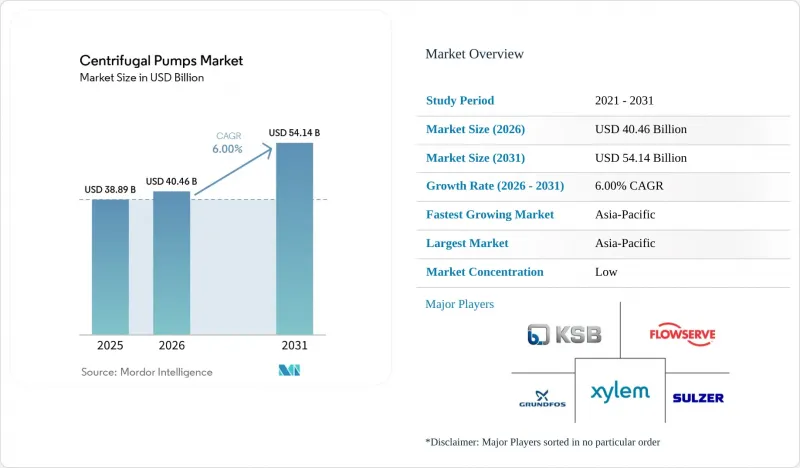
This report is Segmented by Stage (Single-Stage and Multi-Stage), Pump Design (Radial Flow, Mixed Flow, and Axial Flow), Impeller Type (Open, Semi-Open, and Enclosed), Application (Water and Wastewater, Chemical and Petrochemical, HVAC and Building Services, Food and Beverage, Mining and Metals, and More), and Geography (North America, Europe, Asia-Pacific, South America, and Middle East and Africa).
Global Centrifugal Pumps Market Trends and Insights
Waste-Water Infrastructure Spending Boom
Municipal and industrial treatment plants are in a capital-intensive upgrade cycle. The U.S. Environmental Protection Agency allocated USD 11.5 billion in 2024 through State Revolving Fund programs to modernize pump stations, membrane-bioreactor lines, and nutrient-removal assets. The Clean Water State Revolving Fund disbursed USD 32.81 billion for advanced treatment and USD 2.255 billion for reuse projects, both of which depend on multi-stage pumps able to deliver 50-150 psi feed pressure. Utilities are replacing fixed-speed machines from the 1980s and 1990s with variable-speed units that cut energy use by 25-30%, saving USD 40,000-60,000 per 100-horsepower pump each year. PFAS remediation adds volume: 85% of EPA fiscal-year-2022 emerging-contaminant grants target per- and polyfluoroalkyl substances, driving demand for corrosion-resistant pumps that handle acidic regenerant streams. Outside the United States, the Philippines has earmarked PHP 438.4 billion (USD 8.5 billion) for irrigation projects that will install solar-powered single-stage units across 681,709 hectares.
HVAC Retrofit Wave in Commercial Buildings
Building owners are replacing legacy chilled-water pumps to satisfy tougher energy codes and refrigerant phasedown rules. The International Energy Agency identifies resilient cooling technologies such as ground-source heat pumps, chilled-water storage, and evaporative systems, all of which rely on centrifugal circulation pumps operating at 40-60 feet of head. Johnson Controls reports power-usage-effectiveness ratios of 1.18-1.24 for its cooling units, thanks in part to variable-speed pumps that trim parasitic energy 15-20% compared with constant-speed designs. The U.S. EPA's hydrofluorocarbon phasedown rule, finalized in 2023, accelerates the move to low-GWP refrigerants such as R-1234ze, which operate at higher pressures and therefore require pumps with upgraded seals. Daikin specifies pump discharge pressures of 8 bar for hyperscale-data-center chillers using low-GWP refrigerants, 30% above legacy R-134a systems.
Steel & Alloy Price Volatility
The International Monetary Fund's metals index rose 7.7% between February and August 2024, with copper up 8.1% and aluminum up 7.8%. A 10% copper jump historically adds a 0.2-point increase to consumer inflation within 12 months, pressuring pump OEMs that use copper in motor windings and bronze impellers. U.S. stainless-steel production fell 11% in October 2024, while ferrochromium prices dropped 29% year on year, reflecting supply-chain concentration in Kazakhstan and South Africa. Nickel-alloy castings gained 15-20% in 2024 after Indonesian export curbs and electric-vehicle battery demand tightened supply, forcing OEMs to substitute duplex stainless steels or lock in fixed-price contracts. European Union anti-dumping duties on Chinese stainless-steel flanges add 8-12% to landed cost and extend lead times by 4-6 weeks.
Other drivers and restraints analyzed in the detailed report include:
- Oil & Gas Mid-Stream Capacity Expansion
- Power-Generation Build-Outs, Especially CCGT
- Shift to Positive-Displacement Pumps in Niches
For complete list of drivers and restraints, kindly check the Table Of Contents.
Segment Analysis
Multi-stage designs are forecast to grow at a 7.3% CAGR through 2031, outpacing the 6.0% market average as seawater reverse osmosis facilities, high-rise plumbing systems, and boiler-feed lines demand compact, high-pressure capability. Single-stage pumps still delivered 62.8% of 2025 revenue because municipal water distribution and HVAC circulation often work below 150 feet of head, favoring lower complexity. The International Energy Agency estimates that 40% of announced electrolyzer projects are located in water-stressed areas, each requiring reverse-osmosis feed pressure of 60-80 bar and thus six to ten multi-stage pumps per train. Boiler-feedwater packages for combined-cycle plants specify barrel configurations compliant with API 610 BB3, handling 3,000 psi discharge. Grundfos's IE5 motor and VFD package pushes wire-to-water efficiency past 92%, lowering lifecycle energy by one-quarter. Mining companies adopt horizontal split-case multi-stage units that keep 70-75% hydraulic efficiency while resisting abrasion.
Single-stage pumps remain indispensable for cooling-tower makeup, fire-protection loops, and irrigation systems that value low capital cost and simple field repairs. Standard end-suction ANSI/ASME B73.1 footprints allow one-for-one drop-in replacements, and personnel can rebuild seals and bearings on site. Agricultural programs in India supply subsidized single-stage, solar-powered pumps to smallholder farms, boosting irrigation area coverage. In building services, twin-single-stage configurations with duty-standby logic offer redundancy without the cost premium of multi-stage sets. Despite slower growth, the large installed base secures steady aftermarket opportunities for seals, impellers, and wear rings.
Radial-flow designs held 64.1% of 2025 revenue, anchored by their versatility in chemical processing, HVAC, and water supply, where heads run 50-300 feet and flows cover 100-5,000 gallons per minute. Mixed-flow pumps are expanding at a 6.9% CAGR because flood-control districts and open-pit mines favor higher specific speeds of 1,500-4,000 rpm that deliver greater head per stage without oversizing impeller diameters. The U.S. Army Corps of Engineers is retrofitting Mississippi River and Gulf Coast stations with mixed-flow models that achieve 80-85% efficiency, reducing parasitic power by 10-15% against radial predecessors. Mining tailings lines choose mixed-flow hydraulics for 20-30% solids while maintaining 65-70% efficiency, a clear advantage over radial designs in abrasive service.
Axial-flow propeller pumps, though niche, serve very-high-flow and low-head duties such as cooling-water intakes at coastal power plants and drainage in polders, handling more than 50,000 GPM with heads below 30 feet. Radial machines remain dominant in chemical and refinery services because ANSI dimensional interchangeability and low net-positive-suction-head-required values safeguard process uptime. In aquaculture and wastewater aeration, axial-flow models are gaining share for their ability to move large volumes at minimal energy, improving dissolved-oxygen transfer rates. Across all geometries, computational fluid-dynamic optimization and additive-manufactured flow passages fine-tune efficiency and reduce cavitation risk.
Geography Analysis
Asia-Pacific delivered 50.3% of 2025 revenue and is expected to post a 6.4% CAGR to 2031, supported by municipal wastewater upgrades in China, irrigation modernization in India, and geothermal power additions in Indonesia. China's CNP Pumps generated RMB 4.795 billion (USD 670 million) in 2023 and holds more than 600 patents that help win domestic and export tenders. India's Pradhan Mantri Krishi Sinchai Yojana subsidizes solar-powered centrifugal sets for small and marginal farmers, expanding addressable volumes. Southeast Asia's geothermal capacity reached 2,360 MW in 2022, with brine temperatures above 200 °C requiring corrosion-resistant pumps for reinjection loops.
North America and Europe jointly claimed 35-38% of 2025 sales. Aging infrastructure keeps baseline demand stable while energy-efficiency retrofits and PFAS remediation laws lift replacement rates. The U.S. EPA earmarked USD 11.5 billion in 2024 for pump-station modernization, membrane bioreactors, and nutrient-removal projects. Germany provides rebates covering up to 35% of pump-upgrade costs for industrial and commercial facilities, accelerating VFD adoption. KSB's 2024 purchase of Hydro Inc. adds wastewater capacity in Maine and a distribution network across the U.S. Northeast, positioning the group closer to municipal customers.
Middle East-Africa and South America are on track for a 6.5-7.0% CAGR, driven by desalination plants, pipeline expansions, and mining projects. Saudi Arabia's Vision 2030 channels USD 1 trillion into infrastructure, including reverse-osmosis desalination units that each require eight to twelve high-pressure pumps. South Africa's Lesotho Highlands Water Project Phase II budgets USD 2.3 billion for a 1,270 MW pumped-storage scheme using sixteen to twenty reversible pump-turbines. Brazil's sanitation law mandates 90% water-supply and wastewater-collection coverage by 2033, implying 50,000-60,000 new pump installs, mainly single-stage end-suction units.
- Grundfos Holding A/S
- Flowserve Corporation
- Xylem Inc.
- KSB SE & Co. KGaA
- Sulzer Ltd
- Ebara Corporation
- ITT Inc.
- Weir Group PLC
- Dover Corporation
- Baker Hughes Company
- Ruhrpumpen Group
- Schlumberger Ltd.
- Wilo SE
- Pentair PLC
- SPX FLOW Inc.
- Kirloskar Brothers Ltd.
- Torishima Pump Mfg. Co., Ltd.
- Andritz AG
- DESMI A/S
- CP Pumpen AG
Additional Benefits:
- The market estimate (ME) sheet in Excel format
- 3 months of analyst support
TABLE OF CONTENTS
1 Introduction
- 1.1 Study Assumptions & Market Definition
- 1.2 Scope of the Study
2 Research Methodology
3 Executive Summary
4 Market Landscape
- 4.1 Market Overview
- 4.2 Market Drivers
- 4.2.1 Waste-water infrastructure spending boom
- 4.2.2 HVAC retrofit wave in commercial buildings
- 4.2.3 Oil & gas mid-stream capacity expansion
- 4.2.4 Power-generation build-outs, esp. CCGT
- 4.2.5 Modular skid pumps for data-centre cooling
- 4.2.6 Hydrogen-ready liquid pumps for green H? projects
- 4.3 Market Restraints
- 4.3.1 Steel & alloy price volatility
- 4.3.2 Shift to positive-displacement pumps in niches
- 4.3.3 VFD adoption cutting oversized-pump replacements
- 4.3.4 PFAS regulation limiting fluoropolymer-lined pumps
- 4.4 Supply-Chain Analysis
- 4.5 Regulatory Landscape
- 4.6 Technological Outlook
- 4.7 Porter's Five Forces
- 4.7.1 Bargaining Power of Suppliers
- 4.7.2 Bargaining Power of Buyers
- 4.7.3 Threat of New Entrants
- 4.7.4 Threat of Substitutes
- 4.7.5 Competitive Rivalry
5 Market Size & Growth Forecasts
- 5.1 By Stage
- 5.1.1 Single-Stage Pumps
- 5.1.2 Multi-Stage Pumps
- 5.2 By Pump Design (Flow Direction)
- 5.2.1 Radial Flow
- 5.2.2 Mixed Flow
- 5.2.3 Axial Flow
- 5.3 By Impeller Type
- 5.3.1 Open
- 5.3.2 Semi-Open
- 5.3.3 Enclosed
- 5.4 By Application
- 5.4.1 Water and Wastewater
- 5.4.2 Chemical and Petrochemical
- 5.4.3 HVAC and Building Services
- 5.4.4 Oil and Gas (Upstream, Midstream, Downstream)
- 5.4.5 Food and Beverage
- 5.4.6 Mining and Metals
- 5.4.7 Power Generation (Thermal, Nuclear, Renewables)
- 5.4.8 Pharmaceuticals and Biotech
- 5.4.9 Others
- 5.5 By Geography
- 5.5.1 North America
- 5.5.1.1 United States
- 5.5.1.2 Canada
- 5.5.1.3 Mexico
- 5.5.2 Europe
- 5.5.2.1 United Kingdom
- 5.5.2.2 Germany
- 5.5.2.3 France
- 5.5.2.4 Spain
- 5.5.2.5 NORDIC Countries
- 5.5.2.6 Russia
- 5.5.2.7 Turkey
- 5.5.2.8 Rest of Europe
- 5.5.3 Asia-Pacific
- 5.5.3.1 China
- 5.5.3.2 India
- 5.5.3.3 Japan
- 5.5.3.4 South Korea
- 5.5.3.5 Malaysia
- 5.5.3.6 Thailand
- 5.5.3.7 Indonesia
- 5.5.3.8 Vietnam
- 5.5.3.9 Australia
- 5.5.3.10 Rest of Asia-Pacific
- 5.5.4 South America
- 5.5.4.1 Brazil
- 5.5.4.2 Argentina
- 5.5.4.3 Colombia
- 5.5.4.4 Rest of South America
- 5.5.5 Middle East and Africa
- 5.5.5.1 Saudi Arabia
- 5.5.5.2 United Arab Emirates
- 5.5.5.3 South Africa
- 5.5.5.4 Egypt
- 5.5.5.5 Nigeria
- 5.5.5.6 Qatar
- 5.5.5.7 Rest of Middle East and Africa
- 5.5.1 North America
6 Competitive Landscape
- 6.1 Market Concentration
- 6.2 Strategic Moves (M&A, Partnerships, PPAs)
- 6.3 Market Share Analysis (Market Rank/Share for key companies)
- 6.4 Company Profiles (includes Global level Overview, Market level overview, Core Segments, Financials as available, Strategic Information, Products & Services, and Recent Developments)
- 6.4.1 Grundfos Holding A/S
- 6.4.2 Flowserve Corporation
- 6.4.3 Xylem Inc.
- 6.4.4 KSB SE & Co. KGaA
- 6.4.5 Sulzer Ltd
- 6.4.6 Ebara Corporation
- 6.4.7 ITT Inc.
- 6.4.8 Weir Group PLC
- 6.4.9 Dover Corporation
- 6.4.10 Baker Hughes Company
- 6.4.11 Ruhrpumpen Group
- 6.4.12 Schlumberger Ltd.
- 6.4.13 Wilo SE
- 6.4.14 Pentair PLC
- 6.4.15 SPX FLOW Inc.
- 6.4.16 Kirloskar Brothers Ltd.
- 6.4.17 Torishima Pump Mfg. Co., Ltd.
- 6.4.18 Andritz AG
- 6.4.19 DESMI A/S
- 6.4.20 CP Pumpen AG
7 Market Opportunities & Future Outlook
- 7.1 White-space & Unmet-Need Assessment

