PUBLISHER: Mordor Intelligence | PRODUCT CODE: 2066558

PUBLISHER: Mordor Intelligence | PRODUCT CODE: 2066558
United States Floriculture - Market Share Analysis, Industry Trends & Statistics, Growth Forecasts (2026 - 2031)
According to Mordor Intelligence, the united states floriculture market size is projected to expand from USD 8.0 billion in 2025 and USD 8.38 billion in 2026 to USD 10.53 billion by 2031, registering a CAGR of 4.70% from 2026 to 2031.
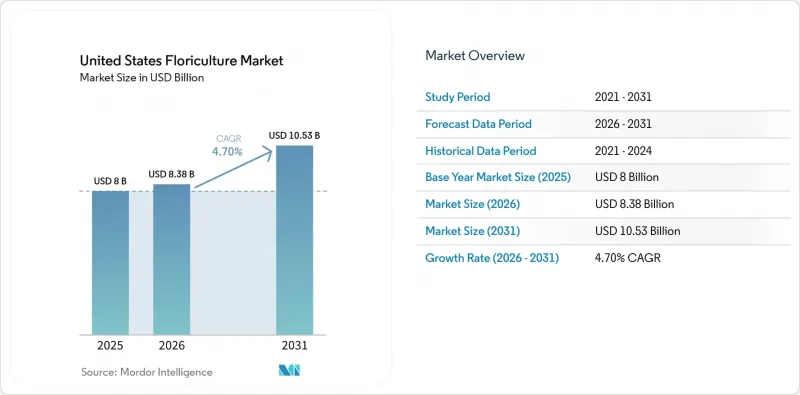
This report is Segmented by Cut Flower Type (Roses, Tulips, Lilies, and More). The Report Includes Production Analysis (Volume), Consumption Analysis (Value and Volume), Export Analysis (Value and Volume), Import Analysis (Value and Volume), Wholesale Price Trend Analysis and Forecast, and Seasonality Analysis. The Market Forecasts are Provided in Terms of Value (USD) and Volume (Metric Tons).
United States Floriculture Market Trends and Insights
Climate-Controlled Greenhouse Technology Adoption
Climate-controlled greenhouses are transforming supply dynamics in the United States floriculture market. According to the United States Department of Agriculture, the covered floriculture production area reached 969 million square feet in 2024, marking a 13.8% increase compared to the previous year . Protected cultivation enables growers to precisely manage light, temperature, and humidity, reducing seasonality and minimizing crop loss. This is particularly significant for crops like lilies, chrysanthemums, and orchids, where consistent year-round availability enhances the competitiveness of domestic growers against imported supply. As advancements in automation, sensors, and energy controls improve project feasibility, capacity expansions are extending beyond California to states such as Michigan, North Carolina, and Virginia.
E-commerce and Subscription Floral Purchasing Expansion
E-commerce and subscription ordering have transformed the purchasing patterns of consumers in the United States floriculture market. Digital purchasing has reduced reliance on a few holiday peaks, as consumers can now schedule recurring deliveries for homes, gifts, and workplaces. Subscription programs provide growers and wholesalers with more stable volume commitments, aiding in greenhouse output planning and arrangement programs. This stability minimizes procurement fluctuations and facilitates improved assortment planning throughout the supply chain. Additionally, younger consumers increasingly view floral purchases as part of everyday wellness and home living, contributing to higher purchase frequency over time.
Labor Cost Inflation and Skilled Labor Scarcity
Labor inflation and the scarcity of skilled labor are significant operational challenges in the United States floriculture market. The H-2A Adverse Effect Wage Rate (AEWR) reached USD 19.97 per hour in California and USD 16.23 per hour in Florida in 2025. Data from the 2024 Census of Horticultural Specialties indicates that labor accounted for 36% of total horticulture expenses, making it the largest cost category . These higher wages and compliance costs make labor-intensive and open-field production less competitive, especially when the imported supply continues to influence market pricing significantly.
Other drivers and restraints analyzed in the detailed report include:
- Home Gardening and Indoor-Plant Wellness Demand
- Hospitality and Workplace Biophilic Demand
- Import Competition and Air-Freight Volatility
For complete list of drivers and restraints, kindly check the Table Of Contents.
Segment Analysis
The roses segment accounted for the largest 29.9% of the United States floriculture market share in 2025. Their strong commercial presence persists due to their widespread use in gifting, event decorations, retail floral arrangements, and premium bouquet programs nationwide. Imported long-stem roses meet the demand from mass retail and supermarkets, while domestic growers are focusing more on specialty garden roses and premium locally sourced varieties. Differentiation based on bloom quality, fragrance, vase life, and sustainable cultivation practices is becoming increasingly significant across retail channels. Year-round consumer purchasing patterns, driven by holidays, weddings, hospitality, and personal gifting occasions, continue to support demand for roses.
The United States floriculture market size for the orchids segment is projected to grow at the fastest 4.9% CAGR from 2026 to 2031. Orchids are gaining popularity as consumers increasingly associate them with premium indoor decor, wellness-focused lifestyles, and longer-lasting floral arrangements. Commercial demand from hospitality venues, corporate offices, and upscale residential decor programs is also driving stronger sales growth for orchids nationwide. Advances in climate-controlled greenhouse production and improved propagation techniques are enabling domestic suppliers to expand the availability of premium orchids. While tulips, lilies, chrysanthemums, carnations, and gerberas maintain stable demand, orchids are emerging as a key driver of premium and higher-margin growth within the floriculture retail market.
Additional Benefits:
- The market estimate (ME) sheet in Excel format
- 3 months of analyst support
TABLE OF CONTENTS
1 Introduction
- 1.1 Study Assumptions and Market Definition
- 1.2 Scope of the Study
2 Research Methodology
3 Executive Summary
4 Market Landscape
- 4.1 Market Overview
- 4.2 Market Drivers
- 4.2.1 Climate-controlled greenhouse technology adoption
- 4.2.2 E-commerce and subscription floral purchasing expansion
- 4.2.3 Home gardening and indoor-plant wellness demand
- 4.2.4 Hospitality and workplace biophilic demand
- 4.2.5 Specialty crop support for greenhouse cash recovery
- 4.2.6 Retail demand for local and longer-vase-life cultivars
- 4.3 Market Restraints
- 4.3.1 Labor cost inflation and skilled labor scarcity
- 4.3.2 Import competition and air-freight volatility
- 4.3.3 Water-use restrictions and climate volatility
- 4.3.4 Phytosanitary compliance and pest-management costs
- 4.4 Opportunities
- 4.5 Challenges
- 4.6 Value Chain Analysis
- 4.7 Technologies and Usage of AI in the Industry
- 4.8 Input Market Analysis
- 4.8.1 Seeds
- 4.8.2 Fertilizers
- 4.8.3 Crop Protection Chemicals
- 4.9 Distribution Channel Analysis
- 4.10 Market Sentiment Analysis
- 4.11 PESTLE Analysis
- 4.12 Regulatory Framework
- 4.13 Logistics and Infrastructure
5 Market Size and Growth Forecast (Value and Volume)
- 5.1 By Cut Flower Type
- 5.1.1 Roses
- 5.1.1.1 Production Analysis
- 5.1.1.1.1 Production Volume
- 5.1.1.1.2 Area Harvested and Yield
- 5.1.1.2 Consumption Analysis (Value and Volume)
- 5.1.1.3 Trade Analysis (Value and Volume)
- 5.1.1.3.1 Import Market Analysis
- 5.1.1.3.1.1 Import Value and Volume
- 5.1.1.3.1.2 Key Supplying Markets
- 5.1.1.3.2 Export Market Analysis
- 5.1.1.3.2.1 Export Value and Volume
- 5.1.1.3.2.2 Key Destinations Markets
- 5.1.1.3.1 Import Market Analysis
- 5.1.1.4 Wholesale Price Trend Analysis and Forecast
- 5.1.1.5 Seasonality Analysis
- 5.1.1.1 Production Analysis
- 5.1.2 Tulips
- 5.1.2.1 Production Analysis
- 5.1.2.1.1 Production Volume
- 5.1.2.1.2 Area Harvested and Yield
- 5.1.2.2 Consumption Analysis (Value and Volume)
- 5.1.2.3 Trade Analysis (Value and Volume)
- 5.1.2.3.1 Import Market Analysis
- 5.1.2.3.1.1 Import Value and Volume
- 5.1.2.3.1.2 Key Supplying Markets
- 5.1.2.3.2 Export Market Analysis
- 5.1.2.3.2.1 Export Value and Volume
- 5.1.2.3.2.2 Key Destinations Markets
- 5.1.2.3.1 Import Market Analysis
- 5.1.2.4 Wholesale Price Trend Analysis and Forecast
- 5.1.2.5 Seasonality Analysis
- 5.1.2.1 Production Analysis
- 5.1.3 Lilies
- 5.1.3.1 Production Analysis
- 5.1.3.1.1 Production Volume
- 5.1.3.1.2 Area Harvested and Yield
- 5.1.3.2 Consumption Analysis (Value and Volume)
- 5.1.3.3 Trade Analysis (Value and Volume)
- 5.1.3.3.1 Import Market Analysis
- 5.1.3.3.1.1 Import Value and Volume
- 5.1.3.3.1.2 Key Supplying Markets
- 5.1.3.3.2 Export Market Analysis
- 5.1.3.3.2.1 Export Value and Volume
- 5.1.3.3.2.2 Key Destinations Markets
- 5.1.3.3.1 Import Market Analysis
- 5.1.3.4 Wholesale Price Trend Analysis and Forecast
- 5.1.3.5 Seasonality Analysis
- 5.1.3.1 Production Analysis
- 5.1.4 Gladioli
- 5.1.4.1 Production Analysis
- 5.1.4.1.1 Production Volume
- 5.1.4.1.2 Area Harvested and Yield
- 5.1.4.2 Consumption Analysis (Value and Volume)
- 5.1.4.3 Trade Analysis (Value and Volume)
- 5.1.4.3.1 Import Market Analysis
- 5.1.4.3.1.1 Import Value and Volume
- 5.1.4.3.1.2 Key Supplying Markets
- 5.1.4.3.2 Export Market Analysis
- 5.1.4.3.2.1 Export Value and Volume
- 5.1.4.3.2.2 Key Destinations Markets
- 5.1.4.3.1 Import Market Analysis
- 5.1.4.4 Wholesale Price Trend Analysis and Forecast
- 5.1.4.5 Seasonality Analysis
- 5.1.4.1 Production Analysis
- 5.1.5 Snapdragons
- 5.1.5.1 Production Analysis
- 5.1.5.1.1 Production Volume
- 5.1.5.1.2 Area Harvested and Yield
- 5.1.5.2 Consumption Analysis (Value and Volume)
- 5.1.5.3 Trade Analysis (Value and Volume)
- 5.1.5.3.1 Import Market Analysis
- 5.1.5.3.1.1 Import Value and Volume
- 5.1.5.3.1.2 Key Supplying Markets
- 5.1.5.3.2 Export Market Analysis
- 5.1.5.3.2.1 Export Value and Volume
- 5.1.5.3.2.2 Key Destinations Markets
- 5.1.5.3.1 Import Market Analysis
- 5.1.5.4 Wholesale Price Trend Analysis and Forecast
- 5.1.5.5 Seasonality Analysis
- 5.1.5.1 Production Analysis
- 5.1.6 Gerberas
- 5.1.6.1 Production Analysis
- 5.1.6.1.1 Production Volume
- 5.1.6.1.2 Area Harvested and Yield
- 5.1.6.2 Consumption Analysis (Value and Volume)
- 5.1.6.3 Trade Analysis (Value and Volume)
- 5.1.6.3.1 Import Market Analysis
- 5.1.6.3.1.1 Import Value and Volume
- 5.1.6.3.1.2 Key Supplying Markets
- 5.1.6.3.2 Export Market Analysis
- 5.1.6.3.2.1 Export Value and Volume
- 5.1.6.3.2.2 Key Destinations Markets
- 5.1.6.3.1 Import Market Analysis
- 5.1.6.4 Wholesale Price Trend Analysis and Forecast
- 5.1.6.5 Seasonality Analysis
- 5.1.6.1 Production Analysis
- 5.1.7 Orchids
- 5.1.7.1 Production Analysis
- 5.1.7.1.1 Production Volume
- 5.1.7.1.2 Area Harvested and Yield
- 5.1.7.2 Consumption Analysis (Value and Volume)
- 5.1.7.3 Trade Analysis (Value and Volume)
- 5.1.7.3.1 Import Market Analysis
- 5.1.7.3.1.1 Import Value and Volume
- 5.1.7.3.1.2 Key Supplying Markets
- 5.1.7.3.2 Export Market Analysis
- 5.1.7.3.2.1 Export Value and Volume
- 5.1.7.3.2.2 Key Destinations Markets
- 5.1.7.3.1 Import Market Analysis
- 5.1.7.4 Wholesale Price Trend Analysis and Forecast
- 5.1.7.5 Seasonality Analysis
- 5.1.7.1 Production Analysis
- 5.1.8 Chrysanthemums
- 5.1.8.1 Production Analysis
- 5.1.8.1.1 Production Volume
- 5.1.8.1.2 Area Harvested and Yield
- 5.1.8.2 Consumption Analysis (Value and Volume)
- 5.1.8.3 Trade Analysis (Value and Volume)
- 5.1.8.3.1 Import Market Analysis
- 5.1.8.3.1.1 Import Value and Volume
- 5.1.8.3.1.2 Key Supplying Markets
- 5.1.8.3.2 Export Market Analysis
- 5.1.8.3.2.1 Export Value and Volume
- 5.1.8.3.2.2 Key Destinations Markets
- 5.1.8.3.1 Import Market Analysis
- 5.1.8.4 Wholesale Price Trend Analysis and Forecast
- 5.1.8.5 Seasonality Analysis
- 5.1.8.1 Production Analysis
- 5.1.9 Carnations
- 5.1.9.1 Production Analysis
- 5.1.9.1.1 Production Volume
- 5.1.9.1.2 Area Harvested and Yield
- 5.1.9.2 Consumption Analysis (Value and Volume)
- 5.1.9.3 Trade Analysis (Value and Volume)
- 5.1.9.3.1 Import Market Analysis
- 5.1.9.3.1.1 Import Value and Volume
- 5.1.9.3.1.2 Key Supplying Markets
- 5.1.9.3.2 Export Market Analysis
- 5.1.9.3.2.1 Export Value and Volume
- 5.1.9.3.2.2 Key Destinations Markets
- 5.1.9.3.1 Import Market Analysis
- 5.1.9.4 Wholesale Price Trend Analysis and Forecast
- 5.1.9.5 Seasonality Analysis
- 5.1.9.1 Production Analysis
- 5.1.1 Roses
6 End Use and Application
- 6.1 Primary Applications and Emerging Applications
- 6.2 Consumption Breakdown by Industries
7 Competitive Landscape
- 7.1 Overview of the Competition
- 7.2 Recent Developments
- 7.3 Market Concentration Analysis
- 7.4 List of Key Players
- 7.4.1 Costa Farms, LLC
- 7.4.2 Altman Specialty Plants, LLC
- 7.4.3 Bell Nursery Holdings, LLC (Central Garden and Pet Company)
- 7.4.4 Metrolina Greenhouses, Inc.
- 7.4.5 Green Circle Growers, Inc.
- 7.4.6 Kurt Weiss Greenhouses, Inc.
- 7.4.7 Bloomia
- 7.4.8 The Queen's Flowers
- 7.4.9 Greenheart Farms
- 7.4.10 TERRA NOVA Nurseries, Inc.
- 7.4.11 Monrovia Nursery Company
- 7.4.12 Ball Horticultural Company
8 Market Opportunities and Future Outlook

