PUBLISHER: Mordor Intelligence | PRODUCT CODE: 2113231

PUBLISHER: Mordor Intelligence | PRODUCT CODE: 2113231
Vietnam Floriculture - Market Share Analysis, Industry Trends & Statistics, Growth Forecasts (2026 - 2031)
According to Mordor Intelligence, the Vietnam floriculture market size is anticipated to increase from USD 0.67 billion in 2025 to USD 0.74 billion in 2026 and reach USD 1.05 billion by 2031, growing at a CAGR of 9.4% over 2026-2031.
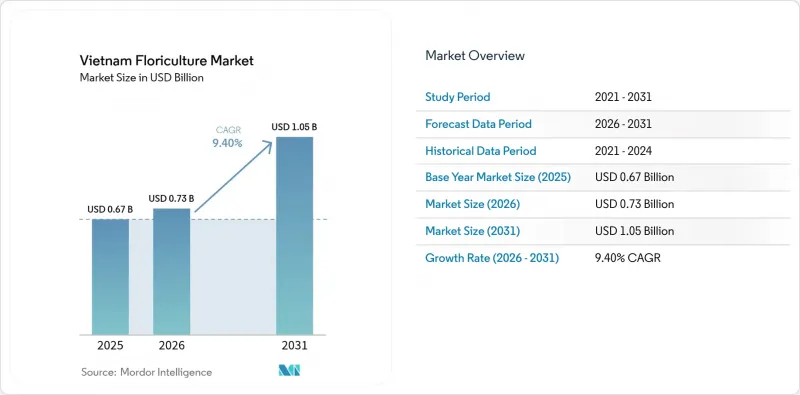
This report is Segmented by Flower Type (Rose, Chrysanthemum, Orchid, Carnation, and Lily). The Report Includes Production Analysis (Volume), Consumption Analysis (Value and Volume), Export Analysis (Value and Volume), Import Analysis (Value and Volume), Wholesale Price Trend Analysis and Forecast and More. The Market Forecasts are Provided in Terms of Value (USD) and Volume (Metric Tons).
Vietnam Floriculture Market Trends and Insights
Favorable Climatic Diversity Along Vietnam's Latitude
Vietnam stretches from 8°N to 23°N, creating cool highland microclimates suited to premium temperate flowers and warm lowland zones ideal for orchids. Lam Dong's 1,500-meter elevation delivers stable 18-22 °C temperatures that meet optimal rose requirements and save growers 30-40% in heating and cooling costs compared with single-climate markets. By utilizing 0% tariffs under the CPTPP, Vietnam increased its share of Japan's flower imports to over 14% in 2025, effectively replacing higher-cost suppliers from Kenya and Ecuador due to its logistical advantages and duty-free access. Hanoi's Red River Delta now hosts 3,000 hectares of high-tech flower farms that exploit four-season conditions to supply chrysanthemums to China within 48 hours. Staggered planting across altitudes supports non-stop harvesting, lowering inventory costs by 18% and improving exporter cash cycles. Widespread climatic flexibility positions the Vietnam floriculture market as a consistent supplier when seasonal shortages constrain competitors.
Growing Bilateral Flower-Trade Agreements
The Japan-Vietnam Economic Partnership Agreement and the Korea-Vietnam Free Trade Agreement eliminated tariffs on cut flowers, shrinking landed costs for Vietnamese stems by up to 12 percentage points. In 2023, Vietnam became South Korea's largest flower supplier by volume accounting for 3.45 thousand metric tons and the second largest by value accounting for USD 13.5 million, with orchids and chrysanthemums accounting for 68% of shipments to meet ceremonial and retail demand. Duty-free access also propelled Japan-bound sales to USD 45 million in 2021, and Vietnam added 2.3 percentage points of Japanese market share in 2024 by guaranteeing 7-day delivery versus 12-day South American transits. Vietnamese floriculture is utilizing duty-free access under the The Comprehensive and Progressive Agreement for Trans-Pacific Partnership (CPTPP) and The Regional Comprehensive Economic Partnership (RCEP) agreements to target Australia as a high-value market. Premium tropical orchids are positioned to command significantly higher prices compared to regional markets, supported by a broader bilateral trade relationship valued at USD 14.1 billion. In 2025, Vietnam's Plant Protection Department (PPD) will implement streamlined e-Phyto protocols, enabling perishable goods to clear borders within 24 hours. This aims to cut rejection rates below 2% and reduce spoilage, boosting exporter margins.
High Upfront Drip-Irrigation Retrofit Costs
Professional drip and fertigation systems require an initial investment of USD 18,000 per hectare. Lam Dong's high-value floral exporters recover these costs within three years, but long-term payback periods challenge smallholders reliant on volatile wholesale vegetable markets. High-tech irrigation can halve water use, but with a low agricultural tariff of VND 1,200 (USD 0.046) per unit, annual savings of USD 195-341 make 9% commercial interest rates viable only with yield-driven revenue gains and a 2% government interest-rate subsidy. Smallholders in Vietnam, averaging 0.8 hectares, often lack collateral for traditional loans, extending payback periods to 8 years without the 2026 government's 'Green Credit' subsidies. High-tech irrigation in Lam Dong covers over 23,900 hectares in the vegetable sector, while the floriculture sector is expanding through the USD 120 million 'Smart Flower Village' initiative. The Vietnamese government offers a 20% subsidy, reducing the cost of high-tech irrigation to USD 14,400. However, nine-month bureaucratic delays limit participation to 15% of eligible farms, leaving much of the market without financial support.
Other drivers and restraints analyzed in the detailed report include:
- Expansion of Cold-Chain Logistics Corridors
- Government Subsidies for Greenhouse Modernization
- Rising Incidence of Pest Infestations
For complete list of drivers and restraints, kindly check the Table Of Contents.
Segment Analysis
Rose maintained the highest 29% consumption share of the Vietnam floriculture market size in 2025, while orchid registered to be the fastest-growing segment, projected to register a 10.6% CAGR through 2031. Using in vitro tissue culture to reduce disease risks, Lam Dong expanded orchid cultivation to 100 hectares by 2025, producing 16 million pots annually and solidifying its position in the Northeast Asian export market. High-tech Phalaenopsis orchid farms in Hai Phong, using Israeli-designed automated greenhouse systems, generate VND 80 billion (USD 3.25 million) per hectare annually, tripling the revenue from rose harvests and making them the city's top floral export. Premium export pricing in Japan and Australia, where orchids sell 40-60% above roses, underlies the rising adoption by growers.
High-tech production in highland areas like Lang Biang generates VND 1-3 billion (USD 38-115 million) per hectare annually, meeting peak demand during Tet and Valentine's Day. Chrysanthemums hold a prominent share, supported by year-round supply from Sa Dec to China and Taiwan. Lily hectares in Khanh Hoa climbed to 180 by 2025 and deliver 38-42% gross margins, displacing disease-stricken carnations. IoT irrigation on 376 hectares curbed water use 30-50%, raising net margins for orchid and lily growers by up to nine points.
Complete Report Scope:
- By Flower Type
- Rose
- Production Analysis
- Production Volume
- Area Harvested and Yield
- Consumption Analysis (Value and Volume)
- Trade Analysis (Value and Volume)
- Import Market Analysis
- Import Value and Volume
- Key Supplying Markets
- Export Market Analysis
- Export Value and Volume
- Key Destinations Markets
- Import Market Analysis
- Wholesale Price Trend Analysis and Forecast
- Seasonality Analysis
- Production Analysis
- Chrysanthemum
- Production Analysis
- Production Volume
- Area Harvested and Yield
- Consumption Analysis (Value and Volume)
- Trade Analysis (Value and Volume)
- Import Market Analysis
- Import Value and Volume
- Key Supplying Markets
- Export Market Analysis
- Export Value and Volume
- Key Destinations Markets
- Import Market Analysis
- Wholesale Price Trend Analysis and Forecast
- Seasonality Analysis
- Production Analysis
- Orchid
- Production Analysis
- Production Volume
- Area Harvested and Yield
- Consumption Analysis (Value and Volume)
- Trade Analysis (Value and Volume)
- Import Market Analysis
- Import Value and Volume
- Key Supplying Markets
- Export Market Analysis
- Export Value and Volume
- Key Destinations Markets
- Import Market Analysis
- Wholesale Price Trend Analysis and Forecast
- Seasonality Analysis
- Production Analysis
- Carnation
- Production Analysis
- Production Volume
- Area Harvested and Yield
- Consumption Analysis (Value and Volume)
- Trade Analysis (Value and Volume)
- Import Market Analysis
- Import Value and Volume
- Key Supplying Markets
- Export Market Analysis
- Export Value and Volume
- Key Destinations Markets
- Import Market Analysis
- Wholesale Price Trend Analysis and Forecast
- Seasonality Analysis
- Production Analysis
- Lily
- Production Analysis
- Production Volume
- Area Harvested and Yield
- Consumption Analysis (Value and Volume)
- Trade Analysis (Value and Volume)
- Import Market Analysis
- Import Value and Volume
- Key Supplying Markets
- Export Market Analysis
- Export Value and Volume
- Key Destinations Markets
- Import Market Analysis
- Wholesale Price Trend Analysis and Forecast
- Seasonality Analysis
- Production Analysis
- Rose
Additional Benefits:
- The market estimate (ME) sheet in Excel format
- 3 months of analyst support
TABLE OF CONTENTS
1 Introduction
- 1.1 Study Assumptions and Market Definition
- 1.2 Scope of the Study
2 Research Methodology
3 Executive Summary
4 Market Landscape
- 4.1 Market Overview
- 4.2 Market Drivers
- 4.2.1 Favorable climatic diversity along Vietnam's latitude
- 4.2.2 Growing bilateral flower-trade agreements
- 4.2.3 Expansion of cold-chain logistics corridors
- 4.2.4 Government subsidies for greenhouse modernization
- 4.2.5 Pilot carbon-credit pricing for sustainable floriculture
- 4.2.6 Bundled micro-finance for smallholder ornamental growers
- 4.3 Market Restraints
- 4.3.1 High upfront drip-irrigation retrofit costs
- 4.3.2 Rising incidence of pest infestations
- 4.3.3 Lack of pathogen-free tissue-culture labs outside Lam Dong
- 4.3.4 Increasing coastal water-salinity from upstream dams
- 4.4 Opportunity
- 4.5 Challenges
- 4.6 Value Chain Analysis
- 4.7 Technologies and usage of AI in the Industry
- 4.8 Input Market Analysis
- 4.8.1 Seeds
- 4.8.2 Fertilizers
- 4.8.3 Crop Protection Chemicals
- 4.9 Distribution Channel Analysis
- 4.10 Market Sentiment Analysis
- 4.11 PESTLE Analysis
- 4.12 Regulatory Framework
- 4.13 Logistics and Infrastructure
5 Market Size and Growth Forecast (Value and Volume)
- 5.1 By Flower Type
- 5.1.1 Rose
- 5.1.1.1 Production Analysis
- 5.1.1.1.1 Production Volume
- 5.1.1.1.2 Area Harvested and Yield
- 5.1.1.2 Consumption Analysis (Value and Volume)
- 5.1.1.3 Trade Analysis (Value and Volume)
- 5.1.1.3.1 Import Market Analysis
- 5.1.1.3.1.1 Import Value and Volume
- 5.1.1.3.1.2 Key Supplying Markets
- 5.1.1.3.2 Export Market Analysis
- 5.1.1.3.2.1 Export Value and Volume
- 5.1.1.3.2.2 Key Destinations Markets
- 5.1.1.3.1 Import Market Analysis
- 5.1.1.4 Wholesale Price Trend Analysis and Forecast
- 5.1.1.5 Seasonality Analysis
- 5.1.1.1 Production Analysis
- 5.1.2 Chrysanthemum
- 5.1.2.1 Production Analysis
- 5.1.2.1.1 Production Volume
- 5.1.2.1.2 Area Harvested and Yield
- 5.1.2.2 Consumption Analysis (Value and Volume)
- 5.1.2.3 Trade Analysis (Value and Volume)
- 5.1.2.3.1 Import Market Analysis
- 5.1.2.3.1.1 Import Value and Volume
- 5.1.2.3.1.2 Key Supplying Markets
- 5.1.2.3.2 Export Market Analysis
- 5.1.2.3.2.1 Export Value and Volume
- 5.1.2.3.2.2 Key Destinations Markets
- 5.1.2.3.1 Import Market Analysis
- 5.1.2.4 Wholesale Price Trend Analysis and Forecast
- 5.1.2.5 Seasonality Analysis
- 5.1.2.1 Production Analysis
- 5.1.3 Orchid
- 5.1.3.1 Production Analysis
- 5.1.3.1.1 Production Volume
- 5.1.3.1.2 Area Harvested and Yield
- 5.1.3.2 Consumption Analysis (Value and Volume)
- 5.1.3.3 Trade Analysis (Value and Volume)
- 5.1.3.3.1 Import Market Analysis
- 5.1.3.3.1.1 Import Value and Volume
- 5.1.3.3.1.2 Key Supplying Markets
- 5.1.3.3.2 Export Market Analysis
- 5.1.3.3.2.1 Export Value and Volume
- 5.1.3.3.2.2 Key Destinations Markets
- 5.1.3.3.1 Import Market Analysis
- 5.1.3.4 Wholesale Price Trend Analysis and Forecast
- 5.1.3.5 Seasonality Analysis
- 5.1.3.1 Production Analysis
- 5.1.4 Carnation
- 5.1.4.1 Production Analysis
- 5.1.4.1.1 Production Volume
- 5.1.4.1.2 Area Harvested and Yield
- 5.1.4.2 Consumption Analysis (Value and Volume)
- 5.1.4.3 Trade Analysis (Value and Volume)
- 5.1.4.3.1 Import Market Analysis
- 5.1.4.3.1.1 Import Value and Volume
- 5.1.4.3.1.2 Key Supplying Markets
- 5.1.4.3.2 Export Market Analysis
- 5.1.4.3.2.1 Export Value and Volume
- 5.1.4.3.2.2 Key Destinations Markets
- 5.1.4.3.1 Import Market Analysis
- 5.1.4.4 Wholesale Price Trend Analysis and Forecast
- 5.1.4.5 Seasonality Analysis
- 5.1.4.1 Production Analysis
- 5.1.5 Lily
- 5.1.5.1 Production Analysis
- 5.1.5.1.1 Production Volume
- 5.1.5.1.2 Area Harvested and Yield
- 5.1.5.2 Consumption Analysis (Value and Volume)
- 5.1.5.3 Trade Analysis (Value and Volume)
- 5.1.5.3.1 Import Market Analysis
- 5.1.5.3.1.1 Import Value and Volume
- 5.1.5.3.1.2 Key Supplying Markets
- 5.1.5.3.2 Export Market Analysis
- 5.1.5.3.2.1 Export Value and Volume
- 5.1.5.3.2.2 Key Destinations Markets
- 5.1.5.3.1 Import Market Analysis
- 5.1.5.4 Wholesale Price Trend Analysis and Forecast
- 5.1.5.5 Seasonality Analysis
- 5.1.5.1 Production Analysis
- 5.1.1 Rose
6 End Use and Application
- 6.1 Primary Applications and Emerging Applications
- 6.2 Consumption Breakdown by Indsutries
7 Competitive Landscape
- 7.1 Overview of the Competition
- 7.2 Recent Developments
- 7.3 Market Concentration Analysis
- 7.4 List of Key Players
- 7.4.1 Dalat Hasfarm Company Limited
- 7.4.2 Dutch Flower Group Vietnam Co., Ltd.
- 7.4.3 Langbiang Farm Company Limited
- 7.4.4 Dummen Orange Holding B.V. - Vietnam
- 7.4.5 Royal Base Corporation
- 7.4.6 JFT Viet Nam Company Ltd.
- 7.4.7 Fresh Flower World Joint Stock Company
- 7.4.8 Linh Ngoc Co. Ltd.
- 7.4.9 SaiGon Flower Trading Co., Ltd.
- 7.4.10 Tropical Flower Joint Stock Company
- 7.4.11 Dasar Farms Co. Limited
- 7.4.12 Thang Long Orchid Co., Ltd.
- 7.4.13 Korea-Vietnam Orchid Joint Venture Co., Ltd.
- 7.4.14 Floriland Dalat Co., Ltd.
- 7.4.15 Vietfloriculture Export Import JSC
8 Market Opportunity and Future Outlook

