PUBLISHER: Mordor Intelligence | PRODUCT CODE: 2116099

PUBLISHER: Mordor Intelligence | PRODUCT CODE: 2116099
Singapore Floriculture - Market Share Analysis, Industry Trends & Statistics, Growth Forecasts (2026 - 2031)
According to Mordor Intelligence, the Singapore floriculture market size is expected to grow from USD 94.0 million in 2025 to USD 99.74 million in 2026 and is forecast to reach USD 134.19 million by 2031 at 6.11% CAGR over 2026-2031.
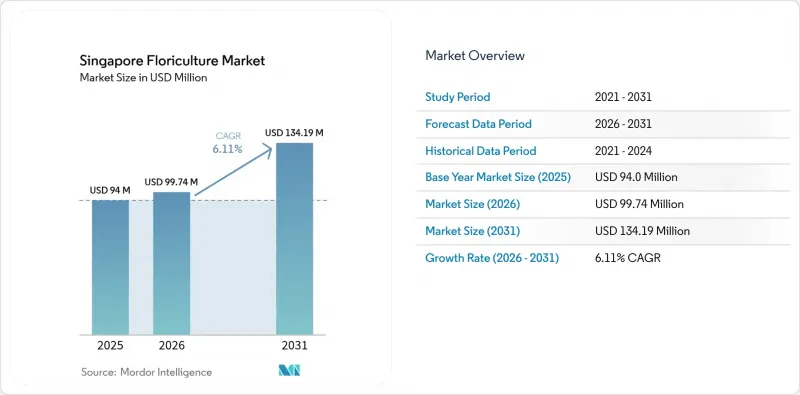
This report is Segmented by Type of Flower (Rosa, Chrysanthemum, Lily, Orchids, Carnation, and More). The Report Includes Production Analysis (Volume), Consumption Analysis (Value and Volume), Export Analysis (Value and Volume), Import Analysis (Value and Volume), and Price Trend Analysis. The Market Forecasts are Provided in Terms of Value (USD) and Volume (Metric Tons).
Singapore Floriculture Market Trends and Insights
Rising Domestic Demand and Urban Gardening
Singapore's younger households, influenced by pandemic-era lifestyle changes, are increasing their purchases of foliage and flowering plants, contributing to steady retail growth in the floriculture market. Weekend plant fairs and terrarium workshops drive consumer spending, while residential developments incorporate rooftop gardens. Commercial property owners are implementing seasonal floral displays to improve tenant satisfaction and achieve sustainability targets. The expansion of public landscaping projects under national environmental initiatives creates broader revenue opportunities for floriculture businesses across retail, residential, and commercial segments.
Government Supports and Grants
The Singapore government provides comprehensive support to the floriculture industry through funding programs for automation, climate control, and data-driven farming initiatives. Equipment co-funding programs increase access to advanced growing systems, facilitating industry modernization. Local growers benefit from certification programs that secure premium retail placement, while partnerships with the hospitality sector ensure consistent demand. These measures minimize financial risk and enhance operational efficiency, enabling floriculture businesses to overcome high operating costs and establish Singapore as a sustainable flower production center.
Labor Shortages and Foreign-worker Curbs
Foreign worker regulations in Singapore impose higher levies and strict quotas, affecting nursery operations that operate with limited profit margins. The preference of local workforce for knowledge-based careers creates a skills gap in horticulture. While automation offers a solution to reduce labor requirements, small nurseries face difficulties in securing the necessary capital investment. The administrative burden of managing work permit renewals impacts operational efficiency. These factors create production constraints during high-demand periods, affecting the supply capacity in the Singapore floriculture market.
Other drivers and restraints analyzed in the detailed report include:
- E-commerce Flower Retail Expansion
- ESG Biophilic Trends and Event Revival
- Freight Cost Volatility
For complete list of drivers and restraints, kindly check the Table Of Contents.
Segment Analysis
Orchids maintained a 31.62% of Singapore floriculture market share in 2025, driven by established breeding programs at the National Orchid Garden, which cultivates over 1,000 species. The flowers' premium pricing and durability during transport enable exporters to consistently supply regional gift and hotel markets. Singapore's diplomatic gifting initiatives enhance the reputation of locally bred hybrids. The market for orchid exports expanded as genetic research accelerates hybrid development. Local greenhouses use fogging and evaporative-cooling systems to create mountain-like conditions, ensuring quality production despite the tropical climate. Roses continue their significant share in premium bouquet sales, with substantial imports from India and China. Rising transportation of roses and cold-chain logistics affect profit margins. In response, distributors are investigating regional sourcing options and hybrid varieties with improved shelf life and petal durability.
Chrysanthemums maintain the highest growth rate in the Singapore floriculture market size with a 6.5% CAGR through 2031, supported by their strong stems, diverse colors, and suitability for events and ceremonial arrangements. Regular supply from Malaysian producers ensures consistent availability, while improved post-harvest techniques increase vase life, making them preferred by event planners and retailers. Carnations are expanding in mid-tier retail and gifting segments, benefiting from their cost-effectiveness, durability, and cultural significance. Local producers implement precise irrigation and nutrient management systems to improve bloom consistency and reduce growing cycles. Their demand during festivals and cultural events strengthens their market position. Other flowers, including tulips, gerberas, and anthuriums, maintain their presence in high-end market segments during peak seasons, contributing to revenue diversification in Singapore's floriculture market.
Complete Report Scope:
- By Type of Flower (Production Analysis (Volume), Consumption Analysis (Volume and Value), Import Analysis (Volume and Value), Export Analysis (Volume and Value), and Price Trend Analysis)
- Rosa (Roses)
- Chrysanthemum
- Lily
- Orchid
- Carnation
- Other Types of Flowers (Tulip, Gerbera, Anthurium, and Others)
Additional Benefits:
- The market estimate (ME) sheet in Excel format
- 3 months of analyst support
TABLE OF CONTENTS
1 Introduction
- 1.1 Study Assumptions and Market Definition
- 1.2 Scope of the Study
2 Research Methodology
3 Executive Summary
4 Market Landscape
- 4.1 Market Overview
- 4.2 Market Drivers
- 4.2.1 Rising Domestic Demand and Urban Gardening
- 4.2.2 Government Supports and Grants
- 4.2.3 E-commerce Flower Retail Expansion
- 4.2.4 ESG Biophilic Trends and Event Revival
- 4.2.5 Controlled-environment Yield Gains
- 4.2.6 Circular Bioeconomy Valorisation of Wastes
- 4.3 Market Restraints
- 4.3.1 Scarce Land and High Real-estate Cost
- 4.3.2 Labour Shortages and Foreign-worker Curbs
- 4.3.3 Freight Cost Volatility
- 4.3.4 Resistant Thrips and Botrytis Strains
- 4.4 Regulatory Landscape
- 4.5 Technological Outlook
- 4.6 Value / Supply-Chain Analysis
- 4.7 PESTLE Analysis
5 Market Size and Growth Forecasts
- 5.1 By Type of Flower (Production Analysis (Volume), Consumption Analysis (Volume and Value), Import Analysis (Volume and Value), Export Analysis (Volume and Value), and Price Trend Analysis)
- 5.1.1 Rosa (Roses)
- 5.1.2 Chrysanthemum
- 5.1.3 Lily
- 5.1.4 Orchid
- 5.1.5 Carnation
- 5.1.6 Other Types of Flowers (Tulip, Gerbera, Anthurium, and Others)
6 Competitive Landscape
- 6.1 List of Stakeholders
- 6.1.1 Far East Flora Holdings Pte Ltd
- 6.1.2 Candy Floriculture Pte Ltd
- 6.1.3 Ji Mei Flower Pte Ltd
- 6.1.4 Sing See Soon Floral and Landscape Pte Ltd
- 6.1.5 Hua Hng Trading Pte Ltd
- 6.1.6 Wee Lee Nursery & Florist
- 6.1.7 Ban Nee Chen Nursery Pte. Ltd.
- 6.1.8 Toh Garden
- 6.1.9 SG Orchids
- 6.1.10 Teo Joo Guan Horticulture
- 6.1.11 Rainbowly Pte Ltd
7 Market Opportunities and Future Outlook

