PUBLISHER: Mordor Intelligence | PRODUCT CODE: 2114361

PUBLISHER: Mordor Intelligence | PRODUCT CODE: 2114361
Malaysia Floriculture - Market Share Analysis, Industry Trends & Statistics, Growth Forecasts (2026 - 2031)
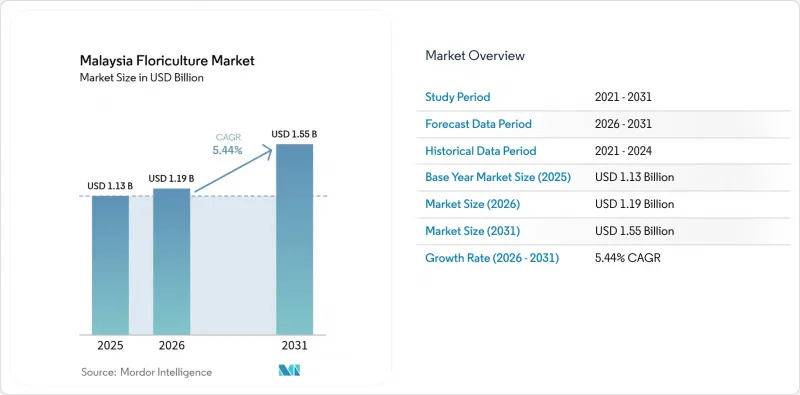
According to Mordor Intelligence, the Malaysia floriculture market size was valued at USD 1.13 billion in 2025 and estimated to grow from USD 1.19 billion in 2026 to reach USD 1.55 billion by 2031, at a CAGR of 5.44% during the forecast period (2026-2031).
This report is Segmented by Flower Type (Orchids, Roses, Chrysanthemums, Carnations, Aster, Lilies, Gerberas, Others). The Report Includes Production Analysis (Volume), Consumption Analysis (Value and Volume), Export Analysis (Value and Volume), Import Analysis (Value and Volume), and Price Trend Analysis. The Market Forecasts are Provided in Terms of Value (USD) and Volume (Metric Tons).
Malaysia Floriculture Market Trends and Insights
Rising Government Subsidies for Orchid Estates
Federal incentives now cover cash grants up to USD 4,400 for young agro-preneurs, alongside low-interest loans at 2% that ease working-capital pressure. Additional allocations of USD 840,000 under the Malaysian Indian Transformative Agri Programme provide up to USD 6,600 per recipient, directly accelerating greenhouse expansion in 2024/2025. Technical upskilling delivered through the Digital Training Information and Management System supplies growers with standardized curricula on nutrient formulation and climate control. Together, these interventions reduce capital barriers and shorten payback periods for new commercial orchid projects. The policy direction aligns with the national goal of raising agriculture's gross value to support rural incomes while diversifying export earnings.
Expansion of E-commerce Gifting Platforms
Urban consumers increasingly favor on-demand floral gifting, with same-day delivery windows as short as four hours for premium bundles. Average transaction values lie between USD 22- 216, much higher than wet-market purchases, boosting revenue per stem for growers that integrate directly with digital platforms. Marketplace start-ups such as TheFloristMarket eliminate website development costs for small retailers, broadening online penetration. Subscription services priced at USD 66 per month normalize recurrent orders and support predictable off-take from farms. The seamless link between greenhouse inventory and application programming interfaces (APIs) lets producers balance supply across multiple channels in real time, minimizing waste during peak seasons.
Volatile Jet-freight Rates for Temperature-Sensitive Cargo
Flowers rely on air transit for 95% of export volume, exposing growers to aviation-fuel surcharges and capacity constraints during popular gifting peaks. Maintaining a 1-2 °C cold chain from farm gate to aircraft belly adds specialized packaging costs that compress export margins. Kuala Lumpur's single-hub dominance creates seasonal bottlenecks, raising the risk of delays that degrade stem life. Competitors such as Kenya and Colombia operate dedicated flower corridors, forcing Malaysian shippers to absorb higher logistics expenses to match landed prices in Tokyo, Sydney, and Hong Kong markets.
Other drivers and restraints analyzed in the detailed report include:
- Growing Export Demand from Japan and Singapore
- Greenhouse Automation Cutting Unit Costs
- Labor Shortage of Skilled Floriculturists
For complete list of drivers and restraints, kindly check the Table Of Contents.
Segment Analysis
Orchids captured 42.10% of Malaysia floriculture market share in 2025, buoyed by Phalaenopsis and Dendrobium lines that trade at premium export prices. Government grants and tissue-culture know-how shorten propagation cycles, allowing estates to replenish benches quickly and maintain year-round supply. The Malaysia floriculture market size for orchids is projected to grow steadily, supported by entrenched demand from Singapore wholesalers and rising Japanese orders.
Lilies, while smaller, record the highest forecast growth at a 7.12% CAGR as lifestyle gift trends pivot toward elegant mono-stem arrangements. E-commerce bundles featuring Oriental hybrids command higher unit revenues than mixed bouquets, encouraging growers to trial new cultivars under net-house conditions. Roses, produced mainly in Cameron Highlands, continue to meet domestic demand, although growers face pressure from red-mite infestations that necessitate integrated pest-management regimens. Chrysanthemums leverage LED-driven photo-period manipulation to hit Valentine's and Mother's Day peaks reliably. Carnations, aster, gerberas, and emerging lines such as amaryllis round out portfolios, offering diversification against disease or price shocks in primary crops.
Complete Report Scope:
- By Flower Type
- Orchids
- Roses
- Chrysanthemums
- Carnations
- Aster
- Lilies
- Gerberas
- Others
Additional Benefits:
- The market estimate (ME) sheet in Excel format
- 3 months of analyst support
TABLE OF CONTENTS
1 Introduction
- 1.1 Study Assumptions and Market Definition
- 1.2 Scope of the Study
2 Research Methodology
3 Executive Summary
4 Market Landscape
- 4.1 Market Overview
- 4.2 Market Drivers
- 4.2.1 Rising government subsidies for commercial orchid estates
- 4.2.2 Expansion of e-commerce floral gifting platforms
- 4.2.3 Growing export demand from Japan and Singapore
- 4.2.4 Greenhouse automation cutting unit costs
- 4.2.5 Agri-tourism initiatives boosting domestic flower sales
- 4.2.6 Corporate ESG targets favoring eco-certified growers
- 4.3 Market Restraints
- 4.3.1 Volatile jet-freight rates for temperature-sensitive cargo
- 4.3.2 Labor shortage of skilled floriculturists
- 4.3.3 Increasing pest and disease pressure under humid climate
- 4.3.4 High capital outlay for climate-controlled structures
- 4.4 Regulatory Landscape
- 4.5 Technological Outlook
- 4.6 Value/Supply-Chain Analysis
- 4.7 PESTEL Analysis
5 Market Size and Growth Forecasts (Production Analysis (Volume)), Consumption Analysis (Volume and Value), Import Analysis (Volume and Value), Export Analysis (Volume and Value), and Price Trend Analysis
- 5.1 By Flower Type
- 5.1.1 Orchids
- 5.1.2 Roses
- 5.1.3 Chrysanthemums
- 5.1.4 Carnations
- 5.1.5 Aster
- 5.1.6 Lilies
- 5.1.7 Gerberas
- 5.1.8 Others
6 Competitive Landscape
- 6.1 List of Stakeholders
- 6.1.1 Far East Flora Pte Ltd
- 6.1.2 Black Tulip Group
- 6.1.3 BloomThis Flora Sdn Bhd
- 6.1.4 Hock Wee Enterprise Sdn Bhd
- 6.1.5 Waltex Biotec Sdn Bhd
- 6.1.6 Floratex Sdn Bhd
- 6.1.7 Advance Orchids Nursery Sdn Bhd
- 6.1.8 Genting Orchids Co Ltd. (OrchidsAsia Network)
- 6.1.9 WH Floral Sdn Bhd
- 6.1.10 Eagle-Link Flowers Ltd
7 Market Opportunities and Future Outlook

