PUBLISHER: Mordor Intelligence | PRODUCT CODE: 2066669

PUBLISHER: Mordor Intelligence | PRODUCT CODE: 2066669
Middle East And Africa Construction Adhesives And Sealants - Market Share Analysis, Industry Trends & Statistics, Growth Forecasts (2026 - 2031)
According to Mordor Intelligence, the middle east and Africa Construction Adhesives and Sealants Market size is expected to increase from USD 1.22 billion in 2025 to USD 1.29 billion in 2026 and reach USD 1.67 billion by 2031, growing at a CAGR of 5.37% over 2026-2031.
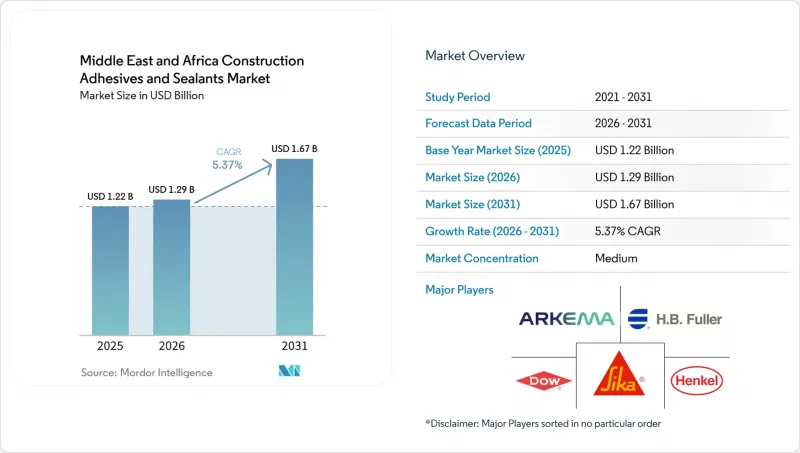
This report is Segmented by Resin (Acrylic and More), Technology (Hot Melt and More), Application (Flooring and Tiling, Roofing, and More), End-Use Sector (Residential, Commercial, and More) and Geography (Saudi Arabia, United Arab Emirates, Qatar, South Africa, Egypt, and Rest of Middle East and Africa). The Market Forecasts are Provided in Terms of Value (USD).
Middle East And Africa Construction Adhesives And Sealants Market Trends and Insights
Booming GCC Giga-Projects Drive Specialty Adhesive Demand
Saudi Arabia's NEOM airport management contract, valued at USD 1.5 billion, and Qiddiya's USD 1.8 billion athletics stadium both require fire-rated sealants and structural epoxies, significantly increasing adhesive consumption, up to three-to-four times more than standard construction projects. The use of curtain walls, insulated metal panels, and prefabricated modules necessitates continuous weatherproofing beads, prompting multinational suppliers to position inventories and technical teams within the kingdom. Additionally, Qatar's QAR 81 billion (USD 22.20 billion) infrastructure pipeline, which includes 286 projects through 2029, sustains demand for silicone and polyurethane joints capable of withstanding temperature swings of up to 50 degrees Celsius. High capital intensity creates entry barriers, steering smaller importers toward less-regulated African markets. As a result, the Middle East and Africa construction adhesives and sealants market benefits from both increased volume and a shift toward certified, premium formulations driven by GCC giga-projects.
Stricter GCC Low-VOC Regulations Accelerate Water-Borne Adoption
The United Arab Emirates (UAE) Federal Decree-Law No. 21 of 2024 limits adhesive volatile organic compounds (VOCs) to 50 grams per liter, while Dubai's TG-04 regulation reduces sealant VOC limits to 250 grams per liter, with compliance enforced through mandatory third-party audits. In response, BASF introduced Baxxodur EC 151, which reduces VOC emissions by 90%, enabling flooring contractors to avoid AED 50,000 penalties for non-compliant batches. Consequently, water-borne acrylic dispersions are projected to rise from 38% of UAE flooring-adhesive sales in 2023 to 60% by 2025. Suppliers are now segmenting their portfolios into premium, compliant lines for GCC projects and legacy solvent-borne grades for less-regulated African markets. This compliance gap is accelerating the adoption of advanced technologies, even in regions with limited enforcement.
Petro-Feedstock Volatility & Freight Surcharges Compress Margins
In 2025, Brent crude oil prices fluctuated between USD 72-95 per barrel, resulting in 22-28% price variations for methylene diphenyl diisocyanate (MDI) and toluene diisocyanate (TDI). These fluctuations have created challenges for contractors working on fixed-price projects, as they face difficulties in managing cost changes. Additionally, rerouting through the Red Sea increased freight costs by USD 1,900 per container and extended acetic acid lead times by up to six weeks. This situation has required African distributors to increase their safety stock levels. Multinational companies with the ability to hedge futures have managed to maintain their margins, while smaller resellers have experienced a reduction in market share.
Other drivers and restraints analyzed in the detailed report include:
- Rise of Modular Construction in East Africa Expands Acrylic Volumes
- Localization of Polyurethane Pre-Polymer Production Reduces Supply-Chain Risk
- Fragmented Distribution Networks Hinder Product Penetration
For complete list of drivers and restraints, kindly check the Table Of Contents.
Segment Analysis
Silicone resins are projected to grow at a 7.02% compound annual growth rate (CAGR) from 2026 to 2031, driven by demand for +-25% movement capacity in bridge, tunnel, and metro joints without cohesive failure. This growth is linked to Qatar's transportation infrastructure expansion and Egypt's high-rise facades, which prioritize low-modulus sealants that contribute to Leadership in Energy and Environmental Design (LEED) certification points. Acrylic resins held a 23.49% share of the Middle East & Africa construction adhesives and sealants market in 2025, supported by flooring and tiling applications that comply with Gulf Cooperation Council (GCC) volatile organic compound (VOC) regulations. Water-borne acrylics, meeting 20-30 minute open-time requirements for large tiles and adhering to 50 grams per liter (g/L) VOC thresholds, have secured contractor preference.
Polyurethane resins are widely used in roofing and insulation, where moisture-curing simplifies logistics in remote African locations. Epoxy resins are preferred for structural bonding in precast elements, with products like Baxxodur EC 151 enabling same-day traffic on industrial floors. Vinyl acetate ethylene (VAE)/ethylene vinyl acetate (EVA) emulsions dominate cost-sensitive housing projects in Egypt and South Africa, offering 70% of acrylic bond strength at 40% lower cost. Hybrid silane systems are utilized in coastal projects exposed to salt spray.
Sealants accounted for 40.73% of 2025 revenue and are expected to grow at a 7.09% CAGR, driven by applications in bridge decks, curtain-wall perimeters, and expansion joints specified in GCC tenders. Qatar's metro extensions and Egypt's administrative capital projects require thermal-shock-resistant silicones and polyurethanes capable of flexing 15-20 millimeters (mm) daily. Water-borne adhesives have increased their share of UAE flooring sales from 38% in 2023 to 60%, following the implementation of Decree-Law No. 21, which enforces 50 g/L VOC limits and imposes AED 50,000 (USD 13,612.3) fines for non-compliance.
Reactive chemistries, such as two-component epoxies, provide bond strengths exceeding 2.5 megapascals (MPa) across job sites with temperatures ranging from 10-50 °C. Hot melts, with three-second set times, are increasingly used for prefabricated insulated panels, with Henkel's 63% bio-based LOCTITE HB S ECO gaining traction among contractors aiming for LEED certification. Solvent-borne adhesives remain in use in markets with limited regulatory enforcement, but are expected to lose market share as South Africa adopts 75 g/L VOC caps by 2028.
List of Companies Covered in this Report:
- 3M
- Arkema
- Avery Dennison Corp.
- BASF
- Dow
- Fosroc, Inc.
- H.B. Fuller Company
- Henkel AG & Co. KGaA
- Huntsman International LLC
- ITW Performance Polymers
- MAPEI S.p.A.
- Permoseal
- Pidilite Industries Ltd.
- RPM International Inc.
- Saint-Gobain
- Sika AG
- Soudal Group
- Tremco Construction Products Group
- Wacker Chemie AG
Additional Benefits:
- The market estimate (ME) sheet in Excel format
- 3 months of analyst support
TABLE OF CONTENTS
1 Introduction
- 1.1 Study Assumptions and Market Definition
- 1.2 Scope of the Study
2 Research Methodology
3 Executive Summary
4 Market Landscape
- 4.1 Market Overview
- 4.2 Market Drivers
- 4.2.1 Booming GCC giga-projects (e.g., NEOM, Qiddiya)
- 4.2.2 Stricter GCC low-VOC regulations shifting demand to water-borne and reactive chemistries
- 4.2.3 Rise of modular/off-site construction across East Africa
- 4.2.4 Localization of polyurethane pre-polymer production in Saudi Arabia and UAE (cost and lead-time)
- 4.2.5 Carbon-reduction mandates accelerating bio-based formulations adoption
- 4.2.6 Adoption of AI-driven smart-dispensing systems improving application productivity
- 4.3 Market Restraints
- 4.3.1 Petro-feedstock price volatility and Red Sea freight surcharges
- 4.3.2 Fragmented distribution network outside GCC slowing product penetration
- 4.3.3 Delayed harmonization of VOC limits across African countries raises compliance costs
- 4.3.4 Skilled-applicator shortage elevating project re-work risk
- 4.4 Value Chain Analysis
- 4.5 Porter's Five Forces
- 4.5.1 Threat of New Entrants
- 4.5.2 Bargaining Power of Suppliers
- 4.5.3 Bargaining Power of Buyers
- 4.5.4 Threat of Substitutes
- 4.5.5 Industry Rivalry
5 Market Size and Growth Forecasts (Value)
- 5.1 By Resin
- 5.1.1 Acrylic
- 5.1.2 Cyanoacrylate
- 5.1.3 Epoxy
- 5.1.4 Polyurethane
- 5.1.5 Silicone
- 5.1.6 VAE/EVA
- 5.1.7 Other Resins
- 5.2 By Technology
- 5.2.1 Water-borne
- 5.2.2 Solvent-borne
- 5.2.3 Reactive
- 5.2.4 Hot-melt
- 5.2.5 Sealants
- 5.3 By Application
- 5.3.1 Flooring and Tiling
- 5.3.2 Roofing
- 5.3.3 Wall Panels and Facades
- 5.3.4 Insulation and Weatherproofing
- 5.3.5 Infrastructure Joints (bridges, tunnels)
- 5.4 By End-use Sector
- 5.4.1 Residential
- 5.4.2 Commercial
- 5.4.3 Industrial
- 5.4.4 Infrastructure
- 5.5 By Geography
- 5.5.1 Saudi Arabia
- 5.5.2 United Arab Emirates
- 5.5.3 Qatar
- 5.5.4 South Africa
- 5.5.5 Egypt
- 5.5.6 Rest of Middle East and Africa
6 Competitive Landscape
- 6.1 Market Concentration
- 6.2 Strategic Moves
- 6.3 Market Share/(%)Ranking Analysis
- 6.4 Company Profiles {(includes Global level Overview, Market level overview, Core Segments, Financials as available, Strategic Information, Products and Services, and Recent Developments)}
- 6.4.1 3M
- 6.4.2 Arkema
- 6.4.3 Avery Dennison Corp.
- 6.4.4 BASF
- 6.4.5 Dow
- 6.4.6 Fosroc, Inc.
- 6.4.7 H.B. Fuller Company
- 6.4.8 Henkel AG & Co. KGaA
- 6.4.9 Huntsman International LLC
- 6.4.10 ITW Performance Polymers
- 6.4.11 MAPEI S.p.A.
- 6.4.12 Permoseal
- 6.4.13 Pidilite Industries Ltd.
- 6.4.14 RPM International Inc.
- 6.4.15 Saint-Gobain
- 6.4.16 Sika AG
- 6.4.17 Soudal Group
- 6.4.18 Tremco Construction Products Group
- 6.4.19 Wacker Chemie AG
7 Market Opportunities and Future Outlook
- 7.1 White-space and Unmet-Need Assessment

