PUBLISHER: Mordor Intelligence | PRODUCT CODE: 2066674

PUBLISHER: Mordor Intelligence | PRODUCT CODE: 2066674
North America Construction Adhesives And Sealants - Market Share Analysis, Industry Trends & Statistics, Growth Forecasts (2026 - 2031)
According to Mordor Intelligence, the north america construction adhesives and sealants market size is expected to increase from USD 3.99 billion in 2025 to USD 4.24 billion in 2026 and reach USD 5.75 billion by 2031, growing at a CAGR of 6.28% over 2026-2031.
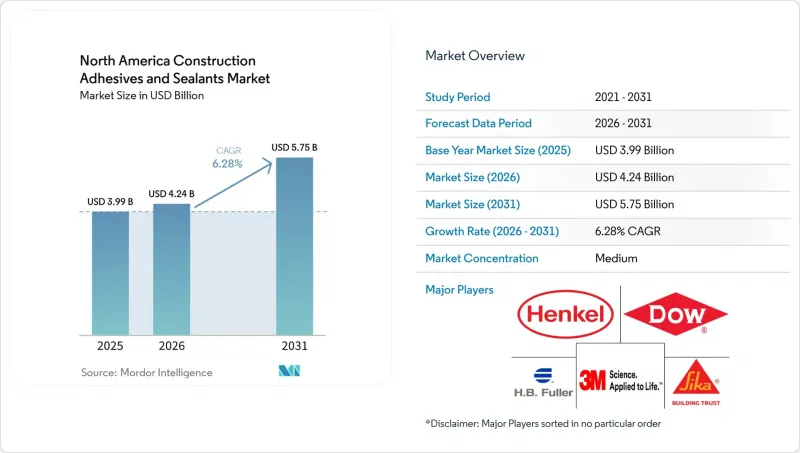
This report is Segmented by Resin (Polyurethane, Acrylic, and More), Technology (Sealants, Water-Borne, and More), Application (Flooring and Tiling, Roofing, Wall Panels and Facades, and More), End-Use Sector (Residential, Commercial, Industrial, and Infrastructure), and Geography (United States, Canada, and Mexico). The Market Forecasts are Provided in Terms of Value (USD).
North America Construction Adhesives And Sealants Market Trends and Insights
Surging Demand for Low-VOC Construction Materials
California's SCAQMD Rule 1168, which limits VOC content to 50-250 g/L, has driven widespread reformulation away from solvent-based chemistries. Similar regulations in Maryland, Massachusetts, Texas, and other OTC states have created a fragmented regulatory environment that benefits suppliers with extensive compliant product portfolios. In March 2025, BASF and Sika introduced Baxxodur EC 151, which reduces VOC emissions by up to 90% and cures at temperatures as low as 5-10 °C. Modified-silane hybrids are gaining market share as they eliminate isocyanate exposure while meeting adhesion requirements. Specifiers are increasingly integrating low-VOC credentials with lifecycle durability, embedding environmental compliance into bid specifications rather than treating it as a regulatory formality.
Rapid Growth of Off-Site Modular Construction
Permanent modular construction reached USD 14.6 billion in 2024, up from USD 4.3 billion a decade earlier, reflecting a shift toward controlled-environment assembly. Factory workflows require adhesives that cure predictably and integrate with robotic dispensers. For instance, SikaWall-3000 Rapid Bond cures within one hour on cross-laminated timber (CLT) production lines, enhancing throughput. Similarly, Kiilto's Pro SW adhesive reduces CLT bond times by 30%, improving cycle-time efficiency. Since modular units are completed in factories, demand for field-focused slow-cure adhesives is declining, steering the North America construction adhesives and sealants market toward factory-optimized formulations.
Volatility in Petro-Derived Raw Material Prices
MDI prices rose by 5.86% in the week ending March 20, 2026, following a spike in benzene feedstock costs, with Covestro and Huntsman announcing price increases of USD 220-260 per ton. Raw materials account for approximately 75% of adhesive production costs, so a 1% price change can impact net income by USD 13.3 million for mid-sized producers. While formulators are exploring bio-based polyols and recycled resins, the requalification process for building codes can take up to two years, leaving smaller firms exposed to margin pressures.
Other drivers and restraints analyzed in the detailed report include:
- Infrastructure Stimulus Packages in the U.S. and Canada
- Adhesive Formulation Innovations Enabling Mixed-Material Bonding
- Stricter REACH and TSCA Compliance Costs
For complete list of drivers and restraints, kindly check the Table Of Contents.
Segment Analysis
Silicone resins are projected to grow at a CAGR of 6.43% through 2031, as facade engineers value their long-term elasticity under UV exposure and thermal cycling. Polyurethane accounted for 24.38% of the North America construction adhesives and sealants market share in 2025, driven by its use in flooring and spray-foam insulation, though it faces cost challenges due to fluctuating isocyanate feedstock prices. Acrylics are preferred for interior applications where ease of cleanup and cost are prioritized over exterior durability. Epoxies are utilized in heavy-duty flooring and chemical-resistant bonds, with advancements such as low-temperature, low-VOC hardeners like Baxxodur EC 151 ensuring their relevance in cold-climate applications.
Silicone's weathering advantage is supported by a 40-year outdoor study that demonstrated minimal modulus loss compared to polyurethane or acrylic sealants under cyclic UV, salt fog, and temperature variations. Code officials now include silicone in curtain-wall specifications, and bridge authorities approve two-part silicone joints for 75-year assets. Phenol-resorcinol remains critical for structural mass-timber laminations, while modified-silane hybrids combine silicone's durability with polyurethane's adhesion. Suppliers with expertise in multi-resin portfolios are better positioned to address the mixed-material bonding challenges in the North America construction adhesives and sealants market.
Water-borne technology is expected to grow at the highest CAGR of 6.43% through 2031, driven by regulatory measures such as SCAQMD Rule 1168 and OTC model rules, which impose strict VOC limits. Sealants accounted for 42.01% of technology revenue in 2025, with performance demands leading to niche formulations for specific applications like concrete-to-FRP, metal-to-glass, and wood-to-polymer joints.
Solvent-borne products maintain a presence in applications where freeze-thaw cycles or porous substrates challenge water-based alternatives, though their market share continues to decline. Reactive chemistries, including epoxies, polyurethanes, and methacrylates, are used for high-strength structural bonds despite their mixing complexity. Hot-melt adhesives are thriving in factory settings for windows and insulated panels, with Arkema expanding UV acrylic capacity in 2024 to meet modular construction demand. Hybrid technologies that combine water-borne low-VOC benefits with reactive strength are emerging as a key growth area in the North America construction adhesives and sealants market.
List of Companies Covered in this Report:
- 3M
- Arkema
- ATP adhesive systems AG
- Avery Dennison
- BASF
- Carlisle Construction Materials
- Dow
- Franklin International
- H.B. Fuller Company
- Henkel AG & Co. KGaA
- Huntsman International LLC
- ITW Performance Polymers
- MAPEI S.p.A.
- Momentive
- PARKER HANNIFIN CORP
- Pecora Corporation
- RPM International Inc.
- Sika AG
- Soudal Group
- Wacker Chemie AG
Additional Benefits:
- The market estimate (ME) sheet in Excel format
- 3 months of analyst support
TABLE OF CONTENTS
1 Introduction
- 1.1 Study Assumptions and Market Definition
- 1.2 Scope of the Study
2 Research Methodology
3 Executive Summary
4 Market Landscape
- 4.1 Market Overview
- 4.2 Market Drivers
- 4.2.1 Surging demand for low-VOC construction materials
- 4.2.2 Rapid growth of off-site modular construction
- 4.2.3 Infrastructure stimulus packages in the U.S. and Canada
- 4.2.4 Adhesive formulation innovations enabling mixed-material bonding
- 4.2.5 Rising multi-story timber buildings adoption
- 4.2.6 Widespread reroofing linked to extreme-weather events
- 4.3 Market Restraints
- 4.3.1 Volatility in petro-derived raw material prices
- 4.3.2 Stricter REACH and TSCA compliance costs
- 4.3.3 Skilled-labor shortages for correct sealant application
- 4.3.4 Competition from mechanical fastening alternatives in roofing
- 4.4 Value Chain Analysis
- 4.5 Porter's Five Forces
- 4.5.1 Bargaining Power of Suppliers
- 4.5.2 Bargaining Power of Buyers
- 4.5.3 Threat of New Entrants
- 4.5.4 Threat of Substitutes
- 4.5.5 Competitive Rivalry
5 Market Size and Growth Forecasts (Value)
- 5.1 By Resin Type
- 5.1.1 Polyurethane
- 5.1.2 Acrylic
- 5.1.3 Cyanoacrylate
- 5.1.4 Epoxy
- 5.1.5 Silicone
- 5.1.6 VAE/EVA
- 5.1.7 Other Resins
- 5.2 By Technology
- 5.2.1 Sealants
- 5.2.2 Water-borne
- 5.2.3 Solvent-borne
- 5.2.4 Reactive
- 5.2.5 Hot-melt
- 5.3 By Application
- 5.3.1 Flooring and Tiling
- 5.3.2 Roofing
- 5.3.3 Wall Panels and Facades
- 5.3.4 Insulation and Weatherproofing
- 5.3.5 Infrastructure Joints (bridges, tunnels)
- 5.4 By End-use Sector
- 5.4.1 Residential
- 5.4.2 Commercial
- 5.4.3 Industrial
- 5.4.4 Infrastructure
- 5.5 By Geography
- 5.5.1 United States
- 5.5.2 Canada
- 5.5.3 Mexico
6 Competitive Landscape
- 6.1 Market Concentration
- 6.2 Strategic Moves
- 6.3 Market Share (%)/Ranking Analysis
- 6.4 Company Profiles (includes Global level Overview, Market level overview, Core Segments, Financials as available, Strategic Information, Products and Services, and Recent Developments)
- 6.4.1 3M
- 6.4.2 Arkema
- 6.4.3 ATP adhesive systems AG
- 6.4.4 Avery Dennison
- 6.4.5 BASF
- 6.4.6 Carlisle Construction Materials
- 6.4.7 Dow
- 6.4.8 Franklin International
- 6.4.9 H.B. Fuller Company
- 6.4.10 Henkel AG & Co. KGaA
- 6.4.11 Huntsman International LLC
- 6.4.12 ITW Performance Polymers
- 6.4.13 MAPEI S.p.A.
- 6.4.14 Momentive
- 6.4.15 PARKER HANNIFIN CORP
- 6.4.16 Pecora Corporation
- 6.4.17 RPM International Inc.
- 6.4.18 Sika AG
- 6.4.19 Soudal Group
- 6.4.20 Wacker Chemie AG
7 Market Opportunities and Future Outlook
- 7.1 White-space and Unmet-Need Assessment

