PUBLISHER: Mordor Intelligence | PRODUCT CODE: 2066696

PUBLISHER: Mordor Intelligence | PRODUCT CODE: 2066696
Europe Polyurethane Adhesives - Market Share Analysis, Industry Trends & Statistics, Growth Forecasts (2026 - 2031)
According to Mordor Intelligence, the europe polyurethane adhesives market size was valued at USD 4.21 billion in 2025 and is estimated to grow from USD 4.47 billion in 2026 to reach USD 6.01 billion by 2031, at a CAGR of 6.11% during the forecast period (2026-2031).
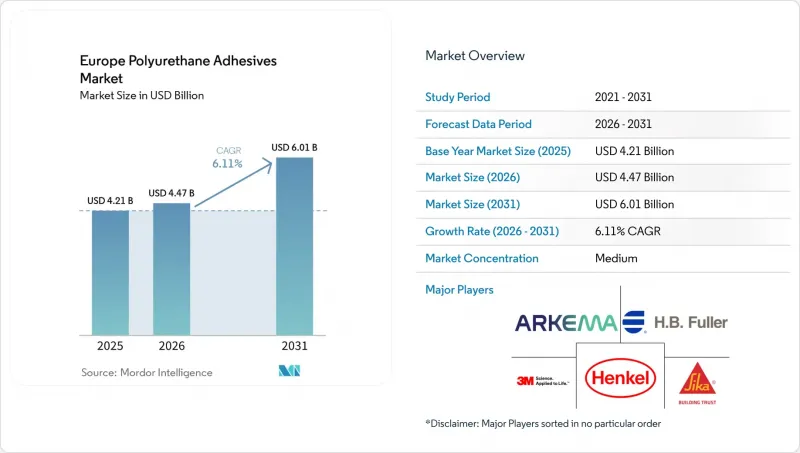
This report is Segmented by End-User Industry (Aerospace, Automotive, Building and Construction, Footwear and Leather, Woodworking and Joinery, and More), Technology (Hot Melt, Reactive, Solvent-Borne, UV Cured, and Water-Borne), and Geography (Germany, France, Italy, Russia, Spain, United Kingdom, NORDIC Countries, and Rest of Europe). The Market Forecasts are Provided in Terms of Value (USD).
Europe Polyurethane Adhesives Market Trends and Insights
Automotive Lightweighting and Structural Bonding Boom
Europe has seen significant growth in battery electric vehicle (BEV) production, with a notable increase compared to the previous year. Each BEV now uses significantly more structural adhesive than internal-combustion vehicles. As gigafactories in Germany, France, and Spain expand their output, the demand for reactive polyurethane in traction-battery bonding is expected to grow at a faster pace than overall automotive production in the coming years. Electric-vehicle battery pack assembly increasingly relies on advanced polyurethane systems. These systems provide structural strength and thermal conductivity while replacing traditional mechanical fasteners, resulting in a notable reduction in pack weight. SikaForce-7888 L30 has gained approval for its effectiveness in aluminum-to-composite joints and is now specified by several major car manufacturers in Germany and France. Additionally, Evonik's ambient-cure potting compounds offer high dielectric strength, addressing both electrical isolation and vibration damping, highlighting the critical role of modern polyurethane systems in the evolving automotive industry.
Energy-Efficient Building Insulation Mandates
The Energy Performance of Buildings Directive mandates zero-emission new constructions and requires member states to renovate the least energy-efficient portion of non-residential buildings. In facade retrofits, polyurethane adhesives are used to secure rigid foam panels, but these formulations must comply with the EU Decopaint Directive, which limits volatile organic compounds (VOCs). Incentives in Germany have significantly increased demand for insulated facades, driving notable growth in adhesive consumption. Despite being priced higher, Henkel's solvent-free Pattex PL Premium has gained a significant share of the German DIY market shortly after its launch, highlighting consumers' willingness to invest in low-emission products. Nordic building codes enforce strict U-value requirements, and Finland's adhesive usage per square meter of building envelope exceeds the European average, indicating potential consumption trends for Western Europe.
Diisocyanate Price and Supply Volatility
Force-majeure outages in Asia and Red Sea shipping delays lifted toluene diisocyanate spot prices by double digits in Q1 2025, raising European converters' input costs by up to 18% quarter-on-quarter. Contract methylene-diphenyl diisocyanate prices moved in tandem, and Dow passed through broad polymer dispersion hikes in early 2026 to counter feedstock inflation amid geopolitical unrest. Wacker Chemie's capacity ramp-up of alpha-silane hybrids at Nunchritz provides a hedge against aromatic-isocyanate dependency, but higher unit costs limit adoption to premium uses. Smaller formulators lack the capital to integrate upstream, leaving them exposed to merchant-supply shocks and squeezing working capital when spot prices spike.
Other drivers and restraints analyzed in the detailed report include:
- EU Green Deal Push for Low- Volatile Organic Compound (VOC), Solvent-Free Systems
- Reactive Polyurethanes in European Medical-Device Assembly
- Tightening REACH Limits on Free NCO Content
For complete list of drivers and restraints, kindly check the Table Of Contents.
Segment Analysis
The automotive segment accounted for 23.18% of the Europe Polyurethane Adhesives market size in 2025, as battery pack, structural, and interior applications all require reactive systems. The bonding of electric vehicle batteries required a significant amount of adhesive, with Dow's VORATRON and SikaForce platforms winning most new specifications. Electrical and electronics remain smaller but post the fastest 6.58% CAGR between 2026 and 2031 as power-semiconductor modules benefit from polyurethane potting compounds, which shield them from heat cycling and vibrations. The building and construction sector, responding to the Energy Performance of Buildings Directive (EPBD) recast, represents a significant share of the volume under mandated retrofits. In Europe, footwear manufacturers in Italy and Spain are increasingly adopting water-borne dispersions with low volatile organic compound (VOC) emissions, showing steady annual growth. While healthcare occupies a niche segment, it commands premium margins, especially for ISO 10993-certified grades like Loctite AA 3952, prominently used in insulin pumps. The demand landscape is further diversified by packaging, woodworking, and aerospace sectors, with woodworking expected to see notable consumption of moisture-cure one-component formulations in the coming years.
List of Companies Covered in this Report:
- 3M
- Arkema
- BASF
- Beardow Adams
- DELO Industrial Adhesives
- Dow Inc.
- H.B. Fuller Company
- Henkel AG & Co. KGaA
- Huntsman International LLC
- ITW Performance Polymers
- Jowat SE
- MAPEI S.p.A.
- Momentive Performance Materials
- PARKER HANNIFIN CORP
- Sika AG
- Soudal Holding N.V.
- Tesa Tapes (India) Private Limited
- ThreeBond Europe
- Wacker Chemie AG
Additional Benefits:
- The market estimate (ME) sheet in Excel format
- 3 months of analyst support
TABLE OF CONTENTS
1 Introduction
- 1.1 Study Assumptions and Market Definition
- 1.2 Scope of the Study
2 Research Methodology
3 Executive Summary
4 Market Landscape
- 4.1 Market Overview
- 4.2 Market Drivers
- 4.2.1 Automotive lightweighting and structural bonding boom
- 4.2.2 Energy-efficient building insulation mandates
- 4.2.3 EU Green Deal push for low-VOC, solvent-free systems
- 4.2.4 Modular timber construction adoption
- 4.2.5 Reactive PURs in European medical-device assembly
- 4.3 Market Restraints
- 4.3.1 Diisocyanate price and supply volatility
- 4.3.2 Tightening REACH limits on free NCO content
- 4.3.3 Bio-based adhesive substitutes gaining share
- 4.4 Value Chain Analysis
- 4.5 Regulatory Analysis
- 4.6 Porter's Five Forces Analysis
- 4.6.1 Threat of New Entrants
- 4.6.2 Bargaining Power of Suppliers
- 4.6.3 Bargaining Power of Buyers
- 4.6.4 Threat of Substitutes
- 4.6.5 Competitive Rivalry
- 4.7 Distribution Channel Analysis
5 Market Size and Growth Forecasts (Value)
- 5.1 End-User Industry
- 5.1.1 Aerospace
- 5.1.2 Automotive
- 5.1.3 Building and Construction
- 5.1.4 Footwear and Leather
- 5.1.5 Healthcare
- 5.1.6 Packaging
- 5.1.7 Woodworking and Joinery
- 5.1.8 Other End-user Industries
- 5.2 Technology
- 5.2.1 Hot-Melt
- 5.2.2 Reactive
- 5.2.3 Solvent-borne
- 5.2.4 UV-Cured
- 5.2.5 Water-borne
- 5.3 Geography
- 5.3.1 Germany
- 5.3.2 France
- 5.3.3 Italy
- 5.3.4 Russia
- 5.3.5 Spain
- 5.3.6 United Kingdom
- 5.3.7 NORDIC Countries
- 5.3.8 Rest of Europe
6 Competitive Landscape
- 6.1 Market Concentration
- 6.2 Key Strategic Moves
- 6.3 Market Share (%)/Ranking Analysis
- 6.4 Company Profiles (includes Global-level Overview, Market-level Overview, Core Segments, Financials as available, Strategic Information, Products & Services, and Recent Developments)
- 6.4.1 3M
- 6.4.2 Arkema
- 6.4.3 BASF
- 6.4.4 Beardow Adams
- 6.4.5 DELO Industrial Adhesives
- 6.4.6 Dow Inc.
- 6.4.7 H.B. Fuller Company
- 6.4.8 Henkel AG & Co. KGaA
- 6.4.9 Huntsman International LLC
- 6.4.10 ITW Performance Polymers
- 6.4.11 Jowat SE
- 6.4.12 MAPEI S.p.A.
- 6.4.13 Momentive Performance Materials
- 6.4.14 PARKER HANNIFIN CORP
- 6.4.15 Sika AG
- 6.4.16 Soudal Holding N.V.
- 6.4.17 Tesa Tapes (India) Private Limited
- 6.4.18 ThreeBond Europe
- 6.4.19 Wacker Chemie AG
7 Market Opportunities and Future Outlook
- 7.1 White-space and Unmet-Need Assessment

