PUBLISHER: Mordor Intelligence | PRODUCT CODE: 2066693

PUBLISHER: Mordor Intelligence | PRODUCT CODE: 2066693
Asia-Pacific Polyurethane Adhesives - Market Share Analysis, Industry Trends & Statistics, Growth Forecasts (2026 - 2031)
According to Mordor Intelligence, the asia-Pacific polyurethane adhesives market size is expected to grow from USD 6.55 billion in 2025 to USD 6.95 billion in 2026 and is forecast to reach USD 9.35 billion by 2031 at a 6.12% CAGR over 2026-2031.
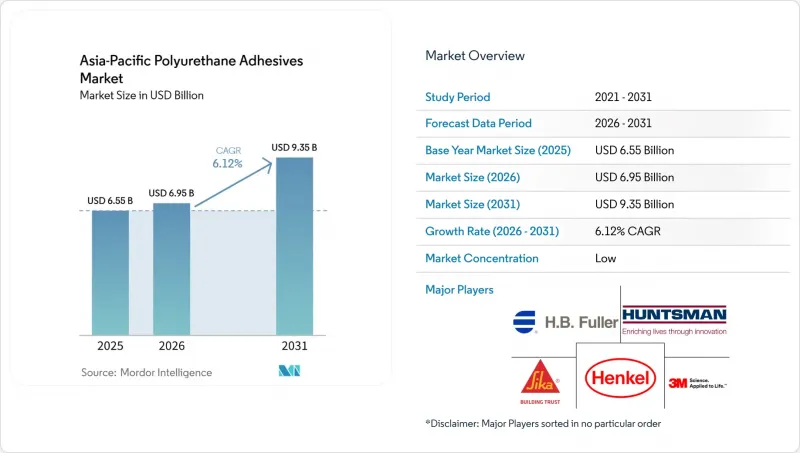
This report is Segmented by End-User Industry (Aerospace, Automotive, Healthcare, Packaging, and More), Technology (Hot Melt, Reactive, Solvent-Borne, UV Cured Adhesives, and Water-Borne), and Geography (Australia, China, India, Indonesia, Japan, Malaysia, Singapore, South Korea, Thailand, Rest of Asia-Pacific). The Market Forecasts are Provided in Terms of Value (USD).
Asia-Pacific Polyurethane Adhesives Market Trends and Insights
Surge in Building-Envelope Retrofits Post-COVID Era
As owners pursue lower operating costs and commit to net-zero goals, refurbishment budgets in major cities are on the rise. In a significant move, China invested a whopping USD 550 billion into low-carbon construction, subsequently boosting the demand for polyurethanes, especially in insulation-panel bonding and waterproofing membranes. Under Singapore's Land Transport Master Plan 2040, newly added rail stations are opting for fire-resistant rigid-foam adhesives. These adhesives are designed to bond with aged steel or concrete, even at ambient cure. Moisture-curing grades are flourishing in the market due to their ability to tolerate surface contaminants, thereby reducing downtime. This trend is mirrored in India's smart-city corridors and Japan's aging high-rise buildings. However, the influx of inexpensive Chinese MDI poses a challenge, potentially squeezing margins for converters. Yet, segment suppliers who combine unique primers with on-site training are managing to capture market share, even amidst pricing pressures.
Automotive Lightweighting Push for EV Range Extension
Automakers are increasingly turning to two-component polyurethanes, moving away from traditional rivets and epoxies. These polyurethanes are adept at bonding cell modules, sealing aluminum housings, and creating thermally conductive gap fillers. H.B. Fuller's UR4515GF achieves a lap-shear strength of 20.05 MPa on E-coat steel after a 70 °C, 120-minute cure, making it a perfect fit for automated EV assembly lines. Launched in 2025, Henkel's Technomelt PUR 6260 ECO boasts over 60% renewable feedstock and softens at a mere 50 °C, leading to energy savings in ovens and safeguarding heat-sensitive substrates. With OEMs extending their ranges to exceed 600 km per charge, the shift towards adhesive substitution becomes evident. Furthermore, India's automotive sector, growing at a CAGR of 7.12%, presents lucrative opportunities for local formulators who align with localization quotas.
Fire-Safety Regulatory Scrutiny on Combustible Cores
Heightened fire-safety standards for polyurethane adhesives in construction applications impose testing burdens and formulation constraints that act as a market restraint, slowing adoption in certain building segments. Australia's AS 5637.1 group-number scheme can push an otherwise compliant panel assembly into costly full-scale fire tests if the adhesive layer shrinks or melts. Korean researchers cut peak heat-release rate 30% by adding phosphorylated polyvinyl alcohol plus magnesium-aluminum layered double hydroxides to water-borne polyurethane, yet bonding strength held above 0.70 MPa. Such additives raise viscosity and cost, so adoption lags until mandated by project insurers.
Other drivers and restraints analyzed in the detailed report include:
- E-Commerce Packaging Shift to High-Performance Laminates
- 3C Electronics Adoption of Low-VOC PUR Hot-Melts
- OEM Qualification Cycles Delaying Tech Substitution
For complete list of drivers and restraints, kindly check the Table Of Contents.
Segment Analysis
Packaging represented 28.24% of the Asia-Pacific polyurethane adhesives market size in 2025 thanks to flexible-laminate formats used for snacks, pharmaceuticals, and e-commerce mailers. Growth hinges on moisture-curing reactive hot-melts that deliver hermetic seals within seconds and cut energy versus solvent-borne lines. Regional laminate plants that install nitrogen-inerted gravure presses avoid condensation defects, supporting bigger lot sizes for instant noodles and condiments. Automotive uses, although smaller in tonnage, grow at 6.94% CAGR as EV battery modules, lightweight body panels, and acoustic foams demand two-component polyurethanes and thermoplastic polyurethane films. The Asia-Pacific polyurethane adhesives market now prizes suppliers able to certify thermal conductivity >=2 W/m*K and provide crash simulation data that meet GB /T 33014 side-impact protocols.
Construction adhesives benefit from insulation retrofits but face slow project approvals in China's tier-3 cities. Footwear factories in Vietnam and Indonesia convert to water-based polyurethane dispersions that slash VOCs by 90-95%. Medical tapes coated with breathable polyurethane interact well with hydrocolloid layers, expanding wound-care exports from Malaysia. Woodworking taps reactive hot-melts for engineered-wood flooring because clamp times drop 50%, boosting line capacity without new kilns. These niche areas collectively sustain baseline growth even if packaging or automotive cycles soften, keeping demand broad-based within the Asia-Pacific polyurethane adhesives market.
List of Companies Covered in this Report:
- 3M
- Arkema
- Avery Dennison Corporation
- BASF
- Dow Inc.
- H.B. Fuller Company
- Henkel AG & Co. KGaA
- Hubei Huitian New Materials Co., Ltd.
- Huntsman Corporation
- ITW Performance Polymers
- Jowat SE
- Kangda New Materials (Group) Co., Ltd.
- NANPAO RESINS CHEMICAL GROUP
- Permabond LLC
- Pidilite Industries Ltd.
- Sika AG
Additional Benefits:
- The market estimate (ME) sheet in Excel format
- 3 months of analyst support
TABLE OF CONTENTS
1 Introduction
- 1.1 Study Assumptions and Market Definition
- 1.2 Scope of the Study
2 Research Methodology
3 Executive Summary
4 Market Landscape
- 4.1 Market Overview
- 4.2 Market Drivers
- 4.2.1 Surge in building-envelope retrofits post-COVID era
- 4.2.2 Automotive lightweighting push for EV range extension
- 4.2.3 E-commerce packaging shift to high-performance laminates
- 4.2.4 3C electronics adoption of low-VOC PUR hot-melts
- 4.2.5 Green-building regulations spurring rigid panel bonding
- 4.3 Market Restraints
- 4.3.1 Volatility in MDI/TDI feedstock prices
- 4.3.2 Fire-safety regulatory scrutiny on combustible cores
- 4.3.3 OEM qualification cycles delaying tech substitution
- 4.4 Value Chain Analysis
- 4.5 Regulatory Analysis
- 4.6 Distribution Channel Analysis
- 4.7 Porter's Five Forces
- 4.7.1 Threat of New Entrants
- 4.7.2 Bargaining Power of Suppliers
- 4.7.3 Bargaining Power of Buyers
- 4.7.4 Threat of Substitutes
- 4.7.5 Competitive Rivalry
5 Market Size and Growth Forecasts (Value)
- 5.1 By End-user Industry
- 5.1.1 Aerospace
- 5.1.2 Automotive
- 5.1.3 Building and Construction
- 5.1.4 Footwear and Leather
- 5.1.5 Healthcare
- 5.1.6 Packaging
- 5.1.7 Woodworking and Joinery
- 5.1.8 Other End-user Industries
- 5.2 Technology
- 5.2.1 Hot Melt
- 5.2.2 Reactive
- 5.2.3 Solvent-borne
- 5.2.4 UV Cured Adhesives
- 5.2.5 Water-borne
- 5.3 By Country
- 5.3.1 Australia
- 5.3.2 China
- 5.3.3 India
- 5.3.4 Indonesia
- 5.3.5 Japan
- 5.3.6 Malaysia
- 5.3.7 Singapore
- 5.3.8 South Korea
- 5.3.9 Thailand
- 5.3.10 Rest of Asia-Pacific
6 Competitive Landscape
- 6.1 Market Concentration
- 6.2 Strategic Moves
- 6.3 Market Share(%)/Ranking Analysis
- 6.4 Company Profiles (includes Global level Overview, Market level overview, Core Segments, Financials as available, Strategic Information, Products & Services, and Recent Developments)
- 6.4.1 3M
- 6.4.2 Arkema
- 6.4.3 Avery Dennison Corporation
- 6.4.4 BASF
- 6.4.5 Dow Inc.
- 6.4.6 H.B. Fuller Company
- 6.4.7 Henkel AG & Co. KGaA
- 6.4.8 Hubei Huitian New Materials Co., Ltd.
- 6.4.9 Huntsman Corporation
- 6.4.10 ITW Performance Polymers
- 6.4.11 Jowat SE
- 6.4.12 Kangda New Materials (Group) Co., Ltd.
- 6.4.13 NANPAO RESINS CHEMICAL GROUP
- 6.4.14 Permabond LLC
- 6.4.15 Pidilite Industries Ltd.
- 6.4.16 Sika AG
7 Market Opportunities and Future Outlook
- 7.1 White-space and Unmet-need Assessment

