PUBLISHER: Mordor Intelligence | PRODUCT CODE: 2072445

PUBLISHER: Mordor Intelligence | PRODUCT CODE: 2072445
Malaysia Life Insurance - Market Share Analysis, Industry Trends & Statistics, Growth Forecasts (2026 - 2031)
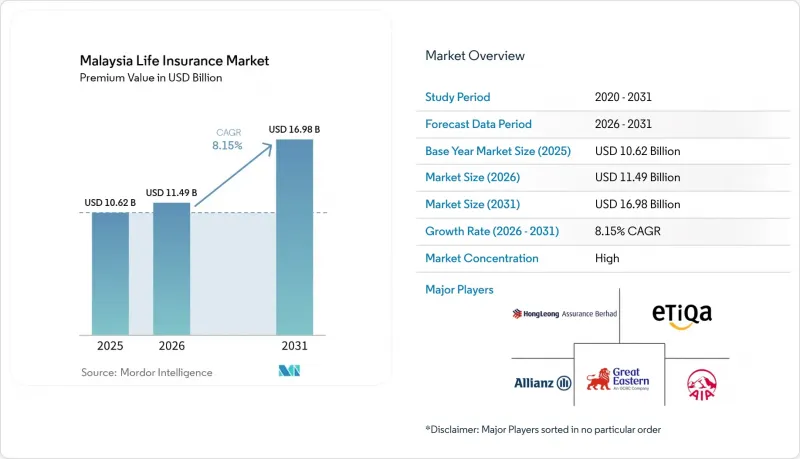
According to Mordor Intelligence, the malaysia life insurance market size in terms of premium value was valued at USD 10.62 billion in 2025 and is estimated to grow from USD 11.49 billion in 2026 to reach USD 16.98 billion by 2031, at a CAGR of 8.15% during the forecast period (2026-2031).
This report is Segmented by Product Type (Term Life Insurance, Whole Life Insurance, Endowment Insurance, and More), Distribution Channel (Agents, Brokers, Banks, and More), Premium Type (Regular Premium, Single Premium), Customer Age Group (0-24 Years, 25-44 Years, and More), and Geography. The Market Forecasts are Provided in Terms of Value (USD).
Malaysia Life Insurance Market Trends and Insights
Rising Middle-Class Disposable Income & Insurance Penetration
Malaysia's middle class is expanding alongside a 2.1% annual population growth rate and a life expectancy of 74.0 years, generating a larger addressable base for the Malaysia life insurance market. The Employees Provident Fund (EPF) delivered a 6.30% dividend for 2024, reinforcing consumer confidence to allocate more income toward protection and savings policies. Penetration remains modest at roughly 5% of GDP, leaving sizeable headroom as incomes climb. Urban clusters such as Klang Valley post above-average wages, accelerating uptake of investment-linked covers that blend protection and wealth creation. Compared with mature markets facing shrinking workforces, Malaysia's demographic profile underpins medium-term premium expansion in the Malaysia life insurance market.
Tax Incentives on Life-Insurance Premiums
Budget 2025 raised tax relief ceilings on medical and education policies from RM3,000 to RM4,000, directly lowering the effective cost of ownership. Extended PRS incentives until 2030 reinforce demand for retirement-focused solutions such as annuities. These measures coincide with BNM's consumer-protection guidance, boosting trust and encouraging innovation. International evidence shows similar fiscal levers can produce two-to-three-fold jumps in new-business premiums when households rush to optimize tax savings. The alignment of tax and regulatory policy, therefore, magnifies growth momentum for the Malaysia life insurance market.
Low Financial Literacy & Product Complexity
The National Strategy for Financial Literacy flagged persistent gaps in understanding investment-linked and annuity mechanics, a hurdle that lowers uptake for advanced solutions. PIDM behavioral studies show many buyers focus on headline premiums rather than long-term value, leading to underinsurance and policy lapses. Complexity triggers decision paralysis, particularly in rural populations with limited adviser access despite rising digital reach. Sustained, multi-year education is needed before literacy gains materially expand the Malaysia life insurance market.
Other drivers and restraints analyzed in the detailed report include:
- Growth of Shariah-Compliant Takaful Life Products
- EPF Withdrawals into Approved Annuity Products
- Prolonged Low-Interest-Rate Environment
For complete list of drivers and restraints, kindly check the Table Of Contents.
Segment Analysis
In 2025, unit-linked and investment-linked covers commanded a 41.20% share of Malaysia's life insurance market, underscoring a strong consumer preference for these flexible protection and investment solutions. These products offer policyholders the ability to combine insurance coverage with investment opportunities, making them particularly attractive in a market where financial planning and wealth accumulation are gaining importance. Meanwhile, annuities surged ahead with a robust 9.52% CAGR, driven by channels like EPF withdrawals and growing concerns over longevity risks. The increasing life expectancy of Malaysia's population has further amplified the demand for annuities, as individuals seek financial security during retirement.
The appeal of unit-linked products, with their transparency and fund-switching options, resonates particularly with younger urban buyers who value flexibility and control over their investments. While conservative savers continue to favor whole-life policies for their guarantees in a low-rate environment, the tightening spreads are squeezing profitability for insurers. Whole-life policies remain a staple for risk-averse consumers, but insurers are facing challenges in maintaining margins due to the prevailing economic conditions. As buyers pivot towards higher-yield options, endowments are witnessing a decline in popularity, with many consumers opting for products that offer better returns and align with their financial goals. Health-linked riders are grappling with rising costs, highlighted by Great Eastern's average claims soaring to RM8,760, leading to a market-wide repricing in Malaysia's life insurance sector. The increasing healthcare costs and inflationary pressures are compelling insurers to reassess their pricing strategies to ensure sustainability while meeting policyholder needs.
In 2025, agents maintained a dominant 50.85% share of Malaysia's life insurance market, highlighting the significance of relational selling in navigating complex products. This dominance reflects the trust and personalized service that agents provide, which remains critical in a market where consumers often seek guidance for intricate insurance decisions. Meanwhile, online marketplaces are on a growth trajectory, boasting a 10.29% CAGR, resonating with the self-directed research tendencies of today's digital-native consumers. These platforms cater to the growing demand for convenience and transparency, enabling customers to compare policies and make informed decisions independently.
In the first half of 2024, bancassurance partnerships, notably the AIA-Public Bank alliance, propelled VONB by 18%, underscoring the influential role of banking channels. Such alliances leverage the extensive customer base and trust associated with banks, making them a powerful distribution channel for life insurance products. Specialized brokers are now addressing niche corporate needs and high-sum-assured cases, offering tailored solutions that cater to specific client requirements. The landscape is evolving: hybrid models are emerging, with agents increasingly equipped with digital tools to enhance efficiency and customer engagement. For instance, 90% of Prudential's Malaysian agents now use PRUForce for e-submission, streamlining processes and improving service delivery. Multichannel engagement strategies are expected to play a pivotal role in shaping customer acquisition approaches across the Malaysia life insurance market, ensuring that insurers can meet diverse consumer preferences effectively.
Complete Report Scope:
- By Product Type (Value)
- Term Life Insurance
- Whole Life Insurance
- Endowment Insurance
- Unit-Linked / Investment-Linked
- Annuity Insurance
- Other Types
- By Distribution Channel (Value)
- Agents
- Brokers
- Banks
- Direct to Consumer
- Online Marketplaces
- By Premium Type (Value)
- Regular Premium
- Single Premium
- By Customer Age Group (Value)
- 0-24 Years
- 25-44 Years
- 45-64 Years
- 65 Years & Above
List of Companies Covered in this Report:
- Great Eastern Life Assurance (Malaysia) Berhad
- AIA Bhd.
- Prudential Assurance Malaysia Berhad
- Etiqa Life Insurance Berhad
- Allianz Life Insurance Malaysia Berhad
- Hong Leong Assurance Berhad
- Sun Life Malaysia Assurance Berhad
- Manulife Insurance Berhad
- Tokio Marine Life Insurance Malaysia Bhd.
- Zurich Life Insurance Malaysia Berhad
- AmMetLife Insurance Berhad
- FWD Takaful Berhad
- Gibraltar BSN Life Berhad
- Takaful Ikhlas Family Berhad
- HSBC Amanah Takaful (Malaysia) Berhad
- RHB Insurance Berhad
- Chubb Life Insurance Malaysia Berhad
- Generali Life Insurance Malaysia Berhad
- MCIS Life
Additional Benefits:
- The market estimate (ME) sheet in Excel format
- 3 months of analyst support
TABLE OF CONTENTS
1 Introduction
- 1.1 Study Assumptions & Market Definition
- 1.2 Scope of the Study
2 Research Methodology
3 Executive Summary
4 Market Landscape
- 4.1 Market Overview
- 4.2 Market Drivers
- 4.2.1 Rising middle-class disposable income & insurance penetration
- 4.2.2 Tax incentives on life-insurance premiums
- 4.2.3 Growth of Shariah-compliant Takaful life products
- 4.2.4 EPF withdrawals into approved annuity products
- 4.2.5 Digital channels post-BNM Regulatory Sandbox expansion
- 4.2.6 Biometric underwriting slashing policy-issuance time
- 4.3 Market Restraints
- 4.3.1 Low financial literacy & product complexity
- 4.3.2 Prolonged low-interest-rate environment
- 4.3.3 Capital requirement hikes under RBC-2
- 4.3.4 Competition from Private Retirement Schemes (PRS)
- 4.4 Value / Supply-Chain Analysis
- 4.5 Regulatory Landscape
- 4.6 Technological Outlook
- 4.7 Porter's Five Forces
- 4.7.1 Threat of New Entrants
- 4.7.2 Bargaining Power of Buyers
- 4.7.3 Bargaining Power of Suppliers
- 4.7.4 Threat of Substitutes
- 4.7.5 Competitive Rivalry
5 Market Size & Growth Forecasts
- 5.1 By Product Type (Value)
- 5.1.1 Term Life Insurance
- 5.1.2 Whole Life Insurance
- 5.1.3 Endowment Insurance
- 5.1.4 Unit-Linked / Investment-Linked
- 5.1.5 Annuity Insurance
- 5.1.6 Other Types
- 5.2 By Distribution Channel (Value)
- 5.2.1 Agents
- 5.2.2 Brokers
- 5.2.3 Banks
- 5.2.4 Direct to Consumer
- 5.2.5 Online Marketplaces
- 5.3 By Premium Type (Value)
- 5.3.1 Regular Premium
- 5.3.2 Single Premium
- 5.4 By Customer Age Group (Value)
- 5.4.1 0-24 Years
- 5.4.2 25-44 Years
- 5.4.3 45-64 Years
- 5.4.4 65 Years & Above
6 Competitive Landscape
- 6.1 Market Concentration
- 6.2 Strategic Moves
- 6.3 Market Share Analysis
- 6.4 Company Profiles (includes Global level Overview, Market level overview, Core Segments, Financials as available, Strategic Information, Market Rank/Share for key companies, Products & Services, and Recent Developments)
- 6.4.1 Great Eastern Life Assurance (Malaysia) Berhad
- 6.4.2 AIA Bhd.
- 6.4.3 Prudential Assurance Malaysia Berhad
- 6.4.4 Etiqa Life Insurance Berhad
- 6.4.5 Allianz Life Insurance Malaysia Berhad
- 6.4.6 Hong Leong Assurance Berhad
- 6.4.7 Sun Life Malaysia Assurance Berhad
- 6.4.8 Manulife Insurance Berhad
- 6.4.9 Tokio Marine Life Insurance Malaysia Bhd.
- 6.4.10 Zurich Life Insurance Malaysia Berhad
- 6.4.11 AmMetLife Insurance Berhad
- 6.4.12 FWD Takaful Berhad
- 6.4.13 Gibraltar BSN Life Berhad
- 6.4.14 Takaful Ikhlas Family Berhad
- 6.4.15 HSBC Amanah Takaful (Malaysia) Berhad
- 6.4.16 RHB Insurance Berhad
- 6.4.17 Chubb Life Insurance Malaysia Berhad
- 6.4.18 Generali Life Insurance Malaysia Berhad
- 6.4.19 MCIS Life
7 Market Opportunities & Future Outlook
- 7.1 White-space & Unmet-Need Assessment

