PUBLISHER: Mordor Intelligence | PRODUCT CODE: 2072459

PUBLISHER: Mordor Intelligence | PRODUCT CODE: 2072459
France Life and Non-Life Insurance - Market Share Analysis, Industry Trends & Statistics, Growth Forecasts (2026 - 2031)
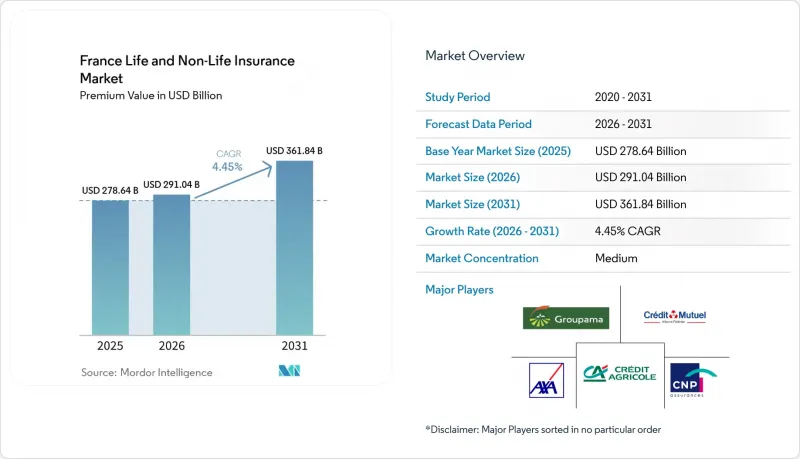
According to Mordor Intelligence, the france life and non-Life insurance market size in terms of premium value is projected to expand from USD 278.64 billion in 2025 and USD 291.04 billion in 2026 to USD 361.84 billion by 2031, registering a CAGR of 4.45% between 2026 to 2031.
This report is Segmented by Insurance Type (Life Insurance, Non-Life Insurance Including Motor, Health, Property, Liability, and Other Insurance), Customer Segment (Retail, Corporate), Distribution Channel (Brokers, Agents, Banks, Direct Sales, Other Channels), and Geography (France). The Market Forecasts are Provided in Terms of Value (USD).
France Life and Non-Life Insurance Market Trends and Insights
Rising Bancassurance Dominance
Banks controlled 53.23% of distribution in 2024, leveraging deep customer data, integrated advisory platforms, and ACPR-approved compliance structures. Their embedded position inside everyday banking journeys lowers acquisition costs and extends lifetime value across savings, credit, and protection touchpoints. Credit Agricole Assurances exemplifies the scale benefits, pairing branch traffic with mobile banking cross-sell to widen household wallet share. Capital efficiency also improves because banks can pool liquidity from deposits and life premiums. Continued consolidation among regional mutual banks points to further entrenchment of the bancassurance model over the medium term.
Shift from Euro-Funds to Unit-Linked Savings
Sub-1% guaranteed rates on traditional euro funds drove savers to unit-linked contracts despite market volatility, helping insurers trim duration mismatches. The 2025 Loi Industrie Verte mandates minimum allocations to non-listed green assets, compelling product redesign toward flexible investment sleeves that transfer market risk to policyholders while meeting ESG targets. This migration boosts fee income and lowers capital charges under Solvency II. It also positions insurers as facilitators of national sustainability financing, enhancing their social license to operate.
Nat-Cat Loss Inflation & Drought Risk
Exceptional floods and prolonged droughts are inflating loss ratios and challenging traditional catastrophe models. Drought-related subsidence events affect wide areas simultaneously, limiting diversification benefits and pushing combined ratios above historical norms. Insurers are rebuilding pricing models with richer climate data sets and advocating for stronger prevention incentives. Government-backed natural disaster compensation schemes temper consumer impact but raise uncertainty over future levy adjustments. The resulting volatility weighs on underwriting appetite for property risks in exposed regions.
Other drivers and restraints analyzed in the detailed report include:
- Mandatory Motor & Health Coverage Expansion
- Digital-First Insurers & InsurTech Partnerships
- IFRS-17 Capital Volatility on Life Portfolios
For complete list of drivers and restraints, kindly check the Table Of Contents.
Segment Analysis
Life products controlled 68.12% of the France life & non-life insurance market in 2025, underpinned by favorable tax treatment and bancassurance sales. Yet non-life premiums are set to compound at a 4.53% CAGR, narrowing the gap as mandatory motor, health, and property lines outpace traditional savings. Motor remains the largest non-life class; higher accident frequency and component costs drove 5% annual premium growth, contributing a substantial lift to the France life & non-life insurance market size in 2025. Property growth is spurred by climate-linked product redesigns that bundle prevention services with coverage, while professional liability demand rises with expanding knowledge-economy employment.
The Loi Industrie Verte accelerates ESG integration by requiring green asset quotas within life policies, blending protection with investment objectives. This blurring of product boundaries enhances cross-sell between life and non-life portfolios. Insurers adept at modular policy architecture can pivot quickly between guarantee structures, capturing incremental France life & non-life insurance market share as consumer preferences evolve. Conversely, carriers slow to retire costly legacy products risk margin erosion and capital strain under stricter solvency charges.
Complete Report Scope:
- By Insurance Type (Value)
- Life Insurance
- Non-Life Insurance
- Motor Insurance
- Health Insurance
- Property Insurance
- Liability Insurance
- Other Insurance
- By Customer Segment (Value)
- Retail
- Corporate
- By Distribution Channel (Value)
- Brokers
- Agents
- Banks
- Direct Sales
- Other Channels
List of Companies Covered in this Report:
- AXA SA
- Credit Agricole Assurances
- CNP Assurances
- Groupama
- Credit Mutuel Alliance Federale (GACM)
- Societe Generale Assurances
- BNP Paribas Cardif
- Swiss Life France
- Macif (Aema Groupe)
- Allianz France
- La Banque Postale Assurances IARD
- Pacifica
- Covea (GMF, MAAF, MAIF)
- Generali France
- Aviva France
- Matmut
- Maif
- Harmonie Mutuelle
- Leocare (InsurTech)
- Alan (InsurTech)
- Otherwise (InsurTech)
Additional Benefits:
- The market estimate (ME) sheet in Excel format
- 3 months of analyst support
TABLE OF CONTENTS
1 Introduction
- 1.1 Study Assumptions & Market Definition
- 1.2 Scope of the Study
2 Research Methodology
3 Executive Summary
4 Market Landscape
- 4.1 Market Overview
- 4.2 Market Drivers
- 4.2.1 Rising bancassurance dominance
- 4.2.2 Shift from euro-funds to unit-linked savings
- 4.2.3 Mandatory motor & health coverage expansion
- 4.2.4 Digital-first insurers & InsurTech partnerships
- 4.2.5 Emerging pay-per-mile auto propositions
- 4.2.6 ESG-linked premium incentives
- 4.3 Market Restraints
- 4.3.1 Nat-cat loss inflation & drought risk
- 4.3.2 Persistently low real bond yields
- 4.3.3 IFRS-17 capital-volatility on life portfolios
- 4.3.4 Rise in uninsured drivers despite enforcement
- 4.4 Value / Supply-Chain Analysis
- 4.5 Regulatory Landscape
- 4.6 Technological Outlook
- 4.7 Porter's Five Forces
- 4.7.1 Threat of New Entrants
- 4.7.2 Bargaining Power of Buyers
- 4.7.3 Bargaining Power of Suppliers
- 4.7.4 Threat of Substitutes
- 4.7.5 Industry Rivalry
5 Market Size & Growth Forecasts
- 5.1 By Insurance Type (Value)
- 5.1.1 Life Insurance
- 5.1.2 Non-Life Insurance
- 5.1.2.1 Motor Insurance
- 5.1.2.2 Health Insurance
- 5.1.2.3 Property Insurance
- 5.1.2.4 Liability Insurance
- 5.1.2.5 Other Insurance
- 5.2 By Customer Segment (Value)
- 5.2.1 Retail
- 5.2.2 Corporate
- 5.3 By Distribution Channel (Value)
- 5.3.1 Brokers
- 5.3.2 Agents
- 5.3.3 Banks
- 5.3.4 Direct Sales
- 5.3.5 Other Channels
6 Competitive Landscape
- 6.1 Market Concentration
- 6.2 Strategic Moves
- 6.3 Market Share Analysis
- 6.4 Company Profiles (includes Global level Overview, Market level overview, Core Segments, Financials as available, Strategic Information, Market Rank/Share for key companies, Products & Services, and Recent Developments)
- 6.4.1 AXA SA
- 6.4.2 Credit Agricole Assurances
- 6.4.3 CNP Assurances
- 6.4.4 Groupama
- 6.4.5 Credit Mutuel Alliance Federale (GACM)
- 6.4.6 Societe Generale Assurances
- 6.4.7 BNP Paribas Cardif
- 6.4.8 Swiss Life France
- 6.4.9 Macif (Aema Groupe)
- 6.4.10 Allianz France
- 6.4.11 La Banque Postale Assurances IARD
- 6.4.12 Pacifica
- 6.4.13 Covea (GMF, MAAF, MAIF)
- 6.4.14 Generali France
- 6.4.15 Aviva France
- 6.4.16 Matmut
- 6.4.17 Maif
- 6.4.18 Harmonie Mutuelle
- 6.4.19 Leocare (InsurTech)
- 6.4.20 Alan (InsurTech)
- 6.4.21 Otherwise (InsurTech)
7 Market Opportunities & Future Outlook
- 7.1 ESG-Driven Products and Climate-Resilient Solutions
- 7.2 Regulatory Developments and Integration of AI, Telematics, and Blockchain

