PUBLISHER: Mordor Intelligence | PRODUCT CODE: 2073446

PUBLISHER: Mordor Intelligence | PRODUCT CODE: 2073446
Japan Life and Non-Life Insurance - Market Share Analysis, Industry Trends & Statistics, Growth Forecasts (2026 - 2031)
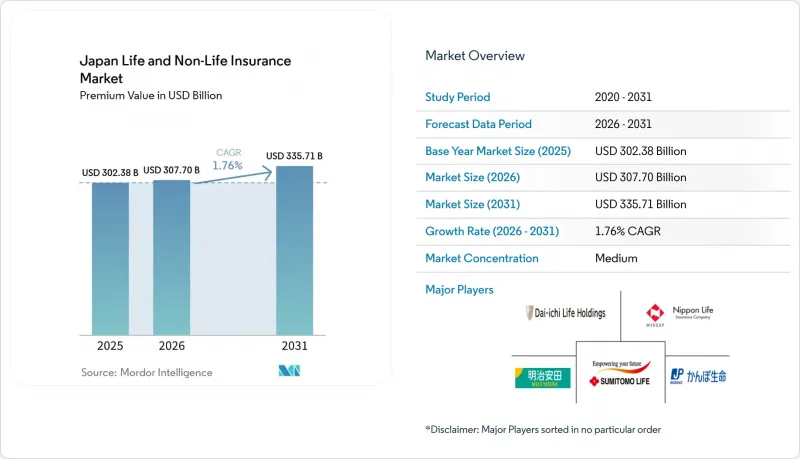
According to Mordor Intelligence, the japan life and non-Life insurance market size in terms of premium value is expected to grow from USD 302.38 billion in 2025 to USD 307.70 billion in 2026 and is forecast to reach USD 335.71 billion by 2031 at 1.76% CAGR over 2026-2031.
This report is Segmented by Insurance Type (Life Insurance, Non-Life Insurance (Motor Insurance, Health Insurance, Property Insurance, Liability Insurance, Other Insurance)), Customer Segment (Retail, Corporate), Distribution Channel (Brokers/Agents, Banks, Direct Sales, Other Channels), and Geography (National). The Market Forecasts are Provided in Terms of Value (USD).
Japan Life and Non-Life Insurance Market Trends and Insights
Super-Aged Population and Increasing Longevity Raising Demand for Life, Medical, Nursing Care, and Annuity Products
Japan is already a super-aged society, and the share of older adults is rising, which supports steady demand for life, medical, nursing care, and annuity offerings. The Cabinet Office projects the elderly share will continue to increase, which shifts household financial planning toward income longevity, health-related contingencies, and care needs that last decades. This demographic structure widens the gap between desired retirement income and public benefits, which heightens the role of private annuities and long-duration protection in the Japan life and non-life insurance market. The number of individual annuity policies in force and the amount in force increased in fiscal 2024, signalling renewed household preference for guaranteed income products as interest rates normalize. Household interest in product features that adjust income upon major health events remains strong, and many consumers indicate openness to annuities and critical illness coverage that link benefits to health status, which aligns product design with the realities of longer lives. Aging also raises the need for wellness and prevention services that help extend healthy life expectancy, which encourages insurers to combine protection with health engagement tools in the Japan life and non-life insurance market.
High Exposure to Earthquakes, Typhoons, And Floods Sustaining Demand for Property and Catastrophe Coverage
Japan's location along the Pacific Ring of Fire drives constant attention to earthquakes and related perils, and the government-backed household earthquake scheme continues to underpin resilience in the property line. Penetration of household earthquake coverage attached to fire policies is high, and the government's pooling mechanism limits private sector burdens at defined layers, which stabilizes underwriting outcomes in severe events. Historical payouts for major earthquakes and recent regional events highlight the concentration of risk and the importance of robust catastrophe modelling and reinsurance for both household and commercial exposures in the Japan life and non-life insurance market. Urban flood risk adds another layer of exposure, and updated analysis of low-lying wards in the Tokyo metropolitan area has reinforced the need for granular hazard mapping and preventive measures that reduce loss severity. Supervisory scenario analysis led by the FSA and industry groups has found increasing acute physical risks as climate change progresses, which keeps capital management and risk transfer central to non-life strategies in the Japan life and non-life insurance market. These risk dynamics push carriers to refine pricing, adopt parametric features, and maintain diversified reinsurance programs to protect balance sheets against clustered events.
Shrinking and Aging Overall Population Reducing the Long-Term Pool of Policyholders
A declining birthrate and rising longevity reshape the future pool of policyholders and reduce the pace of volume expansion, especially in regions with advanced depopulation. The elderly share of the population is set to climb further through the 2030s and 2040s, which increases per-capita protection and care needs while narrowing the base of working-age premium payers. Urban centres maintain relatively stable demand due to the concentration of households and corporate assets, yet rural prefectures face a smaller and older policyholder mix that challenges renewal momentum and distribution economics in the Japan life and non-life insurance market. Carriers are responding by reallocating capital to product lines aligned with longevity and health needs while broadening international exposure to diversify revenue sources and balance demographic headwinds at home. Balance sheet tools such as asset-intensive reinsurance are also in use to reshape liability profiles for in-force blocks, which helps manage risks associated with guarantees and longevity. Over the long term, refined underwriting, regionalized distribution, and product personalization will be needed to defend persistency rates in an aging and shrinking population base in the Japan life and non-life insurance market.
Other drivers and restraints analyzed in the detailed report include:
- Strong FSA Risk-Based Supervision and Solvency Monitoring Supporting Confidence and Stability
- Product Diversification into Flexible Protection, Health, and Retirement Solutions Tailored to Demographic Change
- Persistently Low Interest Rates Compressing Investment Returns and Profitability on Insurers' Portfolios
For complete list of drivers and restraints, kindly check the Table Of Contents.
Segment Analysis
Non-life insurance held a 64.34% share in the Japanese life and non-life insurance market in 2025, driven by demand for catastrophe, property, and liability risk coverage. The public-private household earthquake insurance system, integrated with fire policies, limits private sector financial burdens, enhancing resilience and underwriting capacity. While non-life dominates, life insurance is projected to grow at a 2.65% CAGR through 2031, fueled by the renewed appeal of savings-type products due to normalized policy rates and improved yen asset yields. Insurers now align returns with assumed rates, and a leading life carrier raised assumed return rates for lump-sum whole life in 2025, boosting product appeal. Fiscal 2024 saw increased individual annuity new business, with balanced demand for fixed and variable annuities reflecting household preferences for income certainty and upside potential.
Catastrophic risks shape non-life insurance strategies, influencing capital allocation, risk transfer, and product innovation. Health and medical benefits in life and supplemental lines address out-of-pocket costs unmet by Japan's universal health system, with products expanding to include wellness and preventive care features that improve claims experience and add value for policyholders. The evolving solvency regime drives insurers to refine pricing for blocks with embedded guarantees and explore asset-intensive reinsurance for legacy liabilities, as seen in a significant 2024 longevity transaction for an in-force annuity block. Yield-sensitive demand in life products and catastrophe exposure in non-life provide clear growth drivers for Japan's insurance market.
Complete Report Scope:
- By Insurance Type
- Life Insurance
- Non-Life Insurance
- Motor Insurance
- Health Insurance
- Property Insurance
- Liability Insurance
- Other Insurance
- By Customer Segment
- Retail
- Corporate
- By Distribution Channel
- Brokers/Agents
- Banks
- Direct Sales
- Other Channels
List of Companies Covered in this Report:
- Nippon Life Group
- Dai-ichi Life Group
- Meiji Yasuda Life Group
- Sumitomo Life Group
- Japan Post Insurance Group (Kampo)
- Tokio Marine Group
- MS&AD Insurance Group (Mitsui Sumitomo / Aioi Nissay Dowa)
- Sompo Holdings
- Sony Life Group
- Fukoku Mutual Life Group
- Asahi Mutual Life Group
- Daido Life Group
- Taiyo Life Group
- Nisshin Fire & Marine Group
- Kyoei Fire & Marine Group
- Rakuten Insurance Group
- SBI Insurance Group
- Mitsui Direct Insurance Group
- Aflac Japan (dominant foreign life/health insurer)
Additional Benefits:
- The market estimate (ME) sheet in Excel format
- 3 months of analyst support
TABLE OF CONTENTS
1 Introduction
- 1.1 Study Assumptions & Market Definition
- 1.2 Scope of the Study
2 Research Methodology
3 Executive Summary
4 Market Landscape
- 4.1 Market Overview
- 4.2 Market Drivers
- 4.2.1 Super-aged population and increasing longevity raising demand for life, medical, nursing-care and annuity products.
- 4.2.2 Growing retirement and long-term care needs beyond public pension and health systems.
- 4.2.3 High insurance penetration and strong role of life insurance in household financial planning.
- 4.2.4 High exposure to earthquakes, typhoons and floods sustaining demand for property and catastrophe coverage.
- 4.2.5 Strong FSA risk-based supervision and solvency monitoring supporting confidence and stability.
- 4.2.6 Product diversification into flexible protection, health and retirement solutions tailored to demographic change.
- 4.3 Market Restraints
- 4.3.1 Shrinking and aging overall population reducing the long-term pool of policyholders.
- 4.3.2 Persistently low interest rates compressing investment returns and profitability on insurers' portfolios.
- 4.3.3 Very competitive market with many players and stagnant/declining volumes in several lines.
- 4.3.4 Expected medium- to long-term shrinkage of automobile insurance due to technology and demographic change.
- 4.4 Macroeconomic & Industry Indicators Impacting the Market
- 4.5 Technology Analysis
- 4.6 Industry Value Chain Analysis
- 4.7 Porter's Five Forces Analysis
- 4.7.1 Threat of New Entrants
- 4.7.2 Bargaining Power of Suppliers
- 4.7.3 Bargaining Power of Buyers
- 4.7.4 Threat of Substitutes
- 4.7.5 Competitive Rivalry
5 Market Size & Growth Forecasts (Value)
- 5.1 By Insurance Type
- 5.1.1 Life Insurance
- 5.1.2 Non-Life Insurance
- 5.1.2.1 Motor Insurance
- 5.1.2.2 Health Insurance
- 5.1.2.3 Property Insurance
- 5.1.2.4 Liability Insurance
- 5.1.2.5 Other Insurance
- 5.1.3 By Customer Segment
- 5.1.3.1 Retail
- 5.1.3.2 Corporate
- 5.1.4 By Distribution Channel
- 5.1.4.1 Brokers/Agents
- 5.1.4.2 Banks
- 5.1.4.3 Direct Sales
- 5.1.4.4 Other Channels
6 Competitive Landscape
- 6.1 Market Concentration
- 6.2 Strategic Moves
- 6.3 Market Share Analysis
- 6.4 Company Profiles (includes Global level Overview, Market level overview, Core Segments, Financials as available, Strategic Information, Market Rank/Share for key companies, Products & Services, and Recent Developments)
- 6.4.1 Nippon Life Group
- 6.4.2 Dai-ichi Life Group
- 6.4.3 Meiji Yasuda Life Group
- 6.4.4 Sumitomo Life Group
- 6.4.5 Japan Post Insurance Group (Kampo)
- 6.4.6 Tokio Marine Group
- 6.4.7 MS&AD Insurance Group (Mitsui Sumitomo / Aioi Nissay Dowa)
- 6.4.8 Sompo Holdings
- 6.4.9 Sony Life Group
- 6.4.10 Fukoku Mutual Life Group
- 6.4.11 Asahi Mutual Life Group
- 6.4.12 Daido Life Group
- 6.4.13 Taiyo Life Group
- 6.4.14 Nisshin Fire & Marine Group
- 6.4.15 Kyoei Fire & Marine Group
- 6.4.16 Rakuten Insurance Group
- 6.4.17 SBI Insurance Group
- 6.4.18 Mitsui Direct Insurance Group
- 6.4.19 Aflac Japan (dominant foreign life/health insurer)
7 Market Opportunities & Future Outlook

