PUBLISHER: Mordor Intelligence | PRODUCT CODE: 2073403

PUBLISHER: Mordor Intelligence | PRODUCT CODE: 2073403
Indonesia Life and Non-Life Insurance - Market Share Analysis, Industry Trends & Statistics, Growth Forecasts (2026 - 2031)
According to Mordor Intelligence, the indonesia life and non-Life insurance market size in terms of premium value was valued at USD 27.96 billion in 2025 and is estimated to grow from USD 30.14 billion in 2026 to reach USD 43.88 billion by 2031, at a CAGR of 7.80% during the forecast period (2026-2031).
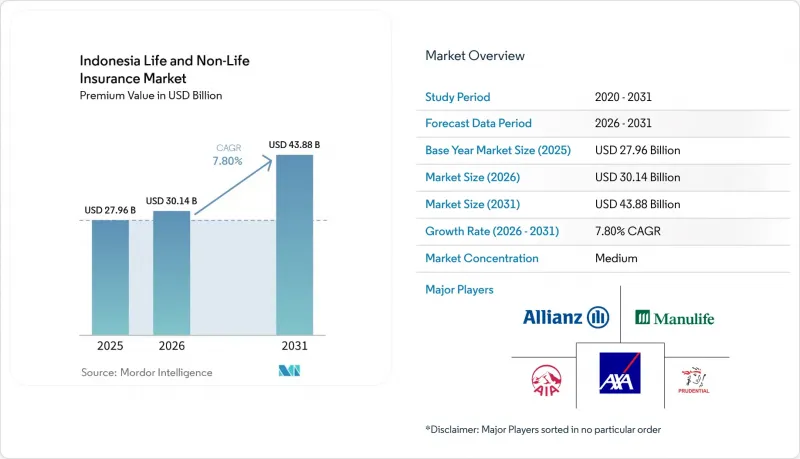
This report is Segmented by Insurance Type (Life Insurance, Non-Life Insurance (Motor Insurance, Health Insurance, Property Insurance, Liability Insurance, Other Insurance)), Customer Segment (Retail, Corporate), and Distribution Channel (Brokers/Agents, Banks, Direct Sales, Other Channels). The Market Forecasts are Provided in Terms of Value (USD Billion).
Indonesia Life and Non-Life Insurance Market Trends and Insights
Digital Bancassurance Adoption Surging Post-OJK POJK No 38/2020
OJK's modernization of distribution rules enabled product sales and servicing through electronic systems under an approval regime that requires registration as an electronic system provider and robust IT risk management, catalyzing a structural shift toward digital bancassurance in 2026. Partnerships illustrate the scale of this shift, including Prudential's long-term bancassurance agreement with Bank Syariah Indonesia in late 2024, which opened access to a large syariah customer base for life and protection products in 2025. OJK's June 2025 launch of the Indonesia Insurance Agents Database and the Indonesia Insurance Policies Database strengthens agent identity verification and policy-level oversight, which reduces mis-selling and improves complaint handling as volumes rise across the Indonesian life and non-life insurance market. IFRS 17 adoption requires more granular digital reporting, which supports profitability analytics and product mix optimization for bancassurance-led portfolios in 2026. Together, these changes are reducing friction across sales and service while deepening bank-insurer integration in the Indonesian life and non-life insurance markets.
Mandatory BPJS Reforms Spurring Supplemental Health Policies
The transition to standardized inpatient benefits under KRIS eliminates class-based differentiation in public coverage, which is motivating employers to adopt supplemental policies to maintain benefit competitiveness in 2026. Policy deliberations on co-payment structures have focused on sustainability and consumer protection as the regulator coordinates timelines and operating standards for health cover in the private system. Health-related premiums rose sharply in late 2024, which reflected rising demand for supplemental cover that complements the public scheme and employee benefit strategies. The scale of Badan Penyelenggara Jaminan Sosial (BPJS) assets highlights the footprint of public programs and the opportunity for add-on coverage as households move up the income curve and employers refine health benefits. These dynamics expand the insured base and reinforce premium growth within the Indonesian life and non-life insurance market.
Low Insurance Literacy in Eastern Provinces
OJK and Statistics Indonesia are fielding the 2025 National Survey of Financial Literacy and Inclusion to update provincial indicators and guide targeted interventions where inclusion and literacy gaps persist. UNDP's inclusive insurance diagnostic highlights systemic gaps that expose households to unsuitable offerings and limit adoption in remote areas, which weakens the underlying demand for protection. A documented digital divide reduces the effectiveness of online education and enrolment, underscoring the need for omnichannel outreach and infrastructure improvements to lift take-up in outer regions. OJK's agent database and policy registry raise conduct standards and enhance traceability, supporting consumer safeguards as the Indonesian life and non-life insurance market extends into less familiar segments. Until literacy improves, adoption will face headwinds in selected provinces of the Indonesian life and non-life insurance market.
Other drivers and restraints analyzed in the detailed report include:
- Climate-Induced Catastrophe Risk Elevating Property Cover Demand
- Syariah Finance Boom Catalyzing Takaful Product Uptake Outside Java
- IDR Volatility Complicating ALM & Capital Buffers
For complete list of drivers and restraints, kindly check the Table Of Contents.
Segment Analysis
Life insurance held 70% in 2025, anchoring the Indonesian life and non-life insurance market with traditional protection products regaining ground under tighter conduct and disclosure standards for investment-linked business. A late-2024 rebound in bank-led unit-linked flows showed that revised governance can coexist with healthier demand, especially when partners strengthen advice journeys and disclosure quality. Elevated solvency buffers reported by OJK in 2025 support pricing and product redesign as IFRS 17 improves attribution of profit and risk across portfolios. Property, motor, and credit lines maintained relevance on the general side as enterprises recalibrate risk-transfer needs following repeated extreme events and higher awareness of asset exposures. This remix of protection and investment features is improving product resilience within the Indonesian life and non-life insurance market as 2026 unfolds.
Non-life is projected to be the fastest-growing segment, with a 11% CAGR from 2026 to 2031, as climate risk, health add-ons, and corporate risk-transfer needs lift demand beyond traditional motor lines. Property remains central in 2026, given hazard profiles and the growing awareness of risk financing in corporate and SME segments, backed by state disaster programs that complement private cover. Employers are increasing supplemental health protection after KRIS standardization, which raises the relevance of A&H within general books alongside accident and employer-focused offerings. IFRS 17 continues to refine pricing and reserve calibration across life and non-life, which should support steadier margins as insurers expand beyond legacy lines in the Indonesian life and non-life insurance market. These changes are guiding more data-driven underwriting and capital allocation across the Indonesian life and non-life insurance industry in 2026.
Complete Report Scope:
- By Insurance Type
- Life Insurance
- Non-Life Insurance
- Motor Insurance
- Health Insurance
- Property Insurance
- Liability Insurance
- Other Insurance
- By Customer Segment
- Retail
- Corporate
- By Distribution Channel
- Brokers/Agents
- Banks
- Direct Sales
- Other Channels
List of Companies Covered in this Report:
- PT Prudential Life Assurance
- PT AIA Financial
- PT Manulife Indonesia
- PT Allianz Life Indonesia
- PT AXA Financial Indonesia
- PT Sun Life Financial Indonesia
- PT Great Eastern Life Indonesia
- PT BNI Life Insurance
- PT Sequis Life
- PT Asuransi Jiwasraya (Persero)
- PT Asuransi Astra Buana
- PT Asuransi Sinar Mas
- PT Zurich Insurance Indonesia
- PT Tokio Marine Indonesia
- PT Adira Dinamika Insurance
- PT Sompo Insurance Indonesia
- PT Chubb General Insurance Indonesia
- PT Asuransi Jasindo (Persero)
- PT KB Insurance Indonesia
- PT AXA Mandiri General Insurance
- PT Asuransi Central Asia
- PT Tugu Pratama Indonesia
- PT Asuransi Kredit Indonesia (Askrindo)
Additional Benefits:
- The market estimate (ME) sheet in Excel format
- 3 months of analyst support
TABLE OF CONTENTS
1 Introduction
- 1.1 Study Assumptions & Market Definition
- 1.2 Scope of the Study
2 Research Methodology
3 Executive Summary
4 Market Landscape
- 4.1 Market Overview
- 4.2 Market Drivers
- 4.2.1 Digital Bancassurance Adoption Surging Post-OJK POJK No 38/2020
- 4.2.2 Mandatory BPJS Reforms Spurring Supplemental Health Policies
- 4.2.3 Climate-Induced Catastrophe Risk Elevating Property Cover Demand
- 4.2.4 Syariah Finance Boom Catalyzing Takaful Product Uptake Outside Java
- 4.2.5 PAYDI (Investment-Linked) Regulation Unlocking Unit-Linked Growth
- 4.2.6 E-commerce & Ride-Hailing Micro-insurance Expanding Risk Pools
- 4.3 Market Restraints
- 4.3.1 Low Insurance Literacy in Eastern Provinces
- 4.3.2 POJK 14/2020 Solvency Hikes Pressuring Small Domestic Carriers
- 4.3.3 Motor Claims Fraud & Data-Quality Gaps Eroding Margins
- 4.3.4 IDR Volatility Complicating ALM & Capital Buffers
- 4.4 Value Chain Analysis
- 4.5 Regulatory Outlook
- 4.6 Technological Outlook
- 4.7 Porter's Five Forces
- 4.7.1 Threat of New Entrants
- 4.7.2 Bargaining Power of Buyers
- 4.7.3 Bargaining Power of Suppliers
- 4.7.4 Threat of Substitutes
- 4.7.5 Intensity of Competitive Rivalry
5 Market Size & Growth Forecasts (Value)
- 5.1 By Insurance Type
- 5.1.1 Life Insurance
- 5.1.2 Non-Life Insurance
- 5.1.2.1 Motor Insurance
- 5.1.2.2 Health Insurance
- 5.1.2.3 Property Insurance
- 5.1.2.4 Liability Insurance
- 5.1.2.5 Other Insurance
- 5.2 By Customer Segment
- 5.2.1 Retail
- 5.2.2 Corporate
- 5.3 By Distribution Channel
- 5.3.1 Brokers/Agents
- 5.3.2 Banks
- 5.3.3 Direct Sales
- 5.3.4 Other Channels
6 Competitive Landscape
- 6.1 Market Concentration
- 6.2 Strategic Moves
- 6.3 Market Share Analysis
- 6.4 Company Profiles (includes Global level Overview, Market level overview, Core Segments, Financials as available, Strategic Information, Market Rank/Share for key companies, Products & Services, and Recent Developments)
- 6.4.1 PT Prudential Life Assurance
- 6.4.2 PT AIA Financial
- 6.4.3 PT Manulife Indonesia
- 6.4.4 PT Allianz Life Indonesia
- 6.4.5 PT AXA Financial Indonesia
- 6.4.6 PT Sun Life Financial Indonesia
- 6.4.7 PT Great Eastern Life Indonesia
- 6.4.8 PT BNI Life Insurance
- 6.4.9 PT Sequis Life
- 6.4.10 PT Asuransi Jiwasraya (Persero)
- 6.4.11 PT Asuransi Astra Buana
- 6.4.12 PT Asuransi Sinar Mas
- 6.4.13 PT Zurich Insurance Indonesia
- 6.4.14 PT Tokio Marine Indonesia
- 6.4.15 PT Adira Dinamika Insurance
- 6.4.16 PT Sompo Insurance Indonesia
- 6.4.17 PT Chubb General Insurance Indonesia
- 6.4.18 PT Asuransi Jasindo (Persero)
- 6.4.19 PT KB Insurance Indonesia
- 6.4.20 PT AXA Mandiri General Insurance
- 6.4.21 PT Asuransi Central Asia
- 6.4.22 PT Tugu Pratama Indonesia
- 6.4.23 PT Asuransi Kredit Indonesia (Askrindo)
7 Market Opportunities & Future Outlook
- 7.1 White-space & Unmet-Need Assessment

