
PUBLISHER: Mordor Intelligence | PRODUCT CODE: 2072552

PUBLISHER: Mordor Intelligence | PRODUCT CODE: 2072552
Germany ICT - Market Share Analysis, Industry Trends & Statistics, Growth Forecasts (2026 - 2031)
According to Mordor Intelligence, the germany ICT market size was valued at USD 196.24 billion in 2025 and estimated to grow from USD 213.49 billion in 2026 to reach USD 325.29 billion by 2031, at a CAGR of 8.79% during the forecast period (2026-2031).
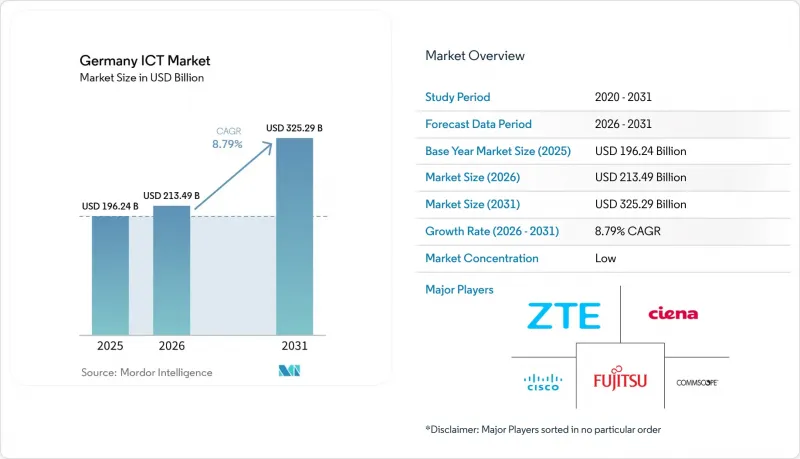
This report is Segmented by Type (Hardware, Software, IT Services), Enterprise Size (Small & Medium Enterprises, Large Enterprises), Industry Vertical (BFSI, IT & Telecom and More), Deployment Model (On-Premises, Public Cloud and More). The Market Forecasts are Provided in Terms of Value (USD).
Germany ICT Market Trends and Insights
Rapid Rise in Enterprise Digitalisation
Three out of four German companies had fully articulated digital strategies by 2024, a proportion that continues to climb as regulatory regimes such as the Digital Operational Resilience Act standardise technology risk management across industries. Manufacturing leaders including Siemens report productivity uplifts of nearly 70% after embedding digital-twin workflows in their Erlangen Lighthouse Factory. Financial institutions accelerate cloud and cybersecurity spending to comply with resilience mandates, while Mittelstand firms exploit sovereign cloud offerings like Open Telekom Cloud to achieve similar compliance without prohibitive capital outlays. The resulting demand spike for secure infrastructure, managed services and AI-enabled analytics underpins a structural uplift in the Germany ICT market.
5G Rollout & Private-Network Pilots
Nationwide 5G coverage surpassed 95% of households in 2024, with Deutsche Telekom at 97%, Vodafone at 92% and O2 at 96%. Private-network pilots in automotive and logistics hubs validate low-latency use-cases such as real-time robotic control and high-definition machine vision. Vodafone's partnership with Autobahn GmbH added 150 macro sites along the 13,200 km highway grid, enabling vehicle-to-infrastructure applications that cut traffic-management delays. Enterprise appetite for network slicing is translating into fresh service-revenue pools for telcos and systems integrators, propelling the Germany ICT market toward higher-value connectivity and IoT solutions.
Persistent Skills Shortage in Cybersecurity & AI
Vacancies for IT professionals reached 149,000 in 2024, and the labour-market gap could balloon to 780,000 by 2026, creating structural hiring bottlenecks. Cybersecurity talent is in particularly short supply: 70% of organisations reported measurable business impact from AI-enabled cyberattacks in 2024. Rising wage inflation forces SMEs to compromise on security postures or outsource critical functions, tempering the growth outlook of the Germany ICT market.
Other drivers and restraints analyzed in the detailed report include:
- Cloud-Native Migration of Mittelstand
- Gen-AI Investment Boom Post-GPT
- High Energy Prices for Data-Centre Operations
For complete list of drivers and restraints, kindly check the Table Of Contents.
Segment Analysis
IT services held the largest Germany ICT market share of 31.72% in 2025 thanks to integration projects required to weave legacy architectures into modern cloud environments. The software segment, however, is charting the fastest 8.92% CAGR as enterprises pivot toward off-the-shelf platforms that scale globally and embed AI out of the box. Software spending contributed USD 52 billion to the Germany ICT market size in 2025 and is slated to reach USD 86.84 billion by 2031, buoyed by SaaS ERP conversions and low-code development suites. Hardware revenue remains pressured by commoditised margins, though the EU Chips Act has unlocked local wafer-fab investments that may induce an up-cycle in semiconductor equipment demand from 2027 onward. Siemens' Xcelerator illustrates how software-centric portfolios can stretch across industrial domains, while telecom services capture incremental ARPU from 5G enterprise contracts. Together, these dynamics underline an enduring shift from bespoke services to repeatable, cloud-native software within the Germany ICT market.
Second-order effects are equally telling. ISVs inject embedded AI modules that compress decision-making time in plant operations, customer service and compliance monitoring. Systems integrators respond with packaged migration services to preserve relevance, while channel partners push outcome-based pricing. The result is a virtuous cycle: software penetration fuels recurring revenues, improves vendor gross margins and reinforces investment capacity, further accelerating the Germany ICT market expansion.
Large corporates continued to generate more than 60% of the Germany ICT market size in 2025, reflecting complex multi-year modernisation programmes and sizeable managed-service contracts. Yet SMEs now represent the growth frontier, with a projected 9.99% CAGR that exceeds the overall market by 120 basis points. This acceleration stems from cloud operating models that turn traditional CAPEX into scalable OPEX, freeing cash for AI pilots, e-commerce integrations and cybersecurity upgrades. Public-cloud hyperscalers deepen localisation measures-data-centre regions staffed by EU citizens and privacy-shielded support-to unlock the latent Mittelstand opportunity.
SME adoption patterns also drive ecosystem change. Domain-specific marketplaces deliver drop-in microservices, reducing the need for in-house developers and smoothing digital skill deficits. Financial institutions roll out embedded-finance APIs that simplify cross-border trade for manufacturing exporters, nudging fresh infrastructure spend. As SMEs climb the technology maturity curve, the Germany ICT market benefits from broadened demand diversity and resilience against sector-specific downturns.
Complete Report Scope:
- By Type
- Hardware
- Software
- IT Services
- Telecommunication Services
- By Enterprise Size
- Small and Medium Enterprises
- Large Enterprises
- By Industry Vertical
- BFSI
- IT and Telecom
- Government and Public Sector
- Retail and E-commerce
- Manufacturing
- Energy and Utilities
- Healthcare and Life-Sciences
- By Deployment Model
- On-Premise
- Public Cloud
- Private/Sovereign Cloud
- Hybrid Cloud
List of Companies Covered in this Report:
- Amazon Web Services, Inc.
- Alphabet Inc. (Google Cloud Germany)
- SAP SE
- Microsoft Deutschland GmbH
- Deutsche Telekom AG (T-Systems)
- Vodafone GmbH
- Telefonica Germany GmbH and Co. OHG
- 1and1 AG
- IBM Deutschland GmbH
- Oracle Deutschland B.V. and Co. KG
- Cisco Systems GmbH
- Fujitsu Technology Solutions GmbH
- Nokia Solutions and Networks GmbH
- Huawei Technologies Deutschland GmbH
- HPE Deutschland GmbH
- Atos Information Technology GmbH
- Capgemini Deutschland GmbH
- Accenture GmbH
- ZF Friedrichshafen AG (Digital Services)
- Siemens AG (Digital Industries)
Additional Benefits:
- The market estimate (ME) sheet in Excel format
- 3 months of analyst support
TABLE OF CONTENTS
1 INTRODUCTION
- 1.1 Market Definition and Scope
- 1.2 Study Assumptions
2 RESEARCH METHODOLOGY
3 EXECUTIVE SUMMARY
4 MARKET LANDSCAPE
- 4.1 Market Overview
- 4.2 Market Drivers
- 4.2.1 Rapid rise in enterprise digitalisation
- 4.2.2 5G rollout and private-network pilots
- 4.2.3 Cloud-native migration of Mittelstand
- 4.2.4 Gen-AI investment boom post-GPT
- 4.2.5 EU Chips Act-linked semiconductor CAPEX
- 4.2.6 Growth of sovereign-cloud and Gaia-X nodes
- 4.3 Market Restraints
- 4.3.1 Persistent skills shortage in cybersecurity and AI
- 4.3.2 High energy prices for data-center ops
- 4.3.3 Lagging FTTP coverage vs EU peers
- 4.3.4 Inflation-driven IT CAPEX deferrals by SMEs
- 4.4 Value / Supply-Chain Analysis
- 4.5 Regulatory Landscape
- 4.6 Technological Outlook
- 4.7 Porter's Five Forces Analysis
- 4.7.1 Bargaining Power of Buyers
- 4.7.2 Threat of New Entrants
- 4.7.3 Threat of Substitutes
- 4.7.4 Competitive Rivalry
5 MARKET SIZE AND GROWTH FORECASTS (VALUE)
- 5.1 By Type
- 5.1.1 Hardware
- 5.1.2 Software
- 5.1.3 IT Services
- 5.1.4 Telecommunication Services
- 5.2 By Enterprise Size
- 5.2.1 Small and Medium Enterprises
- 5.2.2 Large Enterprises
- 5.3 By Industry Vertical
- 5.3.1 BFSI
- 5.3.2 IT and Telecom
- 5.3.3 Government and Public Sector
- 5.3.4 Retail and E-commerce
- 5.3.5 Manufacturing
- 5.3.6 Energy and Utilities
- 5.3.7 Healthcare and Life-Sciences
- 5.4 By Deployment Model
- 5.4.1 On-Premise
- 5.4.2 Public Cloud
- 5.4.3 Private/Sovereign Cloud
- 5.4.4 Hybrid Cloud
6 COMPETITIVE LANDSCAPE
- 6.1 Market Concentration
- 6.2 Strategic Moves
- 6.3 Market Share Analysis
- 6.4 Company Profiles (includes Global level Overview, Market level overview, Core Segments, Financials as available, Strategic Information, Market Rank/Share for key companies, Products and Services, and Recent Developments)
- 6.4.1 Amazon Web Services, Inc.
- 6.4.2 Alphabet Inc. (Google Cloud Germany)
- 6.4.3 SAP SE
- 6.4.4 Microsoft Deutschland GmbH
- 6.4.5 Deutsche Telekom AG (T-Systems)
- 6.4.6 Vodafone GmbH
- 6.4.7 Telefonica Germany GmbH and Co. OHG
- 6.4.8 1and1 AG
- 6.4.9 IBM Deutschland GmbH
- 6.4.10 Oracle Deutschland B.V. and Co. KG
- 6.4.11 Cisco Systems GmbH
- 6.4.12 Fujitsu Technology Solutions GmbH
- 6.4.13 Nokia Solutions and Networks GmbH
- 6.4.14 Huawei Technologies Deutschland GmbH
- 6.4.15 HPE Deutschland GmbH
- 6.4.16 Atos Information Technology GmbH
- 6.4.17 Capgemini Deutschland GmbH
- 6.4.18 Accenture GmbH
- 6.4.19 ZF Friedrichshafen AG (Digital Services)
- 6.4.20 Siemens AG (Digital Industries)
7 MARKET OPPORTUNITIES AND FUTURE OUTLOOK
- 7.1 White-Space and Unmet-Need Assessment

