PUBLISHER: Mordor Intelligence | PRODUCT CODE: 2117339

PUBLISHER: Mordor Intelligence | PRODUCT CODE: 2117339
India Medical Tourism - Market Share Analysis, Industry Trends & Statistics, Growth Forecasts (2026 - 2031)
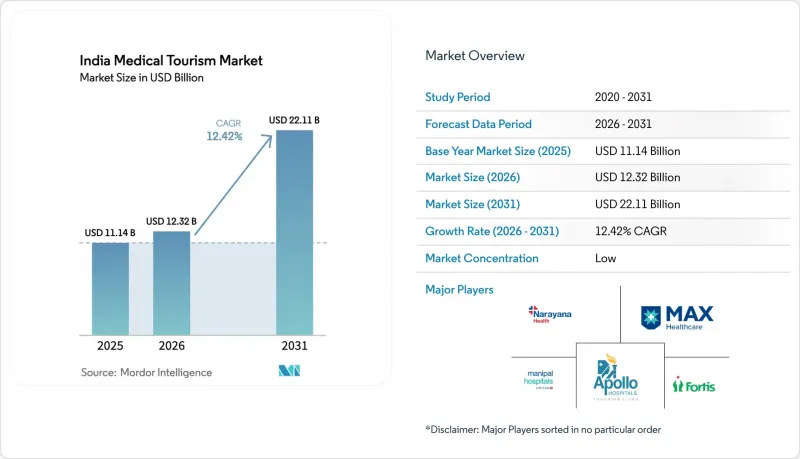
According to Mordor Intelligence, the India medical tourism market size is expected to increase from USD 11.14 billion in 2025 to USD 12.32 billion in 2026 and reach USD 22.11 billion by 2031, growing at a CAGR of 12.42% over 2026-2031.
This report is Segmented by Treatment Type (Dental, Cosmetic & Aesthetic, Cardiovascular, Orthopedic & Spine, Neurology & Neurosurgery, Oncology, Transplant, Fertility, Bariatric, and More), Service Provider (Public, and More), Patient Age (0-18 Years (Pediatrics), and More), Patient Gender (Male and More), and Indian Region (North India and More). Market Forecasts are Provided in Value (USD).
India Medical Tourism Market Trends and Insights
Cost Advantage Of Complex Surgeries Vs OECD Nations
India medical tourism market beneficiaries pay 60-80% less than OECD rates, with bypass grafts starting at USD 5,000 against USD 100,000 in the United States. Lower labor costs, high generic-drug penetration, and dense patient throughput sustain the edge. Growing African and Central Asian middle-income populations, now backed by international insurers, are choosing accredited Indian centers over pricier Southeast Asian hubs. This enduring pricing gap secures long-term volume inflows and positions the India medical tourism market for sustained double-digit expansion.
Expanding Network Of JCI/NABH-Accredited Hospitals
India hosts 57-61 JCI institutions and more than 4,650 NABH hospitals as of May 2025. While 100 facilities received NABH digital health certification by September 2024, accreditation boosts insurer confidence, validates telemedicine systems, and attracts facilitator referrals. Corporate chains spread audit costs across multi-site footprints, and tier-2 providers in Coimbatore, Visakhapatnam, and Jaipur seek the seal to stand apart from unaccredited rivals. The pipeline suggests over 2,000 NABH hospitals by 2028, deepening the India medical tourism market capacity.
Hygiene And Safety Perception Issues Post-COVID-19
Media reports of outbreaks in unaccredited facilities fueled Western skepticism. Accredited centers post infection rates below 2%, yet some tier-2 units record 8-10%. Hospitals now publish live dashboards, pursue ISO 9001 certification, and welcome third-party audits to rebuild trust. The restraint weighs on near-term Europe- and U.S.-origin flows but is expected to ease as data transparency improves within the India medical tourism market.
Other drivers and restraints analyzed in the detailed report include:
- 'Heal In India' Campaign & Streamlined E-Medical Visa
- Advanced Robotics & Transplant Technology Adoption
- Airport And Surface-Transport Bottlenecks
For complete list of drivers and restraints, kindly check the Table Of Contents.
Segment Analysis
Cardiovascular surgery contributed 22.46% revenue to the India medical tourism market in 2025, anchored by USD 5,000 bypass grafts that beat OECD prices by 70-80%. Oncology outpaces others with a 16.73% CAGR through 2031, led by proton therapy at Tata Memorial and Apollo's CAR-T cell platform. Orthopedic and spine work attracts aging Gulf patients, while neurosurgery draws tumors and epilepsy cases from Africa. Robotic kidney transplants, fertility services, bariatric procedures, and cosmetic surgery widen the clinical mix, balancing cyclical dips in any one specialty.
India medical tourism market size for oncology treatments is set to climb sharply as proton therapy slots rise and CAR-T becomes mainstream. Cardiac centers will keep core volume but face price compression from subsidy programs at government sites. Elective aesthetic care serves younger, social-media-savvy travelers and raises average margins. Segment diversity maintains overall resilience.
Private multi-specialty chains captured 66.22% of India medical tourism market revenue in 2025, supported by 200-plus tertiary sites, multilingual liaisons, and insurer links. Facilitator platforms are growing at 15.18% CAGR as Vaidam and peers bundle visas, cost quotes, and tele-follow-up into user-friendly packages. Public hospitals such as AIIMS Guwahati and NIMS Hyderabad offer subsidized robotics and transplant work, undercutting private rates by up to 50%.
Corporate groups rely on facilitators for low-cost distribution into Africa and Central Asia, creating symbiosis rather than rivalry. Single-specialty clinics target ophthalmology or fertility niches with shorter wait times and deeper expertise. The India medical tourism market size for facilitator services is likely to expand as cross-border patients with limited India familiarity value full-service logistics.
Complete Report Scope:
- By Treatment Type
- Dental Treatment
- Cosmetic & Aesthetic Procedures
- Cardiovascular Surgery
- Orthopedic & Spine Surgery
- Neurology & Neurosurgery
- Oncology Treatment
- Organ & Tissue Transplant
- Fertility & Reproductive Treatment
- Bariatric & Metabolic Surgery
- Ophthalmology Procedures
- Others
- By Service Provider
- Public Hospitals
- Private - Multi-Specialty Corporate Hospitals
- Private - Single-Specialty Hospitals & Clinics
- Medical Tourism Facilitators
- By Patient Age Group
- 0-18 Years (Pediatrics)
- 19-45 Years (Young Adults)
- 46-65 Years (Middle Age)
- 66+ Years (Geriatrics)
- By Patient Gender
- Male
- Female
- Other / Non-Binary
- By Indian Region
- North India
- West India
- South India
- East & Northeast India
- Central India
List of Companies Covered in this Report:
- ANAVARA
- Apollo Hospitals
- Artemis Hospital
- Aster DM Healthcare (India)
- BLK-Max Super Speciality Hospital
- Forerunners Healthcare
- Fortis Healthcare
- Gleneagles Global Hospitals
- KIMS Hospitals
- Manipal Hospitals
- Max Healthcare
- Medanta - The Medicity
- MediConnect India
- Mediniq
- Narayana Health
- Sri Ramachandra Medical Centre
- Tour2India4Health
- Vaidam
- Yashoda Hospitals
Additional Benefits:
- The market estimate (ME) sheet in Excel format
- 3 months of analyst support
TABLE OF CONTENTS
1 Introduction
- 1.1 Study Assumptions & Market Definition
- 1.2 Scope of the Study
2 Research Methodology
3 Executive Summary
4 Market Landscape
- 4.1 Market Overview
- 4.2 Market Drivers
- 4.2.1 Cost Advantage of Complex Surgeries Vs OECD Nations
- 4.2.2 Expanding Network Of JCI-/NABH-Accredited Hospitals
- 4.2.3 'Heal In India' Campaign & Streamlined E-Medical Visa
- 4.2.4 Advanced Robotics & Transplant Technology Adoption
- 4.2.5 Overseas Insurance Tie-Ups Enabling Cashless Treatment
- 4.2.6 Tele-Follow-Up Models Boosting Patient Confidence
- 4.3 Market Restraints
- 4.3.1 Hygiene & Safety Perception Issues Post-COVID-19
- 4.3.2 Airport & Surface-Transport Bottlenecks
- 4.3.3 Rupee Volatility Eroding Cost Edge
- 4.3.4 Bed-Capacity Squeeze in High-Demand Specialties
- 4.4 Value/Supply-Chain Analysis
- 4.5 Regulatory Landscape
- 4.6 Technological Outlook
- 4.7 Porter's Five Forces Analysis
- 4.7.1 Bargaining Power of Suppliers
- 4.7.2 Bargaining Power of Buyers
- 4.7.3 Threat of New Entrants
- 4.7.4 Threat of Substitutes
- 4.7.5 Intensity of Competitive Rivalry
5 Market Size & Growth Forecasts (Value in USD)
- 5.1 By Treatment Type
- 5.1.1 Dental Treatment
- 5.1.2 Cosmetic & Aesthetic Procedures
- 5.1.3 Cardiovascular Surgery
- 5.1.4 Orthopedic & Spine Surgery
- 5.1.5 Neurology & Neurosurgery
- 5.1.6 Oncology Treatment
- 5.1.7 Organ & Tissue Transplant
- 5.1.8 Fertility & Reproductive Treatment
- 5.1.9 Bariatric & Metabolic Surgery
- 5.1.10 Ophthalmology Procedures
- 5.1.11 Others
- 5.2 By Service Provider
- 5.2.1 Public Hospitals
- 5.2.2 Private - Multi-Specialty Corporate Hospitals
- 5.2.3 Private - Single-Specialty Hospitals & Clinics
- 5.2.4 Medical Tourism Facilitators
- 5.3 By Patient Age Group
- 5.3.1 0-18 Years (Pediatrics)
- 5.3.2 19-45 Years (Young Adults)
- 5.3.3 46-65 Years (Middle Age)
- 5.3.4 66+ Years (Geriatrics)
- 5.4 By Patient Gender
- 5.4.1 Male
- 5.4.2 Female
- 5.4.3 Other / Non-Binary
- 5.5 By Indian Region
- 5.5.1 North India
- 5.5.2 West India
- 5.5.3 South India
- 5.5.4 East & Northeast India
- 5.5.5 Central India
6 Competitive Landscape
- 6.1 Market Concentration
- 6.2 Market Share Analysis
- 6.3 Company Profiles (includes Global level Overview, Market level overview, Core Segments, Financials as available, Strategic Information, Market Rank/Share for key companies, Products and Services, and Recent Developments)
- 6.3.1 ANAVARA
- 6.3.2 Apollo Hospitals
- 6.3.3 Artemis Hospital
- 6.3.4 Aster DM Healthcare (India)
- 6.3.5 BLK-Max Super Speciality Hospital
- 6.3.6 Forerunners Healthcare
- 6.3.7 Fortis Healthcare
- 6.3.8 Gleneagles Global Hospitals
- 6.3.9 KIMS Hospitals
- 6.3.10 Manipal Hospitals
- 6.3.11 Max Healthcare
- 6.3.12 Medanta - The Medicity
- 6.3.13 MediConnect India
- 6.3.14 Mediniq
- 6.3.15 Narayana Health
- 6.3.16 Sri Ramachandra Medical Centre
- 6.3.17 Tour2India4Health
- 6.3.18 Vaidam
- 6.3.19 Yashoda Hospitals
7 Market Opportunities & Future Outlook
- 7.1 White-space & Unmet-Need Assessment

