PUBLISHER: Mordor Intelligence | PRODUCT CODE: 2117332

PUBLISHER: Mordor Intelligence | PRODUCT CODE: 2117332
Asia-Pacific Medical Tourism - Market Share Analysis, Industry Trends & Statistics, Growth Forecasts (2026 - 2031)
According to Mordor Intelligence, the Asia-Pacific medical tourism market size is estimated at USD 70.77 billion in 2026, and is expected to reach USD 145.66 billion by 2031, at a CAGR of 15.53% during the forecast period (2026-2031).
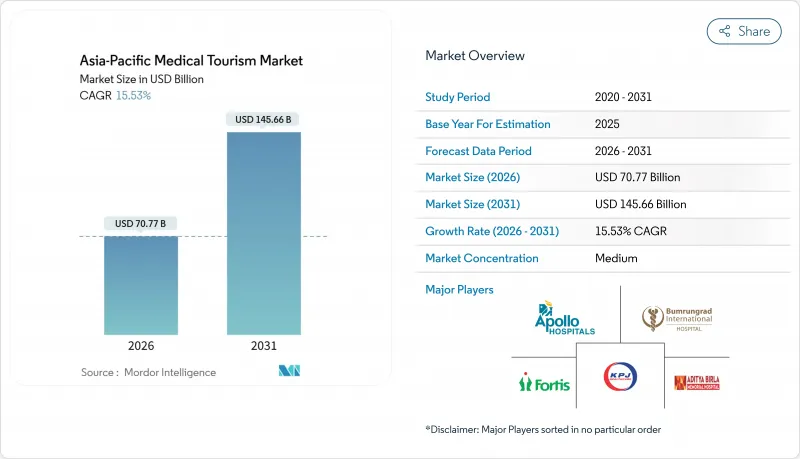
This report is Segmented by Treatment Type (Dental, Cosmetic & Aesthetic, Cardiovascular, Orthopedic, Neurological, Cancer, Fertility & Reproductive, and Other Treatments), Service Provider (Public Hospitals, Private Hospitals, and More), and Country (India, China, Japan, Vietnam, and More). The Market Forecasts are Provided in Terms of Value (USD).
Asia-Pacific Medical Tourism Market Trends and Insights
Cost Differential Versus OECD Countries
Elective procedures in Bangkok or Chennai cost 40%-80% less than in the United States, United Kingdom, or Australia. A knee replacement in Thailand averages USD 12,000 against USD 50,000 in the United States, and cosmetic rhinoplasty in Seoul runs USD 3,500 compared with USD 15,000 in Sydney. Lower physician salaries, subsidized medical-device production under India's Production Linked Incentive scheme, and cheaper real-estate underpin the advantage. Malaysia's "Year of Medical Tourism 2026" bundles treatment and hotel packages priced 60% below home-country rates for Gulf patients.
Rising Middle-Class Affluence & Insurance Portability
ASEAN added 50 million middle-income households between 2020 and 2024, lifting discretionary healthcare budgets. Cross-border insurance pilots now allow Thai citizens to obtain orthopedic or cardiac care in Malaysia with up to 70% reimbursement. Fertility tourism benefits most: Malaysia attracts Indonesian couples seeking halal-compliant IVF protocols, while Singapore draws Chinese and Indian patients for premium genetic screening.
Travel-Health Uncertainty & Pandemic After-Effects
Outbound travel from Japan and Australia recovered to only 70% of 2019 levels in 2024, reflecting lingering infection fears and higher insurance premiums. China's outbound trips stayed subdued at 300,000 because of visa lags and capital-control scrutiny. Booking lead times for Bangkok hospitals stretched to 12 weeks as patients requested multiple teleconsults before traveling.
Other drivers and restraints analyzed in the detailed report include:
- Government Visa & Promotion Schemes
- Proliferation of JCI-Accredited Hospitals
- Perceived Quality / Safety Variability
For complete list of drivers and restraints, kindly check the Table Of Contents.
Segment Analysis
Cosmetic and aesthetic procedures held 28.55% of the Asia-Pacific medical tourism market in 2025, underpinned by 705,044 dermatology patients in South Korea and Thailand's booming device market. In contrast, orthopedic surgery is projected to expand at an 18.25% CAGR, the highest among segments, driven by robotic joint replacements and long public wait times in Japan and Australia. The Asia-Pacific medical tourism market size for dental treatments is climbing on Thailand's USD 4.2 billion forecast by 2031, with travelers saving up to 70% on implants. Cardiovascular, oncology, fertility, and neurological procedures collectively broaden the regional case-mix as proton therapy and advanced IVF labs open across the region.
Technological parity with OECD centers is narrowing. Proton therapy availability in India and South Korea, together with AI-enabled diagnostic imaging, elevates clinical confidence among high-acuity patients. Meanwhile, bundled wellness add-ons, such as post-operative rehabilitation in Thai resorts or Ayurvedic recovery in Kerala, enhance perceived value. The Asia-Pacific medical tourism industry consequently attracts both cost-sensitive and outcome-driven travelers, balancing elective cosmetics with life-saving oncology and cardiac interventions.
Complete Report Scope:
- By Treatment Type
- Dental
- Cosmetic & Aesthetic
- Cardiovascular
- Orthopedic
- Neurological
- Oncology (Cancer)
- Fertility & Reproductive
- Other Treatments
- By Service Provider
- Public Hospitals
- Private Hospitals
- Specialty Clinics
- Ambulatory Surgical Centers
- By Country
- China
- Japan
- Australia
- India
- South Korea
- Vietnam
- Rest of Asia-Pacific
List of Companies Covered in this Report:
- Aditya Birla Memorial Hospital
- Apollo Hospitals
- Asian Heart Institute
- Bangkok Dusit Medical Services
- Bangkok Hospital
- Bumrungrad International Hospital
- Fortis Healthcare Ltd.
- Gleneagles Hospital Kuala Lumpur
- IHH Healthcare Berhad
- KPJ Healthcare Berhad
- LV Prasad Eye Institute
- Mount Elizabeth Hospital
- Penang Adventist Hospital
- Prince Court Medical Centre
- Raffles Medical Group
- Samitivej Sukhumvit Hospital
- Seoul Samsung Medical Center
- Sunway Medical Centre
- Yanhee Hospital
Additional Benefits:
- The market estimate (ME) sheet in Excel format
- 3 months of analyst support
TABLE OF CONTENTS
1 Introduction
- 1.1 Study Assumptions & Market Definition
- 1.2 Scope of the Study
2 Research Methodology
3 Executive Summary
4 Market Landscape
- 4.1 Market Overview
- 4.2 Market Drivers
- 4.2.1 Cost differential versus OECD countries
- 4.2.2 Rising middle-class affluence & insurance portability
- 4.2.3 Government visa & promotion schemes
- 4.2.4 Proliferation of JCI-accredited hospitals
- 4.2.5 Adoption of surgical robotics & advanced tech
- 4.2.6 ASEAN cross-border insurance frameworks
- 4.3 Market Restraints
- 4.3.1 Travel-health uncertainty & pandemic after-effects
- 4.3.2 Perceived quality / safety variability
- 4.3.3 Post-operative continuity-of-care gaps
- 4.3.4 Medical inflation eroding price advantage
- 4.4 Regulatory Landscape
- 4.5 Technological Outlook
- 4.6 Porter's Five Forces
- 4.6.1 Bargaining Power of Suppliers
- 4.6.2 Bargaining Power of Buyers
- 4.6.3 Threat of New Entrants
- 4.6.4 Threat of Substitutes
- 4.6.5 Intensity of Competitive Rivalry
5 Market Size & Growth Forecasts (Value, USD)
- 5.1 By Treatment Type
- 5.1.1 Dental
- 5.1.2 Cosmetic & Aesthetic
- 5.1.3 Cardiovascular
- 5.1.4 Orthopedic
- 5.1.5 Neurological
- 5.1.6 Oncology (Cancer)
- 5.1.7 Fertility & Reproductive
- 5.1.8 Other Treatments
- 5.2 By Service Provider
- 5.2.1 Public Hospitals
- 5.2.2 Private Hospitals
- 5.2.3 Specialty Clinics
- 5.2.4 Ambulatory Surgical Centers
- 5.3 By Country
- 5.3.1 China
- 5.3.2 Japan
- 5.3.3 Australia
- 5.3.4 India
- 5.3.5 South Korea
- 5.3.6 Vietnam
- 5.3.7 Rest of Asia-Pacific
6 Competitive Landscape
- 6.1 Market Concentration
- 6.2 Market Share Analysis
- 6.3 Company Profiles (includes Global level Overview, Market level overview, Core Segments, Financials as available, Strategic Information, Market Rank/Share for key companies, Products & Services, and Recent Developments)
- 6.3.1 Aditya Birla Memorial Hospital
- 6.3.2 Apollo Hospitals Enterprise Ltd.
- 6.3.3 Asian Heart Institute
- 6.3.4 Bangkok Dusit Medical Services
- 6.3.5 Bangkok Hospital
- 6.3.6 Bumrungrad International Hospital
- 6.3.7 Fortis Healthcare Ltd.
- 6.3.8 Gleneagles Hospital Kuala Lumpur
- 6.3.9 IHH Healthcare Berhad
- 6.3.10 KPJ Healthcare Berhad
- 6.3.11 LV Prasad Eye Institute
- 6.3.12 Mount Elizabeth Hospital
- 6.3.13 Penang Adventist Hospital
- 6.3.14 Prince Court Medical Centre
- 6.3.15 Raffles Medical Group
- 6.3.16 Samitivej Sukhumvit Hospital
- 6.3.17 Seoul Samsung Medical Center
- 6.3.18 Sunway Medical Centre
- 6.3.19 Yanhee Hospital
7 Market Opportunities & Future Outlook
- 7.1 White-space & Unmet-Need Assessment

