PUBLISHER: Mordor Intelligence | PRODUCT CODE: 2072781

PUBLISHER: Mordor Intelligence | PRODUCT CODE: 2072781
Japan Cartonboard - Market Share Analysis, Industry Trends & Statistics, Growth Forecasts (2026 - 2031)
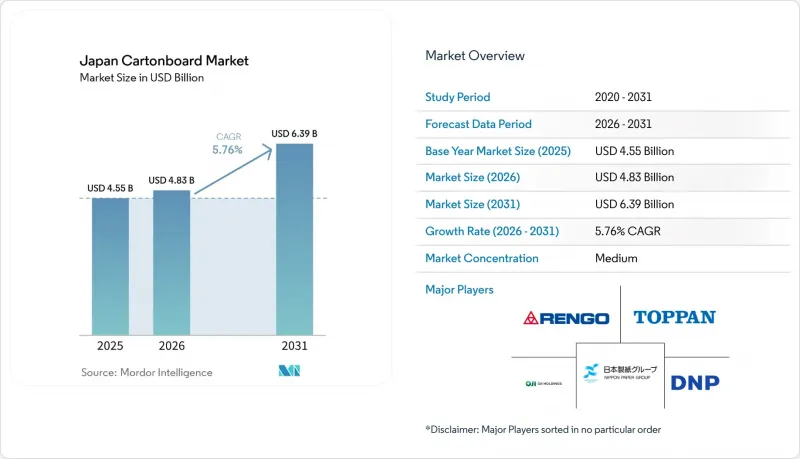
According to Mordor Intelligence, the japan cartonboard market size is projected to expand from USD 4.55 billion in 2025 and USD 4.83 billion in 2026 to USD 6.39 billion by 2031, registering a CAGR of 5.76% between 2026 to 2031.
This report is Segmented by Product Grade (Solid Bleached Board, Solid Unbleached Board, Folding Boxboard, White-Lined Chipboard, Liquid Packaging Board, Food Service Board), Packaging Format (Folding Cartons, Liquid Packaging, Sleeve and Tray, and More), End-User Industry (Food, Beverage, Pharmaceutical and Healthcare, Tobacco, and More). The Market Forecasts are Provided in Terms of Value (USD).
Japan Cartonboard Market Trends and Insights
Plastic-Reduction Regulation Shifting FMCG Packs To Board
Japan's packaging framework combines recycling obligations for paper packs with the Plastic Resource Circulation Act, and that policy mix is giving the Japan cartonboard market a stronger compliance-led demand base in 2026. The regulatory effect is stronger now because businesses using large packaging volumes face clearer reduction and reporting expectations than they did in the early phase of plastic-control policy. The demand pull also intensified when the 2026 naphtha supply disruption tightened plastic packaging availability and raised urgency around fiber substitution in Japanese retail channels. Retail actions such as the shift from plastic food-service lids and containers toward paper alternatives show that substitution is moving from policy intent into commercial execution across the Japan cartonboard market. Converters that can supply food-contact grades, verified recycling routes, and reliable fiber sourcing are therefore in the best position to capture near-term gains as compliance and supply risk start working in the same direction.
Food And Beverage Folding Carton Demand Resilience
Food and beverage remains the most dependable demand base in the Japan cartonboard market because daily replenishment cycles favor rigid packs that combine print quality, structural stability, and shelf visibility. Japan's dense convenience store network keeps carton demand active across ready meals, confectionery, and ready-to-drink products, especially in large metro areas where shelf turnover is high and retail response times are short. Premium food positioning is also helping revenue hold up better than volume, since higher-value packs carry better print requirements, stronger board specifications, and more finishing work per unit. Rengo's Paperboard and Paper Processing segment posted JPY 397,163 million in net sales, equivalent to USD 2.65 billion, in the first 3 quarters of FY2026, with 1.1% year-over-year growth, which shows that pricing and mix management remained effective in a cost-heavy environment. That pattern supports the Japan cartonboard market because food packs are not only a volume anchor, they are also a practical route for passing through higher input costs without losing relevance in essential consumer categories.
Virgin Pulp And Energy Cost Volatility
Virgin pulp and energy remain the most immediate cost risk in the Japan cartonboard market because many producers are exposed to imported fiber and volatile utility costs at the same time. That pressure became harder to manage in 2026 when the naphtha disruption raised the cost burden not only on plastics, but also on coatings and adhesives used in barrier board structures. The result is a margin squeeze that large integrated groups can absorb more easily than smaller converters, since the former have stronger procurement, broader product portfolios, and better internal pricing leverage. This uneven pressure is already supporting a more selective investment environment, where spending goes first to energy efficiency, process stability, and high-value grades rather than to broad-based capacity expansion in the Japan cartonboard market. Mid-tier operators are therefore under the greatest strain, because they face the same sustainability and upgrading demands as larger players without matching balance-sheet strength or sourcing flexibility.
Other drivers and restraints analyzed in the detailed report include:
- E-Commerce And Private-Label Short-Run Print Demand
- Premium Cosmetics And Health Products Need High-Graphics Cartons
- Flexible Pouch Substitution In Snacks And Convenience Formats
For complete list of drivers and restraints, kindly check the Table Of Contents.
Segment Analysis
Folding boxboard retained 38.13% of the Japan cartonboard market share in 2025, which kept it as the leading product grade across food, cosmetics, and pharmaceutical cartons. Its lead comes from the combination of brightness, print consistency, and converting reliability that brand owners need in primary cartons with tight quality tolerances. That position is especially important in the Japan cartonboard market because higher-value end uses are demanding more than basic stiffness, and they increasingly reward boards that combine appearance with functional performance. Solid bleached board also holds a firm place in premium and regulated applications, where food-contact confidence and surface quality remain more important than fiber-cost efficiency. Solid unbleached board stays relevant in beverage multipacks and quick-service formats, where structural strength matters more than a bright outer appearance.
White-lined chipboard is forecast to expand at a 7.26% CAGR through 2031, making it the fastest-growing product grade in the Japan cartonboard market. Its appeal comes from recycled-fiber content, fit with retail-ready packaging, and acceptable print performance for e-commerce and private-label applications that do not require the highest optical finish. Food service board is also gaining from the shift away from single-use plastics, and Oji's recycling work with quick-service restaurant partners shows how circular infrastructure can reinforce future board demand beyond the initial sale of the pack. Liquid packaging board is moving into a broader role as domestic players develop short-run paper beverage formats, and TOPPAN's Cartocan launch in May 2026 is an example of that push into customized fiber-based liquid packs. The Japan cartonboard industry is therefore seeing product-grade boundaries soften, because barrier coatings and customized structures are allowing grades once tied to narrow end uses to serve a wider set of retail and food-service needs.
Complete Report Scope:
- By Product Grade
- Solid Bleached Board
- Solid Unbleached Board
- Folding Boxboard
- White-Lined Chipboard
- Liquid Packaging Board
- Food Service Board
- By Packaging Format
- Folding Cartons
- Liquid Packaging
- Sleeve and Tray
- Other Packaging Formats (Cups, Foodservice Containers)
- By End-User Industry
- Food
- Beverage
- Pharmaceutical and Healthcare
- Tobacco
- Cosmetics and Toiletries
- Other End-User Industries (Toy, Apparel, Automotive, Household, Electrical, Foodservice)
List of Companies Covered in this Report:
- Rengo Co., Ltd.
- Oji Holdings Corporation
- Nippon Paper Industries Co., Ltd.
- TOPPAN Inc.
- Dai Nippon Printing Co., Ltd.
- Hokuetsu Corporation
- TOMOKU Co., Ltd.
- THE PACK CORPORATION
- Tokan Kogyo Co., Ltd.
- Kanae Co., Ltd.
- OSAKA SEALING PRINTING CO., LTD.
- Marubeni-FLX Co., Ltd.
- TAISEI Co., Ltd.
- ARC Corporation
- K-PAC Co., Ltd.
- Mitsu-bishi Co., Ltd.
- Graphic Packaging International, LLC
- Stora Enso Oyj
Additional Benefits:
- The market estimate (ME) sheet in Excel format
- 3 months of analyst support
TABLE OF CONTENTS
1 INTRODUCTION
- 1.1 Study Assumptions and Market Definition
- 1.2 Scope of the Study
2 RESEARCH METHODOLOGY
3 EXECUTIVE SUMMARY
4 MARKET LANDSCAPE
- 4.1 Market Overview
- 4.2 Impact of Macroeconomic Factors on the Market
- 4.3 Market Drivers
- 4.3.1 Plastic-Reduction Regulation Shifting FMCG Packs to Board
- 4.3.2 Food and Beverage Folding Carton Demand Resilience
- 4.3.3 E-Commerce and Private-Label Short-Run Print Demand
- 4.3.4 Premium Cosmetics and Health Products Need High-Graphics Cartons
- 4.3.5 Administrative Recycling of Liquid and Oil Paper Packs
- 4.3.6 Domestic Liquid Carton Localization and Barrier Paper Innovation
- 4.4 Market Restraints
- 4.4.1 Virgin Pulp and Energy Cost Volatility
- 4.4.2 Flexible Pouch Substitution in Snacks and Convenience Formats
- 4.4.3 Barrier and Repulpability Trade-Off in Grease and Liquid Uses
- 4.4.4 Shrinking Population Pressuring Discretionary Pack Volumes
- 4.5 Industry Value Chain Analysis
- 4.6 Regulatory Landscape
- 4.7 Technological Outlook
- 4.8 Porter's Five Forces Analysis
- 4.8.1 Bargaining Power of Buyers
- 4.8.2 Bargaining Power of Suppliers
- 4.8.3 Threat of New Entrants
- 4.8.4 Threat of Substitutes
- 4.8.5 Intensity of Competitive Rivalry
5 MARKET SIZE AND GROWTH FORECASTS (VALUE)
- 5.1 By Product Grade
- 5.1.1 Solid Bleached Board
- 5.1.2 Solid Unbleached Board
- 5.1.3 Folding Boxboard
- 5.1.4 White-Lined Chipboard
- 5.1.5 Liquid Packaging Board
- 5.1.6 Food Service Board
- 5.2 By Packaging Format
- 5.2.1 Folding Cartons
- 5.2.2 Liquid Packaging
- 5.2.3 Sleeve and Tray
- 5.2.4 Other Packaging Formats (Cups, Foodservice Containers)
- 5.3 By End-User Industry
- 5.3.1 Food
- 5.3.2 Beverage
- 5.3.3 Pharmaceutical and Healthcare
- 5.3.4 Tobacco
- 5.3.5 Cosmetics and Toiletries
- 5.3.6 Other End-User Industries (Toy, Apparel, Automotive, Household, Electrical, Foodservice)
6 COMPETITIVE LANDSCAPE
- 6.1 Market Concentration
- 6.2 Strategic Moves
- 6.3 Market Share Analysis
- 6.4 Company Profiles (includes Global Level Overview, Market Level Overview, Core Segments, Financials as available, Strategic Information, Market Rank/Share, Products and Services, Recent Developments)
- 6.4.1 Rengo Co., Ltd.
- 6.4.2 Oji Holdings Corporation
- 6.4.3 Nippon Paper Industries Co., Ltd.
- 6.4.4 TOPPAN Inc.
- 6.4.5 Dai Nippon Printing Co., Ltd.
- 6.4.6 Hokuetsu Corporation
- 6.4.7 TOMOKU Co., Ltd.
- 6.4.8 THE PACK CORPORATION
- 6.4.9 Tokan Kogyo Co., Ltd.
- 6.4.10 Kanae Co., Ltd.
- 6.4.11 OSAKA SEALING PRINTING CO., LTD.
- 6.4.12 Marubeni-FLX Co., Ltd.
- 6.4.13 TAISEI Co., Ltd.
- 6.4.14 ARC Corporation
- 6.4.15 K-PAC Co., Ltd.
- 6.4.16 Mitsu-bishi Co., Ltd.
- 6.4.17 Graphic Packaging International, LLC
- 6.4.18 Stora Enso Oyj
7 MARKET OPPORTUNITIES AND FUTURE OUTLOOK
- 7.1 White-Space and Unmet-Need Assessment

