PUBLISHER: Mordor Intelligence | PRODUCT CODE: 2072902

PUBLISHER: Mordor Intelligence | PRODUCT CODE: 2072902
Neem-Based Fertilizer - Market Share Analysis, Industry Trends & Statistics, Growth Forecasts (2026 - 2031)
According to Mordor Intelligence, the neem-based fertilizer market size was valued at USD 0.98 billion in 2025 and is projected to grow from USD 1.05 billion in 2026 to USD 1.66 billion by 2031, growing at a CAGR of 11.1% from 2026 to 2031.
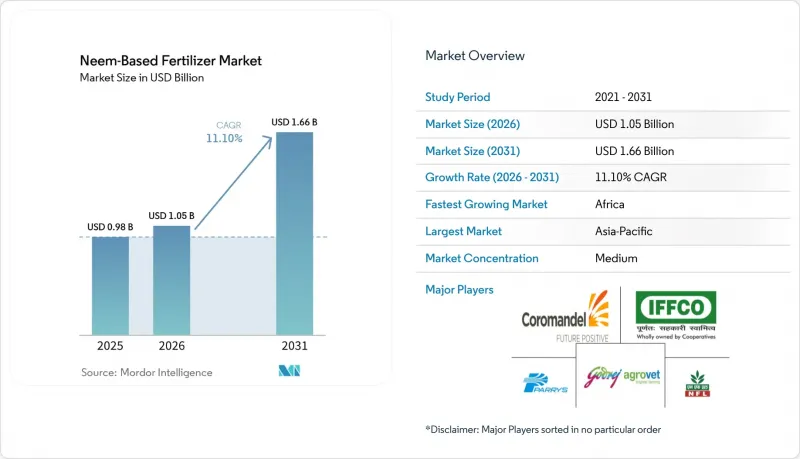
This report is Segmented by Formulation (Powder, Granular, and Liquid), by Crop Type (Cereals and Grains, Oilseeds and Pulses, and More), by Application Method (Soil Application, Foliar Spray, and More), by Distribution Channel (Direct -To-Farmer and Retail/Dealer Network), and by Geography (North America, South America, Europe, and More). The Market Forecasts are Provided in Terms of Value (USD).
Global Neem-Based Fertilizer Market Trends and Insights
Government Mandate on Neem-Coated Urea for Subsidized Nitrogen Fertilizers
India's emphasis on promoting neem-coated urea is driving demand for neem-derived agricultural inputs used in fertilizer production. According to the Press Information Bureau (PIB) of the Government of India, neem-coated urea enhances nitrogen-use efficiency by slowing the release of nitrogen in the soil. This allows farmers to achieve similar results while using approximately 10% less urea compared to conventional formulations. The policy mandating neem coating on subsidized urea remains active, sustaining significant consumption of neem-based coating materials within the fertilizer industry. As manufacturers continue producing neem-coated urea to meet agricultural needs, the demand for neem-derived inputs, including neem oil and azadirachtin, is expected to remain robust, supporting growth in the neem-based fertilizer market.
Growing Demand for Organic Crop Protection in High-Value Horticulture
Fruit and vegetable growers seeking premium export prices adopt neem inputs that comply with the United States Department of Agriculture National Organic Program and the European Union organic regulation. Biological fertilizers provide both nutrient delivery and secondary pest suppression, reducing the need for separate insecticide applications. UPL Limited launched the seaweed-based HYCOXA in 2025, signaling intensified competition within premium biological niches. Price premiums offset higher per-hectare input costs, especially for grapes, tomatoes, and peppers. Wider acceptance in protected agriculture strengthens year-round demand consistency.
Volatile Supply of Azadirachtin Feedstock Due to Climate-Sensitive Neem Yields
The growth of the neem-based fertilizer market is limited by the inconsistent availability of neem seeds, which are the primary source of azadirachtin used in neem-based agricultural products. The flowering and fruiting of neem trees are heavily influenced by seasonal rainfall and climatic conditions, making the feedstock supply susceptible to droughts, irregular monsoons, and extreme weather events. Variations in seed availability can disrupt raw material procurement, raise extraction and processing costs, and pose challenges in ensuring consistent product quality. These supply uncertainties hinder production scalability and profitability, restricting the overall expansion of the neem-based fertilizer market.
Other drivers and restraints analyzed in the detailed report include:
- Rising Restrictions on Synthetic Nitrification Inhibitors in Europe
- Increasing Smallholder Adoption via Micro-Dosing Programs in Africa
- Limited Agronomic Extension Support Outside South Asia
For complete list of drivers and restraints, kindly check the Table Of Contents.
Segment Analysis
Granular products commanded the largest 46% share of the neem-based fertilizer market in 2025 because farmers can apply them with existing broadcast spreaders and seed drills. The format stores well in humid monsoon zones and faces minimal caking risk during warehouse storage. Granular sales remain strong in rice, wheat, and maize systems that dominate Asian and African acreage. Coating technology innovations improve granule integrity, limiting azadirachtin loss during handling. Established dealer networks keep granular shelves stocked in rural outlets, reinforcing farmer familiarity.
Liquid formulations are advancing at the fastest 13.0% CAGR through 2031 as drip irrigation widens across protected horticulture and water-scarce regions. Liquids integrate seamlessly with automated nutrient injection, allowing precise split applications that match crop nitrogen uptake curves. Growers of tomatoes, cucumbers, and bell peppers value the lower labor requirement compared with manual broadcasting. Manufacturers invest in emulsification techniques that stabilize azadirachtin in concentrate form, extending shelf life. Rising fertigation infrastructure investment in the Middle East and Southern Europe further expands the addressable base for liquid products.
Cereals and grains retained the largest 40% of the neem-based fertilizer market size in 2025, as India's mandatory policy targets urea, a cereal input staple. Broadcast application during rice puddling and wheat top-dressing offers straightforward integration. Government procurement programs channel coated urea to public distribution outlets, ensuring consistent offtake. Yield response data collected over a decade reinforces farmer confidence, sustaining repeat purchase cycles. The segment will keep adding absolute volume even as its proportional share tilts downward.
Fruits and vegetables represent the fastest-expanding segment, with a 11.5% CAGR during 2026-2031, as organic-certified production grows for export consumers. Protected cultivation requires tight nutrient management, and neem inputs double as mild pest suppressants, reducing chemical residue risk. Price premiums on grapes, berries, and leafy greens justify higher per-hectare spending on biological fertilizers. Traceability programs that record neem usage help growers access blockchain-verified supply chains. Rising adoption in South American avocado and Asian mango orchards further accelerates demand.
Complete Report Scope:
- By Formulation
- Powder
- Granular
- Liquid
- By Crop Type
- Cereals and Grains
- Oilseeds and Pulses
- Fruits and Vegetables
- Other Crops
- By Application Method
- Soil Application
- Foliar Spray
- Fertigation
- Seed Treatment
- By Distribution Channel
- Direct-To-Farmer
- Retail/Dealer Network
- By Geography
- North America
- United States
- Canada
- Mexico
- Rest of North America
- South America
- Brazil
- Argentina
- Rest of South America
- Europe
- Germany
- France
- United Kingdom
- Italy
- Spain
- Russia
- Rest of Europe
- Asia-Pacific
- China
- India
- Japan
- Australia
- South Korea
- Rest of Asia-Pacific
- Middle East
- Saudi Arabia
- United Arab Emirates
- Rest of Middle East
- Africa
- South Africa
- Nigeria
- Rest of Africa
- North America
Geography Analysis
Asia-Pacific is the largest geography, accounting for 45.3% of the neem-based fertilizer market share in 2025, driven by India's full urea-coating mandate, which locks in annual demand for 25 million metric tons of production. China's push for organic certification in greenhouse vegetables and fruit orchards adds incremental offtake. Japan and South Korea, although smaller, command premium pricing on residue-conscious supermarket channels. ICL Group's 2026 specialty fertilizer plant in Maharashtra underpins the regional supply of water-soluble neem blends. Ongoing subsidies for micro-irrigation in India stimulate the uptake of liquid formulations.
Africa posts the fastest 12.6% CAGR forecast for 2026-2031 as donor-sponsored micro-dosing programs scale from pilot to national coverage in Kenya, Tanzania, and Nigeria. Local neem seed collection initiatives expand raw-material supply and create rural employment. Commercial estates in South Africa adopt neem inputs in citrus and grape orchards to secure European import clearances. North African growers adopt controlled-release products to manage salinity stress under deficit irrigation. Mobile-money ecosystems ease last-mile payment frictions, unlocking demand in remote villages.
Europe and North America grow steadily on the back of organic produce premiums and regulatory limits on synthetic inhibitors. The European Union Fertilizing Products Regulation provides a harmonized route to market, lowering administrative hurdles for Indian and Israeli suppliers. Denmark, the Netherlands, and Germany showcase national nutrient-loss reduction targets that nudge adoption in conventional cereal farms. United States organic acreage in California and Florida absorbs liquid neem concentrates for high-value berries and leafy greens. Canada's greenhouse vegetable cluster increasingly uses neem liquids in fertigation to meet supermarket residue specifications.
- Coromandel International Limited
- Indian Farmers Fertiliser Cooperative Limited
- National Fertilizers Limited
- E.I.D. Parry (India) Limited
- Godrej Agrovet Limited
- UPL Limited
- ICL Group Ltd
- Krishak Bharati Cooperative Limited
- NACL Industries Ltd
- NutriAg Group
- Valent Biosciences LLC
- Haifa Group
- Fortune Biotech Ltd
- Ozone Biotech
- PJ Margo Pvt Ltd
Additional Benefits:
- The market estimate (ME) sheet in Excel format
- 3 months of analyst support
TABLE OF CONTENTS
1 Introduction
- 1.1 Study Assumptions and Market Definition
- 1.2 Scope of the Study
2 Research Methodology
3 Executive Summary
4 Market Landscape
- 4.1 Market Overview
- 4.2 Market Drivers
- 4.2.1 Government mandate on neem-coated urea for subsidized nitrogen fertilizers
- 4.2.2 Growing demand for organic crop protection in high-value horticulture
- 4.2.3 Rising restrictions on synthetic nitrification inhibitors in Europe
- 4.2.4 Increasing smallholder adoption via micro-dosing programs in Africa
- 4.2.5 Commercial roll-out of controlled-release neem nanocarriers
- 4.2.6 Blockchain-enabled provenance premiums for neem-fertilized produce
- 4.3 Market Restraints
- 4.3.1 Volatile supply of azadirachtin feedstock due to climate-sensitive neem yields
- 4.3.2 Limited agronomic extension support outside South Asia
- 4.3.3 Competing cost-effective bio-fertilizer blends with seaweed extracts
- 4.3.4 Slow registration timelines for biostimulants in South American countries
- 4.4 Regulatory Landscape
- 4.5 Technological Outlook
- 4.6 Porter's Five Forces Analysis
- 4.6.1 Threat of New Entrants
- 4.6.2 Bargaining Power of Suppliers
- 4.6.3 Bargaining Power of Buyers
- 4.6.4 Threat of Substitutes
- 4.6.5 Intensity of Competitive Rivalry
5 Market Size and Growth Forecasts (Value)
- 5.1 By Formulation
- 5.1.1 Powder
- 5.1.2 Granular
- 5.1.3 Liquid
- 5.2 By Crop Type
- 5.2.1 Cereals and Grains
- 5.2.2 Oilseeds and Pulses
- 5.2.3 Fruits and Vegetables
- 5.2.4 Other Crops
- 5.3 By Application Method
- 5.3.1 Soil Application
- 5.3.2 Foliar Spray
- 5.3.3 Fertigation
- 5.3.4 Seed Treatment
- 5.4 By Distribution Channel
- 5.4.1 Direct-To-Farmer
- 5.4.2 Retail/Dealer Network
- 5.5 By Geography
- 5.5.1 North America
- 5.5.1.1 United States
- 5.5.1.2 Canada
- 5.5.1.3 Mexico
- 5.5.1.4 Rest of North America
- 5.5.2 South America
- 5.5.2.1 Brazil
- 5.5.2.2 Argentina
- 5.5.2.3 Rest of South America
- 5.5.3 Europe
- 5.5.3.1 Germany
- 5.5.3.2 France
- 5.5.3.3 United Kingdom
- 5.5.3.4 Italy
- 5.5.3.5 Spain
- 5.5.3.6 Russia
- 5.5.3.7 Rest of Europe
- 5.5.4 Asia-Pacific
- 5.5.4.1 China
- 5.5.4.2 India
- 5.5.4.3 Japan
- 5.5.4.4 Australia
- 5.5.4.5 South Korea
- 5.5.4.6 Rest of Asia-Pacific
- 5.5.5 Middle East
- 5.5.5.1 Saudi Arabia
- 5.5.5.2 United Arab Emirates
- 5.5.5.3 Rest of Middle East
- 5.5.6 Africa
- 5.5.6.1 South Africa
- 5.5.6.2 Nigeria
- 5.5.6.3 Rest of Africa
- 5.5.1 North America
6 Competitive Landscape
- 6.1 Market Concentration
- 6.2 Strategic Moves
- 6.3 Market Share Analysis
- 6.4 Company Profiles (Includes Global Level Overview, Market Level Overview, Core Segments, Financials as Available, Strategic Information, Market Rank/Share for Key Companies, Products and Services, and Recent Developments)
- 6.4.1 Coromandel International Limited
- 6.4.2 Indian Farmers Fertiliser Cooperative Limited
- 6.4.3 National Fertilizers Limited
- 6.4.4 E.I.D. Parry (India) Limited
- 6.4.5 Godrej Agrovet Limited
- 6.4.6 UPL Limited
- 6.4.7 ICL Group Ltd
- 6.4.8 Krishak Bharati Cooperative Limited
- 6.4.9 NACL Industries Ltd
- 6.4.10 NutriAg Group
- 6.4.11 Valent Biosciences LLC
- 6.4.12 Haifa Group
- 6.4.13 Fortune Biotech Ltd
- 6.4.14 Ozone Biotech
- 6.4.15 PJ Margo Pvt Ltd
7 Market Opportunities and Future Outlook

