PUBLISHER: MarketsandMarkets | PRODUCT CODE: 2061157
PUBLISHER: MarketsandMarkets | PRODUCT CODE: 2061157
Biofertilizer Market by Type, Crop Type, Mode of Application, Form, Source, Region - Global Forecast to 2031
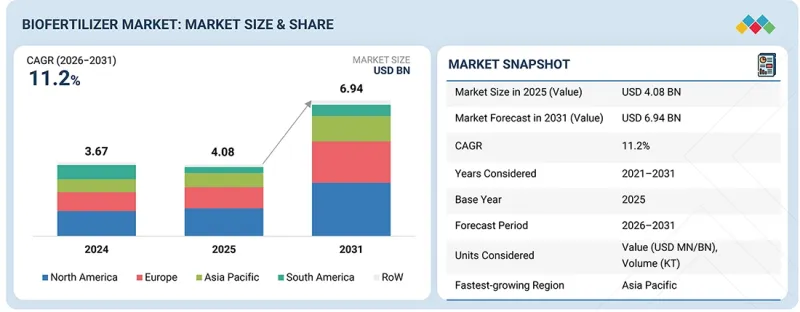
The biofertilizer market is projected to reach USD 6.94 million by 2031 from USD 4.08 million in 2026, at a CAGR of 11.2% from 2026 to 2031.
| Scope of the Report | |
|---|---|
| Years Considered for the Study | 2026-2031 |
| Base Year | 2025 |
| Forecast Period | 2026-2031 |
| Units Considered | Value (USD MN/BN) and Volume (KT) |
| Segments | By Type, Crop Type, Mode of Application, Form, Source, and Region |
| Regions covered | North America, Europe, Asia Pacific, South America, RoW |
The biofertilizers industry is expected to witness robust growth through 2031, driven by soaring global demand for bio-crop nutrition solutions, the mobilization of soil nutrients, and the pursuit of sustainability in agricultural practices. The industry is witnessing a rapid transition driven by rapid innovation and adoption of microbial biotech, precision agriculture, biological formulations, and other regenerative farming practices. Leading players such as Novonesis and UPL Limited are aligning to develop advanced microbial strains, multi-nutrient biofertilizer formulations, and tropical agricultural biosolutions. Some of the upcoming innovations include high-performance microbial consortia, liquid biological formulations, drought and salinity-tolerant microbes, and crop-specific nutrient mobilizers. Investments are being increased in biological research infrastructure, advanced fermentation technologies, and targeted delivery systems to meet the rising demand for organic food, nutrient use efficiency, integrated nutrient management, and carbon-neutral crop production practices. Growing awareness of soil health degradation, chemical fertilizer overuse, and climate sustainability is likely to continue boosting demand for global bio-crop nutrition solutions.
Opportunities and Disruptions in the Biofertilizer Market
The biofertilizer market shows strong growth potential for players in the agricultural biotechnology sector, including microbial solution providers, project developers, and innovators focused on sustainable farming technology. This trend is driven by increasing global demand for biologically based crop production and the growing adoption of regenerative agriculture. Opportunities for agricultural input vendors include creating integrated nutrient management systems that combine microbial inoculants, biostimulants, and precision application tools to boost crop yields while conserving resources. Market prospects are also favorable for microbial technology providers developing multi-purpose biological formulations for different crops, stress-resistant microbial strains, and advanced biological application systems that promote plant growth. The market landscape remains highly dynamic, influenced by the rapid spread of precision farming, stricter regulations on chemical fertilizers, rising demand for residue-free products, and a focus on climate-smart, resilient agriculture. The leading companies will be those that prioritize scientific validation of microbial products, demonstrate consistent performance in the field, and meet farmers' needs for sustainable and cost-effective crop production solutions.
AI-driven nutrient optimization: Artificial intelligence and machine learning are increasingly being adopted in the biofertilizer market to improve microbial formulation development, nutrient optimization, and precision farming practices. These technologies help analyze soil conditions, crop nutrient requirements, and environmental factors to improve the effectiveness of biofertilizer applications.
Advanced formulation technologies: These technologies in the biofertilizer market focus on improving microbial stability, shelf life, and nutrient delivery efficiency in agricultural applications. Technologies such as liquid formulations, microencapsulation, carrier-based systems, and controlled-release delivery platforms are enhancing the survival and performance of beneficial microorganisms under field conditions. Companies are also developing multifunctional microbial consortia capable of simultaneously improving nitrogen fixation, phosphate solubilization, and stress tolerance.
Cereals & grains hold the largest market share in the biofertilizer market within the crop-type segment.
Cereals & grains account for the largest share of the crop-type segment of the global biofertilizer market, owing to their extensive cultivation area, high nutrient requirements, and growing demand for sustainable crop production practices. Major cereal and grain crops such as wheat, rice, maize, barley, and sorghum require significant nutrient inputs to maintain high productivity, accelerating the adoption of biofertilizers across large-scale farming systems globally. Biofertilizers are increasingly used in cereal cultivation to enhance nitrogen fixation, phosphorus mobilization, soil microbial activity, and nutrient-use efficiency, while reducing dependence on synthetic fertilizers. Rising concerns about soil degradation, declining soil fertility, and the environmental impacts associated with excessive chemical fertilizer use are further encouraging farmers to adopt biological nutrient management solutions in cereal production. In addition, growing global food demand, the expansion of sustainable agricultural practices, and increasing government support for integrated nutrient management programs are strengthening the adoption of biofertilizers across cereal and grain-farming regions. Technological advancements in microbial formulations, liquid biofertilizers, and precision farming are further improving field performance and crop productivity, supporting the long-term growth of the cereals & grains segment within the global biofertilizer market.
In-depth interviews were conducted with chief executive officers (CEOs), directors, and other executives from various key organizations operating in the Biofertilizer Market:
- By Company Type: Tier 1 - 25%, Tier 2 - 45%, and Tier 3 - 30%
- By Designation: Directors - 20%, Managers - 50%, Executives - 30%
- By Region: North America - 25%, Europe - 30%, Asia Pacific - 20%, South America - 15%, and Rest of the World (Middle East and Africa) -10%
Prominent companies in the market include Novonesis, UPL Limited, Syngenta AG, T. Stanes & Company, Lallemand Inc., Rizobacter Argentina S.A., Gujarat State Fertilizers and Chemicals Ltd (GSFC), Madras Fertilizers Limited, IPL Biologicals, Koppert Biological Systems, Corteva Agriscience, Kan Biosys, Mapleton Agri Biotech Pvt Ltd, Seipasa S.A., and AgriLife.
Research Coverage:
The scope of the report covers detailed information regarding the major factors, such as drivers, restraints, challenges, and opportunities, influencing the growth of the global biofertilizer market. A detailed analysis of the key industry players has been done to provide insights into their business overview, solutions and services, key strategies, contracts, partnerships, and agreements. New product & service launches, mergers and acquisitions, and recent developments associated with the biofertilizer market. This report covers competitive analysis of upcoming startups in the biofertilizer market ecosystem.
Reasons to buy this report:
The report will help the market leaders/new entrants in this market with information on the closest approximations of the revenue figures for the overall biofertilizer market and the subsegments. This report will help stakeholders understand the competitive landscape and gain deeper insights to better position their businesses and plan suitable go-to-market strategies. The report also helps stakeholders understand the pulse of the market and provides them with information on key market drivers, restraints, challenges, and opportunities.
The report provides insights into the following points:
1. In-depth Segmentation across Type, Crop Type, Form, Source and Mode of Application: The study examines key drivers (rising adoption of sustainable farming practices, growing concerns over soil degradation and chemical fertilizer overuse, government support for biological crop nutrition products, increasing focus on improving crop yield and nutrient efficiency), restraints (low farmer awareness in developing markets, limited shelf life and storage stability, variable field performance across climatic conditions), opportunities (expanding organic agriculture industry, strong growth potential in emerging agricultural economies, advancements in microbial and formulation technologies), and challenges (product contamination and quality consistency issues, complex regulatory approval requirements, competition from low-cost chemical fertilizer).
2. Region-specific Insights with Focus on Emerging Markets: The report provides detailed country- and region-level analysis, highlighting growth opportunities across Asia Pacific, North America, Europe, Latin America, and the Middle East & Africa. It evaluates regional demand patterns, irrigation penetration, regulatory policies related to nutrient management, and investment trends in precision agriculture, offering strategic guidance for expansion and localization initiatives.
3. Competitive Intelligence and Innovation Landscape: A study of leading market participants: Novonesis, UPL Limited, Syngenta AG, T. Stanes & Company, Lallemand Inc., Rizobacter Argentina S.A., Gujarat State Fertilizers and Chemicals Ltd (GSFC), Madras Fertilizers Limited, IPL Biologicals, Koppert Biological Systems, Corteva Agriscience, Kan Biosys, Mapleton Agri Biotech Pvt Ltd, Seipasa S.A., and AgriLife.
4. Demand Forecasts Backed by Data-driven Methodologies: Market sizing and growth projections through 2031 are developed using a combination of top-down and bottom-up approaches, validated by industry experts, trade associations, and official government data. These insights provide reliable guidance for investment planning and market opportunity assessment in the global sector.
TABLE OF CONTENTS
1 INTRODUCTION
- 1.1 STUDY OBJECTIVES
- 1.2 MARKET DEFINITION
- 1.2.1 INCLUSIONS AND EXCLUSIONS
- 1.3 STUDY SCOPE
- 1.3.1 YEARS CONSIDERED
- 1.4 CURRENCY CONSIDERED
- 1.5 UNITS CONSIDERED
- 1.6 STAKEHOLDERS
- 1.7 SUMMARY OF CHANGES
2 EXECUTIVE SUMMARY
- 2.1 MARKET HIGHLIGHTS AND KEY INSIGHTS
- 2.2 KEY MARKET PARTICIPANTS: MAPPING OF STRATEGIC DEVELOPMENTS
- 2.3 DISRUPTIVE TRENDS IN BIOFERTILIZERS MARKET
- 2.4 HIGH-GROWTH SEGMENTS AND EMERGING FRONTIERS
- 2.5 REGIONAL SNAPSHOT: MARKET SIZE, GROWTH RATE, AND FORECAST
3 PREMIUM INSIGHTS
- 3.1 ATTRACTIVE OPPORTUNITIES FOR PLAYERS IN BIOFERTILIZER MARKET
- 3.2 BIOFERTILIZER MARKET, BY TYPE AND REGION
- 3.3 BIOFERTILIZER MARKET, BY SOURCE
- 3.4 BIOFERTILIZER MARKET, BY COUNTRY/REGION
4 MARKET OVERVIEW
- 4.1 INTRODUCTION
- 4.2 MARKET DYNAMICS
- 4.2.1 DRIVERS
- 4.2.1.1 Rising adoption of sustainable farming practices
- 4.2.1.2 Growing concerns over soil degradation and chemical fertilizer overuse
- 4.2.1.3 Government support for biological crop nutrition products
- 4.2.1.4 Increasing focus on improving crop yield and nutrient efficiency
- 4.2.2 RESTRAINTS
- 4.2.2.1 Low farmer awareness in developing markets
- 4.2.2.2 Limited shelf life and storage stability
- 4.2.2.3 Variable field performance across climatic conditions
- 4.2.3 OPPORTUNITIES
- 4.2.3.1 Expanding organic agriculture industry
- 4.2.3.2 Strong growth potential in emerging agricultural economies
- 4.2.3.3 Advancements in microbial and formulation technologies
- 4.2.4 CHALLENGES
- 4.2.4.1 Product contamination and quality consistency issues
- 4.2.4.2 Complex regulatory approval requirements
- 4.2.4.3 Competition from Low-cost chemical fertilizers
- 4.2.1 DRIVERS
- 4.3 UNMET NEEDS AND WHITE SPACES
- 4.3.1 UNMET NEEDS IN BIOFERTILIZERS MARKET
- 4.3.2 WHITE SPACE OPPORTUNITIES
- 4.4 INTERCONNECTED MARKETS AND CROSS-SECTOR OPPORTUNITIES
- 4.4.1 INTERCONNECTED MARKETS
- 4.4.2 CROSS-SECTOR OPPORTUNITIES
- 4.5 EMERGING BUSINESS MODELS AND ECOSYSTEM SHIFTS
- 4.5.1 EMERGING BUSINESS MODELS
- 4.5.2 ECOSYSTEM SHIFTS
- 4.6 STRATEGIC MOVES BY TIER-1/2/3 PLAYERS
- 4.6.1 KEY MOVES AND STRATEGIC FOCUS
5 INDUSTRY TRENDS
- 5.1 PORTER'S FIVE FORCES ANALYSIS
- 5.1.1 THREAT OF NEW ENTRANTS
- 5.1.2 THREAT OF SUBSTITUTES
- 5.1.3 BARGAINING POWER OF SUPPLIERS
- 5.1.4 BARGAINING POWER OF BUYERS
- 5.1.5 INTENSITY OF COMPETITIVE RIVALRY
- 5.2 MACROECONOMIC INDICATORS
- 5.2.1 GLOBAL NITROGEN NUTRIENT DEMAND SUPPORTING ADOPTION OF NITROGEN-FIXING BIOFERTILIZERS
- 5.2.2 EXPANSION OF AGRICULTURAL VALUE ADDED SUPPORTING BIOFERTILIZER MARKET GROWTH
- 5.3 VALUE CHAIN ANALYSIS
- 5.3.1 RAW MATERIAL SUPPLIERS
- 5.3.2 INTERMEDIATE PROCESSING & STRAIN DEVELOPMENT
- 5.3.3 FORMULATION & PRODUCT MANUFACTURING
- 5.3.4 CUSTOMIZATION & BRANDING & PRIVATE LABELING
- 5.3.5 DISTRIBUTION & SUPPLY NETWORK
- 5.3.6 END USERS & POST-SALES SUPPORT
- 5.4 ECOSYSTEM ANALYSIS
- 5.4.1 DEMAND SIDE
- 5.4.2 SUPPLY SIDE
- 5.5 PRICING ANALYSIS
- 5.5.1 AVERAGE SELLING PRICE BY KEY PLAYERS, TYPE
- 5.5.2 AVERAGE SELLING PRICE TREND, BY REGION
- 5.5.3 AVERAGE SELLING PRICE TREND, BY FORM
- 5.6 TRADE ANALYSIS
- 5.6.1 EXPORT SCENARIO OF HS CODE 3101
- 5.6.2 IMPORT SCENARIO OF HS CODE 3101
- 5.7 KEY CONFERENCES AND EVENTS, 2026
- 5.8 TRENDS/DISRUPTIONS IMPACTING CUSTOMER BUSINESS
- 5.9 CASE STUDY ANALYSIS
- 5.9.1 AI-DRIVEN MICROBIAL DISCOVERY FOR NEXT-GENERATION BIOFERTILIZER DEVELOPMENT
- 5.9.2 LEVERAGING MACHINE LEARNING FOR ADVANCED MICROBIAL SEED TREATMENT INNOVATION
- 5.9.3 AI-ENABLED COMPUTATIONAL BIOLOGY FOR PRECISION MICROBIAL AGRICULTURAL SOLUTIONS
- 5.10 IMPACT OF 2026 US TARIFFS - BIOFERTILIZERS MARKET
- 5.10.1 INTRODUCTION
- 5.10.2 KEY TARIFF RATES
- 5.10.3 PRICE IMPACT ANALYSIS
- 5.10.4 IMPACT ON COUNTRIES/REGIONS
- 5.10.4.1 China (Asia Pacific)
- 5.10.4.2 India
- 5.10.4.3 European Union
- 5.10.4.4 Brazil
- 5.10.5 IMPACT ON END-USE INDUSTRIES
- 5.11 INVESTMENT AND FUNDING SCENARIO
6 TECHNOLOGICAL ADVANCEMENTS, AI-DRIVEN IMPACT, PATENTS, INNOVATIONS, AND FUTURE APPLICATIONS
- 6.1 KEY EMERGING TECHNOLOGIES
- 6.1.1 SYNTHETIC MICROBIAL CONSORTIA (SYNCOM) & MULTI-STRAIN BIOFERTILIZERS
- 6.1.2 NANO-ENCAPSULATION & NANOBIOFERTILIZER TECHNOLOGY
- 6.1.3 AI-DRIVEN PRECISION BIOFERTILIZER & SMART AGRICULTURE INTEGRATION
- 6.2 COMPLEMENTARY TECHNOLOGIES
- 6.2.1 PRECISION IRRIGATION & FERTIGATION SYSTEMS
- 6.2.2 DIGITAL AGRICULTURE & SOIL MONITORING PLATFORMS
- 6.2.3 BIOSTIMULANT INTEGRATION & HYBRID BIOLOGICAL INPUT TECHNOLOGY
- 6.3 ADJACENT TECHNOLOGIES
- 6.3.1 BIOLOGICAL SEED ENHANCEMENT & MICROBIOME ENGINEERING
- 6.3.2 CONTROLLED ENVIRONMENT AGRICULTURE (CEA) & HYDROPONIC BIOLOGICAL NUTRITION
- 6.3.3 AGRICULTURAL BIOTECHNOLOGY & GENE-EDITED CROP COMPATIBILITY
- 6.4 TECHNOLOGY/PRODUCT ROADMAP
- 6.4.1 SHORT-TERM (2025-2027) | FOUNDATION & EARLY COMMERCIALIZATION
- 6.4.2 MID-TERM (2027-2030) | EXPANSION & STANDARDIZATION
- 6.4.3 LONG-TERM (2030-2035+) | MASS COMMERCIALIZATION & DISRUPTION
- 6.5 PATENT ANALYSIS
- 6.6 FUTURE APPLICATIONS
- 6.6.1 BIO-ENGINEERED MICROBIAL CONSORTIA
- 6.6.2 AI-DRIVEN PRECISION BIOFERTILIZATION
- 6.6.3 ADVANCED ENCAPSULATION & CONTROLLED-RELEASE SYSTEMS
- 6.6.4 MULTI-FUNCTIONAL BIOLOGICAL INPUT SYSTEMS
- 6.6.5 SUSTAINABLE BIO-BASED PRODUCTION
- 6.7 IMPACT OF GENERATIVE AI ON BIOFERTILIZER MARKET
- 6.7.1 INTRODUCTION
- 6.7.2 USE OF GENERATIVE AI ON BIOFERTILIZER MARKET
- 6.7.3 TOP USE CASES AND MARKET POTENTIAL
- 6.7.4 BEST PRACTICES IN BIOFERTILIZERS INDUSTRY
- 6.7.5 CASE STUDIES OF AI IMPLEMENTATION IN BIOFERTILIZER MARKET
- 6.7.6 INTERCONNECTED ADJACENT ECOSYSTEM AND IMPACT ON MARKET PLAYERS
- 6.7.7 CLIENTS' READINESS TO ADOPT GENERATIVE AI IN BIOFERTILIZER MARKET
- 6.8 SUCCESS STORIES AND REAL-WORLD APPLICATIONS
7 REGULATORY LANDSCAPE AND SUSTAINABILITY INITIATIVES
- 7.1 REGIONAL REGULATIONS AND COMPLIANCE
- 7.1.1 INDUSTRY STANDARDS
- 7.2 SUSTAINABILITY INITIATIVES
- 7.3 IMPACT OF REGULATORY POLICIES ON SUSTAINABILITY INITIATIVES
- 7.4 CERTIFICATIONS, LABELING, ECO-STANDARDS
8 CUSTOMER LANDSCAPE AND BUYER BEHAVIOR
- 8.1 DECISION-MAKING PROCESS
- 8.2 KEY STAKEHOLDERS INVOLVED IN BUYING PROCESS AND THEIR EVALUATION CRITERIA
- 8.2.1 KEY STAKEHOLDERS IN BUYING PROCESS
- 8.2.2 BUYING CRITERIA
- 8.3 ADOPTION BARRIER AND INTERNAL CHALLENGES
- 8.4 UNMET NEEDS OF VARIOUS END-USER/END-USE INDUSTRIES
- 8.4.1 FIELD CROP FARMERS (CEREALS, GRAINS, OILSEEDS)
- 8.4.2 HORTICULTURE & SPECIALTY CROP PRODUCERS
- 8.4.3 ORGANIC FARMING INDUSTRY
- 8.4.4 GREENHOUSE & PROTECTED CULTIVATION SECTOR
- 8.4.5 AGRICULTURAL COOPERATIVES & INPUT DISTRIBUTORS
- 8.4.6 LARGE AGRIBUSINESS & COMMERCIAL FARMING ENTERPRISES
- 8.5 MARKET PROFITABILITY
9 BIOFERTILIZERS MARKET, BY TYPE
- 9.1 INTRODUCTION
- 9.2 NITROGEN-FIXING BIOFERTILIZERS
- 9.2.1 RISING DEMAND FOR SUSTAINABLE NITROGEN MANAGEMENT SUPPORTING ADOPTION OF NITROGEN FIXING BIOFERTILIZERS
- 9.3 PHOSPHATE-SOLUBILIZING & -MOBILIZING BIOFERTILIZERS
- 9.3.1 INCREASING FOCUS ON PHOSPHORUS USE EFFICIENCY: ACCELERATING ADOPTION OF PHOSPHATE-SOLUBILIZING BIOFERTILIZERS
- 9.4 POTASSIUM-SOLUBILIZING & -MOBILIZING BIOFERTILIZERS
- 9.4.1 GROWING EMPHASIS ON SOIL NUTRIENT EFFICIENCY DRIVING DEMAND FOR POTASSIUM-MOBILIZING BIOFERTILIZERS
- 9.5 OTHER TYPES
10 BIOFERTILIZERS MARKET, BY SOURCE
- 10.1 INTRODUCTION
- 10.2 BACTERIAL
- 10.2.1 EXPANDING USE OF BENEFICIAL BACTERIAL STRAINS DRIVING GROWTH OF BACTERIAL BIOFERTILIZERS
- 10.3 FUNGAL
- 10.3.1 INCREASING FOCUS ON SOIL BIOLOGY AND ROOT HEALTH ACCELERATING ADOPTION OF FUNGAL BIOFERTILIZERS
- 10.4 CYANOBACTERIAL/ALGAL
- 10.4.1 RISING DEMAND FOR SUSTAINABLE SOIL ENRICHMENT DRIVING ADOPTION OF CYANOBACTERIAL AND ALGAL BIOFERTILIZERS
- 10.5 CONSORTIUM/MIXED
- 10.5.1 MULTIFUNCTIONAL NUTRIENT MANAGEMENT DRIVING DEMAND FOR CONSORTIUM-BASED BIOFERTILIZERS
11 BIOFERTILIZERS MARKET, BY MODE OF APPLICATION
- 11.1 INTRODUCTION
- 11.2 SOIL TREATMENT
- 11.2.1 INCREASING FOCUS ON SOIL HEALTH RESTORATION DRIVING ADOPTION OF SOIL TREATMENT BIOFERTILIZERS
- 11.3 SEED TREATMENT
- 11.3.1 RISING ADOPTION OF PRECISION NUTRIENT DELIVERY SUPPORTING GROWTH OF SEED TREATMENT BIOFERTILIZERS
- 11.4 OTHER MODES OF APPLICATION
12 BIOFERTILIZERS MARKET, BY FORM
- 12.1 INTRODUCTION
- 12.2 LIQUID BIOFERTILIZERS
- 12.2.1 INCREASING ADOPTION OF PRECISION AGRICULTURE DRIVING DEMAND FOR LIQUID BIOFERTILIZERS
- 12.3 CARRIER-BASED BIOFERTILIZERS
- 12.3.1 COST-EFFECTIVE NUTRIENT MANAGEMENT SOLUTIONS SUSTAINING DEMAND FOR CARRIER-BASED BIOFERTILIZERS
13 BIOFERTILIZERS MARKET, BY CROP TYPE
- 13.1 INTRODUCTION
- 13.2 CEREALS & GRAINS
- 13.2.1 RISING DEMAND FOR HIGH-YIELD FIELD CROPS DRIVING BIOFERTILIZER ADOPTION IN CEREALS AND GRAINS
- 13.3 PULSES & OILSEEDS
- 13.3.1 EXPANDING PROTEIN AND EDIBLE OIL DEMAND ACCELERATING BIOFERTILIZER USAGE IN PULSES AND OILSEEDS
- 13.4 FRUIT & VEGETABLES
- 13.4.1 INCREASING DEMAND FOR HIGH QUALITY HORTICULTURE PRODUCE DRIVING BIOFERTILIZER ADOPTION IN FRUITS AND VEGETABLES
- 13.5 OTHER CROP TYPES
14 BIOFERTILIZERS MARKET, BY REGION
- 14.1 INTRODUCTION
- 14.2 NORTH AMERICA
- 14.2.1 US
- 14.2.1.1 Expansion of precision agriculture and biological soil health programs strengthening biofertilizer adoption in US
- 14.2.2 CANADA
- 14.2.2.1 Regenerative farming expansion and pulse crop cultivation accelerating biofertilizer penetration across Canada
- 14.2.3 MEXICO
- 14.2.3.1 Expansion of export-oriented horticulture and sustainable soil management practices driving biofertilizer demand in Mexico
- 14.2.1 US
- 14.3 EUROPE
- 14.3.1 GERMANY
- 14.3.1.1 Sustainable farming policies and precision biological nutrient technologies accelerating biofertilizer adoption in Germany
- 14.3.2 FRANCE
- 14.3.2.1 Expansion of regenerative viticulture and sustainable crop nutrition programs supporting biofertilizer growth in France
- 14.3.3 UK
- 14.3.3.1 Regenerative agriculture initiatives and soil health restoration programs expanding biofertilizer adoption in the United Kingdom
- 14.3.4 ITALY
- 14.3.4.1 Expansion of organic farming and high-value horticulture cultivation driving biofertilizer demand in Italy
- 14.3.5 SPAIN
- 14.3.5.1 Expansion of greenhouse agriculture and water-efficient farming practices accelerating biofertilizer adoption in Spain
- 14.3.6 REST OF EUROPE
- 14.3.1 GERMANY
- 14.4 ASIA PACIFIC
- 14.4.1 CHINA
- 14.4.1.1 Government-led fertilizer reduction policies and large-scale soil restoration programs driving biofertilizer expansion in China
- 14.4.2 INDIA
- 14.4.2.1 Rising government support for sustainable farming and soil health management accelerating biofertilizer adoption in India
- 14.4.3 JAPAN
- 14.4.3.1 Precision agriculture integration and high-value horticulture production supporting biofertilizer commercialization in Japan
- 14.4.4 AUSTRALIA & NEW ZEALAND
- 14.4.4.1 Regulation-driven market structure supported by high food standards and selective personal care demand
- 14.4.5 REST OF ASIA PACIFIC
- 14.4.1 CHINA
- 14.5 SOUTH AMERICA
- 14.5.1 BRAZIL
- 14.5.1.1 Rising adoption of biological nitrogen fixation and regenerative agriculture practices strengthening Brazil's biofertilizers market growths
- 14.5.2 ARGENTINA
- 14.5.2.1 Sustainable soybean cultivation and precision nutrient management supporting biofertilizer adoption in Argentina
- 14.5.3 REST OF SOUTH AMERICA
- 14.5.1 BRAZIL
- 14.6 REST OF THE WORLD (ROW)
- 14.6.1 AFRICA
- 14.6.1.1 Soil rehabilitation programs and limited access to synthetic fertilizers accelerating biofertilizer adoption across Africa
- 14.6.2 MIDDLE EAST
- 14.6.2.1 Water-efficient agriculture and controlled environment farming expanding biofertilizer utilization across the Middle East
- 14.6.1 AFRICA
15 COMPETITIVE LANDSCAPE
- 15.1 OVERVIEW
- 15.2 KEY PLAYER COMPETITIVE STRATEGIES/RIGHT TO WIN
- 15.3 REVENUE ANALYSIS, 2020-2025
- 15.4 MARKET SHARE ANALYSIS, 2025
- 15.5 PRODUCT COMPARISON
- 15.6 COMPANY EVALUATION MATRIX: KEY PLAYERS, 2025
- 15.6.1 STARS
- 15.6.2 EMERGING LEADERS
- 15.6.3 PERVASIVE PLAYERS
- 15.6.4 PARTICIPANTS
- 15.6.5 COMPANY FOOTPRINT: KEY PLAYERS, 2025
- 15.6.5.1 Company footprint
- 15.6.5.2 Type footprint
- 15.6.5.3 Crop type footprint
- 15.6.5.4 Application footprint
- 15.6.5.5 Form footprint
- 15.7 COMPANY VALUATION AND FINANCIAL METRICS
- 15.8 COMPANY EVALUATION MATRIX: STARTUPS/SMES, 2025
- 15.8.1 PROGRESSIVE COMPANIES
- 15.8.2 RESPONSIVE COMPANIES
- 15.8.3 DYNAMIC COMPANIES
- 15.8.4 STARTING BLOCKS
- 15.8.5 COMPETITIVE BENCHMARKING: STARTUPS/SMES, 2025
- 15.8.5.1 Detailed list of key startups/SMEs
- 15.8.5.2 Competitive benchmarking of key startups/SMEs
- 15.9 COMPETITIVE SCENARIO
- 15.9.1 PRODUCT LAUNCHES
- 15.9.2 DEALS
- 15.9.3 EXPANSIONS
16 COMPANY PROFILES
- 16.1 KEY PLAYERS
- 16.1.1 NOVOZYMES A/S
- 16.1.1.1 Business overview
- 16.1.1.2 Products offered
- 16.1.1.3 Recent developments
- 16.1.1.3.1 Product launches
- 16.1.1.3.2 Deals
- 16.1.1.4 MnM view
- 16.1.1.4.1 Right to win
- 16.1.1.4.2 Strategic choices
- 16.1.1.4.3 Weaknesses and competitive threats
- 16.1.2 UPL
- 16.1.2.1 Business overview
- 16.1.2.2 Products offered
- 16.1.2.3 Recent developments
- 16.1.2.3.1 Deals
- 16.1.2.3.2 Deals
- 16.1.2.4 MnM view
- 16.1.2.4.1 Right to win
- 16.1.2.4.2 Strategic choices
- 16.1.2.4.3 Weaknesses and competitive threats
- 16.1.3 SYNGENTA
- 16.1.3.1 Business overview
- 16.1.3.2 Products offered
- 16.1.3.3 Recent developments
- 16.1.3.3.1 Product launches
- 16.1.3.3.2 Deals
- 16.1.3.3.3 Expansions
- 16.1.3.4 MnM view
- 16.1.3.4.1 Right to win
- 16.1.3.4.2 Strategic choices
- 16.1.3.4.3 Weaknesses and competitive threats
- 16.1.4 T. STANES AND COMPANY LIMITED
- 16.1.4.1 Business overview
- 16.1.4.2 Products offered
- 16.1.4.3 Recent developments
- 16.1.4.3.1 Product launches
- 16.1.4.4 MnM view
- 16.1.4.4.1 Key strengths
- 16.1.4.4.2 Strategic choices
- 16.1.4.4.3 Weaknesses and competitive threats
- 16.1.5 LALLEMAND INC.
- 16.1.5.1 Business overview
- 16.1.5.2 Products offered
- 16.1.5.3 Recent developments
- 16.1.5.3.1 Product launches
- 16.1.5.4 MnM view
- 16.1.5.4.1 Right to win
- 16.1.5.4.2 Strategic choices
- 16.1.5.4.3 Weaknesses and competitive threats
- 16.1.6 RIZOBACTER ARGENTINA S.A.
- 16.1.6.1 Business overview
- 16.1.6.2 Products offered
- 16.1.6.3 Recent developments
- 16.1.6.3.1 Product launches
- 16.1.6.3.2 Deals
- 16.1.6.3.3 Expansions
- 16.1.6.4 MnM view
- 16.1.7 GUJARAT STATE FERTILIZERS & CHEMICALS LIMITED
- 16.1.7.1 Business overview
- 16.1.7.2 Products offered
- 16.1.7.3 MnM view
- 16.1.8 MADRAS FERTILIZERS LIMITED
- 16.1.8.1 Business overview
- 16.1.8.2 Products offered
- 16.1.8.3 MnM view
- 16.1.9 IPL BIOLOGICALS
- 16.1.9.1 Business overview
- 16.1.9.2 Products offered
- 16.1.9.3 Recent developments
- 16.1.9.3.1 Product launches
- 16.1.9.3.2 Expansion
- 16.1.9.4 MnM view
- 16.1.10 KOPPERT
- 16.1.10.1 Business overview
- 16.1.10.2 Products offered
- 16.1.10.3 MnM view
- 16.1.11 CORTEVA AGRISCIENCE
- 16.1.11.1 Business overview
- 16.1.11.2 Products offered
- 16.1.11.3 Recent developments
- 16.1.11.3.1 Product launches
- 16.1.11.3.2 Deals
- 16.1.11.4 MnM view
- 16.1.12 KAN BIOSYS
- 16.1.12.1 Business overview
- 16.1.12.2 Products offered
- 16.1.12.3 Recent developments
- 16.1.12.3.1 Product launches
- 16.1.12.3.2 Deals
- 16.1.12.3.3 Expansions
- 16.1.12.4 MnM view
- 16.1.13 MAPLETON AGRI BIOTECH PT LTD
- 16.1.13.1 Business overview
- 16.1.13.2 Products offered
- 16.1.13.3 MnM view
- 16.1.14 SEIPASA
- 16.1.14.1 Business overview
- 16.1.14.2 Products offered
- 16.1.14.3 Recent developments
- 16.1.14.3.1 Product launches
- 16.1.14.3.2 Deals
- 16.1.14.3.3 Expansions
- 16.1.14.4 MnM view
- 16.1.15 AGRILIFE
- 16.1.15.1 Business overview
- 16.1.15.2 Products offered
- 16.1.15.3 Recent developments
- 16.1.15.3.1 Expansions
- 16.1.15.4 MnM view
- 16.1.1 NOVOZYMES A/S
- 16.2 OTHER PLAYERS
- 16.2.1 MANIDHARMA BIOTECH
- 16.2.1.1 Business overview
- 16.2.1.2 Products offered
- 16.2.1.3 Recent developments
- 16.2.1.3.1 Product launches
- 16.2.1.4 MnM view
- 16.2.2 BIOMAX NATURALS
- 16.2.2.1 Business overview
- 16.2.2.2 Products offered
- 16.2.2.3 MnM view
- 16.2.3 JAIPUR BIO FERTILIZERS
- 16.2.3.1 Business overview
- 16.2.3.2 Products offered
- 16.2.3.3 MnM view
- 16.2.4 BIOCONSORTIA
- 16.2.4.1 Business overview
- 16.2.4.2 Products offered
- 16.2.4.3 MnM view
- 16.2.5 AUMGENE BIOSCIENCES PVT. LTD.
- 16.2.5.1 Business overview
- 16.2.5.2 Products offered
- 16.2.5.3 MnM view
- 16.2.6 AMERICAN VANGUARD CORPORATION
- 16.2.7 CRIYAGEN
- 16.2.8 LKB BIO FERTILIZER
- 16.2.9 VARSHA BIOFERTILIZER & TECHNOLOGY INDIA PVT. LTD.
- 16.2.10 NUTRA MAX LABORATORIES
- 16.2.1 MANIDHARMA BIOTECH
17 RESEARCH METHODOLOGY
- 17.1 RESEARCH DATA
- 17.1.1 SECONDARY DATA
- 17.1.1.1 List of major secondary sources
- 17.1.1.2 Key data from secondary sources
- 17.1.2 PRIMARY DATA
- 17.1.2.1 Key data from primary sources
- 17.1.2.2 Key industry insights
- 17.1.2.3 Breakdown of primaries
- 17.1.1 SECONDARY DATA
- 17.2 MARKET SIZE ESTIMATION
- 17.2.1 BOTTOM-UP APPROACH
- 17.2.2 TOP-DOWN APPROACH
- 17.2.2.1 Approach to estimate market size using top-down analysis
- 17.3 DATA TRIANGULATION
- 17.4 RESEARCH ASSUMPTIONS
- 17.5 RESEARCH LIMITATIONS AND RISK ASSESSMENT
18 ADJACENT AND RELATED MARKETS
- 18.1 INTRODUCTION
- 18.2 LIMITATIONS
- 18.3 AGRICULTURAL BIOLOGICALS MARKET
- 18.3.1 MARKET DEFINITION
- 18.3.2 MARKET OVERVIEW
- 18.4 INOCULANTS MARKET
- 18.4.1 MARKET DEFINITION
- 18.4.2 MARKET OVERVIEW
19 APPENDIX
- 19.1 DISCUSSION GUIDE
- 19.2 KNOWLEDGESTORE: MARKETSANDMARKETS' SUBSCRIPTION PORTAL
- 19.3 AVAILABLE CUSTOMIZATION
- 19.4 RELATED REPORTS
- 19.5 AUTHOR DETAILS
List of Tables
- TABLE 1 INCLUSIONS & EXCLUSIONS
- TABLE 2 USD EXCHANGE RATES, 2021-2025
- TABLE 3 INTERCONNECTED MARKETS
- TABLE 4 IMPACT OF PORTER'S FIVE FORCES ON BIOFERTILIZER MARKET
- TABLE 5 ROLE OF COMPANIES IN ECOSYSTEM
- TABLE 6 AVERAGE SELLING PRICE OF KEY PLAYER, BY TYPE, 2025 (USD/KG)
- TABLE 7 AVERAGE SELLING PRICE TREND OF BIOFERTILIZERS, BY REGION, 2023-2025 (USD/KG)
- TABLE 8 AVERAGE SELLING PRICE TREND OF BIOFERTILIZER, BY TYPE, 2023-2025 (USD/KG)
- TABLE 9 EXPORT VALUE OF HS CODE 3101, BY KEY COUNTRY, 2021-2025 (USD THOUSAND)
- TABLE 10 IMPORT VALUE OF HS CODE 3101, BY KEY COUNTRY, 2021-2025 (USD THOUSAND)
- TABLE 11 BIOFERTILIZERS MARKET: LIST OF KEY CONFERENCES AND EVENTS, 2026
- TABLE 12 US ADJUSTED RECIPROCAL TARIFF RATES
- TABLE 13 REGIONAL TARIFF IMPACT ON BIOFERTILIZER EXPORTS TO US
- TABLE 14 KEY PATENTS PERTAINING TO BIOFERTILIZER, 2016-2025
- TABLE 15 TOP USE CASES AND MARKET POTENTIAL
- TABLE 16 BEST PRACTICES: COMPANIES IMPLEMENTING USE CASES
- TABLE 17 BIOFERTILIZER MARKET: CASE STUDIES RELATED TO GEN AI IMPLEMENTATION
- TABLE 18 INTERCONNECTED ADJACENT ECOSYSTEM AND IMPACT ON MARKET PLAYERS
- TABLE 19 NORTH AMERICA: LIST OF REGULATORY BODIES, GOVERNMENT AGENCIES, AND OTHER ORGANIZATIONS
- TABLE 20 EUROPE: LIST OF REGULATORY BODIES, GOVERNMENT AGENCIES, AND OTHER ORGANIZATIONS
- TABLE 21 ASIA PACIFIC: LIST OF REGULATORY BODIES, GOVERNMENT AGENCIES, AND OTHER ORGANIZATIONS
- TABLE 22 SOUTH AMERICA: LIST OF REGULATORY BODIES, GOVERNMENT AGENCIES, AND OTHER ORGANIZATIONS
- TABLE 23 REST OF THE WORLD: LIST OF REGULATORY BODIES, GOVERNMENT AGENCIES, AND OTHER ORGANIZATIONS
- TABLE 24 GLOBAL INDUSTRY STANDARDS IN BIOFERTILIZER MARKET
- TABLE 25 KEY INDUSTRY STANDARDS FOR BIOFERTILIZER MARKET
- TABLE 26 INFLUENCE OF STAKEHOLDERS ON BUYING PROCESS, BY FORM
- TABLE 27 KEY BUYING CRITERIA, BY FORM
- TABLE 28 BIOFERTILIZERS MARKET, BY TYPE, 2021-2025 (USD MILLION)
- TABLE 29 BIOFERTILIZERS MARKET, BY TYPE, 2026-2031 (USD MILLION)
- TABLE 30 BIOFERTILIZERS MARKET, BY TYPE, 2021-2025 (KT)
- TABLE 31 BIOFERTILIZERS MARKET, BY TYPE, 2026-2031 (KT)
- TABLE 32 NITROGEN FIXING BIOFERTILIZERS MARKET, BY REGION, 2021-2025 (USD MILLION)
- TABLE 33 NITROGEN FIXING BIOFERTILIZERS MARKET, BY REGION, 2026-2031 (USD MILLION)
- TABLE 34 PHOSPHATE-SOLUBILIZING & -MOBILIZING BIOFERTILIZERS MARKET, BY REGION, 2021-2025 (USD MILLION)
- TABLE 35 PHOSPHATE-SOLUBILIZING & -MOBILIZING BIOFERTILIZERS MARKET, BY REGION, 2026-2031 (USD MILLION)
- TABLE 36 POTASSIUM-SOLUBILIZING & -MOBILIZING BIOFERTILIZERS MARKET, BY REGION, 2021-2025 (USD MILLION)
- TABLE 37 POTASSIUM-SOLUBILIZING & -MOBILIZING BIOFERTILIZERS MARKET, BY REGION, 2026-2031 (USD MILLION)
- TABLE 38 OTHER BIOFERTILIZERS TYPES MARKET, BY REGION, 2021-2025 (USD MILLION)
- TABLE 39 OTHER BIOFERTILIZERS TYPES MARKET, BY REGION, 2026-2031 (USD MILLION)
- TABLE 40 BIOFERTILIZERS MARKET, BY SOURCE, 2021-2025 (USD MILLION)
- TABLE 41 BIOFERTILIZERS MARKET, BY SOURCE, 2026-2031 (USD MILLION)
- TABLE 42 BACTERIAL BIOFERTILIZERS MARKET, BY REGION, 2021-2025 (USD MILLION)
- TABLE 43 BACTERIAL BIOFERTILIZERS MARKET, BY REGION, 2026-2031 (USD MILLION)
- TABLE 44 FUNGAL BIOFERTILIZERS MARKET, BY REGION, 2021-2025 (USD MILLION)
- TABLE 45 FUNGAL BIOFERTILIZERS MARKET, BY REGION, 2026-2031 (USD MILLION)
- TABLE 46 CYANOBACTERIAL/ALGAL BIOFERTILIZERS MARKET, BY REGION, 2021-2025 (USD MILLION)
- TABLE 47 CYANOBACTERIAL/ALGAL BIOFERTILIZERS MARKET, BY REGION, 2026-2031 (USD MILLION)
- TABLE 48 CONSORTIUM/MIXED BIOFERTILIZERS MARKET, BY REGION, 2021-2025 (USD MILLION)
- TABLE 49 CONSORTIUM/MIXED BIOFERTILIZERS MARKET, BY REGION, 2026-2031 (USD MILLION)
- TABLE 50 BIOFERTILIZERS MARKET, BY MODE OF APPLICATION, 2021-2025 (USD MILLION)
- TABLE 51 BIOFERTILIZERS MARKET, BY MODE OF APPLICATION, 2026-2031 (USD MILLION)
- TABLE 52 BIOFERTILIZERS MARKET FOR SOIL TREATMENT, BY REGION, 2021-2025 (USD MILLION)
- TABLE 53 BIOFERTILIZERS MARKET FOR SOIL TREATMENT, BY REGION, 2026-2031 (USD MILLION)
- TABLE 54 BIOFERTILIZERS MARKET FOR SEED TREATMENT, BY REGION, 2021-2025 (USD MILLION)
- TABLE 55 BIOFERTILIZERS MARKET FOR SEED TREATMENT, BY REGION, 2026-2031 (USD MILLION)
- TABLE 56 BIOFERTILIZERS MARKET FOR OTHER MODES OF APPLICATION, BY REGION, 2021-2025 (USD MILLION)
- TABLE 57 BIOFERTILIZERS MARKET FOR OTHER MODES OF APPLICATION, BY REGION, 2026-2031 (USD MILLION)
- TABLE 58 BIOFERTILIZERS MARKET, BY FORM, 2021-2025 (USD MILLION)
- TABLE 59 BIOFERTILIZERS MARKET, BY FORM, 2026-2031 (USD MILLION)
- TABLE 60 LIQUID BIOFERTILIZERS MARKET, BY REGION, 2021-2025 (USD MILLION)
- TABLE 61 LIQUID BIOFERTILIZERS MARKET, BY REGION, 2026-2031 (USD MILLION)
- TABLE 62 CARRIER-BASED BIOFERTILIZERS MARKET, BY REGION, 2021-2025 (USD MILLION)
- TABLE 63 CARRIER-BASED BIOFERTILIZERS MARKET, BY REGION, 2026-2031 (USD MILLION)
- TABLE 64 BIOFERTILIZERS MARKET, BY CROP TYPE, 2021-2025 (USD MILLION)
- TABLE 65 BIOFERTILIZERS MARKET, BY CROP TYPE, 2026-2031 (USD MILLION)
- TABLE 66 BIOFERTILIZERS MARKET FOR CEREALS & GRAINS, BY REGION, 2021-2025 (USD MILLION)
- TABLE 67 BIOFERTILIZERS MARKET FOR CEREALS & GRAINS, BY REGION, 2026-2031 (USD MILLION)
- TABLE 68 BIOFERTILIZERS MARKET FOR PULSES & OILSEEDS, BY REGION, 2021-2025 (USD MILLION)
- TABLE 69 BIOFERTILIZERS MARKET FOR PULSES & OILSEEDS, BY REGION, 2026-2031 (USD MILLION)
- TABLE 70 BIOFERTILIZERS MARKET FOR FRUITS & VEGETABLES, BY REGION, 2021-2025 (USD MILLION)
- TABLE 71 BIOFERTILIZERS MARKET FOR FRUITS & VEGETABLES, BY REGION, 2026-2031 (USD MILLION)
- TABLE 72 BIOFERTILIZERS MARKET FOR OTHER CROP TYPES, BY REGION, 2021-2025 (USD MILLION)
- TABLE 73 BIOFERTILIZERS MARKET FOR OTHER CROP TYPES, BY REGION, 2026-2031 (USD MILLION)
- TABLE 74 BIOFERTILIZERS MARKET, BY REGION, 2021-2025 (USD MILLION)
- TABLE 75 BIOFERTILIZERS MARKET, BY REGION, 2026-2031 (USD MILLION)
- TABLE 76 BIOFERTILIZERS MARKET, BY REGION, 2021-2025 (KT)
- TABLE 77 BIOFERTILIZERS MARKET, BY REGION, 2026-2031 (KT)
- TABLE 78 NORTH AMERICA: BIOFERTILIZERS MARKET, BY COUNTRY, 2021-2025 (USD MILLION)
- TABLE 79 NORTH AMERICA: BIOFERTILIZERS MARKET, BY COUNTRY, 2026-2031 (USD MILLION)
- TABLE 80 NORTH AMERICA BIOFERTILIZER MARKET SIZE, BY COUNTRY, 2021-2025 (KT)
- TABLE 81 NORTH AMERICA BIOFERTILIZER MARKET SIZE, BY COUNTRY, 2026-2031 (KT)
- TABLE 82 NORTH AMERICA: BIOFERTILIZERS MARKET, BY TYPE, 2021-2025 (USD MILLION)
- TABLE 83 NORTH AMERICA: BIOFERTILIZERS MARKET, BY TYPE, 2026-2031 (USD MILLION)
- TABLE 84 NORTH AMERICA: BIOFERTILIZERS MARKET, BY TYPE, 2021-2025 (KT)
- TABLE 85 NORTH AMERICA: BIOFERTILIZERS MARKET, BY TYPE, 2026-2031 (KT)
- TABLE 86 NORTH AMERICA: BIOFERTILIZERS MARKET, BY MODE OF APPLICATION, 2021-2025 (USD MILLION)
- TABLE 87 NORTH AMERICA: BIOFERTILIZERS MARKET, BY MODE OF APPLICATION, 2026-2031 (USD MILLION)
- TABLE 88 NORTH AMERICA: BIOFERTILIZERS MARKET, BY CROP TYPE, 2021-2025 (USD MILLION)
- TABLE 89 NORTH AMERICA: BIOFERTILIZERS MARKET, BY CROP TYPE, 2026-2031 (USD MILLION)
- TABLE 90 NORTH AMERICA: BIOFERTILIZERS MARKET, BY SOURCE, 2021-2025 (USD MILLION)
- TABLE 91 NORTH AMERICA: BIOFERTILIZERS MARKET, BY SOURCE, 2026-2031 (USD MILLION)
- TABLE 92 NORTH AMERICA: BIOFERTILIZERS MARKET, BY FORM, 2021-2025 (USD MILLION)
- TABLE 93 NORTH AMERICA: BIOFERTILIZERS MARKET, BY FORM, 2026-2031 (USD MILLION)
- TABLE 94 US: BIOFERTILIZERS MARKET, BY TYPE, 2021-2025 (USD MILLION)
- TABLE 95 US: BIOFERTILIZERS MARKET, BY TYPE, 2026-2031 (USD MILLION)
- TABLE 96 US BIOFERTILIZER MARKET SIZE, BY TYPE, 2021-2025 (KT)
- TABLE 97 US BIOFERTILIZER MARKET SIZE, BY TYPE, 2026-2031 (KT)
- TABLE 98 US: BIOFERTILIZERS MARKET, BY CROP TYPE, 2021-2025 (USD MILLION)
- TABLE 99 US: BIOFERTILIZERS MARKET, BY CROP TYPE, 2026-2031 (USD MILLION)
- TABLE 100 CANADA: BIOFERTILIZERS MARKET SIZE, BY TYPE, 2021-2025 (USD MILLION)
- TABLE 101 CANADA: BIOFERTILIZERS MARKET SIZE, BY TYPE, 2026-2031 (USD MILLION)
- TABLE 102 CANADA BIOFERTILIZER MARKET SIZE, BY TYPE, 2021-2025 (KT)
- TABLE 103 CANADA BIOFERTILIZER MARKET SIZE, BY TYPE, 2026-2031 (KT)
- TABLE 104 CANADA: BIOFERTILIZERS MARKET SIZE, BY CROP TYPE, 2021-2025 (USD MILLION)
- TABLE 105 CANADA: BIOFERTILIZERS MARKET SIZE, BY CROP TYPE, 2026-2031 (USD MILLION)
- TABLE 106 MEXICO: BIOFERTILIZERS MARKET, BY TYPE, 2021-2025 (USD MILLION)
- TABLE 107 MEXICO: BIOFERTILIZERS MARKET, BY TYPE, 2026-2031 (USD MILLION)
- TABLE 108 MEXICO BIOFERTILIZER MARKET SIZE, BY TYPE, 2021-2025 (KT)
- TABLE 109 MEXICO BIOFERTILIZER MARKET SIZE, BY TYPE, 2026-2031 (KT)
- TABLE 110 MEXICO: BIOFERTILIZERS MARKET, BY CROP TYPE, 2021-2025 (USD MILLION)
- TABLE 111 MEXICO: BIOFERTILIZERS MARKET, BY CROP TYPE, 2026-2031 (USD MILLION)
- TABLE 112 EUROPE: BIOFERTILIZERS MARKET, BY COUNTRY, 2021-2025 (USD MILLION)
- TABLE 113 EUROPE: BIOFERTILIZERS MARKET, BY COUNTRY, 2026-2031 (USD MILLION)
- TABLE 114 EUROPE BIOFERTILIZER MARKET SIZE, BY COUNTRY, 2021-2025 (KT)
- TABLE 115 EUROPE BIOFERTILIZER MARKET SIZE, BY COUNTRY, 2026-2031 (KT)
- TABLE 116 EUROPE: BIOFERTILIZERS MARKET, BY TYPE, 2021-2025 (USD MILLION)
- TABLE 117 EUROPE: BIOFERTILIZERS MARKET, BY TYPE, 2026-2031 (USD MILLION)
- TABLE 118 EUROPE BIOFERTILIZER MARKET SIZE, BY TYPE, 2021-2025 (KT)
- TABLE 119 EUROPE BIOFERTILIZER MARKET SIZE, BY TYPE, 2026-2031 (KT)
- TABLE 120 EUROPE: BIOFERTILIZERS MARKET, BY CROP TYPE, 2021-2025 (USD MILLION)
- TABLE 121 EUROPE: BIOFERTILIZERS MARKET, CROP TYPE, 2026-2031 (USD MILLION)
- TABLE 122 EUROPE: BIOFERTILIZERS MARKET, BY FORM, 2021-2025 (USD MILLION)
- TABLE 123 EUROPE: BIOFERTILIZERS MARKET, BY FORM, 2026-2031 (USD MILLION)
- TABLE 124 EUROPE: BIOFERTILIZERS MARKET, BY SOURCE, 2021-2025 (USD MILLION)
- TABLE 125 EUROPE: BIOFERTILIZERS MARKET, BY SOURCE, 2026-2031 (USD MILLION)
- TABLE 126 GERMANY: BIOFERTILIZERS MARKET, BY TYPE, 2021-2025 (USD MILLION)
- TABLE 127 GERMANY: BIOFERTILIZERS MARKET, BY TYPE, 2026-2031 (USD MILLION)
- TABLE 128 GERMANY BIOFERTILIZER MARKET SIZE, BY TYPE, 2021-2025 (KT)
- TABLE 129 GERMANY BIOFERTILIZER MARKET SIZE, BY TYPE, 2026-2031 (KT)
- TABLE 130 GERMANY: BIOFERTILIZERS MARKET, BY CROP TYPE, 2021-2025 (USD MILLION)
- TABLE 131 GERMANY: BIOFERTILIZERS MARKET, BY CROP TYPE, 2026-2031 (USD MILLION)
- TABLE 132 FRANCE: BIOFERTILIZERS MARKET, BY CROP TYPE, 2021-2025 (USD MILLION)
- TABLE 133 FRANCE: BIOFERTILIZERS MARKET, BY CROP TYPE, 2026-2031 (USD MILLION)
- TABLE 134 FRANCE: BIOFERTILIZERS MARKET, BY TYPE, 2021-2025 (USD MILLION)
- TABLE 135 FRANCE: BIOFERTILIZERS MARKET, BY TYPE, 2026-2031 (USD MILLION)
- TABLE 136 FRANCE BIOFERTILIZER MARKET SIZE, BY TYPE, 2021-2025 (KT)
- TABLE 137 FRANCE BIOFERTILIZER MARKET SIZE, BY TYPE, 2026-2031 (KT)
- TABLE 138 UK: BIOFERTILIZERS MARKET, BY TYPE, 2021-2025 (USD MILLION)
- TABLE 139 UK: BIOFERTILIZERS MARKET, BY TYPE, 2026-2031 (USD MILLION)
- TABLE 140 UK BIOFERTILIZER MARKET SIZE, BY TYPE, 2021-2025 (KT)
- TABLE 141 UK BIOFERTILIZER MARKET SIZE, BY TYPE, 2026-2031 (KT)
- TABLE 142 UK: BIOFERTILIZERS MARKET, BY CROP TYPE, 2021-2025 (USD MILLION)
- TABLE 143 UK: BIOFERTILIZERS MARKET, BY CROP TYPE, 2026-2031 (USD MILLION)
- TABLE 144 ITALY: BIOFERTILIZERS MARKET, BY TYPE, 2021-2025 (USD MILLION)
- TABLE 145 ITALY: BIOFERTILIZERS MARKET, BY TYPE, 2026-2031 (USD MILLION)
- TABLE 146 ITALY BIOFERTILIZER MARKET SIZE, BY TYPE, 2021-2025 (KT)
- TABLE 147 ITALY BIOFERTILIZER MARKET SIZE, BY TYPE, 2026-2031 (KT)
- TABLE 148 ITALY: BIOFERTILIZERS MARKET, BY CROP TYPE, 2021-2025 (USD MILLION)
- TABLE 149 ITALY: BIOFERTILIZERS MARKET, BY CROP TYPE, 2026-2031 (USD MILLION)
- TABLE 150 SPAIN: BIOFERTILIZERS MARKET, BY TYPE, 2021-2025 (USD MILLION)
- TABLE 151 SPAIN: BIOFERTILIZERS MARKET, BY TYPE, 2026-2031 (USD MILLION)
- TABLE 152 SPAIN BIOFERTILIZER MARKET SIZE, BY TYPE, 2021-2025 (KT)
- TABLE 153 SPAIN BIOFERTILIZER MARKET SIZE, BY TYPE, 2026-2031 (KT)
- TABLE 154 SPAIN: BIOFERTILIZERS MARKET, BY CROP TYPE, 2021-2025 (USD MILLION)
- TABLE 155 SPAIN: BIOFERTILIZERS MARKET, BY CROP TYPE, 2026-2031 (USD MILLION)
- TABLE 156 REST OF EUROPE: BIOFERTILIZERS MARKET, BY TYPE, 2021-2025 (USD MILLION)
- TABLE 157 REST OF EUROPE: BIOFERTILIZERS MARKET, BY TYPE, 2026-2031 (USD MILLION)
- TABLE 158 REST OF EUROPE BIOFERTILIZER MARKET SIZE, BY TYPE, 2021-2025 (KT)
- TABLE 159 REST OF EUROPE BIOFERTILIZER MARKET SIZE, BY TYPE, 2026-2031 (KT)
- TABLE 160 REST OF EUROPE: BIOFERTILIZERS MARKET, BY CROP TYPE, 2021-2025 (USD MILLION)
- TABLE 161 REST OF EUROPE: BIOFERTILIZERS MARKET, BY CROP TYPE, 2026-2031 (USD MILLION)
- TABLE 162 ASIA PACIFIC: BIOFERTILIZERS MARKET, BY COUNTRY, 2021-2025 (USD MILLION)
- TABLE 163 ASIA PACIFIC: BIOFERTILIZERS MARKET, BY COUNTRY, 2026-2031 (USD MILLION)
- TABLE 164 ASIA PACIFIC: BIOFERTILIZER MARKET, BY COUNTRY, 2021-2025 (KT)
- TABLE 165 ASIA PACIFIC: BIOFERTILIZER MARKET, BY COUNTRY, 2026-2031 (KT)
- TABLE 166 ASIA PACIFIC: BIOFERTILIZERS MARKET, BY TYPE, 2021-2025 (USD MILLION)
- TABLE 167 ASIA PACIFIC: BIOFERTILIZERS MARKET, BY TYPE, 2026-2031 (USD MILLION)
- TABLE 168 ASIA PACIFIC: BIOFERTILIZER MARKET SIZE, BY TYPE, 2021-2025 (KT)
- TABLE 169 ASIA PACIFIC: BIOFERTILIZER MARKET SIZE, BY TYPE, 2026-2031 (KT)
- TABLE 170 ASIA PACIFIC: BIOFERTILIZERS MARKET, BY CROP TYPE, 2021-2025 (USD MILLION)
- TABLE 171 ASIA PACIFIC: BIOFERTILIZERS MARKET, BY CROP TYPE, 2026-2031 (USD MILLION)
- TABLE 172 ASIA PACIFIC: BIOFERTILIZERS MARKET, BY MODE OF APPLICATION, 2021-2025 (USD MILLION)
- TABLE 173 ASIA PACIFIC: BIOFERTILIZERS MARKET, BY MODE OF APPLICATION, 2026-2031 (USD MILLION)
- TABLE 174 ASIA PACIFIC: BIOFERTILIZERS MARKET, BY FORM, 2021-2025 (USD MILLION)
- TABLE 175 ASIA PACIFIC: BIOFERTILIZERS MARKET, BY FORM, 2026-2031 (USD MILLION)
- TABLE 176 ASIA PACIFIC: BIOFERTILIZERS MARKET, BY SOURCE, 2021-2025 (USD MILLION)
- TABLE 177 ASIA PACIFIC: BIOFERTILIZERS MARKET, BY SOURCE, 2026-2031 (USD MILLION)
- TABLE 178 CHINA: BIOFERTILIZERS MARKET, BY TYPE, 2021-2025 (USD MILLION)
- TABLE 179 CHINA: BIOFERTILIZERS MARKET, BY TYPE, 2026-2031 (USD MILLION)
- TABLE 180 CHINA: BIOFERTILIZER MARKET SIZE, BY TYPE, 2021-2025 (KT)
- TABLE 181 CHINA: BIOFERTILIZER MARKET SIZE, BY TYPE, 2026-2031 (KT)
- TABLE 182 CHINA: BIOFERTILIZERS MARKET, BY CROP TYPE, 2021-2025 (USD MILLION)
- TABLE 183 CHINA: BIOFERTILIZERS MARKET, BY CROP TYPE, 2026-2031 (USD MILLION)
- TABLE 184 INDIA: BIOFERTILIZERS MARKET, BY TYPE, 2021-2025 (USD MILLION)
- TABLE 185 INDIA: BIOFERTILIZERS MARKET, BY TYPE, 2026-2031 (USD MILLION)
- TABLE 186 INDIA: BIOFERTILIZER MARKET SIZE, BY TYPE, 2021-2025 (KT)
- TABLE 187 INDIA: BIOFERTILIZER MARKET SIZE, BY TYPE, 2026-2031 (KT)
- TABLE 188 INDIA: BIOFERTILIZERS MARKET, BY CROP TYPE, 2021-2025 (USD MILLION)
- TABLE 189 INDIA: BIOFERTILIZERS MARKET, BY CROP TYPE, 2026-2031 (USD MILLION)
- TABLE 190 JAPAN: BIOFERTILIZERS MARKET, BY TYPE, 2021-2025 (USD MILLION)
- TABLE 191 JAPAN: BIOFERTILIZERS MARKET, BY TYPE, 2026-2031 (USD MILLION)
- TABLE 192 JAPAN: BIOFERTILIZER MARKET SIZE, BY TYPE, 2021-2025 (KT)
- TABLE 193 JAPAN: BIOFERTILIZER MARKET SIZE, BY TYPE, 2026-2031 (KT)
- TABLE 194 JAPAN: BIOFERTILIZERS MARKET, BY CROP TYPE, 2021-2025 (USD MILLION)
- TABLE 195 JAPAN: BIOFERTILIZERS MARKET, BY CROP TYPE, 2026-2031 (USD MILLION)
- TABLE 196 AUSTRALIA & NEW ZEALAND: BIOFERTILIZERS MARKET, BY TYPE, 2021-2025 (USD MILLION)
- TABLE 197 AUSTRALIA & NEW ZEALAND: BIOFERTILIZERS MARKET, BY TYPE, 2026-2031 (USD MILLION)
- TABLE 198 AUSTRALIA & NEW ZEALAND: BIOFERTILIZER MARKET SIZE, BY TYPE, 2021-2025 (KT)
- TABLE 199 AUSTRALIA & NEW ZEALAND: BIOFERTILIZER MARKET SIZE, BY TYPE, 2026-2031 (KT)
- TABLE 200 AUSTRALIA & NEW ZEALAND: BIOFERTILIZERS MARKET, BY CROP TYPE, 2021-2025 (USD MILLION)
- TABLE 201 AUSTRALIA & NEW ZEALAND: BIOFERTILIZERS MARKET, BY CROP TYPE, 2026-2031 (USD MILLION)
- TABLE 202 REST OF ASIA PACIFIC: BIOFERTILIZERS MARKET, BY TYPE, 2021-2025 (USD MILLION)
- TABLE 203 REST OF ASIA PACIFIC: BIOFERTILIZERS MARKET, BY TYPE, 2026-2031 (USD MILLION)
- TABLE 204 REST OF ASIA PACIFIC: BIOFERTILIZER MARKET SIZE, BY TYPE, 2021-2025 (KT)
- TABLE 205 REST OF ASIA PACIFIC: BIOFERTILIZER MARKET SIZE, BY TYPE, 2026-2031 (KT)
- TABLE 206 REST OF ASIA PACIFIC: BIOFERTILIZERS MARKET, BY CROP TYPE, 2021-2025 (USD MILLION)
- TABLE 207 REST OF ASIA PACIFIC: BIOFERTILIZERS MARKET, BY CROP TYPE, 2026-2031 (USD MILLION)
- TABLE 208 SOUTH AMERICA: BIOFERTILIZERS MARKET, BY COUNTRY, 2021-2025 (USD MILLION)
- TABLE 209 SOUTH AMERICA: BIOFERTILIZERS MARKET, BY COUNTRY, 2026-2031 (USD MILLION)
- TABLE 210 SOUTH AMERICA: BIOFERTILIZER MARKET, BY COUNTRY, 2021-2025 (KT)
- TABLE 211 SOUTH AMERICA: BIOFERTILIZER MARKET, BY COUNTRY, 2026-2031 (KT)
- TABLE 212 SOUTH AMERICA: BIOFERTILIZERS MARKET, BY TYPE, 2021-2025 (USD MILLION)
- TABLE 213 SOUTH AMERICA: BIOFERTILIZERS MARKET, BY TYPE, 2026-2031 (USD MILLION)
- TABLE 214 SOUTH AMERICA: BIOFERTILIZER MARKET SIZE, BY TYPE, 2021-2025 (KT)
- TABLE 215 SOUTH AMERICA: BIOFERTILIZER MARKET SIZE, BY TYPE, 2026-2031 (KT)
- TABLE 216 SOUTH AMERICA: BIOFERTILIZERS MARKET, BY CROP TYPE, 2021-2025 (USD MILLION)
- TABLE 217 SOUTH AMERICA: BIOFERTILIZERS MARKET, BY CROP TYPE, 2026-2031 (USD MILLION)
- TABLE 218 SOUTH AMERICA: BIOFERTILIZERS MARKET, BY MODE OF APPLICATION, 2021-2025 (USD MILLION)
- TABLE 219 SOUTH AMERICA: BIOFERTILIZERS MARKET, BY MODE OF APPLICATION, 2026-2031 (USD MILLION)
- TABLE 220 SOUTH AMERICA: BIOFERTILIZERS MARKET, BY FORM, 2021-2025 (USD MILLION)
- TABLE 221 SOUTH AMERICA: BIOFERTILIZERS MARKET, BY FORM, 2026-2031 (USD MILLION)
- TABLE 222 SOUTH AMERICA: BIOFERTILIZERS MARKET, BY SOURCE, 2021-2025 (USD MILLION)
- TABLE 223 SOUTH AMERICA: BIOFERTILIZERS MARKET, BY SOURCE, 2026-2031 (USD MILLION)
- TABLE 224 BRAZIL: BIOFERTILIZERS MARKET, BY TYPE, 2021-2025 (USD MILLION)
- TABLE 225 BRAZIL: BIOFERTILIZERS MARKET, BY TYPE, 2026-2031 (USD MILLION)
- TABLE 226 BRAZIL: BIOFERTILIZER MARKET SIZE, BY TYPE, 2021-2025 (KT)
- TABLE 227 BRAZIL: BIOFERTILIZER MARKET SIZE, BY TYPE, 2026-2031 (KT)
- TABLE 228 BRAZIL: BIOFERTILIZERS MARKET, BY CROP TYPE, 2021-2025 (USD MILLION)
- TABLE 229 BRAZIL: BIOFERTILIZERS MARKET, BY CROP TYPE, 2026-2031 (USD MILLION)
- TABLE 230 ARGENTINA: BIOFERTILIZERS MARKET, BY TYPE, 2021-2025 (USD MILLION)
- TABLE 231 ARGENTINA: BIOFERTILIZERS MARKET, BY TYPE, 2026-2031 (USD MILLION)
- TABLE 232 ARGENTINA: BIOFERTILIZER MARKET SIZE, BY TYPE, 2021-2025 (KT)
- TABLE 233 ARGENTINA: BIOFERTILIZER MARKET SIZE, BY TYPE, 2026-2031 (KT)
- TABLE 234 ARGENTINA: BIOFERTILIZERS MARKET, BY CROP TYPE, 2021-2025 (USD MILLION)
- TABLE 235 ARGENTINA: BIOFERTILIZERS MARKET, BY CROP TYPE, 2026-2031 (USD MILLION)
- TABLE 236 REST OF SOUTH AMERICA: BIOFERTILIZERS MARKET, BY TYPE, 2021-2025 (USD MILLION)
- TABLE 237 REST OF SOUTH AMERICA: BIOFERTILIZERS MARKET, BY TYPE, 2026-2031 (USD MILLION)
- TABLE 238 REST OF SOUTH AMERICA: BIOFERTILIZER MARKET SIZE, BY TYPE, 2021-2025 (KT)
- TABLE 239 REST OF SOUTH AMERICA: BIOFERTILIZER MARKET SIZE, BY TYPE, 2026-2031 (KT)
- TABLE 240 REST OF SOUTH AMERICA: BIOFERTILIZERS MARKET, BY CROP TYPE, 2021-2025 (USD MILLION)
- TABLE 241 REST OF SOUTH AMERICA: BIOFERTILIZERS MARKET, BY CROP TYPE, 2026-2031 (USD MILLION)
- TABLE 242 ROW: BIOFERTILIZERS MARKET, BY REGION, 2021-2025 (USD MILLION)
- TABLE 243 ROW: BIOFERTILIZERS MARKET, BY REGION, 2026-2031 (USD MILLION)
- TABLE 244 ROW: BIOFERTILIZER MARKET, BY REGION, 2021-2025 (KT)
- TABLE 245 ROW: BIOFERTILIZER MARKET, BY REGION, 2026-2031 (KT)
- TABLE 246 ROW: BIOFERTILIZERS MARKET, BY TYPE, 2021-2025 (USD MILLION)
- TABLE 247 ROW: BIOFERTILIZERS MARKET, BY TYPE, 2026-2031 (USD MILLION)
- TABLE 248 ROW: BIOFERTILIZER MARKET SIZE, BY TYPE, 2021-2025 (KT)
- TABLE 249 ROW: BIOFERTILIZER MARKET SIZE, BY TYPE, 2026-2031 (KT)
- TABLE 250 ROW: BIOFERTILIZERS MARKET, BY CROP TYPE, 2021-2025 (USD MILLION)
- TABLE 251 ROW: BIOFERTILIZERS MARKET, BY CROP TYPE, 2026-2031 (USD MILLION)
- TABLE 252 ROW: BIOFERTILIZERS MARKET, BY MODE OF APPLICATION, 2021-2025 (USD MILLION)
- TABLE 253 ROW: BIOFERTILIZERS MARKET, BY MODE OF APPLICATION, 2026-2031 (USD MILLION)
- TABLE 254 ROW: BIOFERTILIZERS MARKET, BY FORM, 2021-2025 (USD MILLION)
- TABLE 255 ROW: BIOFERTILIZERS MARKET, BY FORM, 2026-2031 (USD MILLION)
- TABLE 256 ROW: BIOFERTILIZERS MARKET, BY SOURCE, 2021-2025 (USD MILLION)
- TABLE 257 ROW: BIOFERTILIZERS MARKET, BY SOURCE, 2026-2031 (USD MILLION)
- TABLE 258 AFRICA: BIOFERTILIZERS MARKET, BY TYPE, 2021-2025 (USD MILLION)
- TABLE 259 AFRICA: BIOFERTILIZERS MARKET, BY TYPE, 2026-2031 (USD MILLION)
- TABLE 260 AFRICA: BIOFERTILIZER MARKET SIZE, BY TYPE, 2021-2025 (KT)
- TABLE 261 AFRICA: BIOFERTILIZER MARKET SIZE, BY TYPE, 2026-2031 (KT)
- TABLE 262 AFRICA: BIOFERTILIZERS MARKET, BY CROP TYPE, 2021-2025 (USD MILLION)
- TABLE 263 AFRICA: BIOFERTILIZERS MARKET, BY CROP TYPE, 2026-2031 (USD MILLION)
- TABLE 264 MIDDLE EAST: BIOFERTILIZERS MARKET, BY TYPE, 2021-2025 (USD MILLION)
- TABLE 265 MIDDLE EAST: BIOFERTILIZERS MARKET, BY TYPE, 2026-2031 (USD MILLION)
- TABLE 266 MIDDLE EAST: BIOFERTILIZER MARKET SIZE, BY TYPE, 2021-2025 (KT)
- TABLE 267 MIDDLE EAST: BIOFERTILIZER MARKET SIZE, BY TYPE, 2026-2031 (KT)
- TABLE 268 MIDDLE EAST: BIOFERTILIZERS MARKET, BY CROP TYPE, 2021-2025 (USD MILLION)
- TABLE 269 MIDDLE EAST: BIOFERTILIZERS MARKET, BY CROP TYPE, 2026-2031 (USD MILLION)
- TABLE 270 OVERVIEW OF STRATEGIES ADOPTED BY KEY PLAYERS IN BIOFERTILIZER MARKET, 2020-2025
- TABLE 271 BIOFERTILIZER MARKET: DEGREE OF COMPETITION
- TABLE 272 BIOFERTILIZER MARKET: TYPE FOOTPRINT, 2025
- TABLE 273 BIOFERTILIZER MARKET: CROP TYPE FOOTPRINT, 2025
- TABLE 274 BIOFERTILIZER MARKET: APPLICATION FOOTPRINT, 2025
- TABLE 275 BIOFERTILIZER MARKET: FORM FOOTPRINT, 2025
- TABLE 276 BIOFERTILIZER MARKET: KEY STARTUPS/SMES, 2025
- TABLE 277 BIOFERTILIZER MARKET: COMPETITIVE BENCHMARKING OF KEY STARTUPS/SMES, 2025
- TABLE 278 BIOFERTILIZERS MARKET: PRODUCT LAUNCHES, JANUARY 2021-SEPTEMBER 2025
- TABLE 279 BIOFERTILIZERS MARKET: DEALS, JANUARY 2021-DECEMBER 2025
- TABLE 280 BIOFERTILIZERS MARKET: EXPANSIONS, JANUARY 2020-DECEMBER 2025
- TABLE 281 NOVOZYMES A/S: COMPANY OVERVIEW
- TABLE 282 NOVOZYMES A/S: PRODUCTS OFFERED
- TABLE 283 NOVOZYMES A/S: PRODUCT LAUNCHES
- TABLE 284 NOVOZYMES A/S: DEALS
- TABLE 285 UPL: COMPANY OVERVIEW
- TABLE 286 UPL: PRODUCTS OFFERED
- TABLE 287 UPL: DEALS
- TABLE 288 UPL: DEALS
- TABLE 289 SYNGENTA: COMPANY OVERVIEW
- TABLE 290 SYNGENTA: PRODUCTS OFFERED
- TABLE 291 SYNGENTA: PRODUCT LAUNCHES
- TABLE 292 SYNGENTA: DEALS
- TABLE 293 SYNGENTA: EXPANSIONS
- TABLE 294 T. STANES AND COMPANY LIMITED: COMPANY OVERVIEW
- TABLE 295 T. STANES AND COMPANY LIMITED: PRODUCTS OFFERED
- TABLE 296 T. STANES AND COMPANY LIMITED: PRODUCT LAUNCHES
- TABLE 297 LALLEMAND INC.: COMPANY OVERVIEW
- TABLE 298 LALLEMAND INC.: PRODUCTS OFFERED
- TABLE 299 LALLEMAND INC.: PRODUCT LAUNCHES
- TABLE 300 RIZOBACTER ARGENTINA S.A.: COMPANY OVERVIEW
- TABLE 301 RIZOBACTER ARGENTINA S.A.: PRODUCTS OFFERED
- TABLE 302 RIZOBACTER ARGENTINA S.A.: PRODUCT LAUNCHES
- TABLE 303 RIZOBACTER ARGENTINA S.A.: DEALS
- TABLE 304 RIZOBACTER ARGENTINA S.A.: EXPANSIONS
- TABLE 305 GUJARAT STATE FERTILIZERS & CHEMICALS LIMITED: COMPANY OVERVIEW
- TABLE 306 GUJARAT STATE FERTILIZERS & CHEMICALS LIMITED: PRODUCTS OFFERED
- TABLE 307 MADRAS FERTILIZERS LIMITED: COMPANY OVERVIEW
- TABLE 308 MADRAS FERTILIZERS LIMITED: PRODUCTS OFFERED
- TABLE 309 IPL BIOLOGICALS: COMPANY OVERVIEW
- TABLE 310 IPL BIOLOGICALS: PRODUCTS OFFERED
- TABLE 311 IPL BIOLOGICALS: PRODUCT LAUNCHES
- TABLE 312 IPL BIOLOGICALS: EXPANSION
- TABLE 313 KOPPERT: COMPANY OVERVIEW
- TABLE 314 KOPPERT: PRODUCTS OFFERED
- TABLE 315 CORTEVA AGRISCIENCE: COMPANY OVERVIEW
- TABLE 316 CORTEVA AGRISCIENCE: PRODUCTS OFFERED
- TABLE 317 CORTEVA AGRISCIENCE: PRODUCT LAUNCHES
- TABLE 318 CORTEVA AGRISCIENCE: DEALS
- TABLE 319 KAN BIOSYS: COMPANY OVERVIEW
- TABLE 320 KAN BIOSYS: PRODUCTS OFFERED
- TABLE 321 KAN BIOSYS: PRODUCT LAUNCHES
- TABLE 322 KAN BIOSYS: DEALS
- TABLE 323 KAN BIOSYS: EXPANSIONS
- TABLE 324 MAPLETON AGRI BIOTECH PT LTD: COMPANY OVERVIEW
- TABLE 325 MAPLETON AGRI BIOTECH PT LTD: PRODUCTS OFFERED
- TABLE 326 SEIPASA: COMPANY OVERVIEW
- TABLE 327 SEIPASA: PRODUCTS OFFERED
- TABLE 328 SEIPASA: PRODUCT LAUNCHES
- TABLE 329 SEIPASA: DEALS
- TABLE 330 SEIPASA: EXPANSIONS
- TABLE 331 AGRILIFE: BUSINESS OVERVIEW
- TABLE 332 AGRILIFE: PRODUCTS OFFERED
- TABLE 333 EXPANSIONS: DEALS
- TABLE 334 MANIDHARMA BIOTECH: COMPANY OVERVIEW
- TABLE 335 MANIDHARMA BIOTECH: PRODUCTS OFFERED
- TABLE 336 MANIDHARMA BIOTECH: PRODUCT LAUNCHES
- TABLE 337 BIOMAX NATURALS: COMPANY OVERVIEW
- TABLE 338 BIOMAX NATURALS: PRODUCTS OFFERED
- TABLE 339 JAIPUR BIO FERTILIZERS: COMPANY OVERVIEW
- TABLE 340 JAIPUR BIO FERTILIZERS: PRODUCTS OFFERED
- TABLE 341 BIOCONSORTIA: COMPANY OVERVIEW
- TABLE 342 BIOCONSORTIA: PRODUCTS OFFERED
- TABLE 343 AUMGENE BIOSCIENCES PVT. LTD.: COMPANY OVERVIEW
- TABLE 344 AUMGENE BIOSCIENCES PVT. LTD.: PRODUCTS OFFERED
- TABLE 345 AMERICAN VANGUARD CORPORATION: BUSINESS OVERVIEW
- TABLE 346 CRIYAGEN: BUSINESS OVERVIEW
- TABLE 347 LKB BIO FERTILIZER: BUSINESS OVERVIEW
- TABLE 348 VARSHA BIOFERTILIZER & TECHNOLOGY INDIA PVT. LTD.: BUSINESS OVERVIEW
- TABLE 349 NUTRA MAX LABORATORIES: BUSINESS OVERVIEW
- TABLE 350 ADJACENT MARKET
- TABLE 351 AGRICULTURAL BIOLOGICALS MARKET, BY FUNCTION, 2022-2027 (USD MILLION)
- TABLE 352 INOCULANTS MARKET, BY TYPE, 2022-2027 (USD MILLION)
List of Figures
- FIGURE 1 MARKET SEGMENTATION
- FIGURE 2 STUDY YEARS CONSIDERED
- FIGURE 3 KEY INSIGHTS AND MARKET HIGHLIGHTS
- FIGURE 4 BIOFERTILIZERS MARKET, BY TYPE, 2026-2031 (USD MILLION)
- FIGURE 5 MAJOR STRATEGIES ADOPTED BY KEY PLAYERS IN BIOFERTILIZER MARKET, 2021-2025
- FIGURE 6 DISRUPTIVE TRENDS IMPACTING GROWTH OF BIOFERTILIZERS MARKET
- FIGURE 7 HIGH-GROWTH SEGMENTS AND EMERGING FRONTIERS IN BIOFERTILIZER MARKET, 2026
- FIGURE 8 EUROPE TO REGISTER HIGHEST GROWTH DURING FORECAST PERIOD
- FIGURE 9 GROWING DEMAND FOR SUSTAINABLE FARMING METHOD IN BIOFERTILIZER MARKET
- FIGURE 10 NITROGEN-FIXING BIOFERTILIZERS AND EUROPE ACCOUNTED FOR LARGEST MARKET SHARES IN 2026
- FIGURE 11 LIQUID SEGMENT TO LEAD MARKET IN 2026
- FIGURE 12 FRANCE TO REGISTER HIGHEST CAGR DURING 2026-2031
- FIGURE 13 MARKET DYNAMICS: BIOFERTILIZERS MARKET
- FIGURE 14 US: GROWTH IN ORGANIC FOOD SALES SUPPORTING SUSTAINABLE FARMING PRACTICES, 2012-2024 (USD BILLION)
- FIGURE 15 INCREASING MINERAL FERTILIZER USAGE ACROSS GLOBAL AGRICULTURE RAISING SOIL SUSTAINABILITY CONCERNS
- FIGURE 16 BIOFERTILIZER MARKET: PORTER'S FIVE FORCES ANALYSIS
- FIGURE 17 SHARE OF GLOBAL AGRICULTURAL NITROGEN (N) USE
- FIGURE 18 EXPANSION OF GLOBAL AGRICULTURE, FORESTRY & FISHING VALUE ADDED, 2015-2022 (USD TRILLION)
- FIGURE 19 BIOFERTILIZERS MARKET: VALUE CHAIN ANALYSIS
- FIGURE 20 KEY PARTICIPANTS IN BIOFERTILIZER ECOSYSTEM
- FIGURE 21 BIOFERTILIZERS MARKET: ECOSYSTEM ANALYSIS
- FIGURE 22 AVERAGE SELLING PRICE TREND OF BIOFERTILIZERS, BY REGION, 2023-2025 (USD/KG)
- FIGURE 23 AVERAGE SELLING PRICE TREND OF BIOFERTILIZER, BY TYPE, 2023-2025 (USD/KG)
- FIGURE 24 EXPORT VALUE OF HS CODE 3101, BY KEY COUNTRY, 2021-2025 (USD THOUSAND)
- FIGURE 25 IMPORT VALUE OF HS CODE 3101, BY KEY COUNTRY, 2021-2025 (USD THOUSAND)
- FIGURE 26 BIOFERTILIZERS MARKET: TRENDS/DISRUPTIONS IMPACTING CUSTOMER BUSINESS
- FIGURE 27 INVESTMENT & FUNDING SCENARIO OF FEW MAJOR PLAYERS, 2010-2026
- FIGURE 28 NUMBER OF PATENTS APPLIED FOR AND GRANTED, 2016-2026
- FIGURE 29 FUTURE APPLICATIONS
- FIGURE 30 SUCCESS STORIES AND REAL-WORLD APPLICATIONS
- FIGURE 31 BIOFERTILIZERS MARKET: DECISION-MAKING FACTORS
- FIGURE 32 INFLUENCE OF STAKEHOLDERS ON BUYING PROCESS, BY FORM
- FIGURE 33 KEY INFLUENCE OF STAKEHOLDERS ON BUYING PROCESS, BY FORM
- FIGURE 34 NITROGEN FIXING BIOFERTILIZER TO ACCOUNT FOR LARGEST MARKET BY 2031
- FIGURE 35 BACTERIAL SOURCES TO ACCOUNT FOR LARGEST MARKET BY 2031
- FIGURE 36 SOIL TREATMENT SET TO DOMINATE MARKET, 2026 VS. 2031 (USD MILLION)
- FIGURE 37 LIQUID SET TO DOMINATE FORM SEGMENT, 2026 VS. 2031 (USD MILLION)
- FIGURE 38 CEREALS & GRAINS TO ACCOUNT FOR THE LARGEST MARKET BY 2031
- FIGURE 39 INDIA TO BE FASTEST-GROWING MARKET DURING FORECAST PERIOD
- FIGURE 40 NORTH AMERICA: MARKET SNAPSHOT
- FIGURE 41 EUROPE: MARKET SNAPSHOT
- FIGURE 42 SEGMENTAL REVENUE ANALYSIS OF KEY PLAYERS, 2020-2025 (USD BILLION)
- FIGURE 43 SHARE ANALYSIS OF KEY PLAYERS IN BIOFERTILIZER MARKET, 2025
- FIGURE 44 BIOFERTILIZER MARKET: PRODUCT ANALYSIS OF KEY PLAYERS
- FIGURE 45 BIOFERTILIZER MARKET: COMPANY EVALUATION MATRIX (KEY PLAYERS), 2025
- FIGURE 46 BIOFERTILIZER MARKET: COMPANY FOOTPRINT, 2025
- FIGURE 47 COMPANY VALUATION OF KEY VENDORS, 2025
- FIGURE 48 EV/EBITDA OF KEY COMPANIES, 2025
- FIGURE 49 BIOFERTILIZER MARKET: COMPANY EVALUATION MATRIX (STARTUPS/SMES), 2025
- FIGURE 50 NOVOZYMES A/S: COMPANY SNAPSHOT
- FIGURE 51 UPL: COMPANY SNAPSHOT
- FIGURE 52 SYNGENTA: COMPANY SNAPSHOT
- FIGURE 53 T. STANES AND COMPANY LIMITED: COMPANY SNAPSHOT
- FIGURE 54 GUJARAT STATE FERTILIZERS & CHEMICALS LIMITED: COMPANY SNAPSHOT
- FIGURE 55 CORTEVA AGRISCIENCE: COMPANY SNAPSHOT
- FIGURE 56 BIOFERTILIZER MARKET: RESEARCH DESIGN
- FIGURE 57 KEY DATA FROM SECONDARY SOURCES
- FIGURE 58 KEY DATA FROM PRIMARY SOURCES
- FIGURE 59 INSIGHTS FROM INDUSTRY EXPERTS
- FIGURE 60 BREAKDOWN OF PRIMARIES, BY COMPANY TYPE, DESIGNATION, AND REGION
- FIGURE 61 BIOFERTILIZER MARKET: DEMAND-SIDE CALCULATION
- FIGURE 62 BIOFERTILIZER MARKET SIZE ESTIMATION STEPS AND RESPECTIVE SOURCES: SUPPLY SIDE
- FIGURE 63 BIOFERTILIZER MARKET: SUPPLY-SIDE ANALYSIS
- FIGURE 64 DATA TRIANGULATION METHODOLOGY

