
PUBLISHER: Mordor Intelligence | PRODUCT CODE: 2073107

PUBLISHER: Mordor Intelligence | PRODUCT CODE: 2073107
Middle East and Africa Green IT Software - Market Share Analysis, Industry Trends & Statistics, Growth Forecasts (2026 - 2031)
According to Mordor Intelligence, the middle east and Africa Green IT Software Market size is projected to expand from USD 6.53 billion in 2025 and USD 7.41 billion in 2026 to USD 14.01 billion by 2031, registering a CAGR of 13.58% between 2026 and 2031.
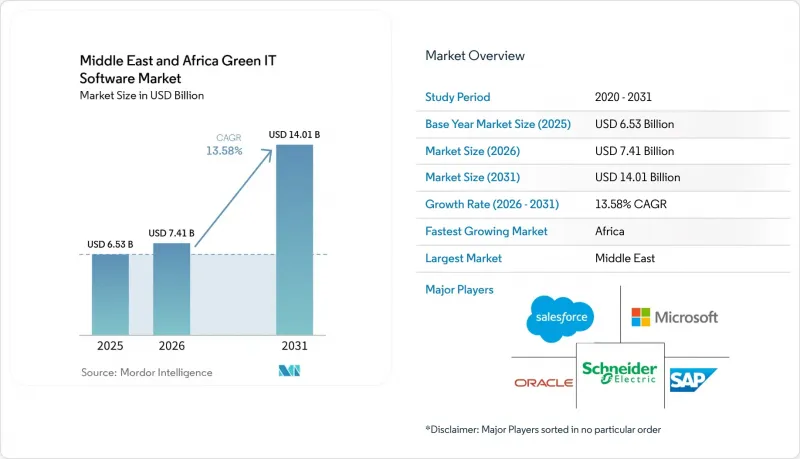
This report is Segmented by Component (Software, and Services), Application (Carbon Accounting and Emissions Reporting, and More), Deployment Mode (Cloud-Based, and On-Premises), Organization Size (Large Enterprises, and Small and Medium Enterprises), End User (Manufacturing, Retail and E-Commerce, and More), and Geography. The Market Forecasts are Provided in Terms of Value (USD).
Middle East and Africa Green IT Software Market Trends and Insights
Mandatory Sustainability Reporting and Audit Readiness Pressure
Mandatory climate disclosure has already become a near-term buying trigger across the Middle East and Africa Green IT Software Market because compliance deadlines now carry direct legal and operational consequences. The UAE climate framework and Egypt's February 2026 decision for non-banking financial institutions both pushed enterprises toward systems that can organize emissions data, support verification, and produce records that withstand formal review. Egypt's Financial Regulatory Authority required Scope 1 and Scope 2 disclosures, along with third-party verification, for non-banking financial institutions with capital above EGP 100 million (USD 2.04 million), with compliance due by June 2026. What matters for vendors is that buyers are no longer treating sustainability software as a separate reporting layer, because they increasingly want systems that can fit into audit, finance, and governance routines with less manual rework. This is why the MEA Green Information Technology software market is seeing a stronger preference for platforms that can handle disclosure workflows, evidence trails, and changing reporting obligations in one environment.
Rising Cloud-Native ESG and Energy Analytics Adoption
Cloud-based platforms held 71.33% of the 2025 Middle East and Africa Green IT Software Market, and that lead reflects more than simple subscription economics. Many regional buyers entered the category after mandatory reporting requirements had already been introduced, so they favored delivery models that could go live quickly and connect with existing enterprise systems without a lengthy infrastructure build. This also explains why the Middle East and Africa Green IT Software Market continues to lean toward software-as-a-service tools for first deployments, especially where sustainability teams were created after disclosure requirements had already started to tighten. A second layer of demand is emerging for energy analytics, as cloud-native environments can collect usage data across dispersed operations and turn it into repeatable reports for management teams and external reviewers. As the buyer base widens, the appeal of cloud tools is likely to remain strong because they give organizations a faster path from procurement to operational use, even when internal sustainability data processes are still being built.
Limited Sustainability Data Quality across Legacy IT Estates
The biggest brake on the Middle East and Africa Green IT Software Market is often not software demand, but the poor condition of the data that new tools are expected to use. Many legacy ERP, facilities, and operations systems were never built to capture electricity use at the asset level or to organize the metadata needed for credible emissions calculations, leaving teams to rely on manual work and fragmented files. That problem is especially important in sectors where sustainability, finance, IT, and operations each control parts of the data chain, because unclear ownership can slow implementation even after software budgets are approved. As a result, the Middle East and Africa Green IT Software Market still carries a meaningful execution gap between procurement and full operational use, particularly in first-time deployments. Vendors that can provide better templates, connectors, governance workflows, and onboarding support are more likely to convert interest into successful use, as buyers increasingly recognize that data readiness determines how quickly compliance benefits can be realized.
Other drivers and restraints analyzed in the detailed report include:
- AI-Enabled Carbon Accounting and Workload Optimization
- Multinational Supplier Traceability Requirements
- Shortage of Skilled ESG and Carbon Data Specialists
For complete list of drivers and restraints, kindly check the Table Of Contents.
Segment Analysis
Software accounted for 68.29% of the 2025 component mix, keeping it firmly in the leading position in the Middle East and Africa Green IT Software Market. That lead reflects buyer preference for ESG, carbon accounting, and energy analytics platforms that can sit on top of existing ERP and reporting environments, rather than forcing a broad system replacement. Many enterprises are still in an early deployment phase, so the appeal of software modules that can be integrated into existing workflows remains strong, especially for finance, IT, and sustainability teams that need faster time-to-value. The software segment also benefits from the fact that most organizations first enter this category through disclosure or data management needs, which are usually addressed through platforms rather than hardware or infrastructure spending.
Services are projected to grow at a 15.12% CAGR from 2026 to 2031, making them the fastest-rising component category in the Middle East and Africa Green IT Software Market. This growth comes from implementation, integration, support, and maintenance work that buyers need when data sits across legacy ERP, cloud, and facility systems with different formats and ownership rules. DXC expanded SAP capabilities across the region through a center of excellence in Egypt, a SAP academy in Saudi Arabia, and the recruitment of more than 300 SAP professionals, which illustrates how demand for certified delivery capacity is rising alongside software demand. Even without calculating new values, the Middle East and Africa Green IT Software Market size for services is clearly supported by the need to document data lineage, governance routines, and assurance methods before enterprises can claim audit-ready reporting. The pattern also shows that many buyers still need hands-on support because out-of-the-box functionality alone is not enough for complex, multi-entity deployments.
ESG reporting and disclosure accounted for 35.23% of application revenue in 2025, making it the largest application area across the Middle East and Africa Green IT Software Market. That result is consistent with the current regulatory landscape, since most near-term obligations in the region have focused first on disclosure readiness, evidence handling, and reporting structure rather than on direct emissions-reduction targets. Buyers, therefore, continue to start with platforms that can centralize metrics, standardize outputs, and support internal and external reporting cycles. This keeps disclosure tools at the center of early adoption, particularly among listed firms, regulated institutions, and enterprises with multi-country reporting needs.
Carbon accounting and emissions reporting are forecast to grow at a 14.09% CAGR through 2031, indicating that the Middle East and Africa Green IT Software Market is moving from basic compliance toward more active measurement and planning. SAP's 2026 Sustainability Control Tower updates strengthened AI support for regulatory readiness and data mapping, which aligns with buyer demand for tools that can turn emissions information into a more usable operational dataset. Energy monitoring and optimization are also becoming more important as enterprises link carbon visibility with electricity cost control, cooling efficiency, and infrastructure performance. Supply chain sustainability management is attracting stronger interest as exporters and suppliers face growing requests for verified upstream data, while waste and water applications are still at an earlier stage across much of the region.
Complete Report Scope:
- By Component
- Software
- Services
- Implementation and Integration Services
- Support and Maintenance Services
- By Application
- Carbon Accounting and Emissions Reporting
- Energy Monitoring and Optimization
- Environmental, Social, and Governance (ESG) Reporting and Disclosure
- Supply Chain Sustainability Management
- Green IT Asset and Data Center Optimization
- Other Applications
- By Deployment Mode
- Cloud-Based
- On-Premises
- By Organization Size
- Large Enterprises
- Small and Medium Enterprises
- By End User
- Information Technology and Telecom
- Banking, Financial Services, and Insurance
- Manufacturing
- Government and Public Sector
- Energy and Utilities
- Healthcare and Life Sciences
- Retail and E-Commerce
- Other End Users
- By Geography
- Middle East
- Gulf Cooperation Council (GCC)
- Turkey
- Rest of Middle East
- Africa
- South Africa
- Nigeria
- Rest of Africa
- Middle East
List of Companies Covered in this Report:
- SAP SE
- Microsoft Corporation
- IBM Corporation
- Schneider Electric SE
- Oracle Corporation
- Salesforce, Inc.
- Wolters Kluwer N.V.
- Sphera Solutions, Inc.
- Cority Software Inc.
- Enablon North America Corp.
- Benchmark Gensuite, LLC
- Intelex Technologies ULC
- Diligent Corporation
- Workiva Inc.
- FigBytes Inc.
- Envirosuite Limited
- ESG Book GmbH
- Persefoni AI, Inc.
- Watershed Technology, Inc.
- Plan A Solutions GmbH
- Normative AB
- Sweep SAS
- Eniscope Limited
Additional Benefits:
- The market estimate (ME) sheet in Excel format
- 3 months of analyst support
TABLE OF CONTENTS
1 INTRODUCTION
- 1.1 Study Assumptions and Market Definition
- 1.2 Scope of the Study
2 RESEARCH METHODOLOGY
3 EXECUTIVE SUMMARY
4 MARKET LANDSCAPE
- 4.1 Market Overview
- 4.2 Market Drivers
- 4.2.1 Mandatory Sustainability Reporting and Audit Readiness Pressure
- 4.2.2 Rising Cloud-Native ESG and Energy Analytics Adoption
- 4.2.3 AI-Enabled Carbon Accounting and Workload Optimization
- 4.2.4 Multinational Supplier Traceability Requirements
- 4.2.5 Energy Cost Volatility and IT Efficiency Mandates
- 4.2.6 Digital Sovereignty and Local Data Hosting Buildouts
- 4.3 Market Restraints
- 4.3.1 Limited Sustainability Data Quality Across Legacy IT Estates
- 4.3.2 Shortage of Skilled ESG and Carbon Data Specialists
- 4.3.3 Integration Complexity Across ERP, Cloud, and IoT Stacks
- 4.3.4 Budget Prioritization Versus Core Revenue Software
- 4.4 Industry Value Chain Analysis
- 4.5 Impact of Macroeconomic Factors on the Market
- 4.6 Technology Outlook
- 4.7 Regulatory Landscape
- 4.8 Porter's Five Forces Analysis
- 4.8.1 Threat of New Entrants
- 4.8.2 Bargaining Power of Suppliers
- 4.8.3 Bargaining Power of Buyers
- 4.8.4 Threat of Substitutes
- 4.8.5 Industry Rivalry
5 MARKET SIZE AND GROWTH FORECASTS (VALUE)
- 5.1 By Component
- 5.1.1 Software
- 5.1.2 Services
- 5.1.2.1 Implementation and Integration Services
- 5.1.2.2 Support and Maintenance Services
- 5.2 By Application
- 5.2.1 Carbon Accounting and Emissions Reporting
- 5.2.2 Energy Monitoring and Optimization
- 5.2.3 Environmental, Social, and Governance (ESG) Reporting and Disclosure
- 5.2.4 Supply Chain Sustainability Management
- 5.2.5 Green IT Asset and Data Center Optimization
- 5.2.6 Other Applications
- 5.3 By Deployment Mode
- 5.3.1 Cloud-Based
- 5.3.2 On-Premises
- 5.4 By Organization Size
- 5.4.1 Large Enterprises
- 5.4.2 Small and Medium Enterprises
- 5.5 By End User
- 5.5.1 Information Technology and Telecom
- 5.5.2 Banking, Financial Services, and Insurance
- 5.5.3 Manufacturing
- 5.5.4 Government and Public Sector
- 5.5.5 Energy and Utilities
- 5.5.6 Healthcare and Life Sciences
- 5.5.7 Retail and E-Commerce
- 5.5.8 Other End Users
- 5.6 By Geography
- 5.6.1 Middle East
- 5.6.1.1 Gulf Cooperation Council (GCC)
- 5.6.1.2 Turkey
- 5.6.1.3 Rest of Middle East
- 5.6.2 Africa
- 5.6.2.1 South Africa
- 5.6.2.2 Nigeria
- 5.6.2.3 Rest of Africa
- 5.6.1 Middle East
6 COMPETITIVE LANDSCAPE
- 6.1 Market Concentration
- 6.2 Strategic Moves
- 6.3 Market Share Analysis
- 6.4 Company Profiles (includes Global Level Overview, Market Level Overview, Core Segments, Financials as available, Strategic Information, Market Rank/Share, Products and Services, Recent Developments)
- 6.4.1 SAP SE
- 6.4.2 Microsoft Corporation
- 6.4.3 IBM Corporation
- 6.4.4 Schneider Electric SE
- 6.4.5 Oracle Corporation
- 6.4.6 Salesforce, Inc.
- 6.4.7 Wolters Kluwer N.V.
- 6.4.8 Sphera Solutions, Inc.
- 6.4.9 Cority Software Inc.
- 6.4.10 Enablon North America Corp.
- 6.4.11 Benchmark Gensuite, LLC
- 6.4.12 Intelex Technologies ULC
- 6.4.13 Diligent Corporation
- 6.4.14 Workiva Inc.
- 6.4.15 FigBytes Inc.
- 6.4.16 Envirosuite Limited
- 6.4.17 ESG Book GmbH
- 6.4.18 Persefoni AI, Inc.
- 6.4.19 Watershed Technology, Inc.
- 6.4.20 Plan A Solutions GmbH
- 6.4.21 Normative AB
- 6.4.22 Sweep SAS
- 6.4.23 Eniscope Limited
7 MARKET OPPORTUNITIES AND FUTURE OUTLOOK
- 7.1 White-space and Unmet-Need Assessment

