PUBLISHER: Mordor Intelligence | PRODUCT CODE: 2073468

PUBLISHER: Mordor Intelligence | PRODUCT CODE: 2073468
Middle East and Africa Battery - Market Share Analysis, Industry Trends & Statistics, Growth Forecasts (2026 - 2031)
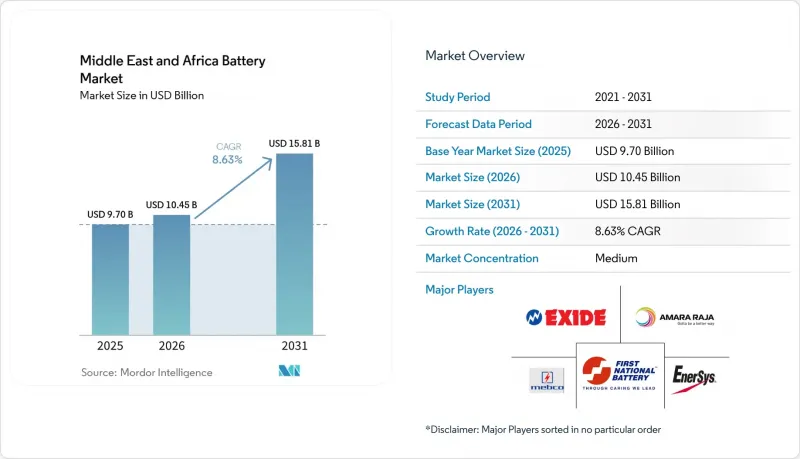
According to Mordor Intelligence, the middle east and Africa Battery Market size is projected to expand from USD 9.70 billion in 2025 and USD 10.45 billion in 2026 to USD 15.81 billion by 2031, registering a CAGR of 8.63% between 2026 and 2031.
This report is Segmented by Battery Type (Primary Batteries and Secondary Batteries), Technology (Lead-Acid, Li-Ion, Nickel-Metal Hydride, Nickel-Cadmium, Sodium-Sulfur, Solid-State, Flow Battery, and Emerging Chemistries), Application (Automotive, Industrial, Portable, Power Tools, SLI, and Other Applications), and Geography (Saudi Arabia, United Arab Emirates, Oman, South Africa, and More).
Middle East and Africa Battery Market Trends and Insights
Declining Lithium-Ion Battery Prices
Lithium-ion pack prices slid to USD 108 per kilowatt-hour in December 2025, down from USD 139 in 2023, narrowing the cost gap with lead-acid batteries and improving total-cost-of-ownership for telecom backup and four-hour utility storage. Saudi Arabia's Tabuk and Hail projects set a regional record at USD 73-75 per kilowatt-hour by deploying HITHIUM's 1,175 Ah lithium-iron-phosphate (LFP) cells, underscoring how volume procurement and Chinese supply-chain scale pass through to buyers. Transparent tenders in GCC states and South Africa capture these savings immediately, while import duties and forex volatility moderate benefits in Kenya and Nigeria. Egypt's 1.1 GW Obelisk solar-plus-storage project, financed by multilateral lenders, shows that LCOE parity with natural-gas peakers is within reach in high-insolation markets. Overall, falling pack costs reinforce the Middle East and Africa battery market's path to scale, especially where subsidies or concessional debt further cut financing costs.
Rapid EV Adoption & GCC Electrification Targets
Saudi Arabia's EV Green Initiative aims for 30% EV penetration in Riyadh by 2030, catalyzed by Ceer Motors and a Saudi Aramco-BYD manufacturing MoU. The United Arab Emirates targets a 20% EV share in Dubai and 10% in Abu Dhabi, with more than 740 public chargers already installed by late 2024. These mandates diversify oil economies and anchor new industrial value chains, lifting battery demand and prompting recycling investments. Qatar, Oman, and Egypt replicate the model on a smaller scale, while Morocco's USD 346 million sovereign investment into Gotion's Kenitra gigafactory underpins export-oriented battery output. EV growth, therefore, pulls forward local cell production, shortens supply lines to European OEMs, and embeds the Middle East and Africa battery market in global automotive platforms.
Raw-Material Supply Constraints (Li, Co)
Lithium carbonate spot prices collapsed from USD 80,000 per ton in 2022 to USD 10,000 in 2024, then rebounded to USD 11,500 in early 2025, upsetting contract negotiations and squeezing manufacturer margins. Cobalt remains 70% concentrated in the Democratic Republic of Congo, raising ESG compliance costs under EU and U.S. battery rules. OEMs respond by pivoting to cobalt-free LFP chemistries, while Morocco leverages phosphate reserves for cathode precursors. Saudi Arabia and Oman explore lithium recovery from oil-field brines. Supply volatility, therefore, tempers but does not derail the Middle East and Africa battery market's growth trajectory.
Other drivers and restraints analyzed in the detailed report include:
- Distributed Solar + Storage Uptake in Off-Grid Africa
- Localization of Cell & Pack Gigafactories (KSA, Morocco)
- High Upfront Cost in Price-Sensitive African Markets
For complete list of drivers and restraints, kindly check the Table Of Contents.
Segment Analysis
Secondary batteries controlled 74.5% of the Middle East and Africa battery market share in 2025, reflecting soaring telecom retrofits and EV uptake. The segment is forecast to post a 15.8% CAGR through 2031, pushing the Middle East and Africa battery market size for rechargeables well above USD 12 billion by the end of the period. Rising cycle-life, declining pack costs, and growing financing options underpin penetration into UPS, mini-grid, and motive-power niches.
Primary batteries now occupy specialized roles in defense and remote sensing. Although they offer high energy density, tightening waste regulations and improving rechargeable economics erode their relative appeal. Lead-acid units lose share each year as tower-cos and C&I customers upgrade to lithium-ion, enabled by pay-as-you-save contracts. Over the forecast horizon, rechargeable penetration rises further as donor-funded electrification schemes specify minimum 2,000-cycle batteries for community systems.
Complete Report Scope:
- By Battery Type
- Primary Batteries
- Secondary Batteries
- By Technology
- Lead-acid
- Li-ion
- Nickel-metal hydride
- Nickel-cadmium
- Sodium-sulfur
- Solid-state
- Flow Battery
- Emerging chemistries
- By Application
- Automotive (HEV, PHEV, and EV)
- Industrial (Motive, Stationary (Telecom, UPS, ESS), etc.)
- Portable (Consumer Electronics, etc.)
- Power Tools
- SLI
- Other Applications
- By Geography
- Middle East
- Saudi Arabia
- United Arab Emirates
- Qatar
- Kuwait
- Oman
- Bahrain
- Rest of Middle East
- Africa
- South Africa
- Egypt
- Kenya
- Nigeria
- Morocco
- Ethiopia
- Rest of Africa
- Middle East
List of Companies Covered in this Report:
- Panasonic Corporation
- Saft Groupe SA
- Middle East Battery Company (MEBCO)
- Amara Raja Batteries Ltd
- First National Battery (Pty) Ltd
- EnerSys
- C&D Technologies Inc.
- East Penn Manufacturing Co.
- Exide Industries Ltd
- LG Energy Solution
- Samsung SDI
- Contemporary Amperex Tech (CATL)
- BYD Co. Ltd
- GS Yuasa Corp.
- Clarios (Johnson Controls spin-off)
- NorthStar Battery Co.
- Hitachi Energy
- Tesla Energy
- Duracell Inc.
- Toshiba Infrastructure Systems
Additional Benefits:
- The market estimate (ME) sheet in Excel format
- 3 months of analyst support
TABLE OF CONTENTS
1 Introduction
- 1.1 Study Assumptions & Market Definition
- 1.2 Scope of the Study
2 Research Methodology
3 Executive Summary
4 Market Landscape
- 4.1 Market Overview
- 4.2 Market Drivers
- 4.2.1 Declining lithium-ion battery prices
- 4.2.2 Rapid EV adoption & GCC electrification targets
- 4.2.3 Distributed solar + storage uptake in off-grid Africa
- 4.2.4 Localization of cell & pack gigafactories (KSA, Morocco)
- 4.2.5 Telecom-tower lithium retrofits
- 4.2.6 Grid unreliability driving lead-acid replacement
- 4.3 Market Restraints
- 4.3.1 Raw-material supply constraints (Li, Co)
- 4.3.2 High upfront cost in price-sensitive African markets
- 4.3.3 Weak recycling ecosystem & lead-handling regulation
- 4.3.4 Policy-incentive fragmentation across ME sub-regions
- 4.4 Supply-Chain Analysis
- 4.5 Regulatory Landscape
- 4.6 Technological Outlook
- 4.7 Porter's Five Forces
- 4.7.1 Bargaining Power of Suppliers
- 4.7.2 Bargaining Power of Buyers
- 4.7.3 Threat of New Entrants
- 4.7.4 Threat of Substitutes
- 4.7.5 Competitive Rivalry
5 Market Size & Growth Forecasts
- 5.1 By Battery Type
- 5.1.1 Primary Batteries
- 5.1.2 Secondary Batteries
- 5.2 By Technology
- 5.2.1 Lead-acid
- 5.2.2 Li-ion
- 5.2.3 Nickel-metal hydride
- 5.2.4 Nickel-cadmium
- 5.2.5 Sodium-sulfur
- 5.2.6 Solid-state
- 5.2.7 Flow Battery
- 5.2.8 Emerging chemistries
- 5.3 By Application
- 5.3.1 Automotive (HEV, PHEV, and EV)
- 5.3.2 Industrial (Motive, Stationary (Telecom, UPS, ESS), etc.)
- 5.3.3 Portable (Consumer Electronics, etc.)
- 5.3.4 Power Tools
- 5.3.5 SLI
- 5.3.6 Other Applications
- 5.4 By Geography
- 5.4.1 Middle East
- 5.4.1.1 Saudi Arabia
- 5.4.1.2 United Arab Emirates
- 5.4.1.3 Qatar
- 5.4.1.4 Kuwait
- 5.4.1.5 Oman
- 5.4.1.6 Bahrain
- 5.4.1.7 Rest of Middle East
- 5.4.2 Africa
- 5.4.2.1 South Africa
- 5.4.2.2 Egypt
- 5.4.2.3 Kenya
- 5.4.2.4 Nigeria
- 5.4.2.5 Morocco
- 5.4.2.6 Ethiopia
- 5.4.2.7 Rest of Africa
- 5.4.1 Middle East
6 Competitive Landscape
- 6.1 Market Concentration
- 6.2 Strategic Moves (M&A, Partnerships, PPAs)
- 6.3 Market Share Analysis (Market Rank/Share for key companies)
- 6.4 Company Profiles (includes Global level Overview, Market level overview, Core Segments, Financials as available, Strategic Information, Products & Services, and Recent Developments)
- 6.4.1 Panasonic Corporation
- 6.4.2 Saft Groupe SA
- 6.4.3 Middle East Battery Company (MEBCO)
- 6.4.4 Amara Raja Batteries Ltd
- 6.4.5 First National Battery (Pty) Ltd
- 6.4.6 EnerSys
- 6.4.7 C&D Technologies Inc.
- 6.4.8 East Penn Manufacturing Co.
- 6.4.9 Exide Industries Ltd
- 6.4.10 LG Energy Solution
- 6.4.11 Samsung SDI
- 6.4.12 Contemporary Amperex Tech (CATL)
- 6.4.13 BYD Co. Ltd
- 6.4.14 GS Yuasa Corp.
- 6.4.15 Clarios (Johnson Controls spin-off)
- 6.4.16 NorthStar Battery Co.
- 6.4.17 Hitachi Energy
- 6.4.18 Tesla Energy
- 6.4.19 Duracell Inc.
- 6.4.20 Toshiba Infrastructure Systems
7 Market Opportunities & Future Outlook
- 7.1 White-space & Unmet-need Assessment

