PUBLISHER: Mordor Intelligence | PRODUCT CODE: 2119349

PUBLISHER: Mordor Intelligence | PRODUCT CODE: 2119349
India Inverter Battery - Market Share Analysis, Industry Trends & Statistics, Growth Forecasts (2026 - 2031)
According to Mordor Intelligence, the India inverter battery market size is expected to increase from USD 1.12 billion in 2025 to USD 1.31 billion in 2026 and reach USD 1.99 billion by 2031, growing at a CAGR of 8.72% over 2026-2031.
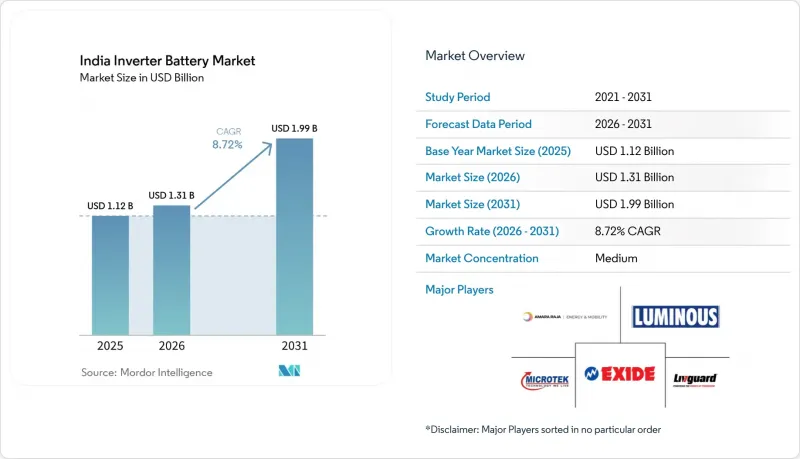
This report is Segmented by Battery Chemistry (Lithium-Ion, Lead-Acid, Sodium-Ion, Flow, Other Chemistries), Inverter Type (Standalone, Solar, Hybrid, UPS), and Application (Residential, Commercial, Industrial, Telecom, Renewable Energy Storage, Others). The Market Forecasts are Provided in Terms of Value (USD).
India Inverter Battery Market Trends and Insights
Frequent Grid Interruptions Sustaining Structural Backup Demand
India's electricity challenge increasingly concerns evening dispatchability rather than installed generation capacity. The India inverter battery market responds to this condition because solar output falls while cooling demand and household consumption continue into the night. The International Energy Agency reported that nighttime demand has increased as cooling demand has risen, creating a stronger need for resources that can supply electricity after sunset. Longer interruptions increase the energy capacity required for a typical installation and can encourage users to select higher-Ah lead-acid units or lithium-based systems. This supports higher transaction values in northern and western states where outages are more disruptive. Small enterprises also require dependable power for lighting, refrigeration, communications, and other essential loads, so demand extends across household and business users.
Rooftop Solar and Solar-Plus-Storage Integration Reshaping Demand Architecture
India added 7.1 GW of rooftop solar in 2025, compared with 3.2 GW in 2024, and residential consumers accounted for nearly 76% of the new capacity. The India inverter battery market gains from this installed base because battery storage converts a grid-connected solar system into a source of backup power during outages. Research by CEEW found that 3 in 10 households expected rooftop solar to provide power backup, even though a standard grid-connected system cannot do so without storage. This gap gives installers a practical opportunity to explain the role of batteries and hybrid inverters during the sales process. The PM Surya Ghar program has made rooftop solar a larger consumer purchase category, which brings battery makers closer to solar installers and EPC distribution networks. As systems become more integrated, product compatibility, installation quality, and service support carry more weight in the buying decision.
High Upfront Cost of Lithium-Ion Systems Limiting Mass-Market Penetration
The initial cost of a lithium-ion system remains the clearest constraint on mass adoption in the India inverter battery market. Buyers who face only occasional outages may not recover the higher initial outlay through lower replacement needs or operating benefits. This limitation is strongest in Tier-2, Tier-3, and rural markets, where lead-acid batteries remain familiar, widely available, and easier to replace through local dealers. Consumer financing for storage is also less standardized than financing for many other household durable products. A solar-plus-storage system requires a larger initial commitment than a grid-connected solar installation without a battery. Adoption will therefore be most immediate in areas with frequent outages, high daily cycling, or clear economic savings from storage use.
Other drivers and restraints analyzed in the detailed report include:
- Government-Led Storage Obligations and Viability-Gap Funding Lowering Market Risk
- Lithium-Ion Cost and Cycle-Life Advantage Accelerating Chemistry Migration
- Lead, Lithium, and Critical-Mineral Supply Exposure Creating Input Volatility
For complete list of drivers and restraints, kindly check the Table Of Contents.
Segment Analysis
Lead-acid batteries held 85.2% of sales in 2025, supported by the country's extensive installed base and routine tubular battery replacement cycle. This chemistry remains accessible to price-sensitive buyers through established retailers and service networks. Manufacturers are using higher-capacity and compact designs to retain consumers who need longer backup time but do not wish to replace a complete inverter system. Okaya introduced the JXT 90 Ah inverter battery in January 2026 after launching its Super Jumbo Tubular and Advanced Tall Tubular ranges during 2025. These product extensions show how suppliers can improve backup duration while maintaining a familiar lead-acid format.
Lithium-ion batteries are forecast to expand at a 10.4% CAGR through 2031, making them the fastest-growing battery chemistry in the India inverter battery market. Their appeal is strongest for daily cycling, where longer life and higher usable capacity can outweigh a higher purchase cost. The segment also benefits from retrofit demand, since compatible packs can upgrade existing inverter installations. Luminous introduced the Helios lithium-ion battery series in September 2025, including a 51.2V 314 Ah configuration and systems scalable to 1 MWh. Sodium-ion and flow batteries remain small within the present mix, although alternative chemistries could become more relevant if local manufacturing matures and critical-mineral exposure persists.
Complete Report Scope:
- By Battery Chemistry
- Lithium-ion Batteries
- Lead-acid Batteries
- Sodium-ion Batteries
- Flow Batteries
- Other Battery Chemistries
- By Inverter Type
- Standalone Inverters
- Solar Inverters
- Hybrid Inverters
- UPS Inverters
- By Application
- Residential Power Backup
- Commercial
- Industrial
- Telecommunications
- Renewable Energy Storage
- Other Applications
List of Companies Covered in this Report:
- Exide Industries Limited
- Luminous Power Technologies Pvt. Ltd.
- Amara Raja Energy & Mobility Limited
- Microtek International Pvt. Ltd.
- Livguard Energy Technologies Private Limited
- Okaya Power Pvt. Ltd.
- V-Guard Industries Limited
- Eastman Auto & Power Limited
- HBL Engineering Limited
- Servotech Renewable Power System Limited
- Statcon Energiaa Private Limited
- Tata Power Solar Systems Limited
- Delta Electronics India Private Limited
- Schneider Electric India Private Limited
- Eaton India Private Limited
- EnerSys
- GS Yuasa Corporation
- Sungrow India Private Limited
- Huawei Technologies India Private Limited
- BYD India Private Limited
- Contemporary Amperex Technology Co., Limited (CATL)
Additional Benefits:
- The market estimate (ME) sheet in Excel format
- 3 months of analyst support
TABLE OF CONTENTS
1 INTRODUCTION
- 1.1 Study Assumptions and Market Definition
- 1.2 Scope of the Study
2 RESEARCH METHODOLOGY
3 EXECUTIVE SUMMARY
4 MARKET LANDSCAPE
- 4.1 Market Overview
- 4.2 Market Drivers
- 4.2.1 Frequent Grid Interruptions and Backup-Critical Loads
- 4.2.2 Rooftop Solar and Solar-Plus-Storage Adoption
- 4.2.3 Government-Led Storage Obligations and Viability-Gap Funding
- 4.2.4 Lithium-Ion Cost and Cycle-Life Advantage
- 4.2.5 Installer-Led Bundling of Inverters, Batteries and Service
- 4.2.6 Battery Health Telemetry Reducing Perceived Lithium-Ion Risk
- 4.3 Market Restraints
- 4.3.1 High Upfront Cost of Lithium-Ion Systems
- 4.3.2 Lead, Lithium and Critical-Mineral Supply Exposure
- 4.3.3 Inconsistent Installation, Sizing and After-Sales Quality
- 4.3.4 Fragmented State-Level Interconnection and Tariff Rules
- 4.4 Supply-Chain Analysis
- 4.5 Porter's Five Forces Analysis
- 4.5.1 Bargaining Power of Suppliers
- 4.5.2 Bargaining Power of Buyers
- 4.5.3 Threat of New Entrants
- 4.5.4 Threat of Substitutes
- 4.5.5 Competitive Rivalry
- 4.6 Technology Outlook
- 4.7 Regulatory Landscape
- 4.8 Investment Analysis
5 MARKET SIZE AND GROWTH FORECASTS
- 5.1 By Battery Chemistry
- 5.1.1 Lithium-ion Batteries
- 5.1.2 Lead-acid Batteries
- 5.1.3 Sodium-ion Batteries
- 5.1.4 Flow Batteries
- 5.1.5 Other Battery Chemistries
- 5.2 By Inverter Type
- 5.2.1 Standalone Inverters
- 5.2.2 Solar Inverters
- 5.2.3 Hybrid Inverters
- 5.2.4 UPS Inverters
- 5.3 By Application
- 5.3.1 Residential Power Backup
- 5.3.2 Commercial
- 5.3.3 Industrial
- 5.3.4 Telecommunications
- 5.3.5 Renewable Energy Storage
- 5.3.6 Other Applications
6 COMPETITIVE LANDSCAPE
- 6.1 Market Concentration
- 6.2 Strategic Moves
- 6.3 Market Share Analysis
- 6.4 Company Profiles (includes Global Level Overview, Market Level Overview, Core Segments, Financials as available, Strategic Information, Market Rank/Share, Products and Services, Recent Developments)
- 6.4.1 Exide Industries Limited
- 6.4.2 Luminous Power Technologies Pvt. Ltd.
- 6.4.3 Amara Raja Energy & Mobility Limited
- 6.4.4 Microtek International Pvt. Ltd.
- 6.4.5 Livguard Energy Technologies Private Limited
- 6.4.6 Okaya Power Pvt. Ltd.
- 6.4.7 V-Guard Industries Limited
- 6.4.8 Eastman Auto & Power Limited
- 6.4.9 HBL Engineering Limited
- 6.4.10 Servotech Renewable Power System Limited
- 6.4.11 Statcon Energiaa Private Limited
- 6.4.12 Tata Power Solar Systems Limited
- 6.4.13 Delta Electronics India Private Limited
- 6.4.14 Schneider Electric India Private Limited
- 6.4.15 Eaton India Private Limited
- 6.4.16 EnerSys
- 6.4.17 GS Yuasa Corporation
- 6.4.18 Sungrow India Private Limited
- 6.4.19 Huawei Technologies India Private Limited
- 6.4.20 BYD India Private Limited
- 6.4.21 Contemporary Amperex Technology Co., Limited (CATL)
7 MARKET OPPORTUNITIES AND FUTURE OUTLOOK
- 7.1 White-Space and Unmet-Need Assessment

