PUBLISHER: Mordor Intelligence | PRODUCT CODE: 2097130

PUBLISHER: Mordor Intelligence | PRODUCT CODE: 2097130
Stationary Lead-Acid Battery - Market Share Analysis, Industry Trends & Statistics, Growth Forecasts (2026 - 2031)
According to Mordor Intelligence, the stationary lead-Acid battery market size is expected to increase from USD 5.60 billion in 2025 to USD 5.91 billion in 2026 and reach USD 7.76 billion by 2031, growing at a CAGR of 5.61% over 2026-2031.
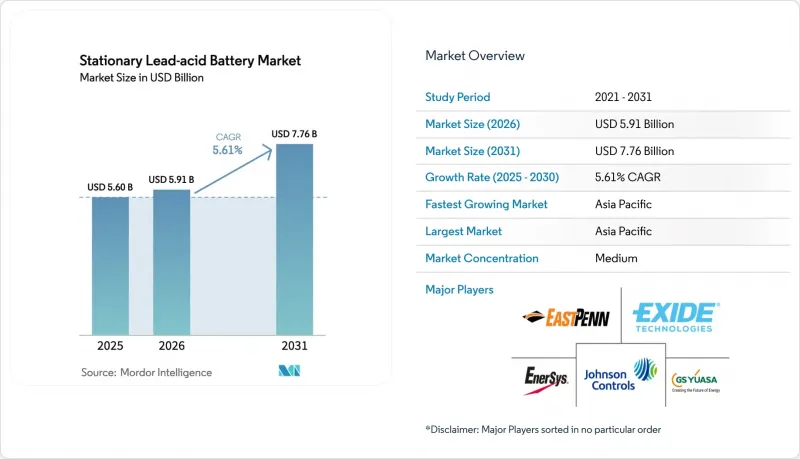
This report is Segmented by Technology (Flooded and VRLA), Application (Telecom, UPS and Data Centres, Utilities and Energy Storage, Industrial Equipment and Motive Power, Oil and Gas and Mining, and Security and Emergency Lighting), and Geography (North America, Europe, Asia-Pacific, South America, and Middle East and Africa). The Market Sizes and Forecasts are Provided in Terms of Value (USD).
Global Stationary Lead-Acid Battery Market Trends and Insights
Data-center Back-Up Renaissance
Explosive growth in global data-center footprints has reset expectations for battery reliability. Operators now rank thermal stability above volumetric efficiency after the January 2025 Moss Landing incident damaged part of a 400 MW lithium-ion site, prompting California regulators to toughen safety inspections. EnerSys responded with high-rate flooded racks that integrate advanced monitoring firmware to guarantee 99.99% uptime without introducing fire-suppression retrofits. Survey data from the Uptime Institute shows 74% of hyperscale managers have added thermal-runaway scoring to procurement checklists, directly benefiting lead chemistry. Pacific Gas & Electric subsequently halted new sealed VRLA purchases for high-temperature rooms, citing superior longevity from ventilated flooded strings.
Telecom Tower Densification in Rural Asia-Pacific & Africa
Fifth-generation networks require dense tower grids, many in off-grid or weak-grid zones of India, Indonesia, and Nigeria. GSMA research confirms that 58% of rural base-stations in low-income countries remain diesel-battery hybrids, and more than 70% of those hybrids specify lead-acid packs for cost and maintenance simplicity. The Rockefeller Foundation identified telecom anchors as prime customers for mini-grid developers, kick-starting orders for 2 V industrial cells that handle deep daily cycles. Lead-acid tolerance for partial state of charge, high ambient heat, and rough handling keeps service intervals long, a decisive factor when sites are hundreds of kilometers from service hubs. This demand surge lifts regional shipment volumes and injects a full point of CAGR uplift into the global Stationary Lead-Acid Battery Market.
Accelerating Li-ion TCO Parity Below 5 kWh Systems
Lithium-ion costs are falling fast enough to narrow the total-cost gap in small backup units. Argonne data place U.S. pack expenses at USD 86 kWh by 2035, and tax credits may trim that to USD 56 kWh by 2029. When installers compare a 3 kWh wall-mount set, the slimmer footprint, lower maintenance, and lighter structure all offset the lead's lower sticker price. Chinese exporters already ship sub-USD 100 kWh cells despite tariffs, making swap-outs tempting for retail banking UPS rooms and emergency lighting arrays. Nature Energy modeling shows sodium-ion lines could join the contest after 2030, adding further margin strain. As a result, the Stationary Lead-Acid Battery Market concedes share in light-duty categories even while holding ground in heavy float service.
Other drivers and restraints analyzed in the detailed report include:
- Grid-Scale Renewable Smoothing in Cost-Sensitive Nations
- Mining & Oil-and-Gas Off-Grid Electrification Mandates
- Stricter EU Lead-Recycling Quotas Hitting New Capacity
For complete list of drivers and restraints, kindly check the Table Of Contents.
Segment Analysis
Flooded units controlled 42.1% of the Stationary Lead-Acid Battery Market share in 2025 and are forecast to grow at a 6.8% CAGR. Pacific Gas & Electric's decision to retire sealed VRLA strings in high-temperature rooms revived interest in vented designs that tolerate sustained 35 °C without capacity fade. The Stationary Lead-Acid Battery Market size attached to flooded formats is projected at USD 3.48 billion by 2031, helped by thin-plate casting upgrades that slash water loss.
Advanced TPPL and lead-carbon hybrids sit between flooded robustness and VRLA convenience. They capture telecom shelters where partial-state cycling is routine, yet price premiums cap penetration. VRLA still owns the largest revenue pool at a 57.9% 2025 share, but its curve moderates as end-users accept limited onsite maintenance in exchange for longer service life from flooded racks. Continuous alloy R&D and automated formation lines should keep all three chemistries profitable, preserving breadth in the Stationary Lead-Acid Battery Market.
Complete Report Scope:
- By Technology
- Flooded
- VRLA
- By Application
- Telecom
- UPS and Data Centres
- Utilities and Energy Storage
- Industrial Equipment and Motive Power
- Oil and Gas and Mining
- Security and Emergency Lighting
- By Geography
- North America
- United States
- Canada
- Mexico
- Europe
- Germany
- United Kingdom
- France
- Spain
- Italy
- NORDIC Countries
- Russia
- Rest of Europe
- Asia-Pacific
- China
- India
- Japan
- South Korea
- ASEAN Countries
- Australia and New Zealand
- Rest of Asia-Pacific
- South America
- Brazil
- Argentina
- Chile
- Rest of South America
- Middle East and Africa
- Saudi Arabia
- United Arab Emirates
- South Africa
- Egypt
- Rest of Middle East and Africa
- North America
Geography Analysis
Asia-Pacific generated the largest 44.6% slice in 2025 as China, India, and ASEAN telecom operators stocked rural sites with 48 V racks. The Stationary Lead-Acid Battery Market size in the region is forecast to surpass USD 3.5 billion by 2031 on a 6.0% CAGR. Stricter Chinese smelter standards turned the nation into a net refined-lead importer, tightening regional supply but boosting profits for integrated local brands. Japan and South Korea provide predictable replacement cycles in metro and rail projects, while Australian miners deploy heavy VRLA packs to electrify haul trucks and camps.
North America remains replacement-driven, tied to data-center rebuilds in Virginia and Texas and to hospital code upgrades. The Inflation Reduction Act adders reward domestically cast grids, enabling EnerSys to shift volumes from a closed Mexican site to new Pennsylvania lines. Europe concentrates on compliance. Recycling quotas spur Clarios and Exide to modernize German, Spanish, and Czech furnaces, locking in supply for OEM and stationary channels despite lower headline unit growth.
The Middle East & Africa posts the fastest 9.2% CAGR through 2031, chasing Saudi Arabia's 48 GWh target and Egypt's early standalone projects supported by AfDB finance. South Africa's 1 GW storage awards and the UAE's 800 MWh procurement illustrate breadth, yet fiscal risk lingers for post-2027 tenders. South America rides Brazil's Mover program and private EV supply-chain commitments. Combined, these patterns underscore why the Stationary Lead-Acid Battery Market continues spreading beyond its traditional strongholds.
- Johnson Controls International plc
- Exide Technologies
- EnerSys
- East Penn Manufacturing
- GS Yuasa Corporation
- C&D Technologies
- Amara Raja Batteries
- Panasonic Holdings
- Leoch International
- Narada Power
- HOPPECKE Batteries
- NorthStar Battery
- CSB Energy Technology
- Hitachi Chemical Energy Tech
- Exide Industries (India)
- Coslight Power
- FIAMM Energy Technology
- Rolls-Surrette
- Zhejiang Tianneng
- Vision Group (Shenzhen Center Power)
Additional Benefits:
- The market estimate (ME) sheet in Excel format
- 3 months of analyst support
TABLE OF CONTENTS
1 Introduction
- 1.1 Study Assumptions & Market Definition
- 1.2 Scope of the Study
2 Research Methodology
3 Executive Summary
4 Market Landscape
- 4.1 Market Overview
- 4.2 Market Drivers
- 4.2.1 Data-center back-up renaissance
- 4.2.2 Telecom tower densification in rural Asia Pacific & Africa
- 4.2.3 Grid-scale renewable smoothing in cost-sensitive nations
- 4.2.4 Mining & oil-&-gas off-grid electrification mandates
- 4.2.5 Safety-driven pivot from lithium in critical infrastructure
- 4.2.6 Re-industrialisation programs in South America
- 4.3 Market Restraints
- 4.3.1 Accelerating Li-ion TCO parity below 5 kWh systems
- 4.3.2 Stricter EU lead-recycling quotas hitting new capacity
- 4.3.3 Volatile lead prices squeezing OEM margins
- 4.3.4 Public-sector cap-ex deferrals post 2027 in MEA
- 4.4 Supply-Chain Analysis
- 4.5 Regulatory Landscape
- 4.6 Technological Outlook
- 4.7 Porter's Five Forces
- 4.7.1 Bargaining Power of Suppliers
- 4.7.2 Bargaining Power of Buyers
- 4.7.3 Threat of New Entrants
- 4.7.4 Threat of Substitutes
- 4.7.5 Competitive Rivalry
5 Market Size & Growth Forecasts
- 5.1 By Technology
- 5.1.1 Flooded
- 5.1.2 VRLA
- 5.2 By Application
- 5.2.1 Telecom
- 5.2.2 UPS and Data Centres
- 5.2.3 Utilities and Energy Storage
- 5.2.4 Industrial Equipment and Motive Power
- 5.2.5 Oil and Gas and Mining
- 5.2.6 Security and Emergency Lighting
- 5.3 By Geography
- 5.3.1 North America
- 5.3.1.1 United States
- 5.3.1.2 Canada
- 5.3.1.3 Mexico
- 5.3.2 Europe
- 5.3.2.1 Germany
- 5.3.2.2 United Kingdom
- 5.3.2.3 France
- 5.3.2.4 Spain
- 5.3.2.5 Italy
- 5.3.2.6 NORDIC Countries
- 5.3.2.7 Russia
- 5.3.2.8 Rest of Europe
- 5.3.3 Asia-Pacific
- 5.3.3.1 China
- 5.3.3.2 India
- 5.3.3.3 Japan
- 5.3.3.4 South Korea
- 5.3.3.5 ASEAN Countries
- 5.3.3.6 Australia and New Zealand
- 5.3.3.7 Rest of Asia-Pacific
- 5.3.4 South America
- 5.3.4.1 Brazil
- 5.3.4.2 Argentina
- 5.3.4.3 Chile
- 5.3.4.4 Rest of South America
- 5.3.5 Middle East and Africa
- 5.3.5.1 Saudi Arabia
- 5.3.5.2 United Arab Emirates
- 5.3.5.3 South Africa
- 5.3.5.4 Egypt
- 5.3.5.5 Rest of Middle East and Africa
- 5.3.1 North America
6 Competitive Landscape
- 6.1 Market Concentration
- 6.2 Strategic Moves (M&A, Partnerships, PPAs)
- 6.3 Market Share Analysis (Market Rank/Share for key companies)
- 6.4 Company Profiles (includes Global level Overview, Market level overview, Core Segments, Financials as available, Strategic Information, Products & Services, and Recent Developments)
- 6.4.1 Johnson Controls International plc
- 6.4.2 Exide Technologies
- 6.4.3 EnerSys
- 6.4.4 East Penn Manufacturing
- 6.4.5 GS Yuasa Corporation
- 6.4.6 C&D Technologies
- 6.4.7 Amara Raja Batteries
- 6.4.8 Panasonic Holdings
- 6.4.9 Leoch International
- 6.4.10 Narada Power
- 6.4.11 HOPPECKE Batteries
- 6.4.12 NorthStar Battery
- 6.4.13 CSB Energy Technology
- 6.4.14 Hitachi Chemical Energy Tech
- 6.4.15 Exide Industries (India)
- 6.4.16 Coslight Power
- 6.4.17 FIAMM Energy Technology
- 6.4.18 Rolls-Surrette
- 6.4.19 Zhejiang Tianneng
- 6.4.20 Vision Group (Shenzhen Center Power)
7 Market Opportunities & Future Outlook
- 7.1 White-space & Unmet-need Assessment

