PUBLISHER: Mordor Intelligence | PRODUCT CODE: 2097169

PUBLISHER: Mordor Intelligence | PRODUCT CODE: 2097169
Ceramic Sanitaryware - Market Share Analysis, Industry Trends & Statistics, Growth Forecasts (2026 - 2031)
According to Mordor Intelligence, the ceramic sanitaryware market size is projected to be USD 40.38 billion in 2025, USD 43.26 billion in 2026, and reach USD 61.03 billion by 2031, growing at a CAGR of 7.13% from 2026 to 2031.
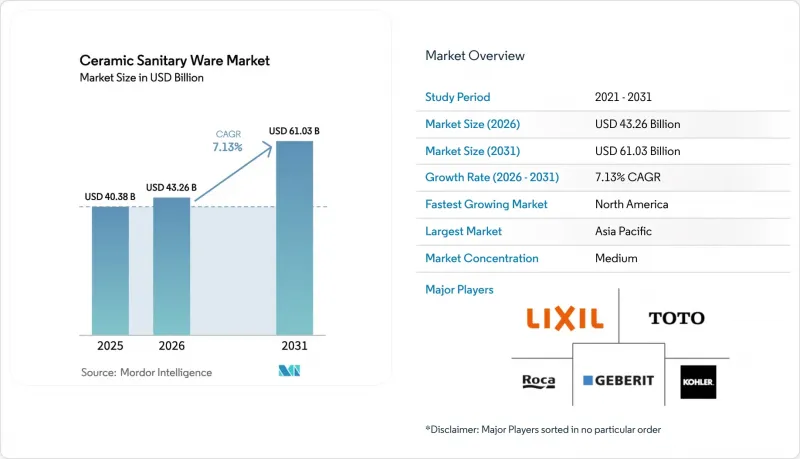
This report is Segmented by Product Type (Wash Basins, Water Closets, Cisterns, Bidets, Urinals, Bathtubs & Shower Trays, Accessories), End-User (Residential, Commercial), Distribution Channel (Offline, Online), and Geography (North America, South America, Europe, Asia-Pacific, Middle East and Africa). Market Forecasts are Provided in Terms of Value (USD).
Global Ceramic Sanitaryware Market Trends and Insights
Urban Housing and Renovation Boom
Urban migration is expanding municipal sanitation buildouts and mobilizing household renovation cycles that sustain the ceramic sanitaryware market across residential and mixed-use projects. In Japan, renovation accounted for 51% of Water Technology revenue at LIXIL in fiscal 2024, and that pivot underscores how mature markets balance new-build softness with upgrades in the ceramic sanitaryware market. Developer-led activity in the United Arab Emirates continued through 2025, with RAK Ceramics reporting a 26.4% year-on-year domestic revenue rise in Q2 2025, which supported scale utilization and mix improvements in sanitaryware. In Europe, Geberit's business mix reflected steady renovation demand that cushioned the trough in new residential starts, which disciplines product development toward retrofit-friendly systems in the ceramic sanitaryware market. At the same time, a drop in global project finance for water and sanitation in developing regions during 2024 signaled near-term constraints in public-sector upgrades, which can temper unit growth until financing normalizes.
Sanitation Subsidies in Emerging Markets
Policy support in large emerging economies sustains baseline demand for durable fixtures, and procurement rules increasingly reward certified water efficiency in the ceramic sanitaryware market. TOTO targets 3.50 million overseas WASHLET unit shipments by fiscal 2026, up from 3.06 million in fiscal 2024, aligning product penetration goals with government-backed sanitation programs and hygiene campaigns. In Bangladesh, new showrooms and capacity actions by multinational and regional players signal latent urban demand that could be unlocked as energy supply stabilizes, which keeps the ceramic sanitaryware market engaged in local buildouts. In the European Union, the European Water Label registry has expanded across brands and SKUs and is increasingly used to screen products in public tenders, which aligns subsidies and specifications with conservation outcomes in the ceramic sanitaryware market.
Volatile Prices of Feldspar, Clay, Silica, and Natural-Gas/LNG Power
Producers are exposed to energy price volatility because firing cycles depend on uninterrupted high-temperature processes, which pushes energy efficiency to the top of plant-upgrade agendas in the ceramic sanitaryware market. In Europe, ceramics are largely gas reliant and are simultaneously subject to carbon-pricing signals that can raise operating costs, which create strong incentives to electrify kilns and implement heat recovery solutions. On the materials side, feldspar logistics and mining bottlenecks in key exporting countries trigger price spikes and scheduling delays, and those shocks can cascade into delivery lead times for sanitaryware lines in the ceramic sanitaryware market. Manufacturers with diversified sourcing, larger safety stocks, and closer collaboration with mines and processors are better placed to sustain service levels in the ceramic sanitaryware market. As more suppliers switch to hydrogen-ready or fully electric tunnels, the sensitivity to gas supply volatility should ease, but transition costs will remain a near-term margin headwind in the ceramic sanitaryware market.
Other drivers and restraints analyzed in the detailed report include:
- Growth of Organized Home-Improvement Retail & E-Commerce
- Uptake of Prefabricated Bathroom Pods in Commercial Builds
- Rising Carbon Costs and Tight Emission Caps on Ceramic Firing Lines (EU ETS, UK CBAM 2027, China Pilot ETS)
For complete list of drivers and restraints, kindly check the Table Of Contents.
Segment Analysis
Wash basins captured 37.33% of the 2025 product-type market size, while water closets are projected to post the fastest advance at a 7.67% CAGR to 2031, setting the tone for premium performance and hygiene features in the ceramic sanitaryware market. Expanded feature sets, such as electrolyzed-water sanitization and integrated bidet functions, support price realization as brands elevate perceived value in water closets within the ceramic sanitaryware market. Kohler's design-led connected bathing systems, including Anthem+, show how controls and experiences in adjacent categories influence expectations for coordinated bathroom suites in the ceramic sanitaryware market. Additive manufacturing demonstrations, such as Kohler's 3D-printed vitreous china concepts, spotlight a pathway to rapid iteration and potential scrap reduction, which could compress lead times for select basin formats in the ceramic sanitaryware market. Emerging industrial research suggests that ceramic 3D printing can reduce waste and improve energy footprints under certain geometries, which strengthens the case for targeted deployment in complex sanitaryware parts over the planning horizon.
Urinals and cisterns are advancing more steadily where public and commercial projects move in line with broader construction cycles, which directs emphasis to reliability and maintenance ease in the ceramic sanitaryware market. Bathtubs and shower trays face design shifts toward walk-in configurations in aging-in-place renovations, which favors a subset of SKUs aligned with ease of entry and cleaning. In Europe, renovation continues to anchor demand, and that tilt supports retrofit-friendly product families and concealed systems that integrate smoothly into existing footprints in the ceramic sanitaryware market. As brands coordinate finishes and accessories across collections, the aesthetic coherence of basins, water closets, and fittings helps pull through premium combinations, which can raise average selling prices in the ceramic sanitaryware market. Over the forecast window, the mix of smart-ready and antimicrobial finishes in top-selling categories should deepen differentiation without compromising production efficiency in core lines of the ceramic sanitaryware market.
Complete Report Scope:
- By Product Type
- Wash Basins
- Water Closets
- Cisterns
- Bidets
- Urinals
- Bathtubs & Shower Trays
- Accessories (Soap Holders, Shelves, etc.)
- By End-user
- Residential
- Commercial
- Hospitality
- Healthcare
- Institutional & Educational
- Offices
- Retail & Other Commercial
- By Distribution Channel
- Offline
- Sanitary Ware Showrooms & Specialty Stores
- Home Improvement & DIY Chains
- Builders & Contractor Sales
- Online
- Company-Owned E-stores
- Third-Party Marketplaces
- Offline
- By Geography
- North America
- United States
- Canada
- Mexico
- South America
- Brazil
- Peru
- Chile
- Argentina
- Rest of South America
- Europe
- United Kingdom
- Germany
- France
- Spain
- Italy
- BENELUX (Belgium, Netherlands, Luxembourg)
- NORDICS (Denmark, Finland, Iceland, Norway, Sweden)
- Rest of Europe
- Asia-Pacific
- India
- China
- Japan
- Australia
- South Korea
- South East Asia (Singapore, Malaysia, Thailand, Indonesia, Vietnam, Philippines)
- Rest of Asia-Pacific
- Middle East and Africa
- United Arab Emirates
- Saudi Arabia
- South Africa
- Nigeria
- Rest of Middle East and Africa
- North America
Geography Analysis
Asia-Pacific held 43.39% of the 2025 market size, while North America is set to chart the highest regional advance at a 7.67% CAGR through 2031, which frames the growth map for the ceramic sanitaryware market share and supplier deployment plans. China's provincial emissions trading pilots have extended coverage to ceramics, where intensity-based allocations and provincial credit purchases now apply in Guangdong, Fujian, and Hubei, and these rules are influencing kiln modernization choices in the ceramic sanitaryware market. In Japan, LIXIL's revenue mix in fiscal 2024 emphasized the importance of renovations, and that pattern supports a steady pull for concealed systems and retrofit-friendly SKUs across urban housing stock in the ceramic sanitaryware market. Southeast Asian markets continue to expand sanitaryware penetration through private development and improving retail channels, where showroom investments by multinationals are pairing with e-commerce to raise assortment breadth in the ceramic sanitaryware market. As energy system reliability improves and credit conditions normalize, the addressable base for mid-tier products will broaden in key metropolitan corridors in the ceramic sanitaryware market.
Europe remains anchored by renovation activity and compliance-driven upgrades, which reinforce demand for water-efficient flush systems, low-noise concealed cisterns, and durable glazes in the ceramic sanitaryware market. Carbon costs under the EU ETS continue to support returns on electric tunnel kilns and heat recovery deployments, and that is reshaping capex priorities across European production hubs in the ceramic sanitaryware market. The European Water Label registry is a growing procurement reference that helps public agencies and large property owners screen products on performance and conservation, which aligns brand portfolios with subsidy criteria in the ceramic sanitaryware market. Logistical constraints in feldspar supply routes periodically influence cost baselines, and diversification of sources and recycled inputs is becoming part of resilience strategies in the ceramic sanitaryware market. As manufacturers weigh plant electrification and hydrogen-ready conversions, financing terms and green electricity access will be decisive for European cost competitiveness in the ceramic sanitaryware market.
North America is forecast to post a 7.67% CAGR through 2031, with growth supported by smart-ready upgrades, aging-in-place renovations, and strong brand investments in network and production technology within the ceramic sanitaryware market. Kohler's U.S. expansion in retail and its Casa Grande, Arizona, facility's focus on energy and water efficiency illustrate how brands are integrating sustainability and operational performance in their strategies for the ceramic sanitaryware market. Canada's push toward low-emission manufacturing, including electric kilns powered by low-carbon electricity, positions select facilities to supply premium decarbonized lines to the region's retrofit-heavy channels in the ceramic sanitaryware market. In the Middle East, strong residential and mixed-use pipelines in the United Arab Emirates supported revenue gains for local producers in 2025, and tariff adjustments in Saudi Arabia in late 2024 aided cross-border flows into the ceramic sanitaryware market. Sub-Saharan African markets face skills and energy constraints that slow modernization, which sustains import reliance and shapes mid-tier assortments in the ceramic sanitaryware market.
- Roca Sanitario S.A.
- Kohler Co.
- Toto Ltd.
- LIXIL Corporation (INAX, American Standard)
- Geberit AG
- Villeroy & Boch AG
- Duravit AG
- Ideal Standard International
- RAK Ceramics PJSC
- Jaquar Group
- Grohe AG (LIXIL)
- VitrA (EczacIbasI)
- Lecico Egypt
- Porcelanosa Grupo
- Kerovit (Kajaria Ceramics)
- Hindware (Brilloca Limited)
- Saudi Ceramic Company
- CERA Sanitaryware Limited
- Delta Faucet Company
- Oras Group
Additional Benefits:
- The market estimate (ME) sheet in Excel format
- 3 months of analyst support
TABLE OF CONTENTS
1 Introduction
- 1.1 Study Assumptions & Market Definition
- 1.2 Scope of the Study
2 Research Methodology
3 Executive Summary
4 Market Landscape
- 4.1 Market Overview
- 4.2 Market Drivers
- 4.2.1 Established urbanization-led housing construction & renovation boom
- 4.2.2 Government sanitation initiatives & subsidies in emerging economies
- 4.2.3 Rising consumer preference for water-efficient & smart sanitary ware
- 4.2.4 Rapid growth of organized retail & e-commerce channels for home improvement
- 4.2.5 Shift to decentralized prefabricated bathroom pods in commercial projects
- 4.2.6 Adoption of antimicrobial-glazed ceramics post-pandemic in healthcare & hospitality
- 4.3 Market Restraints
- 4.3.1 Volatile Prices of Feldspar, Clay, Silica, and Natural-Gas/LNG Power
- 4.3.2 Rising Carbon Costs and Tight EmissCaps on Ceramic Firing Lines (EU ETS, UK CBAM 2027, China Pilot ETS)
- 4.3.3 Persistent Shortage of Trained Kiln Operators and Maintenance Technicians Slowing Modernization
- 4.3.4 Share Capture by Lightweight Polymer-Composite and Brushed Stainless-Steel Sanitary Fixtures in Premium Segments
- 4.4 Industry Value Chain Analysis
- 4.5 Porter's Five Forces
- 4.5.1 Threat of New Entrants
- 4.5.2 Bargaining Power of Suppliers
- 4.5.3 Bargaining Power of Buyers
- 4.5.4 Threat of Substitutes
- 4.5.5 Competitive Rivalry
- 4.6 Insights into the Latest Trends and Innovations in the Market
- 4.7 Insights on Recent Developments (New Product Launches, Strategic Initiatives, Investments, Partnerships, JVs, Expansion, M&As, etc.) in the Market
5 Market Size & Growth Forecasts
- 5.1 By Product Type
- 5.1.1 Wash Basins
- 5.1.2 Water Closets
- 5.1.3 Cisterns
- 5.1.4 Bidets
- 5.1.5 Urinals
- 5.1.6 Bathtubs & Shower Trays
- 5.1.7 Accessories (Soap Holders, Shelves, etc.)
- 5.2 By End-user
- 5.2.1 Residential
- 5.2.2 Commercial
- 5.2.2.1 Hospitality
- 5.2.2.2 Healthcare
- 5.2.2.3 Institutional & Educational
- 5.2.2.4 Offices
- 5.2.2.5 Retail & Other Commercial
- 5.3 By Distribution Channel
- 5.3.1 Offline
- 5.3.1.1 Sanitary Ware Showrooms & Specialty Stores
- 5.3.1.2 Home Improvement & DIY Chains
- 5.3.1.3 Builders & Contractor Sales
- 5.3.2 Online
- 5.3.2.1 Company-Owned E-stores
- 5.3.2.2 Third-Party Marketplaces
- 5.3.1 Offline
- 5.4 By Geography
- 5.4.1 North America
- 5.4.1.1 United States
- 5.4.1.2 Canada
- 5.4.1.3 Mexico
- 5.4.2 South America
- 5.4.2.1 Brazil
- 5.4.2.2 Peru
- 5.4.2.3 Chile
- 5.4.2.4 Argentina
- 5.4.2.5 Rest of South America
- 5.4.3 Europe
- 5.4.3.1 United Kingdom
- 5.4.3.2 Germany
- 5.4.3.3 France
- 5.4.3.4 Spain
- 5.4.3.5 Italy
- 5.4.3.6 BENELUX (Belgium, Netherlands, Luxembourg)
- 5.4.3.7 NORDICS (Denmark, Finland, Iceland, Norway, Sweden)
- 5.4.3.8 Rest of Europe
- 5.4.4 Asia-Pacific
- 5.4.4.1 India
- 5.4.4.2 China
- 5.4.4.3 Japan
- 5.4.4.4 Australia
- 5.4.4.5 South Korea
- 5.4.4.6 South East Asia (Singapore, Malaysia, Thailand, Indonesia, Vietnam, Philippines)
- 5.4.4.7 Rest of Asia-Pacific
- 5.4.5 Middle East and Africa
- 5.4.5.1 United Arab Emirates
- 5.4.5.2 Saudi Arabia
- 5.4.5.3 South Africa
- 5.4.5.4 Nigeria
- 5.4.5.5 Rest of Middle East and Africa
- 5.4.1 North America
6 Competitive Landscape
- 6.1 Market Concentration
- 6.2 Strategic Moves
- 6.3 Market Share Analysis
- 6.4 Company Profiles (includes Global level Overview, Market level overview, Core Segments, Financials as available, Strategic Information, Market Rank/Share for key companies, Products & Services, and Recent Developments)
- 6.4.1 Roca Sanitario S.A.
- 6.4.2 Kohler Co.
- 6.4.3 Toto Ltd.
- 6.4.4 LIXIL Corporation (INAX, American Standard)
- 6.4.5 Geberit AG
- 6.4.6 Villeroy & Boch AG
- 6.4.7 Duravit AG
- 6.4.8 Ideal Standard International
- 6.4.9 RAK Ceramics PJSC
- 6.4.10 Jaquar Group
- 6.4.11 Grohe AG (LIXIL)
- 6.4.12 VitrA (EczacIbasI)
- 6.4.13 Lecico Egypt
- 6.4.14 Porcelanosa Grupo
- 6.4.15 Kerovit (Kajaria Ceramics)
- 6.4.16 Hindware (Brilloca Limited)
- 6.4.17 Saudi Ceramic Company
- 6.4.18 CERA Sanitaryware Limited
- 6.4.19 Delta Faucet Company
- 6.4.20 Oras Group
7 Market Opportunities & Future Outlook
- 7.1 Rising demand for water-efficient and smart ceramic sanitaryware

