PUBLISHER: Mordor Intelligence | PRODUCT CODE: 2115233

PUBLISHER: Mordor Intelligence | PRODUCT CODE: 2115233
Malaysia Sanitaryware - Market Share Analysis, Industry Trends & Statistics, Growth Forecasts (2026 - 2031)
According to Mordor Intelligence, the Malaysia sanitaryware market size was valued at USD 6.42 billion in 2025 and estimated to grow from USD 6.78 billion in 2026 to reach USD 8.93 billion by 2031, at a CAGR of 5.66% during the forecast period (2026-2031).
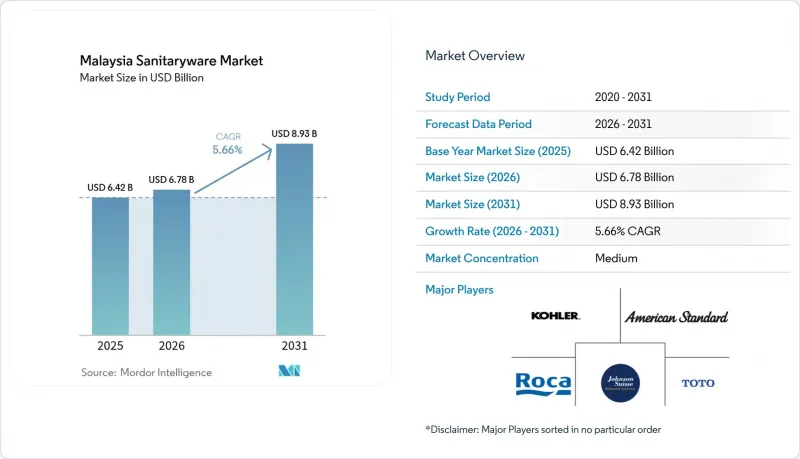
This report Segments the Industry Into by Product (Water Closet, Wash Basins, and Other), by Material (Ceramic, and Others), by Application (Kitchen, Bathroom), by Distribution Channel (Supermarkets/Hypermarkets, Specialty Stores, Online, Other Distribution Channels), and by End-User (Residential, Commercial), by ( Northern Region, and Other). The Market Forecasts are Provided in Terms of Value (USD).
Malaysia Sanitaryware Market Trends and Insights
Rapid Urbanization and Government Housing Initiatives
Malaysia's urban population will move past 80% by 2030, locking in multi-year demand for affordable, standardized sanitaryware that meets procurement rules in programs such as PR1MA and Rumah Mesra Rakyat . Productivity targets under the Construction Industry Transformation Programme are steering contractors toward bulk ordering from local factories able to guarantee on-time volume. Housing tenders now include explicit low-flow and dual-flush specifications, which create a technology minimum that lifts overall product quality. Because each state-backed project carries firm delivery milestones, suppliers can plan capacity with greater certainty and spread fixed costs over predictable production runs. That stability has encouraged domestic players to invest in new kilns and glazing lines, raising the Malaysia sanitaryware market's technical baseline.
Rising Disposable Incomes and Middle-Class Renovation Demand
Urban middle-income households increasingly treat bathroom upgrades as value-enhancement projects that parallel rising apartment resale prices in Kuala Lumpur and Penang. In 2024, retail chains such as MR DIY expanded their operations, driving the mainstream adoption of mid-tier bathroom products, including faucets, wash basins, and soft-close seats. The increasing purchasing power of dual-income households, coupled with higher discretionary budgets, has positioned these consumers as key drivers of demand for complete bathroom renovations. Many of these households are utilizing in-store credit plans to finance such upgrades, reflecting a growing trend toward convenience and affordability in home improvement spending. This segment cares about aesthetics and longevity, raising pull-through for porcelain and natural-stone finishes. The cycle supports higher average selling prices and smooths seasonal demand fluctuations, reinforcing the Malaysia sanitaryware market's revenue resilience.
Volatility in Ceramic Raw-Material Prices
Energy-linked clay and glaze inputs have witnessed abrupt price spikes, crimping gross margins for domestic kilns. Local producers such as Claytan Group must juggle spot purchases with longer-term contracts to secure supply continuity. Smaller firms with limited hedging capabilities face significant challenges in submitting fixed-price tenders, which restricts their ability to compete for inclusion in large-scale housing projects. This inability to mitigate cost fluctuations exposes these firms to financial risks, thereby reducing their competitiveness in the market. The persistent uncertainty surrounding input costs is expected to constrain capacity expansion efforts, which, in turn, could moderate the short-term growth trajectory of Malaysia's sanitaryware market.
Other drivers and restraints analyzed in the detailed report include:
- Growth of E-commerce Home-Improvement Platforms
- Hotel & Tourism Boom Accelerating Hospitality Restroom Upgrades
- Sluggish Completion of Public Infrastructure Projects
For complete list of drivers and restraints, kindly check the Table Of Contents.
Segment Analysis
Water Closets generated 41.73% of 2025 revenue, confirming their status as the essential fixture in every new build and renovation within the Malaysia sanitaryware market. Steady population growth and rising household formation guarantee basal demand, whereas design refreshes such as rimless bowls lift replacement cycles. Cisterns, however, claim the fastest 10.02% CAGR between 2026-2031 as dual-flush technology becomes mandatory in municipal tender books and green-building checklists. Vendors able to certify 4.5-liter flush performance under SIRIM standards secure priority placement on government supplier rosters.
Claytan's Water Saver cistern exemplifies local innovation that meets both price and efficiency goals, reinforcing domestic share. International premium brands compete by bundling concealed tanks and electronic bidet controls, appealing to luxury condos. Combined, these dynamics push average transaction values upwards and help the Malaysia sanitaryware market capture higher specification tiers without sacrificing baseline affordability.
Ceramic constitutes 69.05% of 2025 sales thanks to mature kiln infrastructure, abundant local clay, and predictable cost curves in the Malaysia sanitaryware market. Mass-market apartments and budget hotels continue to default to white-glazed ceramic for durability and price. Nevertheless, Natural Stone and Mosaic variants are climbing at 9.21% CAGR on the back of premium hotel refurbishments and upscale landed homes. Developers position stone basins and textured mosaics as visual differentiators that justify premium selling prices.
The Malaysian Green Technology Corporation has issued guidelines emphasizing the use of recycled materials and energy-efficient firing techniques in green manufacturing processes. Companies adopting these practices, particularly those experimenting with composite blends and fireclay, are strategically positioning themselves to earn GBI points, thereby broadening their material portfolios. This strategic shift is fostering diversification in supplier revenue streams while mitigating the risks associated with raw material price fluctuations in the traditional ceramics segment of the Malaysian sanitaryware market.
Complete Report Scope:
- By Product
- Water Closets
- Wash Basins
- Pedestals
- Cisterns
- Others
- By Material
- Ceramic
- Porcelain
- Natural Stone
- Mosaic
- Others
- By Application
- Kitchen
- Bathroom
- By Distribution Channel
- Supermarkets/Hypermarkets
- Specialty Stores
- Online
- Other Distribution Channels
- By End-User
- Residential
- Commercial
- By Geography
- Northern Region
- Central Region
- Southern Region
- East Coast
- East Malaysia
List of Companies Covered in this Report:
- Roca Malaysia
- American Standard (LIXIL)
- TOTO Malaysia
- Johnson Suisse
- Kohler (Malaysia)
- Claytan Group
- Royal Selangor Cloisonne
- Lecston Industrial
- Porcelanosa Grupo
- Duravit AG
- Villeroy & Boch
- Grohe Malaysia
- Geberit International
- Ideal Standard
- Xeric Malaysia
- Rigel Technology
- Inno Ceramic
- Moen Malaysia
- Rocell Malaysia
- HCG (Hocheng)
Additional Benefits:
- The market estimate (ME) sheet in Excel format
- 3 months of analyst support
TABLE OF CONTENTS
1 Introduction
- 1.1 Study Assumptions & Market Definition
- 1.2 Scope of the Study
2 Research Methodology
3 Executive Summary
4 Market Landscape
- 4.1 Market Overview
- 4.2 Market Drivers
- 4.2.1 Rapid Urbanization and Government Housing Initiatives
- 4.2.2 Rising Disposable Incomes and Middle-Class Renovation Demand
- 4.2.3 Growth of E-commerce Home-Improvement Platforms
- 4.2.4 Hotel & Tourism Boom Accelerating Hospitality Restroom Upgrades
- 4.2.5 Water-Efficient Green-Building Certification Push
- 4.2.6 Modular Prefabricated Bathroom Pods Adoption in High-Rise Projects
- 4.3 Market Restraints
- 4.3.1 Volatility in Ceramic Raw-Material Prices
- 4.3.2 Sluggish Completion of Public Infrastructure Projects
- 4.3.3 Rising Competition from Low-Cost Imports (e.g., Vietnam, China)
- 4.3.4 Limited Awareness of Hygienic Touchless Sanitaryware
- 4.4 Value / Supply-Chain Analysis
- 4.5 Regulatory Landscape
- 4.6 Technological Outlook
- 4.7 Porter's Five Forces
- 4.7.1 Threat of New Entrants
- 4.7.2 Bargaining Power of Suppliers
- 4.7.3 Bargaining Power of Buyers
- 4.7.4 Threat of Substitutes
- 4.7.5 Competitive Rivalry
5 Market Size & Growth Forecasts
- 5.1 By Product
- 5.1.1 Water Closets
- 5.1.2 Wash Basins
- 5.1.3 Pedestals
- 5.1.4 Cisterns
- 5.1.5 Others
- 5.2 By Material
- 5.2.1 Ceramic
- 5.2.2 Porcelain
- 5.2.3 Natural Stone
- 5.2.4 Mosaic
- 5.2.5 Others
- 5.3 By Application
- 5.3.1 Kitchen
- 5.3.2 Bathroom
- 5.4 By Distribution Channel
- 5.4.1 Supermarkets/Hypermarkets
- 5.4.2 Specialty Stores
- 5.4.3 Online
- 5.4.4 Other Distribution Channels
- 5.5 By End-User
- 5.5.1 Residential
- 5.5.2 Commercial
- 5.6 By Geography
- 5.6.1 Northern Region
- 5.6.2 Central Region
- 5.6.3 Southern Region
- 5.6.4 East Coast
- 5.6.5 East Malaysia
6 Competitive Landscape
- 6.1 Market Concentration
- 6.2 Strategic Moves
- 6.3 Market Share Analysis
- 6.4 Company Profiles (includes Global level Overview, Market level overview, Core Segments, Financials as available, Strategic Information, Market Rank/Share for key companies, Products & Services, and Recent Developments)
- 6.4.1 Roca Malaysia
- 6.4.2 American Standard (LIXIL)
- 6.4.3 TOTO Malaysia
- 6.4.4 Johnson Suisse
- 6.4.5 Kohler (Malaysia)
- 6.4.6 Claytan Group
- 6.4.7 Royal Selangor Cloisonne
- 6.4.8 Lecston Industrial
- 6.4.9 Porcelanosa Grupo
- 6.4.10 Duravit AG
- 6.4.11 Villeroy & Boch
- 6.4.12 Grohe Malaysia
- 6.4.13 Geberit International
- 6.4.14 Ideal Standard
- 6.4.15 Xeric Malaysia
- 6.4.16 Rigel Technology
- 6.4.17 Inno Ceramic
- 6.4.18 Moen Malaysia
- 6.4.19 Rocell Malaysia
- 6.4.20 HCG (Hocheng)
7 Market Opportunities & Future Outlook
- 7.1 Smart Bathroom Integration with IoT Sensors
- 7.2 Circular Economy - Recycled Materials Sanitaryware

