PUBLISHER: Mordor Intelligence | PRODUCT CODE: 2187425

PUBLISHER: Mordor Intelligence | PRODUCT CODE: 2187425
Sanitaryware - Market Share Analysis, Industry Trends & Statistics, Growth Forecasts (2027 - 2032)
According to Mordor Intelligence, the sanitaryware market size was valued at USD 60.22 billion in 2026 and estimated to grow from USD 62.95 billion in 2027 to reach USD 77.59 billion by 2032, at a CAGR of 4.27% during the forecast period (2027-2032).
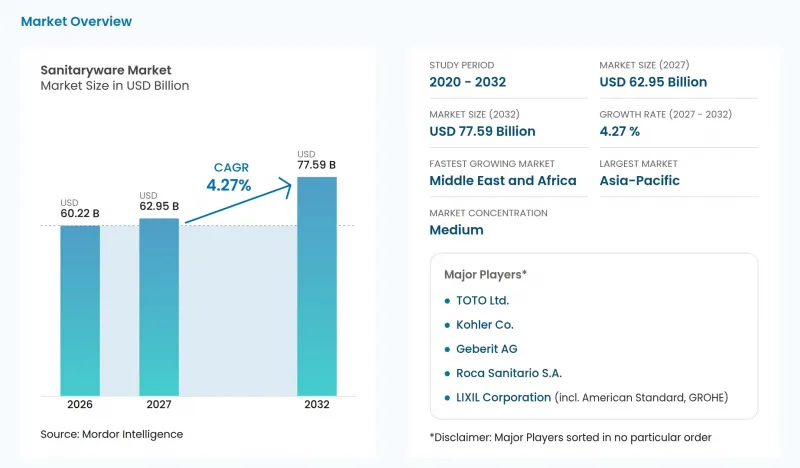
This report is segmented by Product Type (Toilets & Cisterns, Wash Basins & Sinks, and more), Material (Ceramic, Acrylic & Plastics, and more), End-User (Residential, Commercial, and more), Distribution Channel (B2C/Retail and B2B/Project), and Geography (Asia-Pacific, North America, and more). The market forecasts are provided in terms of value (USD), based on availability.
Global Sanitaryware Market Trends and Insights
Premium-segment and water-efficient product uptake
Premium toilet demand can develop around integrated functionality and lower water use, giving buyers a performance-based reason to consider an upgrade. By March 2025, TOTO had shipped more than 4 million NEOREST WASHLET-integrated toilets cumulatively worldwide, describing the line as its top-class toilet product. TOTO reported that NEOREST flush volume had fallen from 8 liters at its 1993 launch to 3.8 liters by April 2025. Cumulative shipments rose from 3 million units in October 2020 to more than 4 million units by March 2025.
Modular, space-saving & prefabricated bathroom pods
Accommodation developments concentrate demand for prefabricated bathroom pods into project-scale orders. Walker Modular won an August 2026 award to supply 2,000 bespoke pods for Newcastle upon Tyne's Castle Leazes redevelopment, identified with 2,000 student beds. Separately, it delivered 742 steel-framed bathroom pods for Belfast's Loft Lines build-to-rent development in August 2026, identified with 778 homes. EcoReadyBath reported a completed 2025 delivery of 74 bathroom pods for a Cologne hotel project, with sanitaryware factory-installed in the units. Factory installation brings sanitaryware into the pod delivery scope, creating fixture demand at the manufacturing stage.
Volatile energy & raw-material prices (clay, zircon)
Energy volatility constrains sanitaryware supply through production interruptions as well as higher fuel expenses at the factory. CERA Sanitaryware Ltd. reported higher weighted average gas costs in Q1 FY2026-27 and said temporary gas-supply uncertainty reduced production and fixed-cost absorption. Gas represented approximately 3.3% of its revenue during that quarter, while the production effect also spread across factory overheads. This combination can make interrupted kiln operations commercially damaging beyond the direct fuel bill, reducing room to absorb cost pressure without repricing. CERA said calibrated price revisions across sanitaryware and faucetware over the preceding 2 quarters offset part of the input-cost increase. Price recovery alone cannot protect the producer from the additional overhead burden of interrupted production.
Other drivers and restraints analyzed in the detailed report include:
- E-commerce-led D2C sanitaryware sales expansion
- Renovation-driven bathroom remodel surge in mature economies
- Stringent kiln-emission & wastewater regulations
For complete list of drivers and restraints, kindly check the Table Of Contents.
Segment Analysis
Toilets and cisterns accounted for a 41.66% share of the sanitaryware market size in 2026, making them the largest segment. In 2025, TOTO USA, a subsidiary of TOTO Ltd., opened a Morrow, Georgia, facility adding annual capacity for about 300,000 luxury one-piece toilets. Before the plant opened, TOTO sourced these toilets primarily from group plants in Asia, where they often faced extended lead times. Localizing this format gives Americas buyers a shorter supply route for premium one-piece toilets.
Wash basins and sinks, including pedestal basins, are the fastest-growing segment, with a forecast CAGR of 6.3% during 2027-2032. By December 2025, RSL Deluxe Bathware had started a SACMI-supplied casting bench at its third plant, the new Nilwala plant in Akuressa, Sri Lanka. The bench is dedicated to pieces made with 2-part molds, so washbasins share it with pedestals, squat pans and lids.
Ceramic represented a 77.07% sanitaryware market share in 2026, making it the largest segment. In May 2025, TOTO reported combined annual capacity of about 2.65 million sanitary-ceramic pieces at its Liaoning and Fujian sites serving mainland China. Production at Liaoning began on May 21, 2025, as TOTO developed this 2-site manufacturing arrangement for the mainland Chinese market. Liaoning's designed annual capacity of about 700,000 pieces is roughly a quarter of the 2-site total, leaving Fujian with the larger capacity share serving mainland China.
Solid surface and composite materials form the fastest-growing segment, with a forecast CAGR of 6.2% during 2027-2032. In March 2025, Roman molded solid-surface trays and basins in-house at its County Durham manufacturing operation in the United Kingdom. It also fabricated bespoke solid-surface bathroom structures, including vanity tops. At that time Roman operated a 400,000-square-foot County Durham facility that also produced shower enclosures, wetroom panels and bath screens.
Complete Report Scope:
- By Product Type
- Toilets & Cisterns (Water Closets)
- Wash Basins & Sinks (incl. Pedestal Basins)
- Bathtubs & Whirlpool Tubs
- Urinals
- Bidets
- Other Products (such as ceramic soap trays, soap dispensers, etc.)
- By Material
- Ceramic
- Pressed Metal
- Acrylic & Plastics
- Solid Surface & Composite
- By End-User
- Residential (New-build and Renovation)
- Commercial (Hospitality, Offices, Retail)
- Institutional (Healthcare, Education, Public)
- By Distribution Channel
- B2C/Retail
- Multi-brand Stores
- Exclusive Brand Outlets
- Local Hardware Stores
- Online
- B2B/Project (developers, architects, interior designers, contractors, etc.)
- B2C/Retail
- By Geography
- North America
- United States
- Canada
- Mexico
- South America
- Brazil
- Argentina
- Chile
- Peru
- Rest of South America
- Europe
- United Kingdom
- Germany
- France
- Spain
- Italy
- BENELUX
- NORDICS
- Rest of Europe
- Asia-Pacific
- China
- India
- Japan
- South Korea
- Australia
- South-East Asia
- Rest of Asia-Pacific
- Middle East and Africa
- United Arab Emirates
- Saudi Arabia
- South Africa
- Nigeria
- Rest of Middle East and Africa
- North America
Geography Analysis
Asia-Pacific accounted for a 40.01% sanitaryware market share in 2026, making it the largest regional market. China produced 172 million sanitary-ceramic pieces in 2025, down 4.87% from 2024, according to association data reproduced in Dongpeng Holdings' annual report. That production scale provides a supply-side foundation for the region's position, despite the decline in Chinese output in 2025. In Bangladesh, part of the rest of Asia-Pacific, ROSA Sanitaryware sold 140,000 pieces in May 2025, its highest monthly volume reported at that point.
Middle East and Africa is the fastest-growing region, with a forecast CAGR of 6.7% during 2027-2032. Saudi Ceramic Company installed and commissioned low-pressure casting machines for its sanitaryware segment in Saudi Arabia in 2025. In the rest of Middle East and Africa, Lecico Egypt sold 226,000 sanitaryware pieces in Egypt in Q2 2026, up from 165,000 a year earlier. Lodging Econometrics' Q2 2026 hotel pipelines reached 724 Middle East projects, up 11% year over year, and 343 African projects, up 15%, at varying development stages, offering future fixture-specification opportunities.
In North America, 42% of new single-family homes completed for sale in the US Northeast in 2025 had 3 or more bathrooms. In South America, Brazil's Minha Casa, Minha Vida program launched 224,842 housing units in 2025, up 13.5% from 2024, and sold 196,876 units, up 15.9%. In the rest of South America, Colombia's housing ministry opened a December 2025 urban and rural housing-improvement subsidy call covering 16 departments including Vichada, with sanitary-fixture upgrades among eligible interventions. In the rest of Europe, Poland's dwelling completions increased in 2025 even as permits and construction starts declined. EU nonresidential energy-renovation milestones for 2030 and 2033, subject to national thresholds and permitted historic-building or negative cost-benefit exemptions, can create occasions to coordinate optional fixture work with broader building upgrades.
- TOTO Ltd.
- Kohler Co.
- LIXIL Corporation (incl. American Standard, GROHE)
- Roca Sanitario S.A.
- Geberit AG
- Hansgrohe SE
- Villeroy & Boch AG
- Duravit AG
- Jaquar Group
- Ideal Standard International
- RAK Ceramics PJSC
- Huida Sanitary Ware Co.
- Foshan Faen Sanitary Ware Co., Ltd.
- CERA Sanitaryware Ltd.
- Hindware Home Innovation Ltd.
- VitrA (EczacIbasI)
- Lecico Egypt
- H & R Johnson (Prism Johnson)
- Oras Group
- Colavene S.p.A.
- Globe Union Industrial Corp.
- Jabra Sanitary
Additional Benefits:
- The market estimate (ME) sheet in Excel format
- 3 months of analyst support
TABLE OF CONTENTS
1 INTRODUCTION
- 1.1 Study Assumptions and Market Definition
- 1.2 Scope of the Study
2 RESEARCH METHODOLOGY
3 EXECUTIVE SUMMARY
4 MARKET LANDSCAPE
- 4.1 Market Overview
- 4.2 Market Drivers
- 4.2.1 Premium-segment and water-efficient product uptake
- 4.2.2 Modular, space-saving & prefabricated bathroom pods
- 4.2.3 E-commerce-led D2C sanitaryware sales expansion
- 4.2.4 Renovation-driven bathroom remodel surge in mature economies
- 4.2.5 Rapid urbanization & residential construction boom
- 4.2.6 Smart, antimicrobial ceramic-coating innovations
- 4.3 Market Restraints
- 4.3.1 Volatile energy & raw-material prices (clay, zircon)
- 4.3.2 Stringent kiln-emission & wastewater regulations
- 4.3.3 Plumbing labor shortages delaying installations
- 4.3.4 Refurbishment/reuse trend under circular-economy pressure
- 4.4 Industry Value Chain Analysis
- 4.5 Regulatory Landscape
- 4.6 Technological Outlook
- 4.7 Porter's Five Forces Analysis
- 4.7.1 Threat of New Entrants
- 4.7.2 Bargaining Power of Suppliers
- 4.7.3 Bargaining Power of Buyers
- 4.7.4 Threat of Substitutes
- 4.7.5 Competitive Rivalry
- 4.8 Insights Into The Latest Trends And Innovations in the Market
- 4.9 Insights On Recent Developments (New Product Launches, Strategic Initiatives, Investments, Partnerships, JVs, Expansion, M&As, Etc.) In The Market
5 MARKET SIZE AND GROWTH FORECASTS (VALUE)
- 5.1 By Product Type
- 5.1.1 Toilets & Cisterns (Water Closets)
- 5.1.2 Wash Basins & Sinks (incl. Pedestal Basins)
- 5.1.3 Bathtubs & Whirlpool Tubs
- 5.1.4 Urinals
- 5.1.5 Bidets
- 5.1.6 Other Products (such as ceramic soap trays, soap dispensers, etc.)
- 5.2 By Material
- 5.2.1 Ceramic
- 5.2.2 Pressed Metal
- 5.2.3 Acrylic & Plastics
- 5.2.4 Solid Surface & Composite
- 5.3 By End-User
- 5.3.1 Residential (New-build and Renovation)
- 5.3.2 Commercial (Hospitality, Offices, Retail)
- 5.3.3 Institutional (Healthcare, Education, Public)
- 5.4 By Distribution Channel
- 5.4.1 B2C/Retail
- 5.4.1.1 Multi-brand Stores
- 5.4.1.2 Exclusive Brand Outlets
- 5.4.1.3 Local Hardware Stores
- 5.4.1.4 Online
- 5.4.2 B2B/Project (developers, architects, interior designers, contractors, etc.)
- 5.4.1 B2C/Retail
- 5.5 By Geography
- 5.5.1 North America
- 5.5.1.1 United States
- 5.5.1.2 Canada
- 5.5.1.3 Mexico
- 5.5.2 South America
- 5.5.2.1 Brazil
- 5.5.2.2 Argentina
- 5.5.2.3 Chile
- 5.5.2.4 Peru
- 5.5.2.5 Rest of South America
- 5.5.3 Europe
- 5.5.3.1 United Kingdom
- 5.5.3.2 Germany
- 5.5.3.3 France
- 5.5.3.4 Spain
- 5.5.3.5 Italy
- 5.5.3.6 BENELUX
- 5.5.3.7 NORDICS
- 5.5.3.8 Rest of Europe
- 5.5.4 Asia-Pacific
- 5.5.4.1 China
- 5.5.4.2 India
- 5.5.4.3 Japan
- 5.5.4.4 South Korea
- 5.5.4.5 Australia
- 5.5.4.6 South-East Asia
- 5.5.4.7 Rest of Asia-Pacific
- 5.5.5 Middle East and Africa
- 5.5.5.1 United Arab Emirates
- 5.5.5.2 Saudi Arabia
- 5.5.5.3 South Africa
- 5.5.5.4 Nigeria
- 5.5.5.5 Rest of Middle East and Africa
- 5.5.1 North America
6 COMPETITIVE LANDSCAPE
- 6.1 Market Concentration
- 6.2 Strategic Moves
- 6.3 Market Share Analysis
- 6.4 Company Profiles (includes Global level Overview, Market level overview, Core Segments, Financials as available, Strategic Information, Market Rank/Share for key companies, Products and Services, and Recent Developments)
- 6.4.1 TOTO Ltd.
- 6.4.2 Kohler Co.
- 6.4.3 LIXIL Corporation (incl. American Standard, GROHE)
- 6.4.4 Roca Sanitario S.A.
- 6.4.5 Geberit AG
- 6.4.6 Hansgrohe SE
- 6.4.7 Villeroy & Boch AG
- 6.4.8 Duravit AG
- 6.4.9 Jaquar Group
- 6.4.10 Ideal Standard International
- 6.4.11 RAK Ceramics PJSC
- 6.4.12 Huida Sanitary Ware Co.
- 6.4.13 Foshan Faen Sanitary Ware Co., Ltd.
- 6.4.14 CERA Sanitaryware Ltd.
- 6.4.15 Hindware Home Innovation Ltd.
- 6.4.16 VitrA (EczacIbasI)
- 6.4.17 Lecico Egypt
- 6.4.18 H & R Johnson (Prism Johnson)
- 6.4.19 Oras Group
- 6.4.20 Colavene S.p.A.
- 6.4.21 Globe Union Industrial Corp.
- 6.4.22 Jabra Sanitary
7 MARKET OPPORTUNITIES AND FUTURE OUTLOOK
- 7.1 White-Space and Unmet-Need Assessment

