PUBLISHER: Mordor Intelligence | PRODUCT CODE: 2156899

PUBLISHER: Mordor Intelligence | PRODUCT CODE: 2156899
Pottery Ceramic - Market Share Analysis, Industry Trends & Statistics, Growth Forecasts (2026 - 2031)
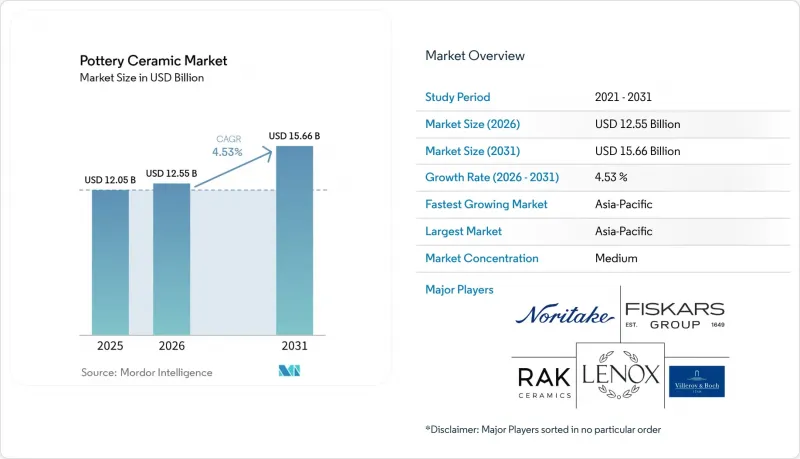
According to Mordor Intelligence, the pottery ceramic market size was valued at USD 12.05 billion in 2025 and is estimated to grow from USD 12.55 billion in 2026 to reach USD 15.66 billion by 2031, at a CAGR of 4.53% during the forecast period (2026-2031).
Global Pottery Ceramic Market Trends and Insights
Hospitality-Led Demand for Premium and Custom Pottery
Premium hospitality increasingly treats tableware as part of the guest experience, shifting demand toward custom shapes, finishes, and dependable replacement supply. Hilton added nearly 800 hotels and more than 100,000 rooms during 2025 and maintained a pipeline of more than 520,000 rooms in January 2026. This expansion provides the pottery ceramic market with a visible forward base for commercial tableware purchasing. Hotels require products that can withstand high service frequency, repeated washing, and routine handling without compromising presentation. Food-contact requirements also support demand for certified lead-free formulations in commercial procurement. The pottery ceramic market benefits when suppliers can meet custom needs while maintaining consistent specifications across subsequent orders.
E-Commerce Access for Artisanal Producers
Digital platforms have changed how artisanal producers enter the pottery ceramic market and how customers discover small-batch products. Claymistry reported more than 10,000 orders to over 8,000 households between November 2023 and April 2026, with more than 265 SKUs and over 30 B2B clients. This channel reduces dependence on proximity to major manufacturing hubs and traditional retail networks. It also allows studios to test designs, manage limited runs, and serve customers across multiple locations. A peer-reviewed study found that packaging level was the main determinant of porcelain transport losses in e-commerce supply chains. Digital access improves market reach, but logistics execution remains essential to the pottery ceramic market.
Kiln Energy Exposure and Carbon-Compliance Costs
Energy remains a major variable cost in fired ceramic production. According to the British Ceramic Confederation, the UK ceramic sector derived 85.00% of its energy consumption from gas. This reliance limits producers' ability to respond quickly to changes in fuel and carbon costs. A 2025 life-cycle study found that switching to hydrogen fuel could reduce global warming potential by 85.00% under net-zero pathways, although the economic case depends on future carbon prices. High-temperature firing is difficult to decarbonize because it relies on intense, reliable heat. These pressures affect the pottery ceramic market most sharply, where smaller producers have limited capacity for capital investment and verification systems.
Other drivers and restraints analyzed in the detailed report include:
- Mainstream Shift Toward Sustainable and Reusable Ceramics
- Digital Design and Precision Firing Adoption
- Breakage, Returns, and Freight Losses in Omnichannel Distribution
For complete list of drivers and restraints, kindly check the Table Of Contents.
Segment Analysis
Functional pottery accounted for 44.13% of the ceramic pottery market share in 2025. It benefits from repeat purchases by hotels, restaurants, and households that replace items used in daily service. Buyers in these channels value durability, stackability, chip resistance, and stable glazing quality. Functional formats also align with recurring procurement cycles in hospitality, where standardization supports both staff and purchasing teams. Artistic pottery serves premium collectors and gifting demand in North America and Europe. Its expansion is constrained by limited production scalability and the labor involved in handmade work.
Decorative pottery is projected to grow at a 5.21% CAGR from 2026 to 2031. It benefits from home decor spending and digital product discovery, especially when an object can serve both as a display and for everyday use. The decorative pottery and ceramic market size is supported by the growing overlap between functional objects and lifestyle purchases. Pottery-making is also associated with well-being and sensory engagement, which strengthens interest in handmade goods. Digital therapeutic and heritage experiences further enhance the visibility of craft-based products. Producers that retain a distinct handmade identity while managing reliable fulfillment can address both decorative and functional demand.
Wheel-throwing held 48.34% of the manufacturing-technique share in 2025. It remains central to artisan studios and premium collections, where the handmade appearance supports product differentiation. The process is closely associated with provenance, limited batches, and the visible qualities sought by collectors. Hand-building remains relevant for ceramics education, art therapy, and bespoke sculptural work. These uses support commercial activity through studio enrollment and institutional buying. Wheel-throwing continues to hold a strong position where customers value the maker's involvement in the finished product.
Slip-casting is projected to grow at a 4.95% CAGR from 2026 to 2031. It consistently reproduces complex forms at scale without relying on wheel skills for each piece. This makes it suitable for hospitality, original equipment manufacturing orders, and architectural components that require repeatable specifications. Digital firing controls support this process by reducing temperature variation and the risk of defects. ISA's WD300 system provides real-time process monitoring for reduction-fired ceramics. The pottery and ceramic market continues to rely on wheel-thrown production for premium niches, while slip-casting serves larger commercial contracts.
Complete Report Scope:
- By Type
- Artistic Pottery
- Functional Pottery
- Decorative Pottery
- By Manufacturing Technique
- Wheel-Throwing
- Hand-Building
- Slip-Casting
- By Material
- Earthenware
- Stoneware
- Porcelain
- Bone China
- By Glaze Type
- Clear Glaze
- Matte Glaze
- Glossy Glaze
- Craquelure Glaze
- By Firing Temperature
- Low-Fire Pottery
- Mid-Range Pottery
- High-Fire Pottery
- By Application
- Tableware and Kitchenware
- Decorative Items
- Architectural and Building Pottery
- Others
- By Geography
- Asia-Pacific
- China
- India
- Japan
- South Korea
- ASEAN Countries
- Rest of Asia-Pacific
- North America
- United States
- Canada
- Mexico
- Europe
- Germany
- United Kingdom
- France
- Italy
- NORDIC Countries
- Rest of Europe
- South America
- Brazil
- Argentina
- Rest of South America
- Middle East and Africa
- Saudi Arabia
- South Africa
- Rest of Middle East and Africa
- Asia-Pacific
Geography Analysis
Asia-Pacific accounted for 42.17% of the pottery and ceramic market share in 2025 and is forecast to grow at a 5.38% CAGR from 2026 to 2031. China remains a major production center due to its manufacturing scale and established ceramic clusters. Jingdezhen operates a 5G-enabled smart kiln production cluster that supports monitoring of energy, emissions, and firing conditions. India is seeing design-led demand grow alongside its large household base. Claymistry reported growth in repeat purchases and average order values across Indian metropolitan areas, with Jaipur and Kochi identified as additional locations for handcrafted ceramics. Japan and South Korea support premium craft output through established ceramic traditions. Aichi Prefecture hosted the 65th Father of Seto Pottery Festival in April 2026.
North America and Europe are established yet structurally distinct segments of the pottery and ceramic market. North American demand reflects HoReCa activity, an active studio culture, and consumer interest in premium kitchen and home goods. Canada has developed direct-to-consumer demand for handcrafted pottery through craft markets and e-commerce. European buyers place strong value on design, provenance, and product quality, particularly in Germany, France, Italy, and the UK. The 46th European Ceramic Market in Hohr-Grenzhausen brought together 134 juried ceramicists from 8 countries in June 2026, reflecting the continuing role of European craft standards in the global pottery ceramic market. Premium suppliers in the region continue to face cautious discretionary spending conditions.
South America, the Middle East, and Africa hold smaller positions in the pottery ceramic market but have distinct sources of demand. Brazil's hospitality expansion is supporting purchases of commercial tableware for tourism-related facilities. Argentina's artisan ceramics culture supports export activity to North American boutique buyers. Saudi Arabia's hospitality investment is driving demand for premium tableware and custom architectural ceramics. South Africa contributes to consumer demand through its urban middle class and design-craft ceramics activity. Local sourcing capacity is limited in several of these markets, creating an opening for international suppliers with dependable delivery. These regions will benefit when tourism projects move from planning to procurement for functional and architectural products.
- Bernardaud
- Churchill China Ltd
- Denby
- Fiskars Group
- Kutahya Porcelain
- Lenox Corporation
- NORITAKE CO., LIMITED
- Porland Porselen
- Portmeirion Group PLC
- RAK CERAMICS
- Rosenthal GmbH
- Steelite International
- The Royal Crown Derby Porcelain Company Limited
- Villeroy & Boch Group
- Vista Alegre Atlantis SGPS, S.A.
Additional Benefits:
- The market estimate (ME) sheet in Excel format
- 3 months of analyst support
TABLE OF CONTENTS
1 Introduction
- 1.1 Study Assumptions and Market Definition
- 1.2 Scope of the Study
2 Research Methodology
3 Executive Summary
4 Market Landscape
- 4.1 Market Overview
- 4.2 Market Drivers
- 4.2.1 Hospitality-Led Demand for Premium and Custom Pottery
- 4.2.2 E-Commerce Access for Artisanal Producers
- 4.2.3 Mainstream Shift Toward Sustainable and Reusable Ceramics
- 4.2.4 Digital Design and Precision Firing Adoption
- 4.2.5 Therapeutic, Educational, and Cultural Participation in Pottery
- 4.3 Market Restraints
- 4.3.1 Kiln Energy Exposure and Carbon-Compliance Costs
- 4.3.2 Breakage, Returns, and Freight Losses in Omnichannel Distribution
- 4.3.3 Geographic Concentration of Clay and Mineral Inputs
- 4.4 Value Chain Analysis
- 4.5 Porter's Five Forces Analysis
- 4.5.1 Threat of New Entrants
- 4.5.2 Bargaining Power of Suppliers
- 4.5.3 Bargaining Power of Buyers
- 4.5.4 Threat of Substitutes
- 4.5.5 Competitive Rivalry
5 Market Size and Growth Forecasts (Value)
- 5.1 By Type
- 5.1.1 Artistic Pottery
- 5.1.2 Functional Pottery
- 5.1.3 Decorative Pottery
- 5.2 By Manufacturing Technique
- 5.2.1 Wheel-Throwing
- 5.2.2 Hand-Building
- 5.2.3 Slip-Casting
- 5.3 By Material
- 5.3.1 Earthenware
- 5.3.2 Stoneware
- 5.3.3 Porcelain
- 5.3.4 Bone China
- 5.4 By Glaze Type
- 5.4.1 Clear Glaze
- 5.4.2 Matte Glaze
- 5.4.3 Glossy Glaze
- 5.4.4 Craquelure Glaze
- 5.5 By Firing Temperature
- 5.5.1 Low-Fire Pottery
- 5.5.2 Mid-Range Pottery
- 5.5.3 High-Fire Pottery
- 5.6 By Application
- 5.6.1 Tableware and Kitchenware
- 5.6.2 Decorative Items
- 5.6.3 Architectural and Building Pottery
- 5.6.4 Others
- 5.7 By Geography
- 5.7.1 Asia-Pacific
- 5.7.1.1 China
- 5.7.1.2 India
- 5.7.1.3 Japan
- 5.7.1.4 South Korea
- 5.7.1.5 ASEAN Countries
- 5.7.1.6 Rest of Asia-Pacific
- 5.7.2 North America
- 5.7.2.1 United States
- 5.7.2.2 Canada
- 5.7.2.3 Mexico
- 5.7.3 Europe
- 5.7.3.1 Germany
- 5.7.3.2 United Kingdom
- 5.7.3.3 France
- 5.7.3.4 Italy
- 5.7.3.5 NORDIC Countries
- 5.7.3.6 Rest of Europe
- 5.7.4 South America
- 5.7.4.1 Brazil
- 5.7.4.2 Argentina
- 5.7.4.3 Rest of South America
- 5.7.5 Middle East and Africa
- 5.7.5.1 Saudi Arabia
- 5.7.5.2 South Africa
- 5.7.5.3 Rest of Middle East and Africa
- 5.7.1 Asia-Pacific
6 Competitive Landscape
- 6.1 Market Concentration
- 6.2 Strategic Moves
- 6.3 Market Share (%)/Ranking Analysis
- 6.4 Company Profiles (includes Global Overview, Market Overview, Core Segments, Financials as available, Strategic Information, Products and Services, and Recent Developments)
- 6.4.1 Bernardaud
- 6.4.2 Churchill China Ltd
- 6.4.3 Denby
- 6.4.4 Fiskars Group
- 6.4.5 Kutahya Porcelain
- 6.4.6 Lenox Corporation
- 6.4.7 NORITAKE CO., LIMITED
- 6.4.8 Porland Porselen
- 6.4.9 Portmeirion Group PLC
- 6.4.10 RAK CERAMICS
- 6.4.11 Rosenthal GmbH
- 6.4.12 Steelite International
- 6.4.13 The Royal Crown Derby Porcelain Company Limited
- 6.4.14 Villeroy & Boch Group
- 6.4.15 Vista Alegre Atlantis SGPS, S.A.
7 Market Opportunities and Future Outlook
- 7.1 White-Space and Unmet-Need Assessment

