PUBLISHER: Mordor Intelligence | PRODUCT CODE: 2097183

PUBLISHER: Mordor Intelligence | PRODUCT CODE: 2097183
Middle East and Africa Fruits and Vegetables - Market Share Analysis, Industry Trends & Statistics, Growth Forecasts (2026 - 2031)
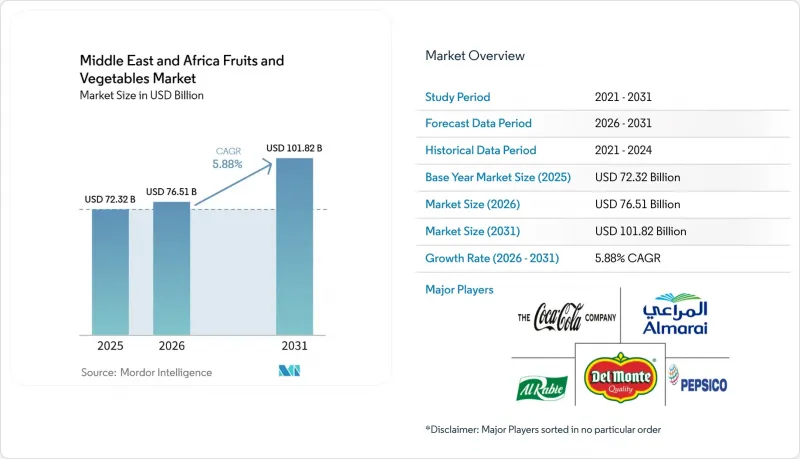
According to Mordor Intelligence, the Middle East and Africa fruits and vegetables market is forecast to grow from USD 72.32 billion in 2025 to USD 76.51 billion in 2026, reaching USD 101.82 billion by 2031, at a CAGR of 5.8% during the forecast period 2026-2031.
This report is Segmented by Type (Fruits and Vegetables), and by Geography (Middle East and Africa). The Report Includes Production Analysis (Volume), Consumption Analysis (Value and Volume), Export Analysis (Value and Volume), Import Analysis (Value and Volume), and More. The Market Forecasts are Provided in Terms of Value (USD) and Volume (Metric Tons).
Middle East and Africa Fruits and Vegetables Market Trends and Insights
Rising Import Dependence in the Middle East
The fresh fruits and vegetables market in the Middle East and Africa remains highly exposed to the Gulf region's dependence on imports. This dependence supports trade volumes but also increases supply risks. In early 2026, disruptions to movement through the Strait of Hormuz forced retailers, including LuLu Group, to arrange more than 37 charter flights and import over 6,000 tons of fresh produce within a short period. This event showed that buyers could no longer rely on narrow just-in-time replenishment systems, as fresh produce availability could be affected within days. It also prompted importers to broaden their supplier base, hold more safety stock, and place greater value on distributors that could secure cargo capacity under pressure. South Africa and Kenya stand to benefit from this shift, as both already supply regional produce flows and can support diversification goals when Gulf buyers seek alternative origins. As a result, the fresh fruits and vegetables market in the Middle East and Africa is seeing demand growth from higher import planning needs and stronger local production spending.
Expansion of Controlled Environment Agriculture
Controlled-environment agriculture (CEA) is reshaping the supply side of the fresh fruits and vegetables market in the Middle East and Africa by stabilizing production in areas where open-field farming is constrained by climate conditions and water scarcity. Investment across the Middle East is shifting this model from pilot projects to commercial scale, particularly in Saudi Arabia, where Dava Agricultural's Taif project spans 350 hectares of glass greenhouses and targets output of 250 metric tons of fresh produce per day by 2028 and 1,000 metric tons per day by 2030. In the United Arab Emirates, adoption of greenhouse, hydroponic, and precision irrigation systems is also expanding. In May 2025, Silal and China's Shouguang Vegetable Industry Group announced an AED 120 million (USD 32.7 million) smart AgriTech hub in Al Ain, anticipated to reduce water and fertilizer use by up to 30%. These projects are reducing exposure to import disruptions, improving supply reliability for retailers and foodservice buyers, and supporting year-round sourcing of premium categories such as pesticide-free, traceable, and retail-ready produce. Over time, these developments are anticipated to retain more value within the regional fresh produce market and gradually reduce dependence on emergency imports across selected vegetable and premium fruit categories.
Water Scarcity and High Irrigation Costs
Water scarcity remains the most structural constraint on the fresh fruits and vegetables market in the Middle East and Africa, as local supply expansion cannot extend far beyond resource limits without costly technology. This situation makes conventional open-field cultivation less competitive in areas where desalination, groundwater pressure, and irrigation costs affect farm economics. It also concentrates local production growth among operators that can invest in hydroponics, drip systems, climate control, and tighter crop management. Smaller farms struggle to keep pace as yields, water use, and market standards become more demanding. As a result, the fresh fruits and vegetables market in the Middle East and Africa continues to face a persistent tension between food security goals and the cost of producing more crops in arid environments.
Other drivers and restraints analyzed in the detailed report include:
- Food Security Programs Supporting Local Production
- Modern Retail Expansion and Cold-Chain Development
- Post-Harvest Losses and Weak Cold-Chain Coverage in Africa
For complete list of drivers and restraints, kindly check the Table Of Contents.
Segment Analysis
Vegetables held a 56.25% market share in 2025, maintaining their position as the dominant fresh produce category across the Middle East and Africa. This is driven by the consistent demand for staple items such as tomatoes, onions, potatoes, cucumbers, and leafy greens in daily diets across both regions. Vegetable demand remains stable across income groups, as these products are distributed through wet markets, supermarkets, and foodservice channels with limited substitution. In the Middle East, greenhouse and controlled-environment farming is gradually reducing dependence on imported vegetables, particularly in categories such as tomatoes. In Africa, vegetable supply remains largely domestic and informal, though weak cold-chain infrastructure continues to limit the volume of farm output that reaches the market in saleable condition.
Fruits are projected to grow at a CAGR of 5.9% between 2026 and 2031, making them the faster-growing product type. This growth is supported by rising consumption of premium and health-focused fruit in GCC cities and through organized retail in markets such as South Africa. African fruit exports have also demonstrated strong long-term momentum, supporting the segment's outlook. Categories such as avocados, blueberries, grapes, and citrus are contributing greater value to the fruit segment, while local production projects in the Gulf are beginning to replace some imported premium varieties. Kenya remains an important supplier in this space, with fruits accounting for 30% of the country's horticultural export earnings in 2025. Africa's avocado export growth further highlights the region's increasing role as a premium fruit supplier to both Middle Eastern and European buyers.
Complete Report Scope:
- By Type
- Vegetables
- Potatoes
- Production Analysis
- Production Volume
- Area Harvested and Yield
- Consumption Analysis (Value and Volume)
- Trade Analysis (Value and Volume)
- Import Market Analysis
- Import Value and Volume
- Key Supplying Markets
- Export Market Analysis
- Export Value and Volume
- Key Destination Markets
- Import Market Analysis
- Wholesale Price Trend Analysis and Forecast
- Seasonality Analysis
- Production Analysis
- Tomatoes
- Production Analysis
- Production Volume
- Area Harvested and Yield
- Consumption Analysis (Value and Volume)
- Trade Analysis (Value and Volume)
- Import Market Analysis
- Import Value and Volume
- Key Supplying Markets
- Export Market Analysis
- Export Value and Volume
- Key Destination Markets
- Import Market Analysis
- Wholesale Price Trend Analysis and Forecast
- Seasonality Analysis
- Production Analysis
- Onions
- Production Analysis
- Production Volume
- Area Harvested and Yield
- Consumption Analysis (Value and Volume)
- Trade Analysis (Value and Volume)
- Import Market Analysis
- Import Value and Volume
- Key Supplying Markets
- Export Market Analysis
- Export Value and Volume
- Key Destination Markets
- Import Market Analysis
- Wholesale Price Trend Analysis and Forecast
- Seasonality Analysis
- Production Analysis
- Potatoes
- Fruits
- Grapes
- Production Analysis
- Production Volume
- Area Harvested and Yield
- Consumption Analysis (Value and Volume)
- Trade Analysis (Value and Volume)
- Import Market Analysis
- Import Value and Volume
- Key Supplying Markets
- Export Market Analysis
- Export Value and Volume
- Key Destination Markets
- Import Market Analysis
- Wholesale Price Trend Analysis and Forecast
- Seasonality Analysis
- Production Analysis
- Apples
- Production Analysis
- Production Volume
- Area Harvested and Yield
- Consumption Analysis (Value and Volume)
- Trade Analysis (Value and Volume)
- Import Market Analysis
- Import Value and Volume
- Key Supplying Markets
- Export Market Analysis
- Export Value and Volume
- Key Destination Markets
- Import Market Analysis
- Wholesale Price Trend Analysis and Forecast
- Seasonality Analysis
- Production Analysis
- Blueberries
- Production Analysis
- Production Volume
- Area Harvested and Yield
- Consumption Analysis (Value and Volume)
- Trade Analysis (Value and Volume)
- Import Market Analysis
- Import Value and Volume
- Key Supplying Markets
- Export Market Analysis
- Export Value and Volume
- Key Destination Markets
- Import Market Analysis
- Wholesale Price Trend Analysis and Forecast
- Seasonality Analysis
- Production Analysis
- Cherries
- Production Analysis
- Production Volume
- Area Harvested and Yield
- Consumption Analysis (Value and Volume)
- Trade Analysis (Value and Volume)
- Import Market Analysis
- Import Value and Volume
- Key Supplying Markets
- Export Market Analysis
- Export Value and Volume
- Key Destination Markets
- Import Market Analysis
- Wholesale Price Trend Analysis and Forecast
- Seasonality Analysis
- Production Analysis
- Avocados
- Production Analysis
- Production Volume
- Area Harvested and Yield
- Consumption Analysis (Value and Volume)
- Trade Analysis (Value and Volume)
- Import Market Analysis
- Import Value and Volume
- Key Supplying Markets
- Export Market Analysis
- Export Value and Volume
- Key Destination Markets
- Import Market Analysis
- Wholesale Price Trend Analysis and Forecast
- Seasonality Analysis
- Production Analysis
- Kiwi
- Production Analysis
- Production Volume
- Area Harvested and Yield
- Consumption Analysis (Value and Volume)
- Trade Analysis (Value and Volume)
- Import Market Analysis
- Import Value and Volume
- Key Supplying Markets
- Export Market Analysis
- Export Value and Volume
- Key Destination Markets
- Import Market Analysis
- Wholesale Price Trend Analysis and Forecast
- Seasonality Analysis
- Production Analysis
- Grapes
- Vegetables
- Geography
- Middle East
- Saudi Arabia
- Production Analysis (Area Harvested, Yield, and Production Volume)
- Consumption Analysis (Consumption Value and Volume)
- Import Market Analysis (Import Value, Volume, and Key Supplying Markets)
- Export Market Analysis (Export Value, Volume, and Key Destination Markets)
- Wholesale Price Trend Analysis and Forecast
- Regulatory Framework
- List of Key Players
- Logistics and Infrastructure
- Seasonality Analysis
- United Arab Emirates
- Production Analysis (Area Harvested, Yield, and Production Volume)
- Consumption Analysis (Consumption Value and Volume)
- Import Market Analysis (Import Value, Volume, and Key Supplying Markets)
- Export Market Analysis (Export Value, Volume, and Key Destination Markets)
- Wholesale Price Trend Analysis and Forecast
- Regulatory Framework
- List of Key Players
- Logistics and Infrastructure
- Seasonality Analysis
- Saudi Arabia
- Africa
- South Africa
- Production Analysis (Area Harvested, Yield, and Production Volume)
- Consumption Analysis (Consumption Value and Volume)
- Import Market Analysis (Import Value, Volume, and Key Supplying Markets)
- Export Market Analysis (Export Value, Volume, and Key Destination Markets)
- Wholesale Price Trend Analysis and Forecast
- Regulatory Framework
- List of Key Players
- Logistics and Infrastructure
- Seasonality Analysis
- Kenya
- Production Analysis (Area Harvested, Yield, and Production Volume)
- Consumption Analysis (Consumption Value and Volume)
- Import Market Analysis (Import Value, Volume, and Key Supplying Markets)
- Export Market Analysis (Export Value, Volume, and Key Destination Markets)
- Wholesale Price Trend Analysis and Forecast
- Regulatory Framework
- List of Key Players
- Logistics and Infrastructure
- Seasonality Analysis
- South Africa
- Middle East
Additional Benefits:
- The market estimate (ME) sheet in Excel format
- 3 months of analyst support
TABLE OF CONTENTS
1 INTRODUCTION
- 1.1 Study Assumptions and Market Definition
- 1.2 Scope of the Study
2 RESEARCH METHODOLOGY
3 EXECUTIVE SUMMARY
4 MARKET LANDSCAPE
- 4.1 Market Overview
- 4.2 Market Drivers
- 4.2.1 Rising import dependence in the Middle East
- 4.2.2 Expansion of controlled environment agriculture
- 4.2.3 Food security programs supporting local production
- 4.2.4 Modern retail expansion and cold-chain development
- 4.2.5 Premium demand for fresh, organic, and ready-to-eat produce
- 4.2.6 Digital procurement and traceability adoption
- 4.3 Market Restraints
- 4.3.1 Water scarcity and high irrigation costs
- 4.3.2 Post-harvest losses and weak cold-chain coverage in Africa
- 4.3.3 Import cost volatility and logistics disruptions
- 4.3.4 Fragmented smallholder supply and quality inconsistency
- 4.4 Opportunities
- 4.5 Challenges
- 4.6 Value Chain Analysis
- 4.7 Technologies and Usage of AI in the Industry
- 4.8 Input Market Analysis
- 4.8.1 Seeds
- 4.8.2 Fertilizers
- 4.8.3 Crop Protection Chemicals
- 4.9 Distribution Channel Analysis
- 4.10 Market Sentiment Analysis
- 4.11 PESTLE Analysis
5 MARKET SIZE AND GROWTH FORECAST (VALUE AND VOLUME)
- 5.1 By Type
- 5.1.1 Vegetables
- 5.1.1.1 Potatoes
- 5.1.1.1.1 Production Analysis
- 5.1.1.1.1.1 Production Volume
- 5.1.1.1.1.2 Area Harvested and Yield
- 5.1.1.1.2 Consumption Analysis (Value and Volume)
- 5.1.1.1.3 Trade Analysis (Value and Volume)
- 5.1.1.1.3.1 Import Market Analysis
- 5.1.1.1.3.1.1 Import Value and Volume
- 5.1.1.1.3.1.2 Key Supplying Markets
- 5.1.1.1.3.2 Export Market Analysis
- 5.1.1.1.3.2.1 Export Value and Volume
- 5.1.1.1.3.2.2 Key Destination Markets
- 5.1.1.1.3.1 Import Market Analysis
- 5.1.1.1.4 Wholesale Price Trend Analysis and Forecast
- 5.1.1.1.5 Seasonality Analysis
- 5.1.1.1.1 Production Analysis
- 5.1.1.2 Tomatoes
- 5.1.1.2.1 Production Analysis
- 5.1.1.2.1.1 Production Volume
- 5.1.1.2.1.2 Area Harvested and Yield
- 5.1.1.2.2 Consumption Analysis (Value and Volume)
- 5.1.1.2.3 Trade Analysis (Value and Volume)
- 5.1.1.2.3.1 Import Market Analysis
- 5.1.1.2.3.1.1 Import Value and Volume
- 5.1.1.2.3.1.2 Key Supplying Markets
- 5.1.1.2.3.2 Export Market Analysis
- 5.1.1.2.3.2.1 Export Value and Volume
- 5.1.1.2.3.2.2 Key Destination Markets
- 5.1.1.2.3.1 Import Market Analysis
- 5.1.1.2.4 Wholesale Price Trend Analysis and Forecast
- 5.1.1.2.5 Seasonality Analysis
- 5.1.1.2.1 Production Analysis
- 5.1.1.3 Onions
- 5.1.1.3.1 Production Analysis
- 5.1.1.3.1.1 Production Volume
- 5.1.1.3.1.2 Area Harvested and Yield
- 5.1.1.3.2 Consumption Analysis (Value and Volume)
- 5.1.1.3.3 Trade Analysis (Value and Volume)
- 5.1.1.3.3.1 Import Market Analysis
- 5.1.1.3.3.1.1 Import Value and Volume
- 5.1.1.3.3.1.2 Key Supplying Markets
- 5.1.1.3.3.2 Export Market Analysis
- 5.1.1.3.3.2.1 Export Value and Volume
- 5.1.1.3.3.2.2 Key Destination Markets
- 5.1.1.3.3.1 Import Market Analysis
- 5.1.1.3.4 Wholesale Price Trend Analysis and Forecast
- 5.1.1.3.5 Seasonality Analysis
- 5.1.1.3.1 Production Analysis
- 5.1.1.1 Potatoes
- 5.1.2 Fruits
- 5.1.2.1 Grapes
- 5.1.2.1.1 Production Analysis
- 5.1.2.1.1.1 Production Volume
- 5.1.2.1.1.2 Area Harvested and Yield
- 5.1.2.1.2 Consumption Analysis (Value and Volume)
- 5.1.2.1.3 Trade Analysis (Value and Volume)
- 5.1.2.1.3.1 Import Market Analysis
- 5.1.2.1.3.1.1 Import Value and Volume
- 5.1.2.1.3.1.2 Key Supplying Markets
- 5.1.2.1.3.2 Export Market Analysis
- 5.1.2.1.3.2.1 Export Value and Volume
- 5.1.2.1.3.2.2 Key Destination Markets
- 5.1.2.1.3.1 Import Market Analysis
- 5.1.2.1.4 Wholesale Price Trend Analysis and Forecast
- 5.1.2.1.5 Seasonality Analysis
- 5.1.2.1.1 Production Analysis
- 5.1.2.2 Apples
- 5.1.2.2.1 Production Analysis
- 5.1.2.2.1.1 Production Volume
- 5.1.2.2.1.2 Area Harvested and Yield
- 5.1.2.2.2 Consumption Analysis (Value and Volume)
- 5.1.2.2.3 Trade Analysis (Value and Volume)
- 5.1.2.2.3.1 Import Market Analysis
- 5.1.2.2.3.1.1 Import Value and Volume
- 5.1.2.2.3.1.2 Key Supplying Markets
- 5.1.2.2.3.2 Export Market Analysis
- 5.1.2.2.3.2.1 Export Value and Volume
- 5.1.2.2.3.2.2 Key Destination Markets
- 5.1.2.2.3.1 Import Market Analysis
- 5.1.2.2.4 Wholesale Price Trend Analysis and Forecast
- 5.1.2.2.5 Seasonality Analysis
- 5.1.2.2.1 Production Analysis
- 5.1.2.3 Blueberries
- 5.1.2.3.1 Production Analysis
- 5.1.2.3.1.1 Production Volume
- 5.1.2.3.1.2 Area Harvested and Yield
- 5.1.2.3.2 Consumption Analysis (Value and Volume)
- 5.1.2.3.3 Trade Analysis (Value and Volume)
- 5.1.2.3.3.1 Import Market Analysis
- 5.1.2.3.3.1.1 Import Value and Volume
- 5.1.2.3.3.1.2 Key Supplying Markets
- 5.1.2.3.3.2 Export Market Analysis
- 5.1.2.3.3.2.1 Export Value and Volume
- 5.1.2.3.3.2.2 Key Destination Markets
- 5.1.2.3.3.1 Import Market Analysis
- 5.1.2.3.4 Wholesale Price Trend Analysis and Forecast
- 5.1.2.3.5 Seasonality Analysis
- 5.1.2.3.1 Production Analysis
- 5.1.2.4 Cherries
- 5.1.2.4.1 Production Analysis
- 5.1.2.4.1.1 Production Volume
- 5.1.2.4.1.2 Area Harvested and Yield
- 5.1.2.4.2 Consumption Analysis (Value and Volume)
- 5.1.2.4.3 Trade Analysis (Value and Volume)
- 5.1.2.4.3.1 Import Market Analysis
- 5.1.2.4.3.1.1 Import Value and Volume
- 5.1.2.4.3.1.2 Key Supplying Markets
- 5.1.2.4.3.2 Export Market Analysis
- 5.1.2.4.3.2.1 Export Value and Volume
- 5.1.2.4.3.2.2 Key Destination Markets
- 5.1.2.4.3.1 Import Market Analysis
- 5.1.2.4.4 Wholesale Price Trend Analysis and Forecast
- 5.1.2.4.5 Seasonality Analysis
- 5.1.2.4.1 Production Analysis
- 5.1.2.5 Avocados
- 5.1.2.5.1 Production Analysis
- 5.1.2.5.1.1 Production Volume
- 5.1.2.5.1.2 Area Harvested and Yield
- 5.1.2.5.2 Consumption Analysis (Value and Volume)
- 5.1.2.5.3 Trade Analysis (Value and Volume)
- 5.1.2.5.3.1 Import Market Analysis
- 5.1.2.5.3.1.1 Import Value and Volume
- 5.1.2.5.3.1.2 Key Supplying Markets
- 5.1.2.5.3.2 Export Market Analysis
- 5.1.2.5.3.2.1 Export Value and Volume
- 5.1.2.5.3.2.2 Key Destination Markets
- 5.1.2.5.3.1 Import Market Analysis
- 5.1.2.5.4 Wholesale Price Trend Analysis and Forecast
- 5.1.2.5.5 Seasonality Analysis
- 5.1.2.5.1 Production Analysis
- 5.1.2.6 Kiwi
- 5.1.2.6.1 Production Analysis
- 5.1.2.6.1.1 Production Volume
- 5.1.2.6.1.2 Area Harvested and Yield
- 5.1.2.6.2 Consumption Analysis (Value and Volume)
- 5.1.2.6.3 Trade Analysis (Value and Volume)
- 5.1.2.6.3.1 Import Market Analysis
- 5.1.2.6.3.1.1 Import Value and Volume
- 5.1.2.6.3.1.2 Key Supplying Markets
- 5.1.2.6.3.2 Export Market Analysis
- 5.1.2.6.3.2.1 Export Value and Volume
- 5.1.2.6.3.2.2 Key Destination Markets
- 5.1.2.6.3.1 Import Market Analysis
- 5.1.2.6.4 Wholesale Price Trend Analysis and Forecast
- 5.1.2.6.5 Seasonality Analysis
- 5.1.2.6.1 Production Analysis
- 5.1.2.1 Grapes
- 5.1.1 Vegetables
- 5.2 Geography
- 5.2.1 Middle East
- 5.2.1.1 Saudi Arabia
- 5.2.1.1.1 Production Analysis (Area Harvested, Yield, and Production Volume)
- 5.2.1.1.2 Consumption Analysis (Consumption Value and Volume)
- 5.2.1.1.3 Import Market Analysis (Import Value, Volume, and Key Supplying Markets)
- 5.2.1.1.4 Export Market Analysis (Export Value, Volume, and Key Destination Markets)
- 5.2.1.1.5 Wholesale Price Trend Analysis and Forecast
- 5.2.1.1.6 Regulatory Framework
- 5.2.1.1.7 List of Key Players
- 5.2.1.1.8 Logistics and Infrastructure
- 5.2.1.1.9 Seasonality Analysis
- 5.2.1.2 United Arab Emirates
- 5.2.1.2.1 Production Analysis (Area Harvested, Yield, and Production Volume)
- 5.2.1.2.2 Consumption Analysis (Consumption Value and Volume)
- 5.2.1.2.3 Import Market Analysis (Import Value, Volume, and Key Supplying Markets)
- 5.2.1.2.4 Export Market Analysis (Export Value, Volume, and Key Destination Markets)
- 5.2.1.2.5 Wholesale Price Trend Analysis and Forecast
- 5.2.1.2.6 Regulatory Framework
- 5.2.1.2.7 List of Key Players
- 5.2.1.2.8 Logistics and Infrastructure
- 5.2.1.2.9 Seasonality Analysis
- 5.2.1.1 Saudi Arabia
- 5.2.2 Africa
- 5.2.2.1 South Africa
- 5.2.2.1.1 Production Analysis (Area Harvested, Yield, and Production Volume)
- 5.2.2.1.2 Consumption Analysis (Consumption Value and Volume)
- 5.2.2.1.3 Import Market Analysis (Import Value, Volume, and Key Supplying Markets)
- 5.2.2.1.4 Export Market Analysis (Export Value, Volume, and Key Destination Markets)
- 5.2.2.1.5 Wholesale Price Trend Analysis and Forecast
- 5.2.2.1.6 Regulatory Framework
- 5.2.2.1.7 List of Key Players
- 5.2.2.1.8 Logistics and Infrastructure
- 5.2.2.1.9 Seasonality Analysis
- 5.2.2.2 Kenya
- 5.2.2.2.1 Production Analysis (Area Harvested, Yield, and Production Volume)
- 5.2.2.2.2 Consumption Analysis (Consumption Value and Volume)
- 5.2.2.2.3 Import Market Analysis (Import Value, Volume, and Key Supplying Markets)
- 5.2.2.2.4 Export Market Analysis (Export Value, Volume, and Key Destination Markets)
- 5.2.2.2.5 Wholesale Price Trend Analysis and Forecast
- 5.2.2.2.6 Regulatory Framework
- 5.2.2.2.7 List of Key Players
- 5.2.2.2.8 Logistics and Infrastructure
- 5.2.2.2.9 Seasonality Analysis
- 5.2.2.1 South Africa
- 5.2.1 Middle East
6 END USE APPLICATIONS AND INDUSTRIES
- 6.1 Primary Applications and Emerging Applications
- 6.2 Consumption Breakdown by Industries
7 COMPETITIVE LANDSCAPE
- 7.1 Overview of the Competition
- 7.2 Recent Developments
- 7.3 Market Concentration Analysis
8 MARKET OPPORTUNITIES AND FUTURE OUTLOOK

