PUBLISHER: Mordor Intelligence | PRODUCT CODE: 2115147

PUBLISHER: Mordor Intelligence | PRODUCT CODE: 2115147
United Kingdom Fruits And Vegetables - Market Share Analysis, Industry Trends & Statistics, Growth Forecasts (2026 - 2031)
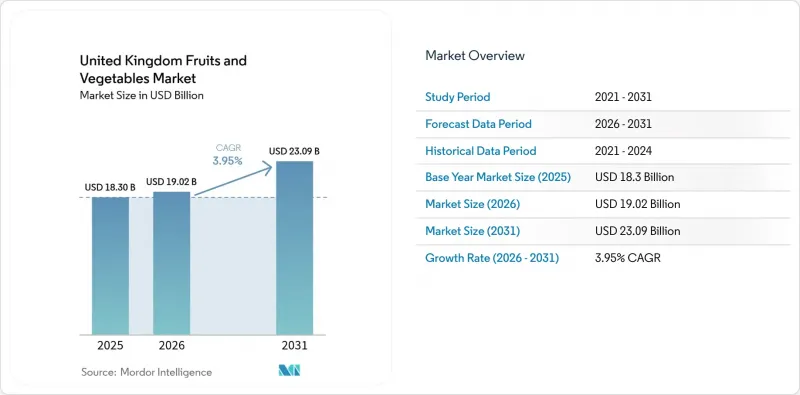
According to Mordor Intelligence, the United Kingdom fruits and vegetables market size is expected to grow from USD 18.3 billion in 2025 to USD 19.02 billion in 2026 and is forecast to reach USD 23.09 billion by 2031 at 3.95% CAGR over 2026-2031.
This report is Segmented by Commodity Type (Fruits and Vegetables). The Report Includes Production Analysis (Volume), Consumption Analysis (Value and Volume), Export Analysis (Value and Volume), Import Analysis (Value and Volume), and Price Trend Analysis. The Market Forecasts are Provided in Terms of Value (USD) and Volume (Metric Tons).
United Kingdom Fruits And Vegetables Market Trends and Insights
Increasing retailer-backed long-term supply contracts
Major supermarket groups are shifting from annual tenders to multiyear agreements that cover volumes, pricing frameworks, and joint investment in sustainable infrastructure. These contracts provide growers with stable cash flows that de-risk capital-intensive greenhouse projects and robotics upgrades. Supermarkets capture differentiated supply while signaling support for domestic food security objectives. The trend also mitigates waste by locking in harvest planning and committing retailers to predictable offtake volumes.
Rising consumer demand for local, low-carbon produce
United Kingdom consumers demonstrate a strong preference for produce with verified local origin and low transportation emissions. Retailers now highlight "grown-in-Britain" labels and carbon-footprint scores on shelf tags, enabling price premiums that offset higher domestic production costs. Public health campaigns encouraging fruit and vegetable intake further amplify demand, especially among urban shoppers who value traceability and freshness.
Labor shortages post-Brexit
The United Kingdom's agriculture sector faces acute labor shortages that threaten production capacity and operational efficiency, with Brexit restrictions on European Union worker mobility exacerbating pre-existing workforce challenges. Post-Brexit labor constraints have intensified due to restrictive access to EU workers, affecting 40% of food supply chains and creating particular pressure in labor-intensive fruit and vegetable harvesting operations. The British Berry Growers survey revealed that half of strawberry and raspberry growers could cease operations by 2026, with labor shortages cited as a primary concern alongside inadequate retailer pricing.
Other drivers and restraints analyzed in the detailed report include:
- Government grants for on-farm renewable energy integration
- Adoption of regenerative practices to meet ESG (Environmental, Social, and Governance) targets
- Limited cold-chain infrastructure for perishables exports
For complete list of drivers and restraints, kindly check the Table Of Contents.
Segment Analysis
Fruits represented 55.60% of the United Kingdom fruits and vegetables market share in 2025, and are projected to expand at a 4.42% CAGR through 2031, supported by strong demand for berries and convenience packs. Soft-fruit revenue slightly declined to GBP 734 million (USD 857.5 million) in 2024 as protected cultivation and substrate systems extended picking seasons. In contrast, orchard-fruit output fell as growers replanted toward higher-margin raspberries. Retail promotions and healthy-snacking trends sustain premium price elasticity that cushions growers against input-cost shocks.
Vegetables remained essential for daily diets but faced tighter margins. Domestic supply met just over half of the demand in 2023, highlighting both import reliance and productivity gains from precision irrigation and disease-resistant seeds. Cucumber self-sufficiency rose markedly after the Fenland complex came online, evidencing the scalability of renewable-energy greenhouses. Tomato growers confronted disease risk and heating expenses, prompting trials of heat-tolerant cultivars, waste-wood biomass boilers, and intercropping rotations to retain production viability.
Complete Report Scope:
- By Commodity Type
- Fruits
- Apple
- Strawberry
- Pear
- Raspberry
- Cherries
- Vegetables
- Carrot
- Cauliflower
- Onion
- Pea
- Tomato
- Cucumber
- Fruits
Additional Benefits:
- The market estimate (ME) sheet in Excel format
- 3 months of analyst support
TABLE OF CONTENTS
1 Introduction
- 1.1 Study Assumptions and Market Definition
- 1.2 Scope of the Study
2 Research Methodology
3 Executive Summary
4 Market Landscape
- 4.1 Market Overview
- 4.2 Market Drivers
- 4.2.1 Increasing retailer-backed long-term supply contracts
- 4.2.2 Rising consumer demand for local, low-carbon produce
- 4.2.3 Rapid expansion of controlled-environment agriculture capacity
- 4.2.4 Government grants for on-farm renewable energy integration
- 4.2.5 Digitization of produce traceability systems
- 4.2.6 Adoption of regenerative practices to meet ESG (Environmental, Social, and Governance) targets
- 4.3 Market Restraints
- 4.3.1 Labor shortages post-Brexit
- 4.3.2 Volatile energy prices affecting greenhouse economics
- 4.3.3 Phytosanitary trade barriers with the European Union
- 4.3.4 Limited cold-chain infrastructure for perishables exports
- 4.4 Regulatory Landscape
- 4.5 Technological Outlook
- 4.6 Value / Supply Chain Analysis
- 4.7 PESTLE Analysis
5 Market Size and Growth Forecasts (Production Analysis (Volume), Consumption Analysis (Volume and Value), Import Analysis (Volume and Value), Export Analysis (Volume and Value), and Price Trend Analysis)
- 5.1 By Commodity Type
- 5.1.1 Fruits
- 5.1.1.1 Apple
- 5.1.1.2 Strawberry
- 5.1.1.3 Pear
- 5.1.1.4 Raspberry
- 5.1.1.5 Cherries
- 5.1.2 Vegetables
- 5.1.2.1 Carrot
- 5.1.2.2 Cauliflower
- 5.1.2.3 Onion
- 5.1.2.4 Pea
- 5.1.2.5 Tomato
- 5.1.2.6 Cucumber
- 5.1.1 Fruits
6 Competitive Landscape
- 6.1 List of Stakeholders
- 6.1.1 Fresca Group Limited
- 6.1.2 Dole UK
- 6.1.3 Worldwide Fruit Ltd
- 6.1.4 Berry Gardens Growers Limited
- 6.1.5 G's Fresh
- 6.1.6 Greenyard
- 6.1.7 Thanet Earth Limited
- 6.1.8 Flamingo
- 6.1.9 Minor, Weir and Willis Ltd
- 6.1.10 Barfoots
- 6.1.11 S&A Group Holdings Limited
- 6.1.12 Fyffes
7 Market Opportunities and Future Outlook

