PUBLISHER: Mordor Intelligence | PRODUCT CODE: 2114266

PUBLISHER: Mordor Intelligence | PRODUCT CODE: 2114266
Vietnam Fruits And Vegetables - Market Share Analysis, Industry Trends & Statistics, Growth Forecasts (2026 - 2031)
According to Mordor Intelligence, the Vietnam fruits and vegetables market is projected to expand from USD 17.32 billion in 2025 and USD 18.51 billion in 2026 to USD 25.40 billion by 2031, registering a CAGR of 6.53% between 2026 to 2031.
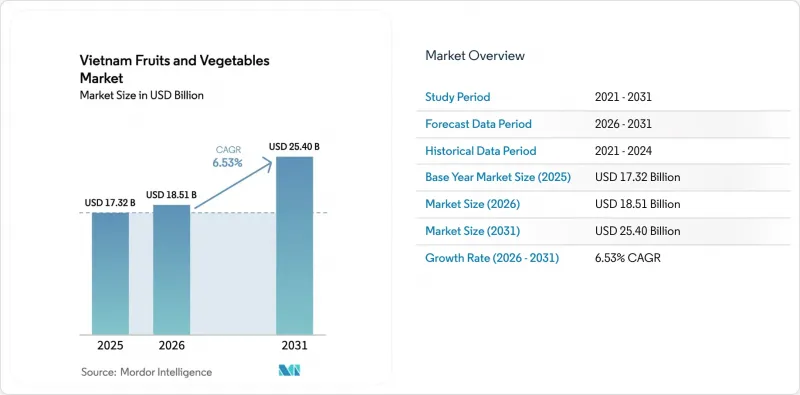
This report is Segmented by Type (Fruits and Vegetables). The Report Includes Production Analysis (Volume), Consumption Analysis (Value and Volume), Import Analysis (Value and Volume), Export Analysis (Value and Volume), Wholesale Price Trend Analysis and Forecast, List of Key Players, and More. The Market Forecasts are Provided in Terms of Value (USD) and Volume (Metric Tons).
Vietnam Fruits And Vegetables Market Trends and Insights
Rising Domestic Per-Capita Intake of Fresh Produce
Urban Vietnamese households have increased their weekly spending on fresh fruits and vegetables, driven by a growing middle class that prioritizes convenience over price. This demand surge is reshaping supply chains, as supermarkets and app-based platforms require consistent quality and next-day delivery windows that traditional wet markets cannot match. Dalat Hasfarm reported that 40% of its highland vegetable output is now distributed through AEON MaxValu stores, which stock pre-washed salad mixes and portion-controlled packs tailored for two-person households. Protein intake is also rising, yet fresh produce remains the fastest-growing category in household food expenditure, suggesting that health-conscious consumers view fruits and vegetables as complements rather than substitutes to animal products.
Shift from Wet-Markets to Omnichannel Retailing
Modern retail formats, including supermarkets and e-commerce platforms, are investing in cold-chain infrastructure to sell fresh produce, a feature typically absent in wet markets. By 2025, AEON Vietnam planned to open 15 supermarkets and 45 medium-format stores, all equipped with walk-in chillers designed to maintain temperatures between 2 °C and 4 °C. This setup will reduce spoilage by 12 percentage points compared to ambient display conditions. Sumitomo has announced plans to expand Fuji Mart from 20 to 50 stores by 2028, focusing on affluent districts where consumers are willing to pay a 15% premium for traceable produce with QR codes linked to farm records. Additionally, the omnichannel model is facilitating direct-to-consumer sales. For example, cooperatives in Lam Dong Province are bypassing wholesalers and achieving 30% higher margins by selling strawberries through platforms like Shopee Fresh and Lazada.
Aging Rural Labor Force
Farmworkers over 45 years old accounted for 62% of Vietnam's agricultural labor pool in 2025, a demographic imbalance that is tightening harvest-season availability and pushing daily wages up by 8% annually. Youth migration to manufacturing hubs in Binh Duong and Dong Nai has left cooperatives scrambling to recruit seasonal workers, with some orchards reporting unfilled positions during peak mango and dragon fruit harvests. The gap is widening productivity differentials, as industrial estates operated by Hoang Anh Gia Lai Agricultural achieve yields 30% higher than neighboring family farms through mechanized pruning and automated irrigation. Training programs launched by the Ministry of Agriculture and Rural Development in 2024 enrolled 5,000 young farmers in precision agriculture courses and retention rates remain below 40%, as graduates opt for urban jobs that pay 50% more.
Other drivers and restraints analyzed in the detailed report include:
- China-Plus-One Sourcing Push by Global Buyers
- European Union-Vietnam Free Trade Agreement Tariff Phase-Outs
- High Post-Harvest Loss
For complete list of drivers and restraints, kindly check the Table Of Contents.
Segment Analysis
Fruits accounted for 59% of the Vietnam fruits and vegetables market size in 2025 and are forecast to grow at a 7.2% CAGR through 2031. Berries are projected to grow at the fastest rate among all product categories, as highland growers in Lam Dong Province implement hothouse systems that extend the strawberry season from 4 to 9 months and facilitate year-round blueberry production. According to the Ministry of Agriculture and Rural Development of Vietnam, durian acreage reached 112,000 hectares nationwide by late 2024, with annual output hitting 900,000 metric tons, yet frozen durian exports to China faced logistical bottlenecks as only 40 pack-houses held the required permits, constraining shipments to 60% of potential volume .
The diverse climatic conditions in the country support the cultivation of a wide range of crops, including tropical fruits such as dragon fruit, mango, and litchi, as well as temperate vegetables like tomatoes and cabbage. In recent years, the harvest area for fruit and vegetable production has expanded as farmers increasingly adopt advanced agricultural techniques and technologies to enhance yield and quality. Vietnam is also investing in post-harvest infrastructure to minimize losses and improve export quality. Efforts include the development of cold chain logistics, innovative packaging solutions, and processing facilities to maintain freshness and meet international standards. With these advancements, Vietnam is well-positioned to strengthen its supply capabilities both regionally and globally.
Complete Report Scope:
- Type
- Vegetables
- Cucumbers
- Production Analysis
- Production Volume
- Area Harvested and Yield
- Consumption Analysis (Value and Volume)
- Trade Analysis (Value and Volume)
- Import Market Analysis
- Import Value and Volume
- Key Supplying Markets
- Export Market Analysis
- Export Value and Volume
- Key Destination Markets
- Import Market Analysis
- Wholesale Price Trend Analysis and Forecast
- Seasonality Analysis
- Production Analysis
- Tomatoes
- Production Analysis
- Production Volume
- Area Harvested and Yield
- Consumption Analysis (Value and Volume)
- Trade Analysis (Value and Volume)
- Import Market Analysis
- Import Value and Volume
- Key Supplying Markets
- Export Market Analysis
- Export Value and Volume
- Key Destination Markets
- Import Market Analysis
- Wholesale Price Trend Analysis and Forecast
- Seasonality Analysis
- Production Analysis
- Cabbage
- Production Analysis
- Production Volume
- Area Harvested and Yield
- Consumption Analysis (Value and Volume)
- Trade Analysis (Value and Volume)
- Import Market Analysis
- Import Value and Volume
- Key Supplying Markets
- Export Market Analysis
- Export Value and Volume
- Key Destination Markets
- Import Market Analysis
- Wholesale Price Trend Analysis and Forecast
- Seasonality Analysis
- Production Analysis
- Carrots
- Production Analysis
- Production Volume
- Area Harvested and Yield
- Consumption Analysis (Value and Volume)
- Trade Analysis (Value and Volume)
- Import Market Analysis
- Import Value and Volume
- Key Supplying Markets
- Export Market Analysis
- Export Value and Volume
- Key Destination Markets
- Import Market Analysis
- Wholesale Price Trend Analysis and Forecast
- Seasonality Analysis
- Production Analysis
- Cucumbers
- Fruits
- Grapes
- Production Analysis
- Production Volume
- Area Harvested and Yield
- Consumption Analysis (Value and Volume)
- Trade Analysis (Value and Volume)
- Import Market Analysis
- Import Value and Volume
- Key Supplying Markets
- Export Market Analysis
- Export Value and Volume
- Key Destination Markets
- Import Market Analysis
- Wholesale Price Trend Analysis and Forecast
- Seasonality Analysis
- Production Analysis
- Apples
- Production Analysis
- Production Volume
- Area Harvested and Yield
- Consumption Analysis (Value and Volume)
- Trade Analysis (Value and Volume)
- Import Market Analysis
- Import Value and Volume
- Key Supplying Markets
- Export Market Analysis
- Export Value and Volume
- Key Destination Markets
- Import Market Analysis
- Wholesale Price Trend Analysis and Forecast
- Seasonality Analysis
- Production Analysis
- Banana
- Production Analysis
- Production Volume
- Area Harvested and Yield
- Consumption Analysis (Value and Volume)
- Trade Analysis (Value and Volume)
- Import Market Analysis
- Import Value and Volume
- Key Supplying Markets
- Export Market Analysis
- Export Value and Volume
- Key Destination Markets
- Import Market Analysis
- Wholesale Price Trend Analysis and Forecast
- Seasonality Analysis
- Production Analysis
- Mango
- Production Analysis
- Production Volume
- Area Harvested and Yield
- Consumption Analysis (Value and Volume)
- Trade Analysis (Value and Volume)
- Import Market Analysis
- Import Value and Volume
- Key Supplying Markets
- Export Market Analysis
- Export Value and Volume
- Key Destination Markets
- Import Market Analysis
- Wholesale Price Trend Analysis and Forecast
- Seasonality Analysis
- Production Analysis
- Durian
- Production Analysis
- Production Volume
- Area Harvested and Yield
- Consumption Analysis (Value and Volume)
- Trade Analysis (Value and Volume)
- Import Market Analysis
- Import Value and Volume
- Key Supplying Markets
- Export Market Analysis
- Export Value and Volume
- Key Destination Markets
- Import Market Analysis
- Wholesale Price Trend Analysis and Forecast
- Seasonality Analysis
- Production Analysis
- Dragon Fruit
- Production Analysis
- Production Volume
- Area Harvested and Yield
- Consumption Analysis (Value and Volume)
- Trade Analysis (Value and Volume)
- Import Market Analysis
- Import Value and Volume
- Key Supplying Markets
- Export Market Analysis
- Export Value and Volume
- Key Destination Markets
- Import Market Analysis
- Wholesale Price Trend Analysis and Forecast
- Seasonality Analysis
- Production Analysis
- Grapes
- Vegetables
Additional Benefits:
- The market estimate (ME) sheet in Excel format
- 3 months of analyst support
TABLE OF CONTENTS
1 Introduction
- 1.1 Study Assumptions and Market Definition
- 1.2 Scope of the Study
2 Research Methodology
3 Executive Summary
4 Market Landscape
- 4.1 Market Overview
- 4.2 Market Drivers
- 4.2.1 Rising domestic per-capita intake of fresh produce
- 4.2.2 Shift from wet-markets to omnichannel retailing
- 4.2.3 China-plus-One sourcing push by global buyers
- 4.2.4 European Union-Vietnam Free Trade Agreement tariff phase-outs
- 4.2.5 Precision-farming adoption in Mekong Delta
- 4.2.6 Carbon border adjustment risk for high-footprint crops
- 4.3 Market Restraints
- 4.3.1 Aging rural labor force
- 4.3.2 High post-harvest loss
- 4.3.3 Fragmented land-holding structure
- 4.3.4 Escalating plant-health incidents
- 4.4 Opportunities
- 4.5 Challenges
- 4.6 Value Chain Analysis
- 4.7 Technologies and usage of AI in the Industry
- 4.8 Input Market Analysis
- 4.8.1 Seeds
- 4.8.2 Fertilizers
- 4.8.3 Crop Protection Chemicals
- 4.9 Distribution Channel Analysis
- 4.10 Market Sentiment Analysis
- 4.11 PESTLE Analysis
- 4.12 Regulatory Framework
- 4.13 Logistics and Infrastructure
5 Market Size and Growth Forecasts (Value and Volume)
- 5.1 Type
- 5.1.1 Vegetables
- 5.1.1.1 Cucumbers
- 5.1.1.1.1 Production Analysis
- 5.1.1.1.1.1 Production Volume
- 5.1.1.1.1.2 Area Harvested and Yield
- 5.1.1.1.2 Consumption Analysis (Value and Volume)
- 5.1.1.1.3 Trade Analysis (Value and Volume)
- 5.1.1.1.3.1 Import Market Analysis
- 5.1.1.1.3.1.1 Import Value and Volume
- 5.1.1.1.3.1.2 Key Supplying Markets
- 5.1.1.1.3.2 Export Market Analysis
- 5.1.1.1.3.2.1 Export Value and Volume
- 5.1.1.1.3.2.2 Key Destination Markets
- 5.1.1.1.3.1 Import Market Analysis
- 5.1.1.1.4 Wholesale Price Trend Analysis and Forecast
- 5.1.1.1.5 Seasonality Analysis
- 5.1.1.1.1 Production Analysis
- 5.1.1.2 Tomatoes
- 5.1.1.2.1 Production Analysis
- 5.1.1.2.1.1 Production Volume
- 5.1.1.2.1.2 Area Harvested and Yield
- 5.1.1.2.2 Consumption Analysis (Value and Volume)
- 5.1.1.2.3 Trade Analysis (Value and Volume)
- 5.1.1.2.3.1 Import Market Analysis
- 5.1.1.2.3.1.1 Import Value and Volume
- 5.1.1.2.3.1.2 Key Supplying Markets
- 5.1.1.2.3.2 Export Market Analysis
- 5.1.1.2.3.2.1 Export Value and Volume
- 5.1.1.2.3.2.2 Key Destination Markets
- 5.1.1.2.3.1 Import Market Analysis
- 5.1.1.2.4 Wholesale Price Trend Analysis and Forecast
- 5.1.1.2.5 Seasonality Analysis
- 5.1.1.2.1 Production Analysis
- 5.1.1.3 Cabbage
- 5.1.1.3.1 Production Analysis
- 5.1.1.3.1.1 Production Volume
- 5.1.1.3.1.2 Area Harvested and Yield
- 5.1.1.3.2 Consumption Analysis (Value and Volume)
- 5.1.1.3.3 Trade Analysis (Value and Volume)
- 5.1.1.3.3.1 Import Market Analysis
- 5.1.1.3.3.1.1 Import Value and Volume
- 5.1.1.3.3.1.2 Key Supplying Markets
- 5.1.1.3.3.2 Export Market Analysis
- 5.1.1.3.3.2.1 Export Value and Volume
- 5.1.1.3.3.2.2 Key Destination Markets
- 5.1.1.3.3.1 Import Market Analysis
- 5.1.1.3.4 Wholesale Price Trend Analysis and Forecast
- 5.1.1.3.5 Seasonality Analysis
- 5.1.1.3.1 Production Analysis
- 5.1.1.4 Carrots
- 5.1.1.4.1 Production Analysis
- 5.1.1.4.1.1 Production Volume
- 5.1.1.4.1.2 Area Harvested and Yield
- 5.1.1.4.2 Consumption Analysis (Value and Volume)
- 5.1.1.4.3 Trade Analysis (Value and Volume)
- 5.1.1.4.3.1 Import Market Analysis
- 5.1.1.4.3.1.1 Import Value and Volume
- 5.1.1.4.3.1.2 Key Supplying Markets
- 5.1.1.4.3.2 Export Market Analysis
- 5.1.1.4.3.2.1 Export Value and Volume
- 5.1.1.4.3.2.2 Key Destination Markets
- 5.1.1.4.3.1 Import Market Analysis
- 5.1.1.4.4 Wholesale Price Trend Analysis and Forecast
- 5.1.1.4.5 Seasonality Analysis
- 5.1.1.4.1 Production Analysis
- 5.1.1.1 Cucumbers
- 5.1.2 Fruits
- 5.1.2.1 Grapes
- 5.1.2.1.1 Production Analysis
- 5.1.2.1.1.1 Production Volume
- 5.1.2.1.1.2 Area Harvested and Yield
- 5.1.2.1.2 Consumption Analysis (Value and Volume)
- 5.1.2.1.3 Trade Analysis (Value and Volume)
- 5.1.2.1.3.1 Import Market Analysis
- 5.1.2.1.3.1.1 Import Value and Volume
- 5.1.2.1.3.1.2 Key Supplying Markets
- 5.1.2.1.3.2 Export Market Analysis
- 5.1.2.1.3.2.1 Export Value and Volume
- 5.1.2.1.3.2.2 Key Destination Markets
- 5.1.2.1.3.1 Import Market Analysis
- 5.1.2.1.4 Wholesale Price Trend Analysis and Forecast
- 5.1.2.1.5 Seasonality Analysis
- 5.1.2.1.1 Production Analysis
- 5.1.2.2 Apples
- 5.1.2.2.1 Production Analysis
- 5.1.2.2.1.1 Production Volume
- 5.1.2.2.1.2 Area Harvested and Yield
- 5.1.2.2.2 Consumption Analysis (Value and Volume)
- 5.1.2.2.3 Trade Analysis (Value and Volume)
- 5.1.2.2.3.1 Import Market Analysis
- 5.1.2.2.3.1.1 Import Value and Volume
- 5.1.2.2.3.1.2 Key Supplying Markets
- 5.1.2.2.3.2 Export Market Analysis
- 5.1.2.2.3.2.1 Export Value and Volume
- 5.1.2.2.3.2.2 Key Destination Markets
- 5.1.2.2.3.1 Import Market Analysis
- 5.1.2.2.4 Wholesale Price Trend Analysis and Forecast
- 5.1.2.2.5 Seasonality Analysis
- 5.1.2.2.1 Production Analysis
- 5.1.2.3 Banana
- 5.1.2.3.1 Production Analysis
- 5.1.2.3.1.1 Production Volume
- 5.1.2.3.1.2 Area Harvested and Yield
- 5.1.2.3.2 Consumption Analysis (Value and Volume)
- 5.1.2.3.3 Trade Analysis (Value and Volume)
- 5.1.2.3.3.1 Import Market Analysis
- 5.1.2.3.3.1.1 Import Value and Volume
- 5.1.2.3.3.1.2 Key Supplying Markets
- 5.1.2.3.3.2 Export Market Analysis
- 5.1.2.3.3.2.1 Export Value and Volume
- 5.1.2.3.3.2.2 Key Destination Markets
- 5.1.2.3.3.1 Import Market Analysis
- 5.1.2.3.4 Wholesale Price Trend Analysis and Forecast
- 5.1.2.3.5 Seasonality Analysis
- 5.1.2.3.1 Production Analysis
- 5.1.2.4 Mango
- 5.1.2.4.1 Production Analysis
- 5.1.2.4.1.1 Production Volume
- 5.1.2.4.1.2 Area Harvested and Yield
- 5.1.2.4.2 Consumption Analysis (Value and Volume)
- 5.1.2.4.3 Trade Analysis (Value and Volume)
- 5.1.2.4.3.1 Import Market Analysis
- 5.1.2.4.3.1.1 Import Value and Volume
- 5.1.2.4.3.1.2 Key Supplying Markets
- 5.1.2.4.3.2 Export Market Analysis
- 5.1.2.4.3.2.1 Export Value and Volume
- 5.1.2.4.3.2.2 Key Destination Markets
- 5.1.2.4.3.1 Import Market Analysis
- 5.1.2.4.4 Wholesale Price Trend Analysis and Forecast
- 5.1.2.4.5 Seasonality Analysis
- 5.1.2.4.1 Production Analysis
- 5.1.2.5 Durian
- 5.1.2.5.1 Production Analysis
- 5.1.2.5.1.1 Production Volume
- 5.1.2.5.1.2 Area Harvested and Yield
- 5.1.2.5.2 Consumption Analysis (Value and Volume)
- 5.1.2.5.3 Trade Analysis (Value and Volume)
- 5.1.2.5.3.1 Import Market Analysis
- 5.1.2.5.3.1.1 Import Value and Volume
- 5.1.2.5.3.1.2 Key Supplying Markets
- 5.1.2.5.3.2 Export Market Analysis
- 5.1.2.5.3.2.1 Export Value and Volume
- 5.1.2.5.3.2.2 Key Destination Markets
- 5.1.2.5.3.1 Import Market Analysis
- 5.1.2.5.4 Wholesale Price Trend Analysis and Forecast
- 5.1.2.5.5 Seasonality Analysis
- 5.1.2.5.1 Production Analysis
- 5.1.2.6 Dragon Fruit
- 5.1.2.6.1 Production Analysis
- 5.1.2.6.1.1 Production Volume
- 5.1.2.6.1.2 Area Harvested and Yield
- 5.1.2.6.2 Consumption Analysis (Value and Volume)
- 5.1.2.6.3 Trade Analysis (Value and Volume)
- 5.1.2.6.3.1 Import Market Analysis
- 5.1.2.6.3.1.1 Import Value and Volume
- 5.1.2.6.3.1.2 Key Supplying Markets
- 5.1.2.6.3.2 Export Market Analysis
- 5.1.2.6.3.2.1 Export Value and Volume
- 5.1.2.6.3.2.2 Key Destination Markets
- 5.1.2.6.3.1 Import Market Analysis
- 5.1.2.6.4 Wholesale Price Trend Analysis and Forecast
- 5.1.2.6.5 Seasonality Analysis
- 5.1.2.6.1 Production Analysis
- 5.1.2.1 Grapes
- 5.1.1 Vegetables
6 End Use Applications and Industries
- 6.1 Primary Applications and Emerging Applications
- 6.2 Consumption Breakdown by Industries
7 Competitive Landscape
- 7.1 Overview of the Competition
- 7.2 Recent Developments
- 7.3 Market Concentration Analysis
- 7.4 List of Key Players
- 7.4.1 Hortifrut
- 7.4.2 Copefrut
- 7.4.3 Exportadora Subsole
- 7.4.4 Dole Chile
- 7.4.5 Agricola Garces Fruit
- 7.4.6 Nature's Pride Chile
- 7.4.7 Agrofruta
- 7.4.8 David Del Curto
- 7.4.9 San Clemente Foods
- 7.4.10 Verfrut
- 7.4.11 Frusan
- 7.4.12 Exportadora Rio Blanco
- 7.4.13 Unifrutti Traders
- 7.4.14 Agrocommerce
- 7.4.15 Rucaray
8 Market Opportunities and Future Outlook

