PUBLISHER: Mordor Intelligence | PRODUCT CODE: 2121337

PUBLISHER: Mordor Intelligence | PRODUCT CODE: 2121337
Fruits And Vegetables Processing - Market Share Analysis, Industry Trends & Statistics, Growth Forecasts (2026 - 2031)
According to Mordor Intelligence, the fruits and vegetables processing market size is projected to be USD 328.48 billion in 2025, USD 347.27 billion in 2026, and reach USD 458.64 billion by 2031, growing at a CAGR of 5.72% from 2026 to 2031.
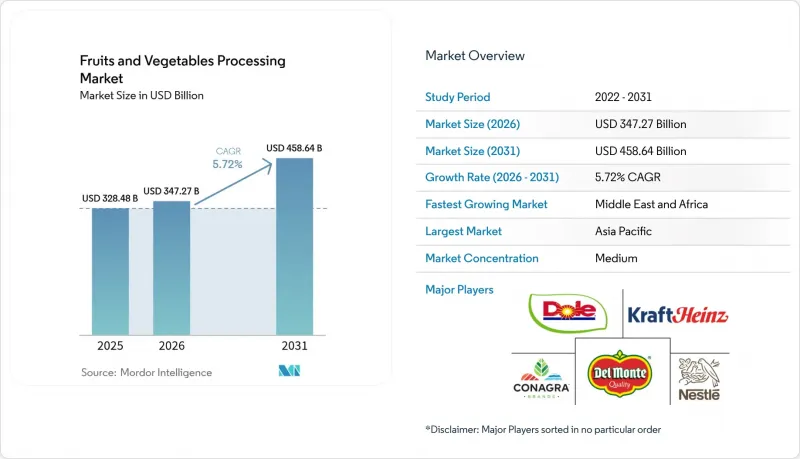
This report is Segmented by Product Type (Fruits and Vegetables), Form (Fresh, Fresh-Cut, and More), End User (Food Processing Industry, Food Service/HoReCa, and More), and Geography (North America, Europe, Asia-Pacific, South America, Middle East, and Africa). The Market Forecasts are Provided in Terms of Value (USD).
Global Fruits And Vegetables Processing Market Trends and Insights
Rising consumer demand for convenient and ready-to-eat fruit and vegetable products
The growing demand for convenient, ready-to-eat food products is driving the fruits and vegetables processing market. This trend is largely due to increasingly busy lifestyles and higher workforce participation. For instance, as of May 2024, the employment rate across member countries of the Organisation for Economic Co-operation and Development (OECD) reached 95.1%. With more people working, there is less time to prepare fresh meals, leading to a greater reliance on pre-cut, frozen, and ready-to-eat fruits and vegetables. Urban households and individuals living alone are particularly drawn to these products because they are portion-controlled and easy to prepare. Furthermore, supermarkets are expanding their ready-meal sections, and online grocery platforms and meal-kit services are incorporating more processed fruits and vegetables into their offerings.
Growing health awareness and preference for nutritious processed products
Health awareness is rising globally, and more people are focusing on increasing their protein intake, driving growth in the fruits and vegetables processing market. Many consumers are looking for foods that are not only convenient but also packed with nutrients, including protein. According to the International Food Information Council (IFIC) Food and Health Survey 2024, 71% of Americans are actively trying to include more protein in their diets. This has led to a growing demand for products enriched with plant-based proteins, such as pea protein, vegetable concentrates, and legume blends. To meet this demand, manufacturers are creating processed fruit and vegetable products that are both nutritious and easy to consume. These products are designed to support balanced diets and offer additional health benefits. As more people prioritize health and convenience, processed fruits and vegetables are becoming key ingredients in a wide range of health-focused food products.
Fluctuations in raw material availability and prices due to seasonality and climate conditions
Changes in the availability and prices of raw materials, driven by seasonal patterns and climate variability, pose a significant challenge to the fruits and vegetables processing market. Weather events such as droughts, frost, and irregular rainfall can severely impact crop yields, leading to shortages. As a result, processors often need to depend on more expensive imports or alternative sources to meet demand. This unpredictability makes it harder for companies to plan production efficiently, increases procurement costs, and reduces profit margins. Furthermore, many small and mid-sized processors lack effective risk management strategies, leaving them more vulnerable to these supply and price fluctuations. These challenges collectively hinder consistent market growth.
Other drivers and restraints analyzed in the detailed report include:
- Innovation in value-added products such as juices, purees, and snacks
- Growing popularity of plant-based diets is boosting demand
- High capital investment requirements for processing equipment
For complete list of drivers and restraints, kindly check the Table Of Contents.
Segment Analysis
The fruits segment led the fruits and vegetables processing market, accounting for 54.25% of the total market share in 2025. This dominance is due to the high demand for processed fruit products like juices, concentrates, canned fruits, frozen fruits, and purees. These products are widely used in industries such as beverages, dairy, bakery, and confectionery. Consumers increasingly prefer convenient, ready-to-consume options, and fruit-based ingredients are becoming more popular in functional and fortified foods. The growing export of tropical and exotic fruit products has further boosted the segment's growth.
The vegetables segment is expected to grow at a CAGR of 6.39% from 2026 to 2031, driven by the rising demand for frozen, canned, and minimally processed vegetables. Consumers are focusing more on healthy eating and convenient meal options, which has increased the popularity of ready-to-cook and ready-to-eat vegetable products. Processed vegetables are also being used more in foodservice, packaged meals, and quick-service restaurants. Moreover, advancements in preservation technologies, such as freezing and drying, are helping to maintain nutritional value and extend shelf life, supporting the segment's long-term growth.
Complete Report Scope:
- By Product Type
- Fruits
- Vegetables
- By Form
- Fresh
- Fresh-Cut
- Canned
- Frozen
- Dried/Dehydrated
- Juices/Purees
- By End User
- Food Processing Industry
- Foodservice/HoReCa
- Retail/Household
- Supermarkets/Hypermarkets
- Convenience/Grocery Stores
- Online Retailers
- Other Channels
- By Geography
- North America
- United States
- Canada
- Mexico
- Rest of North America
- South America
- Brazil
- Argentina
- Colombia
- Chile
- Peru
- Rest of South America
- Europe
- Germany
- United Kingdom
- Italy
- France
- Spain
- Poland
- Belgium
- Sweden
- Netherlands
- Rest of Europe
- Asia-Pacific
- China
- Japan
- India
- Australia
- Indonesia
- South Korea
- Thailand
- Singapore
- Rest of Asia-Pacific
- Middle East and Africa
- South Africa
- Saudi Arabia
- United Arab Emirates
- Nigeria
- Egypt
- Morocco
- Turkey
- Rest of Middle East and Africa
- North America
Geography Analysis
Asia-Pacific accounted for 33.04% of the fruits and vegetables processing market revenue in 2025, driven by advancements in post-harvest infrastructure, high agricultural output, and expanding processing capabilities. Countries like India are improving cold storage and transportation systems to reduce food wastage and enhance supply efficiency. Japan's aging population is increasing the demand for easy-to-consume, single-serve, and fortified processed products. Indonesia is capitalizing on its tropical fruit production to boost exports, while Australia's strict organic certification standards are helping its exporters target premium global markets. These factors collectively make Asia-Pacific a dominant player in the global processing market.
The Middle East and Africa are expected to experience the fastest growth in the fruits and vegetables processing market, with a CAGR of 8.04% through 2031. This growth is fueled by rising investments in local food processing infrastructure and initiatives to improve food security. Countries like Saudi Arabia and the United Arab Emirates are focusing on domestic processing to reduce dependency on imports. South Africa is strengthening its position in processed fruit exports, while Nigeria is enhancing its processing capacity by connecting farmers directly with processors. These efforts are improving regional self-reliance and creating a more integrated supply chain.
North America and Europe are mature markets but remain important for premium, organic, and value-added processed products. Consumer demand for clean-label, organic, and functional foods is pushing processors to adopt certified sourcing and advanced technologies. Europe is leading in organic product innovation, supported by regulatory goals and the expansion of private-label offerings by retailers. Meanwhile, South American countries like Chile and Brazil play a key role in global supply by exporting processed fruits and vegetables during the off-season in Northern Hemisphere markets. This ensures a steady supply of products worldwide, even during seasonal gaps.
- The Kraft Heinz Company
- Conagra Brands Inc.
- Nestle S.A.
- Archer Daniels Midland Company
- Dole plc
- Del Monte Foods
- Agrana Beteiligungs-AG
- B&G Foods
- Albertsons Companies
- SVZ International
- Olam Group
- JBT Corporation
- Bohler AG
- GEA Group AG
- Tetra Pak
- Bonduelle Group
- Seneca Foods
- SunOpta Inc.
- The J. M. Smucker Company
- Hain Celestial Group
Additional Benefits:
- The market estimate (ME) sheet in Excel format
- 3 months of analyst support
TABLE OF CONTENTS
1 INTRODUCTION
- 1.1 Study Assumptions and Market Definition
- 1.2 Scope of the Study
2 RESEARCH METHODOLOGY
3 EXECUTIVE SUMMARY
4 MARKET LANDSCAPE
- 4.1 Market Overview
- 4.2 Market Drivers
- 4.2.1 Rising consumer demand for convenient and ready-to-eat fruit and vegetable products
- 4.2.2 Growing health awareness and preference for nutritious processed products
- 4.2.3 Innovation in value-added products such as juices, purees, and snacks
- 4.2.4 Technological advancements in processing, packaging, and cold chain logistics
- 4.2.5 Growing popularity of plant-based diets is boosting demand
- 4.2.6 Increasing focus on food safety and hygiene standards
- 4.3 Market Restraints
- 4.3.1 High capital investment requirements for processing equipment
- 4.3.2 Fluctuations in raw material availability and prices due to seasonality and climate conditions
- 4.3.3 Limited shelf-life perception of certain processed products
- 4.3.4 High energy and water consumption in processing operations
- 4.4 Supply Chain Analysis
- 4.5 Regulatory Outlook
- 4.6 Technological Outlook
- 4.7 Porter's Five Forces
- 4.7.1 Threat of New Entrants
- 4.7.2 Bargaining Power of Buyers
- 4.7.3 Bargaining Power of Suppliers
- 4.7.4 Threat of Substitute Products
- 4.7.5 Intensity of Competitive Rivalry
5 MARKET SIZE AND GROWTH FORECASTS (VALUE)
- 5.1 By Product Type
- 5.1.1 Fruits
- 5.1.2 Vegetables
- 5.2 By Form
- 5.2.1 Fresh
- 5.2.2 Fresh-Cut
- 5.2.3 Canned
- 5.2.4 Frozen
- 5.2.5 Dried/Dehydrated
- 5.2.6 Juices/Purees
- 5.3 By End User
- 5.3.1 Food Processing Industry
- 5.3.2 Foodservice/HoReCa
- 5.3.3 Retail/Household
- 5.3.3.1 Supermarkets/Hypermarkets
- 5.3.3.2 Convenience/Grocery Stores
- 5.3.3.3 Online Retailers
- 5.3.3.4 Other Channels
- 5.4 By Geography
- 5.4.1 North America
- 5.4.1.1 United States
- 5.4.1.2 Canada
- 5.4.1.3 Mexico
- 5.4.1.4 Rest of North America
- 5.4.2 South America
- 5.4.2.1 Brazil
- 5.4.2.2 Argentina
- 5.4.2.3 Colombia
- 5.4.2.4 Chile
- 5.4.2.5 Peru
- 5.4.2.6 Rest of South America
- 5.4.3 Europe
- 5.4.3.1 Germany
- 5.4.3.2 United Kingdom
- 5.4.3.3 Italy
- 5.4.3.4 France
- 5.4.3.5 Spain
- 5.4.3.6 Poland
- 5.4.3.7 Belgium
- 5.4.3.8 Sweden
- 5.4.3.9 Netherlands
- 5.4.3.10 Rest of Europe
- 5.4.4 Asia-Pacific
- 5.4.4.1 China
- 5.4.4.2 Japan
- 5.4.4.3 India
- 5.4.4.4 Australia
- 5.4.4.5 Indonesia
- 5.4.4.6 South Korea
- 5.4.4.7 Thailand
- 5.4.4.8 Singapore
- 5.4.4.9 Rest of Asia-Pacific
- 5.4.5 Middle East and Africa
- 5.4.5.1 South Africa
- 5.4.5.2 Saudi Arabia
- 5.4.5.3 United Arab Emirates
- 5.4.5.4 Nigeria
- 5.4.5.5 Egypt
- 5.4.5.6 Morocco
- 5.4.5.7 Turkey
- 5.4.5.8 Rest of Middle East and Africa
- 5.4.1 North America
6 COMPETITIVE LANDSCAPE
- 6.1 Market Concentration
- 6.2 Strategic Moves
- 6.3 Market Share Analysis
- 6.4 Company Profiles (includes Global-level Overview, Market-level Overview, Core Segments, Financials (if available), Strategic Information, Market Rank/Share, Products and Services, Recent Developments)
- 6.4.1 The Kraft Heinz Company
- 6.4.2 Conagra Brands Inc.
- 6.4.3 Nestle S.A.
- 6.4.4 Archer Daniels Midland Company
- 6.4.5 Dole plc
- 6.4.6 Del Monte Foods
- 6.4.7 Agrana Beteiligungs-AG
- 6.4.8 B&G Foods
- 6.4.9 Albertsons Companies
- 6.4.10 SVZ International
- 6.4.11 Olam Group
- 6.4.12 JBT Corporation
- 6.4.13 Bohler AG
- 6.4.14 GEA Group AG
- 6.4.15 Tetra Pak
- 6.4.16 Bonduelle Group
- 6.4.17 Seneca Foods
- 6.4.18 SunOpta Inc.
- 6.4.19 The J. M. Smucker Company
- 6.4.20 Hain Celestial Group
7 MARKET OPPORTUNITIES AND FUTURE OUTLOOK

