PUBLISHER: Mordor Intelligence | PRODUCT CODE: 2097191

PUBLISHER: Mordor Intelligence | PRODUCT CODE: 2097191
Americas Medium and Large Caliber Ammunition - Market Share Analysis, Industry Trends & Statistics, Growth Forecasts (2026 - 2031)
According to Mordor Intelligence, the americas medium and large caliber ammunition market size is expected to grow from USD 2.41 billion in 2025 to USD 2.6 billion in 2026 and is forecasted to reach USD 3.32 billion by 2031 at a 4.97% CAGR over 2026-2031.
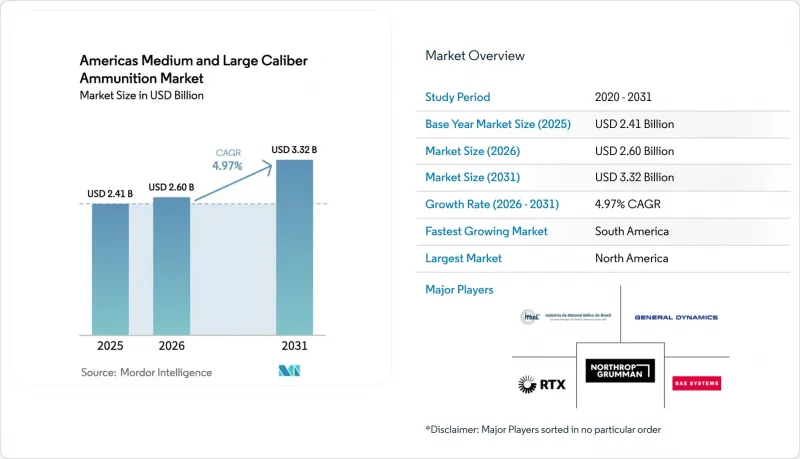
This report is Segmented by Caliber (Medium Caliber and Large Caliber), Product (Rounds, Artillery Shells and Mortars, and Aerial Bombs and Grenades), Guidance (Guided and Unguided), End-User (Military and Law Enforcement), Platform (Land, Naval, and Airborne), and Geography (North America and South America). The Market Forecasts are Provided in Terms of Value (USD).
Americas Medium and Large Caliber Ammunition Market Trends and Insights
Rising Defense Budgets Across the Americas
Defense budgets across the Americas reached USD 912 billion in 2025, with a significant focus on ammunition allocations. The US increased its ammunition budget to USD 2.1 billion, emphasizing multi-year contracts to support industry investments in tooling and production stability. Canada allocated CAD 553 million (USD 398.18 million), enabling bulk purchases of 155mm and 50mm rounds for Arctic operations. Brazil's BRL 137 billion (USD 25.58 billion) defense budget included funding for insensitive-munition conversions, providing IMBEL with a stable multi-year revenue stream. Mexico allocated MXN 178 billion (approximately USD 9.90 billion) to bolster National Guard inventories, demonstrating the influence of homeland-security agencies on the medium- and large-caliber ammunition market, particularly when conventional military budgets face constraints. Chile maintained its overall defense budget but redirected 18% of procurement funds to consumables, with a particular focus on ammunition as a critical component for operational readiness.
Modernization of Armored and Artillery Platforms
Modernization programs for armored and artillery platforms are driving diversification in demand for calibers. The US Army's M109A7 Paladin now uses insensitive 155mm rounds requiring thicker-walled cases, while Canada's LAV III upgrade to the XM913 50mm cannon has established a new caliber standard. Brazil's Guarani APC and Mexico's DN-XI IFV adopted 40mm and 30mm weapons, respectively, shifting away from the previously dominant 25mm calibers. The US Marine Corps' ACV-30 employs MK 310 programmable ammunition, which doubles the annual consumption per vehicle. The US Army's ERCA gun extends the 155mm range to 70 kilometers, necessitating stricter controls on steel grain structure. These modernization efforts are expected to continuously refresh SKU lists in the Americas medium and large caliber ammunition market through 2031, with retrofits impacting the entire supply chain.
Stringent Export Control and ITAR Compliance Costs
Export controls and ITAR compliance are imposing high costs on ammunition exports. ITAR filings add USD 1,200-1,800 per line item, extend approval timelines, and increase shipment costs by 12-15%. The average wait time of 127 days deters smaller US suppliers from pursuing quick-turn orders. Mexico incurred USD 2.3 million in compliance costs for a USD 21 million grenade purchase, leading to a preference for non-ITAR suppliers from South Korea and Israel. Brazil's IMBEL faced a nine-month delay in ramping up 155mm production due to US propellant ingredient waivers. At the same time, Colombia canceled a US joint venture over projected compliance costs of USD 4.8 million. These regulatory challenges benefit European and South American manufacturers, reducing the market share available to US exporters in the Americas medium and large caliber ammunition market.
Other drivers and restraints analyzed in the detailed report include:
- Geopolitical Tensions and Border-Security Operations
- Replacement of Aging Ammunition Stockpiles
- Volatility in Raw-Material Prices (Copper, Steel, Propellants)
For complete list of drivers and restraints, kindly check the Table Of Contents.
Segment Analysis
Medium rounds led the Americas medium and large caliber ammunition market in 2025, accounting for a 63.89% share. This dominance is attributed to the widespread use of 20-40mm guns on infantry vehicles, close-in weapon systems (CIWS), and attack helicopters. However, demand for large-caliber ammunition is expected to grow at a CAGR of 5.21%, driven by programs such as the ERCA initiative and Brazil's ASTROS rocket-artillery expansion, both of which emphasize 155mm shells. The market size for large-caliber projectiles is projected to increase from approximately USD 1 billion in 2026 to USD 1.3 billion by 2031. Notable contracts, such as General Dynamics' USD 465 million agreement in July 2025 for 120mm M1002 training rounds, highlight sustained demand from the Abrams fleet, while Northrop's Bushmaster contract supports medium-caliber production through 2028.
The market faces a strategic balance between volume and lethality. Medium calibers are cost-effective and support rapid-fire tactics essential for border patrol, naval interdiction, and urban defense. In contrast, large calibers offer higher payloads, extended range, and superior performance in peer warfare scenarios. Innovations like Textron's XM204 120mm top-attack round, priced at USD 12,000 and capable of defeating active-protection systems, blur the distinction between shells and missiles. However, logistical challenges persist, as seen in Canada's adoption of a 50mm cannon for its LAV III, which necessitated funding a standalone ammunition line due to limited allied stockpiles. These divergences complicate efforts to standardize SKUs, increasing inventory costs for coalition planners.
Artillery shells and mortars accounted for 53.41% of revenue in 2025, solidifying their position as the cornerstone of the Americas medium and large caliber ammunition market. US monthly production targets of 70,000 155mm shells could generate approximately USD 1.7 billion in annual revenue by 2031, assuming unit prices for unguided variants remain near USD 1,050. Aerial bombs and grenades are expected to grow at a CAGR of 6.34%, supported by the AH-1Z Viper and A-10 fleets, which utilize programmable fuzes that increase average selling prices without significantly raising material costs. The USD 819 million Amtec training-grenade contract demonstrated the potential for economies of scale in this previously fragmented sub-sector, creating a strategic revenue stream for suppliers adept at producing low-cost composite casings.
Mortar ammunition, once considered a niche product, has seen renewed interest as light-infantry units shift from relying on heavy artillery to adopting mobile firepower. For instance, Orbital ATK's M821A3 insensitive 81mm round completed fielding with the Marine Corps in June 2025, establishing a baseline reorder rate that mitigates potential declines in 120mm tank ammunition consumption. Brazil's ASTROS system, which integrates 127mm rockets and tube artillery, has attracted new electronics suppliers to the value chain, as these hybrid systems require GPS, data links, and fuse setters traditionally absent from conventional shell production.
Complete Report Scope:
- By Caliber
- Medium Caliber
- Large Caliber
- By Product
- Rounds
- Artillery Shells and Mortars
- Aerial Bombs and Grenades
- By Guidance
- Guided
- Unguided
- By End-User
- Military
- Law Enforcement
- By Platform
- Land
- Naval
- Airborne
- By Geography
- North America
- United States
- Canada
- Mexico
- South America
- Brazil
- Rest of South America
- North America
List of Companies Covered in this Report:
- General Dynamics Corporation
- BAE Systems plc
- CBC Global Ammunition
- Northrop Grumman Corporation
- Day & Zimmermann, Inc.
- Industria de Material Belico do Brasil
- Empresa Gerencial de Projetos Navais (EMGEPRON)
- Elbit Systems Ltd.
- Nammo AS
- Rheinmetall Denel Munition (Pty) Ltd. (Rheinmetall AG)
- Poongsan Corporation
- Day & Zimmermann(R)
- RTX Corporation
- Textron Inc.
Additional Benefits:
- The market estimate (ME) sheet in Excel format
- 3 months of analyst support
TABLE OF CONTENTS
1 INTRODUCTION
- 1.1 Study Assumptions and Market Definition
- 1.2 Scope of the Study
2 RESEARCH METHODOLOGY
3 EXECUTIVE SUMMARY
4 MARKET LANDSCAPE
- 4.1 Market Overview
- 4.2 Market Drivers
- 4.2.1 Rising defense budgets across the Americas
- 4.2.2 Modernization of armored and artillery platforms
- 4.2.3 Geopolitical tensions and border-security operations
- 4.2.4 Replacement of aging ammunition stockpiles
- 4.2.5 Surge in joint hemispheric training exercises
- 4.2.6 Growth of local ammunition manufacturing in South America
- 4.3 Market Restraints
- 4.3.1 Stringent export control and ITAR compliance costs
- 4.3.2 Volatility in raw-material prices (copper, steel, propellants)
- 4.3.3 Environmental regulations on lead and energetic materials
- 4.3.4 Shift toward precision-strike alternatives (loitering munitions)
- 4.4 Value Chain Analysis
- 4.5 Regulatory Landscape
- 4.6 Technological Outlook
- 4.7 Porter's Five Forces Analysis
- 4.7.1 Bargaining Power of Buyers
- 4.7.2 Bargaining Power of Suppliers
- 4.7.3 Threat of New Entrants
- 4.7.4 Threat of Substitutes
- 4.7.5 Competitive Rivalry
5 MARKET SIZE AND GROWTH FORECASTS (VALUE)
- 5.1 By Caliber
- 5.1.1 Medium Caliber
- 5.1.2 Large Caliber
- 5.2 By Product
- 5.2.1 Rounds
- 5.2.2 Artillery Shells and Mortars
- 5.2.3 Aerial Bombs and Grenades
- 5.3 By Guidance
- 5.3.1 Guided
- 5.3.2 Unguided
- 5.4 By End-User
- 5.4.1 Military
- 5.4.2 Law Enforcement
- 5.5 By Platform
- 5.5.1 Land
- 5.5.2 Naval
- 5.5.3 Airborne
- 5.6 By Geography
- 5.6.1 North America
- 5.6.1.1 United States
- 5.6.1.2 Canada
- 5.6.1.3 Mexico
- 5.6.2 South America
- 5.6.2.1 Brazil
- 5.6.2.2 Rest of South America
- 5.6.1 North America
6 COMPETITIVE LANDSCAPE
- 6.1 Market Concentration
- 6.2 Strategic Moves
- 6.3 Market Share Analysis
- 6.4 Company Profiles (includes Global level Overview, Market level overview, Core Segments, Financials as available, Strategic Information, Market Rank/Share for key companies, Products and Services, and Recent Developments)
- 6.4.1 General Dynamics Corporation
- 6.4.2 BAE Systems plc
- 6.4.3 CBC Global Ammunition
- 6.4.4 Northrop Grumman Corporation
- 6.4.5 Day & Zimmermann, Inc.
- 6.4.6 Industria de Material Belico do Brasil
- 6.4.7 Empresa Gerencial de Projetos Navais (EMGEPRON)
- 6.4.8 Elbit Systems Ltd.
- 6.4.9 Nammo AS
- 6.4.10 Rheinmetall Denel Munition (Pty) Ltd. (Rheinmetall AG)
- 6.4.11 Poongsan Corporation
- 6.4.12 Day & Zimmermann(R)
- 6.4.13 RTX Corporation
- 6.4.14 Textron Inc.
7 MARKET OPPORTUNITIES AND FUTURE OUTLOOK
- 7.1 White-space and Unmet-Need Assessment

