PUBLISHER: Mordor Intelligence | PRODUCT CODE: 2097194

PUBLISHER: Mordor Intelligence | PRODUCT CODE: 2097194
Dental Infection Control - Market Share Analysis, Industry Trends & Statistics, Growth Forecasts (2026 - 2031)
According to Mordor Intelligence, the dental infection control market size was valued at USD 1.65 billion in 2025 and estimated to grow from USD 1.76 billion in 2026 to reach USD 2.39 billion by 2031, at a CAGR of 6.38% during the forecast period (2026-2031).
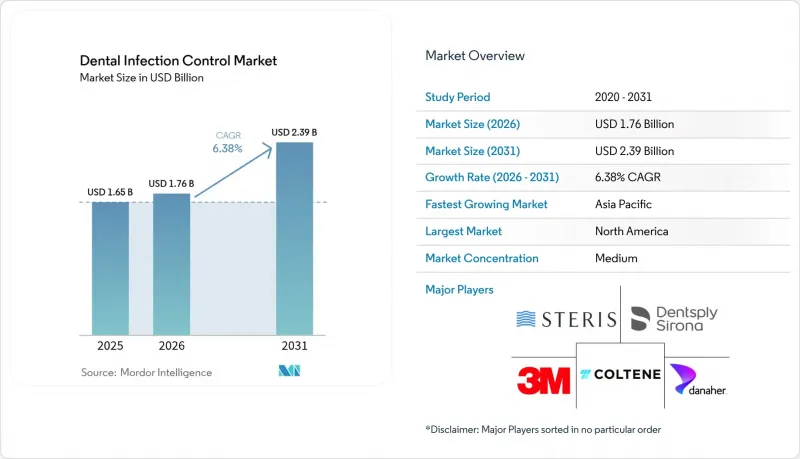
This report is Segmented by Product Type (Equipment, Consumables, Services), End User (Hospitals & Dental Clinics, Dental Laboratories, Academic & Research Institutes, Others), and Geography (North America, Europe, Asia Pacific, Middle East & Africa, and South America). The Market Forecasts are Provided in Terms of Value (USD).
Global Dental Infection Control Market Trends and Insights
Rising Prevalence of Dental Ailments & Surgeries
Complex implant and periodontal procedures are increasing instrument loads and turnaround frequency, forcing clinics to invest in advanced processing units that can sterilize intricate geometries without damage. Aging populations in North America and Europe continue to fuel high-value surgeries that require validated traceability, pushing demand for barcode-scanning autoclaves and biological indicator monitoring systems. Updated CDC guidelines classify bone-involving interventions as high-risk, giving practices a compliance imperative to replace legacy benchtop sterilizers with higher-capacity vacuum units.
Technological Advances in Sterilization & Disinfection
UV-C LED arrays now achieve 99.9999% inactivation of resistant fungi at 270 nm, providing an airborne safeguard that complements steam sterilization without breaking room occupancy rules. Solventum's 2025 eBowie-Dick system digitizes daily test records, eliminating hand-written logs and cutting audit prep time. IoT sensors embedded in chamber gaskets feed maintenance data to the cloud, letting service teams intervene before a cycle failure can disrupt patient flow, although data-security hurdles still stall adoption among smaller offices.
High Capital Cost of Advanced Equipment & Consumables
Midmark's 2024 steam sterilizers boast 25,000-cycle lifespans but command premium prices that place them beyond many solo practices, especially in regions where reimbursement remains flat. Rising single-use product volumes also escalate recurring expenses, and leasing programs often bundle proprietary consumables that prevent cost-saving substitutions. Consequently, funding constraints delay upgrades in locations where infection-risk profiles are actually highest.
Other drivers and restraints analyzed in the detailed report include:
- Stricter Infection-Control Accreditation Standards
- Expansion of Dental Clinics & Medical Tourism
- Stringent Multi-Jurisdictional Regulatory Approvals
For complete list of drivers and restraints, kindly check the Table Of Contents.
Segment Analysis
Equipment captured 51.02% of 2025 revenue, reflecting the capital-intensive backbone of the dental infection control market. High-capacity pre-vacuum autoclaves fitted with RFID-tracked cassettes generate long amortization cycles, and UV-C LED cabinets are emerging to address aerosol contamination previously unmanaged by steam technology. Consumables, however, are expanding at a 9.02% CAGR on the back of heightened cycle frequency, increased biological indicator usage, and single-use sheathing for handpieces. This twin-track dynamic balances predictable equipment replacement budgets against the recurring outflow for test packs and chemical integrators.
Consumables' momentum underscores a procedural shift toward safety-first workflows that depend on validated indicators for every load rather than random sampling. Elevated PPE norms post-2024 have steadied but remain above pre-pandemic baselines, locking in higher quarterly supply spending. Meanwhile, the services niche outsourced instrument reprocessing and regulated waste management grows as urban clinics seek to free chair-time by subcontracting back-office sterilization. However, its share of the dental infection control market is still minor.
Complete Report Scope:
- By Product Type
- Equipment
- Sterilization Equipment
- Cleaning & Disinfection Equipment
- Packaging Equipment
- UV-C LED Disinfection Units
- Consumables
- Surface Disinfectants
- Sterilization Indicators & Biological Monitors
- Hand-hygiene Products
- Personal Protective Equipment (Masks, Gloves, Barriers)
- Services
- Sterilization Services
- Regulated Waste-disposal Services
- Equipment
- By End User
- Hospitals & Dental Clinics
- Dental Laboratories
- Academic & Research Institutes
- Others
- By Geography
- North America
- United States
- Canada
- Mexico
- Europe
- Germany
- United Kingdom
- France
- Italy
- Spain
- Rest of Europe
- Asia Pacific
- China
- Japan
- India
- South Korea
- Australia
- Rest of Asia Pacific
- Middle East & Africa
- GCC
- South Africa
- Rest of Middle East & Africa
- South America
- Brazil
- Argentina
- Rest of South America
- North America
Geography Analysis
North America generated 30.15% of the total 2025 revenue, leveraging mature reimbursement schemes and entrenched accreditation bodies that enforce rigorous sterilization audits. Growth is now tempered as replacement, not expansion, dominates purchase cycles. Clinics face staff shortages that limit throughput gains, and proposed tariffs on dental imports threaten supply cost spikes, pushing dealers to explore near-shore sourcing.
Asia-Pacific stands as the fastest mover with an 7.76% CAGR through 2031. Tipping factors include government-led oral-health campaigns and the rebound of dental tourism corridors in Thailand, Malaysia, and South Korea. Malaysia's dental services market alone is projected to hit USD 2.8 billion by 2027, spurring private clinics to advertise sterilization transparency to win international patients. Nonetheless, disparate approval pathways across ASEAN create onboarding delays for imported equipment, prompting regional distributors to hold higher safety stocks.
Europe shows consistent mid-single-digit growth anchored by sustainability directives such as HTM 0701 that encourage low-energy sterilizers and reusable textiles. Practices benefit from waste-classification revisions that cut disposal fees, freeing capital for software that automates documentation. Southern Europe, with its strong outbound dental-tourism flows, now invests in infection-control upgrades to reclaim domestic patient loyalty.
Emerging markets in the Middle East & Africa and South America lag but register rising tender volumes tied to public-sector clinic modernization. Currency volatility and limited technician pools continue to hamper uptake, yet multilateral health-fund grants are seeding first-time purchases of Class B sterilizers. Vendors entering these regions must combine maintenance training with sales, or risk under-utilization of sophisticated systems.
- 3M
- Dentsply Sirona
- Steris (Cantel, Hu-Friedy, Crosstex)
- Danaher (Kerr, KaVo)
- COLTENE Holding
- Getinge
- Midmark
- Tuttnauer
- SciCan
- A-dec
- Planmeca
- W&H Group
- Ivoclar Vivadent
- Euronda
- Matachana Group
- GC Corporation (GC America)
- Biotrol
- Dentisan
- NSK Nakanishi
- DentalEZ
Additional Benefits:
- The market estimate (ME) sheet in Excel format
- 3 months of analyst support
TABLE OF CONTENTS
1 Introduction
- 1.1 Study Assumptions & Market Definition
- 1.2 Scope of the Study
2 Research Methodology
3 Executive Summary
4 Market Landscape
- 4.1 Market Overview
- 4.2 Market Drivers
- 4.2.1 Rising Prevalence Of Dental Ailments & Surgeries
- 4.2.2 Technological Advances In Sterilization & Disinfection
- 4.2.3 Stricter Infection-Control Accreditation Standards
- 4.2.4 Expansion Of Dental Clinics & Medical Tourism
- 4.2.5 AI-Enabled Sterilization Tracking & IoT Compliance
- 4.2.6 Sustainability Push For Reusable Barriers & Plastics Bans
- 4.3 Market Restraints
- 4.3.1 High Capital Cost Of Advanced Equipment & Consumables
- 4.3.2 Stringent Multi-Jurisdictional Regulatory Approvals
- 4.3.3 Tariff-Driven Supply-Chain Disruption
- 4.3.4 Shortage Of Trained Sterile-Processing Technicians
- 4.4 Supply Chain Analysis
- 4.5 Regulatory Landscape
- 4.6 Technological Outlook
- 4.7 Porter's Five Forces Analysis
- 4.7.1 Threat of New Entrants
- 4.7.2 Bargaining Power of Buyers
- 4.7.3 Bargaining Power of Suppliers
- 4.7.4 Threat of Substitutes
- 4.7.5 Intensity of Competitive Rivalry
5 Market Size & Growth Forecasts (Value)
- 5.1 By Product Type
- 5.1.1 Equipment
- 5.1.1.1 Sterilization Equipment
- 5.1.1.2 Cleaning & Disinfection Equipment
- 5.1.1.3 Packaging Equipment
- 5.1.1.4 UV-C LED Disinfection Units
- 5.1.2 Consumables
- 5.1.2.1 Surface Disinfectants
- 5.1.2.2 Sterilization Indicators & Biological Monitors
- 5.1.2.3 Hand-hygiene Products
- 5.1.2.4 Personal Protective Equipment (Masks, Gloves, Barriers)
- 5.1.3 Services
- 5.1.3.1 Sterilization Services
- 5.1.3.2 Regulated Waste-disposal Services
- 5.1.1 Equipment
- 5.2 By End User
- 5.2.1 Hospitals & Dental Clinics
- 5.2.2 Dental Laboratories
- 5.2.3 Academic & Research Institutes
- 5.2.4 Others
- 5.3 By Geography
- 5.3.1 North America
- 5.3.1.1 United States
- 5.3.1.2 Canada
- 5.3.1.3 Mexico
- 5.3.2 Europe
- 5.3.2.1 Germany
- 5.3.2.2 United Kingdom
- 5.3.2.3 France
- 5.3.2.4 Italy
- 5.3.2.5 Spain
- 5.3.2.6 Rest of Europe
- 5.3.3 Asia Pacific
- 5.3.3.1 China
- 5.3.3.2 Japan
- 5.3.3.3 India
- 5.3.3.4 South Korea
- 5.3.3.5 Australia
- 5.3.3.6 Rest of Asia Pacific
- 5.3.4 Middle East & Africa
- 5.3.4.1 GCC
- 5.3.4.2 South Africa
- 5.3.4.3 Rest of Middle East & Africa
- 5.3.5 South America
- 5.3.5.1 Brazil
- 5.3.5.2 Argentina
- 5.3.5.3 Rest of South America
- 5.3.1 North America
6 Competitive Landscape
- 6.1 Market Concentration
- 6.2 Market Share Analysis
- 6.3 Company Profiles (includes Global level Overview, Market level overview, Core Segments, Financials as available, Strategic Information, Market Rank/Share, Products & Services, Recent Developments)
- 6.3.1 3M
- 6.3.2 Dentsply Sirona
- 6.3.3 Steris (Cantel, Hu-Friedy, Crosstex)
- 6.3.4 Danaher (Kerr, KaVo)
- 6.3.5 COLTENE Holding
- 6.3.6 Getinge
- 6.3.7 Midmark
- 6.3.8 Tuttnauer
- 6.3.9 SciCan
- 6.3.10 A-dec
- 6.3.11 Planmeca
- 6.3.12 W&H Group
- 6.3.13 Ivoclar Vivadent
- 6.3.14 Euronda
- 6.3.15 Matachana Group
- 6.3.16 GC Corporation (GC America)
- 6.3.17 Biotrol
- 6.3.18 Dentisan
- 6.3.19 NSK Nakanishi
- 6.3.20 DentalEZ
7 Market Opportunities & Future Outlook
- 7.1 White-space & Unmet-need Assessment

