PUBLISHER: Mordor Intelligence | PRODUCT CODE: 2097247

PUBLISHER: Mordor Intelligence | PRODUCT CODE: 2097247
China Mutual Fund - Market Share Analysis, Industry Trends & Statistics, Growth Forecasts (2026 - 2031)
According to Mordor Intelligence, China mutual fund market size in 2026 is estimated at USD 5.15 trillion, growing from 2025 value of USD 4.82 trillion with 2031 projections showing USD 7.21 trillion, growing at 6.95% CAGR over 2026-2031.
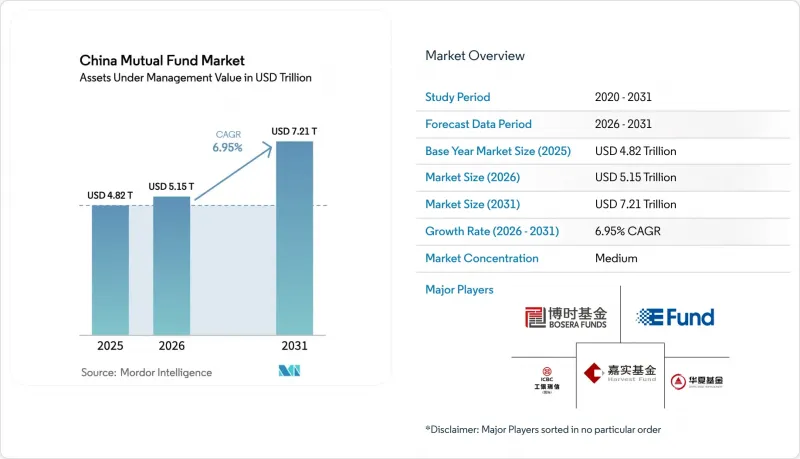
This report is Segmented by Fund Type (Equity, Bond, Hybrid, and More), by Investor Type (Retail, Institutional), by Management Style (Active, Passive), and by Distribution Channel (Online Trading Platform, Banks, Securities Firm, Others). The Market Forecasts are Provided in Terms of Value (USD).
China Mutual Fund Market Trends and Insights
Rising Middle-Class Wealth & Shift from Deposits to Investments
Chinese banks cut long-term deposit rates by up to 45 basis points in 2025, lowering headline yields below 1% and prompting savers to reallocate cash into equity and hybrid funds. Growing disposable income among urban households reinforces this pivot, particularly in tier-2 cities where living costs remain moderate. Asset managers report brisk expansion in balanced-risk products that appeal to first-time investors seeking real-return potential. The withdrawal of many fixed-income certificates by large lenders hastened the flow of idle cash into low-threshold money-market and bond funds. Together, these shifts increase penetration of the China mutual fund market and diversify its asset mix.
Private Pension (3rd-Pillar) Reform Funneling Assets
Nationwide rollout of the private pension scheme in December 2024 opened accounts for more than 72.8 million workers, introducing a powerful pipeline of sticky capital. Annual tax-deductible contributions up to CNY 12,000 favor systematic investing and longer holding periods that align with mutual fund structures. Regulators authorized 85 equity index funds for pension menus, ensuring broad equity exposure and deepening liquidity across multiple benchmarks. Low early-stage contribution rates signal untapped growth once financial literacy programs take hold. Demographic pressure, with one-third of the population projected to be over 60 by 2035, underscores the urgency to cultivate funded retirement assets and cements the China mutual fund market as a key beneficiary.
High Market Volatility & Policy Uncertainty
Repeated bouts of price swings caused elevated fund liquidations in 2024, especially among thematic equity mandates. The MSCI China Index whipsawed investors despite a 34% year-end rally, nurturing redemption spikes and short holding periods. Regulatory messaging often changes at short notice, as seen in tighter reviews for outbound investment vehicles that rattled sentiment. Over 100 enforcement actions against securities firms in 2024 underscore a tougher supervisory stance. Geopolitical frictions remain a wildcard, limiting overseas interest in advanced-technology holdings and constraining flows into the China mutual fund market during stress events.
Other drivers and restraints analyzed in the detailed report include:
- Regulatory Liberalization for Foreign-Owned Fund Managers
- Decline in Bank WMP Yields Pushing Flows to Equity Funds
- Fee Compression from Dominance of Money-Market Funds
For complete list of drivers and restraints, kindly check the Table Of Contents.
Segment Analysis
Equity funds controlled 38.74% of the China mutual fund market in 2025 and are set to expand at an 8.25% CAGR over the forecast period, outpacing every other category. This leadership rests on persistent deposit-rate weakness and the rise of new benchmarks such as the CSI A50, which concentrate market interest in technology, consumption, and green energy exposures. Investors position for structural themes including artificial intelligence and energy transition, pushing assets into growth-tilted mandates and broad-based index trackers. Simultaneous increase in QDII quotas enables managers to embed overseas diversification within mixed-asset products, reinforcing equity uptake. Bond funds grow in tandem as monetary easing elevates fixed-income valuations and anchors balanced portfolios. Hybrid strategies remain popular stepping-stones for conservative savers migrating from cash. Meanwhile, money-market funds experience subdued inflows following the drop in seven-day yields to multi-year lows. Together, these trends deepen the China mutual fund market size of each fund type and recalibrate the asset mix toward risk-bearing products.
Technology ETFs capture headline flows, with ten CSI A50 tracker approvals ratifying a growing appetite for transparent low-cost instruments. Active stock-pickers still dominate absolute share through breadth of style and sector weightings, but passive adoption gains pace under fee pressure. ESG overlays become standard as authorities channel capital toward carbon-neutral projects. Managers also extend alternative investment capabilities, integrating commodity and private-market exposures permitted within the QDLP framework. Performance dispersion widens between skillful houses and laggards, encouraging retail investors to scrutinize track records. Consequently, competition among fund types intensifies, amplifying the strategic significance of scale and product innovation within the China mutual fund market.
Retail clients held 58.35% of the assets of the China mutual fund market in 2025 and show the fastest 7.85% CAGR through 2031, reflecting widening financial inclusion via mobile platforms. Low minimum subscriptions and automated payroll deductions for private pension accounts nurture disciplined long-term investing. Younger savers gravitate toward themed index funds bundled inside super-apps, marking a generational shift from property-centric wealth accumulation to diversified portfolios. Institutional investors enlarge positions in bond and quantitative mandates to meet asset-liability goals, yet growth lags behind retail due to mature penetration levels. The latest QDII quota increase provides endowments and insurers with greater foreign-asset headroom, boosting demand for global equity and fixed-income products. Concurrent regulatory scrutiny of local government financing exposures raises risk management thresholds for professional investors. In parallel, the rise of corporate annuity plans opens a stable channel of inflows for balanced and fixed-income offerings.
Retail geography broadens beyond coastal hubs as digital connectivity tightens the gap between metropolitan and inland regions, though education deficits persist in lower-tier cities. Investor-protection rules now require distributors to deploy suitability tests and portfolio-stress disclosures, strengthening market integrity. Mass-market acceptance of model-portfolio ETFs provides simplified entry points while shielding investors from single-stock concentration risk. Collectively, these shifts anchor robust expansion in the China mutual fund market size for both retail and institutional cohorts, yet the former remains the main growth lever over the forecast horizon.
Complete Report Scope:
- By Fund Type
- Equity
- Bond
- Hybrid
- Money Market
- Others
- By Investor Type
- Retail
- Institutional
- By Management Style
- Active
- Passive
- By Distribution Channel
- Online Trading Platform
- Banks
- Securities Firm
- Others
List of Companies Covered in this Report:
- E Fund Management
- China Asset Management Co. (ChinaAMC)
- ICBC Credit Suisse Asset Management
- Harvest Fund Management
- Bosera Asset Management
- Southern Asset Management
- GF Fund Management
- Huaxia Fund Management
- Penghua Fund Management
- Fullgoal Fund Management
- Invesco Great Wall Fund Management
- HSBC Jintrust Fund Management
- UBS SDIC Fund Management
- BlackRock Fund Management (China)
- J.P. Morgan Asset Management (China)
- Abrdn Fund Management (China)
- Neuberger Berman Fund Management (China)
- Matthews Asia Funds (China strategies)
- Goldman Sachs Asset Management (China)
- AMG Veritas China Fund
Additional Benefits:
- The market estimate (ME) sheet in Excel format
- 3 months of analyst support
TABLE OF CONTENTS
1 Introduction
- 1.1 Study Assumptions & Market Definition
- 1.2 Scope of the Study
2 Research Methodology
3 Executive Summary
4 Market Landscape
- 4.1 Market Overview
- 4.2 Market Drivers
- 4.2.1 Rising middle-class wealth & shift from deposits to investments
- 4.2.2 Private pension (3rd-pillar) reform funneling assets
- 4.2.3 Regulatory liberalisation for foreign-owned fund managers
- 4.2.4 Decline in bank WMP yields pushing flows to equity funds
- 4.2.5 Super-app & robo-advisory micro-investing adoption
- 4.2.6 Housing Provident Fund boosts household risk appetite
- 4.3 Market Restraints
- 4.3.1 High market volatility & policy uncertainty
- 4.3.2 Fee compression from dominance of money-market funds
- 4.3.3 Competitive pressure from low-cost ETFs & WM products
- 4.3.4 Low retail financial literacy triggers redemption shocks
- 4.4 Value / Supply-Chain Analysis
- 4.5 Regulatory Landscape
- 4.6 Technological Outlook
- 4.7 Porter's Five Forces
- 4.7.1 Threat of New Entrants
- 4.7.2 Bargaining Power of Buyers
- 4.7.3 Bargaining Power of Suppliers
- 4.7.4 Threat of Substitutes
- 4.7.5 Intensity of Competitive Rivalry
5 Market Size & Growth Forecasts (Value)
- 5.1 By Fund Type
- 5.1.1 Equity
- 5.1.2 Bond
- 5.1.3 Hybrid
- 5.1.4 Money Market
- 5.1.5 Others
- 5.2 By Investor Type
- 5.2.1 Retail
- 5.2.2 Institutional
- 5.3 By Management Style
- 5.3.1 Active
- 5.3.2 Passive
- 5.4 By Distribution Channel
- 5.4.1 Online Trading Platform
- 5.4.2 Banks
- 5.4.3 Securities Firm
- 5.4.4 Others
6 Competitive Landscape
- 6.1 Market Concentration
- 6.2 Strategic Moves
- 6.3 Market Share Analysis
- 6.4 Company Profiles (includes Global Level Overview, Market Level Overview, Core Segments, Financials as available, Strategic Information, Market Rank/Share for Key Companies, Products & Services, and Recent Developments)
- 6.4.1 E Fund Management
- 6.4.2 China Asset Management Co. (ChinaAMC)
- 6.4.3 ICBC Credit Suisse Asset Management
- 6.4.4 Harvest Fund Management
- 6.4.5 Bosera Asset Management
- 6.4.6 Southern Asset Management
- 6.4.7 GF Fund Management
- 6.4.8 Huaxia Fund Management
- 6.4.9 Penghua Fund Management
- 6.4.10 Fullgoal Fund Management
- 6.4.11 Invesco Great Wall Fund Management
- 6.4.12 HSBC Jintrust Fund Management
- 6.4.13 UBS SDIC Fund Management
- 6.4.14 BlackRock Fund Management (China)
- 6.4.15 J.P. Morgan Asset Management (China)
- 6.4.16 Abrdn Fund Management (China)
- 6.4.17 Neuberger Berman Fund Management (China)
- 6.4.18 Matthews Asia Funds (China strategies)
- 6.4.19 Goldman Sachs Asset Management (China)
- 6.4.20 AMG Veritas China Fund
7 Market Opportunities & Future Outlook
- 7.1 White-space & Unmet-Need Assessment

