PUBLISHER: Mordor Intelligence | PRODUCT CODE: 2115897

PUBLISHER: Mordor Intelligence | PRODUCT CODE: 2115897
Europe Mutual Fund - Market Share Analysis, Industry Trends & Statistics, Growth Forecasts (2026 - 2031)
According to Mordor Intelligence, Europe mutual fund market size in 2026 is estimated at USD 43.01 trillion, growing from 2025 value of USD 41.54 trillion with 2031 projections showing USD 51.18 trillion, growing at 3.54% CAGR over 2026-2031.
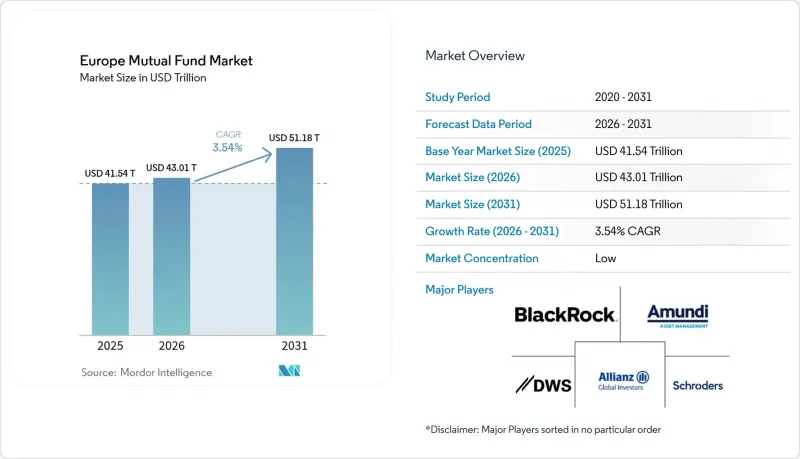
This report is Segmented by Asset Class (Equity, Bond, Hybrid, Money Market, Others), Investor Type (Retail, Institutional), Distribution Channel (Banks, Online Platforms, Financial Advisors, Direct), and Geography (United Kingdom, Germany, France, Spain, Italy, BENELUX, NORDICS, Rest of Europe). The Market Forecasts are Provided in Terms of Value (USD).
Europe Mutual Fund Market Trends and Insights
ESG-aligned fund shift
Demand for sustainable strategies has vaulted Article 8 and Article 9 funds to the forefront of the Europe mutual fund market, pulling in USD 191-195 billion (EUR 180 billion) of net inflows during 2024, or 75% of aggregate mutual fund subscriptions. ESMA's 2024 naming guidance tightened eligibility, forcing widespread reclassifications and temporary outflows from marginal products before stabilizing with more robust disclosure. Larger managers have exploited their research scale to meet the Sustainable Finance Disclosure Regulation's Principal Adverse Impact demands, thereby shielding fee structures from the wider compression trend. France's taxonomy-driven incentives catalyzed fresh thematic launches, including climate-transition and biodiversity strategies that command premium pricing. Institutional allocators now use ESG credentials as a gating criterion for manager selection, steering mandates toward platforms with proven stewardship frameworks. Retail investors, empowered by transparent impact metrics delivered through digital dashboards, are allocating a growing share of recurring monthly savings plans to sustainability-labeled funds. The evolving EU taxonomy, poised to add nuclear and gas to transition activities in 2025, is expected to unlock adjacent product lines and maintain inflow momentum into the Europe mutual fund market.
Rising robo-advisory adoption
Digital platforms that automate portfolio construction are carving out double-digit market-share gains, particularly across Nordic retail channels where 18% of assets already sit in automated mandates. Algorithmic advice, now blessed by clarified MiFID II suitability rules, enables cost-effective offerings that charge 0.25-0.75% versus 1.5-2.5% at traditional branches. Germany's BaFin green-lit 12 new robo licenses during 2024, signaling regulatory comfort with algorithmic services so long as governance and transparency standards are met. Vanguard's European robo business logged 40% asset growth year-on-year, driven by tax-loss harvesting and low minimums that appeal to mass-affluent savers. Banks have responded by embedding white label robo modules into mobile apps, defending their 44.87% distribution share while bluntly lowering operating costs. Customer experience improvements, including straight-through KYC and biometric onboarding, shorten the investment funnel and accelerate AUM conversion. As artificial-intelligence engines mature, robo platforms will integrate ESG scoring and personalized retirement glide paths, raising the ceiling on digital penetration within the Europe mutual fund market.
Fee compression from passive products
Index-tracking vehicles continue to siphon flows from higher-fee active peers, dragging average mutual-fund expense ratios in Germany down to 1.15% in 2024 from 1.45% in 2020. Vanguard's European ETF book surged 35% to USD 207.9 billion (EUR 180 billion), emboldened by government-backed savings plans that waive transaction fees for ETF allocation. Fixed-income ETFs now offer 0.05% headline TERs, forcing active bond managers to justify fees north of 0.75% with demonstrable alpha or bespoke mandates. Product rationalization accelerated, with 15% of European fund ranges consolidated or liquidated during 2024, shedding sub-scale offerings that cannot compete on price. Managers responded by introducing factor-based hybrids and performance-fee share classes, but these measures often cannibalize legacy revenue streams. Margin contraction has intensified M&A rationales as mid-tier platforms search for cost synergies and digital operating leverage. Sustained price competition is forecast to shave 0.9 percentage points off aggregate CAGR potential for the Europe Mutual Fund Market over the next two years.
Other drivers and restraints analyzed in the detailed report include:
- Expansion of EU Capital Markets Union reforms
- Cross-border passporting efficiencies post-ELTIF 2.0
- Demographic shift to decumulation among aging investors
For complete list of drivers and restraints, kindly check the Table Of Contents.
Segment Analysis
Equity funds commanded 38.35% of the Europe mutual fund market share in 2025, reflecting a sustained appetite for growth themes and the rapid mainstreaming of ESG mandates. Bond funds followed closely at 35.42% as investors sought duration and inflation hedges amid ECB tightening cycles that nudged yields off historic lows without triggering recession. Hybrid allocations captured 15.62%, appealing to balanced-profile savers who value downside buffers during volatile rate regimes. Money-market strategies maintained 8.01% as corporate treasurers parked cash to earn improved overnight returns in a recovering rate backdrop. Alternative UCITS, though only 2.60%, grew swiftly on infra-debt and private-credit replication funds that promise diversification plus liquidity. The forecast 6.18% CAGR for equity funds implies that the Europe mutual fund markett size for equities could surpass USD 22.27 trillion by 2031 if current inflow momentum persists. Regulatory clarity under the Digital Operational Resilience Act requires each asset-class platform to invest in cyber infrastructure, lifting compliance spend to USD 2.88 million (EUR 2.5 million) per manager on average.
Equity funds are increasingly Article 8 or Article 9-labeled, with ESG screening embedded into standard prospectus language rather than marketed as stand-alone features. Bond funds benefit from renewed institutional allocations to investment-grade credit, particularly in the UK, where pension fund LDI unwind has freed balance-sheet capacity for traditional mutual-fund vehicles. Hybrid strategies leverage automated rebalancing engines to maintain risk bands, offering comfort to retail investors wary after the 2022-2023 volatility episodes. Money-market offerings reinvented themselves through tokenized share classes that settle on blockchain within minutes, reducing counterparty and settlement risk while meeting MiFID cost-transparency rules. Alternative UCITS continue to harvest relative-value and macro-trend opportunities, attracting institutions that want daily dealing with lower operational due diligence overheads than private fund structures. As a result, the Europe mutual fund market size dedicated to alternatives is projected to triple by 2030, albeit from a low base, contributing marginally but meaningfully to overall diversification. Cross-asset correlations will dictate product development velocity, encouraging managers to bundle multi-asset ESG, climate, and factor overlays into turnkey wrappers for both retail and institutional clients.
Complete Report Scope:
- By Asset Class
- Equity
- Bond
- Hybrid
- Money Market
- Others
- By Investor Type
- Retail
- Institutional
- By Distribution Channel
- Banks
- Online Platforms
- Financial Advisors
- Direct
- By Geography
- United Kingdom
- Germany
- France
- Spain
- Italy
- BENELUX (Belgium, Netherlands, Luxembourg)
- NORDICS (Denmark, Finland, Iceland, Norway, Sweden)
- Rest of Europe
List of Companies Covered in this Report:
- BlackRock
- Amundi
- DWS Group
- Schroders
- Allianz Global Investors
- J.P. Morgan Asset Management
- UBS Asset Management
- AXA Investment Managers
- Legal & General Investment Management
- Invesco
- Fidelity International
- Franklin Templeton
- Pictet Asset Management
- abrdn
- M&G Investments
- Robeco
- BNP Paribas Asset Management
- Nordea Asset Management
- Danske Invest
- Goldman Sachs Asset Management (incl. NN IP)
Additional Benefits:
- The market estimate (ME) sheet in Excel format
- 3 months of analyst support
TABLE OF CONTENTS
1 Introduction
- 1.1 Study Assumptions & Market Definition
- 1.2 Scope of the Study
2 Research Methodology
3 Executive Summary
4 Market Landscape
- 4.1 Market Overview
- 4.2 Market Drivers
- 4.2.1 Shift toward ESG-aligned funds
- 4.2.2 Persistent low interest-rate environment until 2027
- 4.2.3 Expansion of EU Capital Markets Union reforms
- 4.2.4 Rising adoption of robo-advisory platforms
- 4.2.5 Tokenization of fund units on blockchain
- 4.2.6 Cross-border passporting efficiencies post-ELTIF 2.0
- 4.3 Market Restraints
- 4.3.1 Fee-compression pressure from passive products
- 4.3.2 Regulatory uncertainty around SFDR Level-2 disclosures
- 4.3.3 Heightened cyber-security & data-privacy risks
- 4.3.4 Demographic shift to decumulation among aging investors
- 4.4 Value / Supply-Chain Analysis
- 4.5 Regulatory Landscape
- 4.6 Technological Outlook
- 4.7 Porter's Five Forces
- 4.7.1 Threat of New Entrants
- 4.7.2 Bargaining Power of Buyers
- 4.7.3 Bargaining Power of Suppliers
- 4.7.4 Threat of Substitutes
- 4.7.5 Competitive Rivalry
5 Market Size & Growth Forecasts
- 5.1 By Asset Class
- 5.1.1 Equity
- 5.1.2 Bond
- 5.1.3 Hybrid
- 5.1.4 Money Market
- 5.1.5 Others
- 5.2 By Investor Type
- 5.2.1 Retail
- 5.2.2 Institutional
- 5.3 By Distribution Channel
- 5.3.1 Banks
- 5.3.2 Online Platforms
- 5.3.3 Financial Advisors
- 5.3.4 Direct
- 5.4 By Geography
- 5.4.1 United Kingdom
- 5.4.2 Germany
- 5.4.3 France
- 5.4.4 Spain
- 5.4.5 Italy
- 5.4.6 BENELUX (Belgium, Netherlands, Luxembourg)
- 5.4.7 NORDICS (Denmark, Finland, Iceland, Norway, Sweden)
- 5.4.8 Rest of Europe
6 Competitive Landscape
- 6.1 Market Concentration
- 6.2 Strategic Moves
- 6.3 Market Share Analysis
- 6.4 Company Profiles (includes Global-level Overview, Market-level Overview, Core Segments, Financials as available, Strategic Information, Market Rank/Share for key companies, Products & Services, and Recent Developments)
- 6.4.1 BlackRock
- 6.4.2 Amundi
- 6.4.3 DWS Group
- 6.4.4 Schroders
- 6.4.5 Allianz Global Investors
- 6.4.6 J.P. Morgan Asset Management
- 6.4.7 UBS Asset Management
- 6.4.8 AXA Investment Managers
- 6.4.9 Legal & General Investment Management
- 6.4.10 Invesco
- 6.4.11 Fidelity International
- 6.4.12 Franklin Templeton
- 6.4.13 Pictet Asset Management
- 6.4.14 abrdn
- 6.4.15 M&G Investments
- 6.4.16 Robeco
- 6.4.17 BNP Paribas Asset Management
- 6.4.18 Nordea Asset Management
- 6.4.19 Danske Invest
- 6.4.20 Goldman Sachs Asset Management (incl. NN IP)
7 Market Opportunities & Future Outlook
- 7.1 Pan-European retail investment hub via Open Finance
- 7.2 Integration of tokenized funds into MiCA-compliant exchanges

