PUBLISHER: Mordor Intelligence | PRODUCT CODE: 2119610

PUBLISHER: Mordor Intelligence | PRODUCT CODE: 2119610
United Kingdom Mutual Fund - Market Share Analysis, Industry Trends & Statistics, Growth Forecasts (2026 - 2031)
According to Mordor Intelligence, the United Kingdom mutual fund market size is expected to grow from USD 14.13 trillion in 2025 to USD 14.86 trillion in 2026 and is forecast to reach USD 19.13 trillion by 2031 at 5.16% CAGR over 2026-2031.
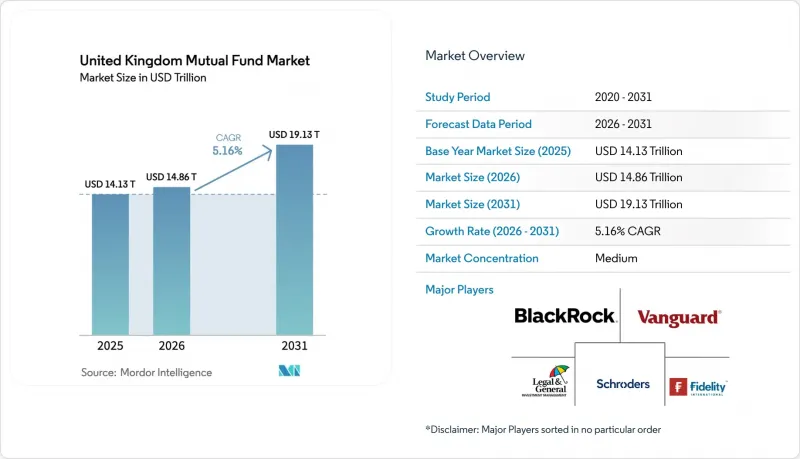
This report is Segmented by Asset Class (Equity, Bond, Hybrid, Money Market, Others), Investor Type (Retail, Institutional), Distribution Channel (Banks, Online Platforms, Financial Advisors, Direct), and Geography (England, Scotland, Wales, Northern Ireland). The Market Forecasts are Provided in Terms of Value (USD).
United Kingdom Mutual Fund Market Trends and Insights
Shrinking retail cash hoards redirected into funds
Households accumulated sizeable cash positions during the pandemic, but rising inflation eroded deposit returns and spurred a hunt for yield. The FCA's 2025 guidance on "excess-cash" nudges platforms to flag idle balances and suggest suitable investment options, unlocking fresh inflows to the United Kingdom mutual fund market. Digital prompts and risk-profiling tools simplify fund selection, while Consumer Duty rules ensure transparency around value for money. Banks are collaborating with asset managers to curate low-cost fund baskets, reinforcing the shift from deposits to investments. These behavioral changes are most visible in England and Wales, yet Scotland's retail base is beginning to mirror the trend.
Defined-contribution auto-enrolment glide-path upgrades favor multi-asset defaults
Automatic enrollment now covers more than 10 million workers and is pushing plan sponsors to upgrade default funds. Providers are embedding multi-asset building blocks that blend public and private investments, benefiting from scale purchasing power. The Mansion House Accord further pushes fiduciaries toward private-market allocations, enhancing diversification and return potential for long-term savers. Employers welcome the simplified lifecycle structure, while trustees appreciate the transparent fee mechanics stipulated by Consumer Duty. Over time, these strategies are expected to reduce retirement-outcome dispersion and anchor stickier institutional flows into the United Kingdom mutual fund market.
Persistent retail outflows from UK-equity funds despite valuation discounts
Domestic equities trade at notable discounts to U.S. peers, yet sentiment remains subdued. Brexit aftershocks and macro sluggishness deter retail allocations, while global ETFs offer diversified exposure at lower cost. Headline underperformance perpetuates a negative feedback loop, with press coverage reinforcing outflow momentum. Although the Mansion House Compact aims to reverse this, retail behaviors respond slowly to policy signaling. Re-engaging investors will require tangible evidence of earnings resilience among UK-listed firms.
Other drivers and restraints analyzed in the detailed report include:
- Record tracker-fund inflows driven by fee compression and Consumer Duty disclosures
- Pension fund Mansion House Compact to shift 5% of assets into UK growth equity
- High concentration of platform distribution fees squeezing active-manager margins
For complete list of drivers and restraints, kindly check the Table Of Contents.
Segment Analysis
By Investor Type: Institutional weight remains decisive while retail acceleratesEquity funds captured 47.50% of the United Kingdom mutual fund market in 2025, supported by widespread index adoption and institutional allocations. Bond funds accounted for 24.20%, buoyed by liability-driven investments and gilt issuance. Hybrid strategies held 18.10% as target-date solutions became the default for auto-enrolled savers. Money-market products remained at 7.10% amid persistent low policy rates. The "others" bucket-primarily Long-Term Asset Funds-claimed just 3.10% yet is projected to post a 12.19% CAGR through 2031. This pace suggests private-asset vehicles will eat into traditional equity shares, but diversification benefits should empower investors to blend both. Active equity teams are therefore emphasizing stewardship initiatives to retain relevance and defend fee levels.
Historically, equity funds weathered 2019-2024 shocks thanks to broad-based recovery rallies and consistent pension-scheme inflows. Fixed-income allocations grew after the 2022 gilt crisis, when schemes retooled risk budgets. Momentum behind LTAFs stems from the search for yield, retail appetite for real-asset exposure, and regulatory safeguards that calm liquidity worries. Technology also matters; tokenized share classes promise near-instant settlement, lowering administration costs for illiquid holdings. Overall, diversification across asset classes underpins the resilience of the United Kingdom mutual fund market.
Complete Report Scope:
- By Asset Class
- Equity
- Bond
- Hybrid
- Money Market
- Others
- By Investor Type
- Retail
- Institutional
- By Distribution Channel
- Banks
- Online Platforms
- Financial Advisors
- Direct
- By Region
- England
- Scotland
- Wales
- Northern Ireland
List of Companies Covered in this Report:
- BlackRock
- Vanguard
- Legal & General Investment Management
- Fidelity International
- Schroders
- abrdn
- Invesco
- Jupiter Asset Management
- Baillie Gifford
- HSBC Global Asset Management
- M&G Investments
- BNY Mellon IM
- Royal London AM
- Dimensional Fund Advisors
- Franklin Templeton
- Janus Henderson
- UBS AM
- Columbia Threadneedle
- T. Rowe Price
- Northern Trust AM
Additional Benefits:
- The market estimate (ME) sheet in Excel format
- 3 months of analyst support
TABLE OF CONTENTS
1 Introduction
- 1.1 Study Assumptions & Market Definition
- 1.2 Scope of the Study
2 Research Methodology
3 Executive Summary
4 Market Landscape
- 4.1 Market Overview
- 4.2 Market Drivers
- 4.2.1 Shrinking retail cash hoards redirected into funds by FCA "excess-cash" initiative
- 4.2.2 Defined-contribution (DC) auto-enrolment glide-path upgrades favour multi-asset defaults
- 4.2.3 Record tracker-fund inflows driven by fee compression and Consumer Duty disclosures
- 4.2.4 Pension fund "Mansion House Compact" to shift 5 % of assets into UK growth equity
- 4.2.5 AI-enabled hyper-personalised portfolio construction on direct-to-consumer platforms
- 4.2.6 Emerging "Long-Term Asset Fund" (LTAF) structure opening private-market access
- 4.3 Market Restraints
- 4.3.1 Persistent retail outflows from UK-equity funds despite valuation discounts
- 4.3.2 High concentration of platform distribution fees squeezing active-manager margins
- 4.3.3 Rising operational costs from Consumer Duty & Sustainability Disclosure Requirements
- 4.3.4 Regulatory capital strain on small boutiques under IFPR harms product innovation
- 4.4 Value / Supply-Chain Analysis
- 4.5 Regulatory Landscape
- 4.6 Technological Outlook
- 4.7 Porter's Five Forces
- 4.7.1 Threat of New Entrants
- 4.7.2 Bargaining Power of Buyers
- 4.7.3 Bargaining Power of Suppliers
- 4.7.4 Threat of Substitutes
- 4.7.5 Competitive Rivalry
5 Market Size & Growth Forecasts
- 5.1 By Asset Class
- 5.1.1 Equity
- 5.1.2 Bond
- 5.1.3 Hybrid
- 5.1.4 Money Market
- 5.1.5 Others
- 5.2 By Investor Type
- 5.2.1 Retail
- 5.2.2 Institutional
- 5.3 By Distribution Channel
- 5.3.1 Banks
- 5.3.2 Online Platforms
- 5.3.3 Financial Advisors
- 5.3.4 Direct
- 5.4 By Region
- 5.4.1 England
- 5.4.2 Scotland
- 5.4.3 Wales
- 5.4.4 Northern Ireland
6 Competitive Landscape
- 6.1 Market Concentration
- 6.2 Strategic Moves
- 6.3 Market Share Analysis
- 6.4 Company Profiles (includes Global level Overview, Market level overview, Core Segments, Financials as available, Strategic Information, Market Rank/Share for key companies, Products & Services, and Recent Developments)
- 6.4.1 BlackRock
- 6.4.2 Vanguard
- 6.4.3 Legal & General Investment Management
- 6.4.4 Fidelity International
- 6.4.5 Schroders
- 6.4.6 abrdn
- 6.4.7 Invesco
- 6.4.8 Jupiter Asset Management
- 6.4.9 Baillie Gifford
- 6.4.10 HSBC Global Asset Management
- 6.4.11 M&G Investments
- 6.4.12 BNY Mellon IM
- 6.4.13 Royal London AM
- 6.4.14 Dimensional Fund Advisors
- 6.4.15 Franklin Templeton
- 6.4.16 Janus Henderson
- 6.4.17 UBS AM
- 6.4.18 Columbia Threadneedle
- 6.4.19 T. Rowe Price
- 6.4.20 Northern Trust AM
7 Market Opportunities & Future Outlook
- 7.1 Tokenised fund share classes cutting settlement cycles & enabling fractional ownership
- 7.2 UK ISA allowance boost tied to domestic-growth funds broadens retail addressable pool

