PUBLISHER: Mordor Intelligence | PRODUCT CODE: 2115901

PUBLISHER: Mordor Intelligence | PRODUCT CODE: 2115901
GCC Mutual Fund - Market Share Analysis, Industry Trends & Statistics, Growth Forecasts (2026 - 2031)
According to Mordor Intelligence, the GCC mutual fund market size was valued at USD 2.36 trillion in 2025 and estimated to grow from USD 2.55 trillion in 2026 to reach USD 3.73 trillion by 2031, at a CAGR of 7.92% during the forecast period (2026-2031).
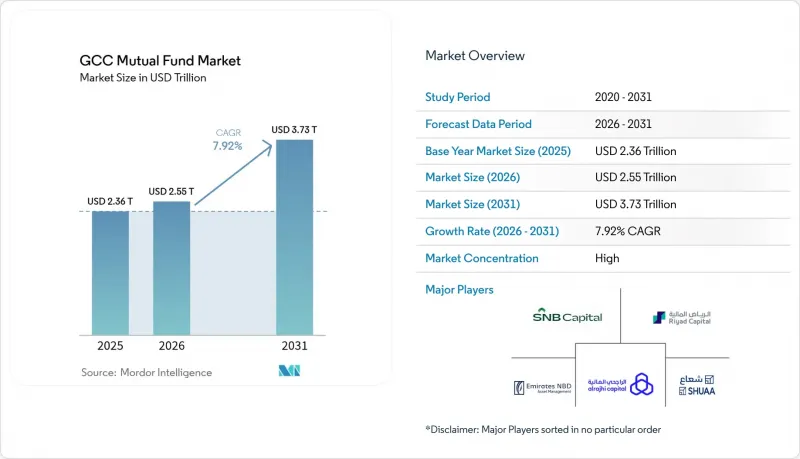
This report is Segmented by Asset Class (Equity, Bond, Hybrid, Money Market, Others), Investor Type (Retail, Institutional), Distribution Channel (Banks, Online Platforms, Financial Advisors, Direct), and Geography (Saudi Arabia, United Arab Emirates, Qatar, Kuwait, Oman, Bahrain). The Market Forecasts are Provided in Terms of Value (USD).
GCC Mutual Fund Market Trends and Insights
Rising IPO Pipeline Expanding Investable Universe
Saudi Arabia's Tadawul exchange processed 32 new listings in 2024, while the UAE's exchanges added 18 companies, creating expanded opportunity sets for equity-focused mutual funds. This pipeline expansion directly correlates with mutual fund AUM growth as managers gain access to previously unavailable sectors, including renewable energy, healthcare technology, and logistics infrastructure. The strategic implication extends beyond asset availability-new listings often carry higher volatility and information asymmetries that favor active management strategies over passive indexing. Regional exchanges are implementing fast-track listing procedures for qualifying companies, reducing time-to-market from 18 months to 8-12 months. Saudi Aramco's subsidiary IPO plans and similar large-scale listings create anchor opportunities for institutional fund strategies while providing retail funds with diversification beyond traditional banking and petrochemical exposures.
Surge in Sharia-Compliant Savings Products
Islamic finance assets in the GCC reached USD 1.8 trillion in 2024, with mutual fund products representing the fastest-growing segment within this universe. Regulatory bodies, including Saudi Arabia's CMA and the UAE's SCA, have streamlined Sharia-compliant fund approval processes, reducing certification timelines from 6 months to 3 months while expanding eligible investment categories. The competitive advantage lies in demographic alignment-over 85% of GCC retail investors express preference for Sharia-compliant investment options, yet traditional product offerings have historically underserved this demand. Technology integration through platforms like Alpaca's partnership with ZAD enables automated Sharia screening and real-time compliance monitoring, reducing operational costs while improving investor confidence. Fund managers are developing hybrid structures that combine conventional investment strategies with Islamic principles, accessing broader institutional capital while maintaining religious compliance.
Fee Compression from Passive & Robo Advisers
Global ETF assets reached USD 14.64 trillion in Q1 2025, with expense ratios averaging 0.15% compared to 0.85% for actively managed mutual funds, creating sustained pressure on traditional fund management fee structures. GCC-based robo-advisory platforms including Sarwa and Wahed Invest, are expanding automated portfolio management services with fees below 0.50%, forcing traditional managers to justify premium pricing through alpha generation or specialized services. The strategic response involves product differentiation through alternative asset classes, private market access, and enhanced advisory services that justify higher fee structures. Deloitte's 2025 Investment Management Outlook identifies actively managed ETFs as a growing compromise solution, combining cost efficiency with active management strategies. Regional fund managers are exploring outcome-based fee structures and performance-linked pricing to maintain margins while competing with passive alternatives.
Other drivers and restraints analyzed in the detailed report include:
- Sovereign Debt Issuance Boosting Fixed-Income AUM
- Open-Banking Rules Widening Retail Access
- Limited Secondary-Market Liquidity in GCC Bonds
For complete list of drivers and restraints, kindly check the Table Of Contents.
Segment Analysis
Equity funds held 60.73% of % GCC mutual fund market share in 2025 as buoyant IPO activity and index inclusions propelled allocations. Bond and sukuk vehicles, however, are growing fastest at a 9.55% CAGR, lifting their slice of the GCC mutual fund market size alongside sovereign issuance growth. In the near term, money-market strategies provide liquidity management tools for institutions, while hybrid balanced funds capture risk-averse retail inflows. Over the outlook horizon, alternative structures such as REITs and private-credit funds should diversify revenue streams for asset managers eager to escape fee compression threats. Premia Partners' BOCHK Saudi Government Sukuk ETF launch in July 2025 offered passive access to local sovereign Islamic bonds. Goldman Sachs followed with sector-specific GCC ETFs targeting healthcare and technology exposures. Regulatory reforms in Saudi Arabia shortened approval processes, unlocking innovative structures that blend passive baskets with Islamic screens. Collectively, these dynamics support asset-class breadth, enhancing portfolio-construction flexibilities for the GCC mutual fund market.
Complete Report Scope:
- By Asset Class
- Equity
- Bond
- Hybrid
- Money Market
- Others
- By Investor Type
- Retail
- Institutional
- By Distribution Channel
- Banks
- Online Platforms
- Financial Advisors
- Direct
- By Geography
- Saudi Arabia
- United Arab Emirates
- Qatar
- Kuwait
- Oman
- Bahrain
List of Companies Covered in this Report:
- SNB Capital
- Al Rajhi Capital
- Riyad Capital
- Jadwa Investment
- Saudi Fransi Capital
- Samba Capital
- SHUAA Capital
- Emirates NBD Asset Management
- FAB Asset Management
- ADCB Asset Management
- Mashreq Capital
- QNB Capital
- QInvest
- Ahli United Investments
- Kuwait Financial Centre (Markaz)
- KAMCO Invest
- Gulf Investment Corporation
- SICO Bahrain
- GFH Financial Group
- Oman National Investments Co.
Additional Benefits:
- The market estimate (ME) sheet in Excel format
- 3 months of analyst support
TABLE OF CONTENTS
1 Introduction
- 1.1 Study Assumptions & Market Definition
- 1.2 Scope of the Study
2 Research Methodology
3 Executive Summary
4 Market Landscape
- 4.1 Market Overview
- 4.2 Market Drivers
- 4.2.1 Rising IPO pipeline expanding investable universe
- 4.2.2 Surge in Sharia-compliant savings products
- 4.2.3 Sovereign debt issuance boosting fixed-income AUM
- 4.2.4 Open-banking rules widening retail access
- 4.2.5 SWF seeding of local fund managers
- 4.2.6 High net-worth migration into GCC
- 4.3 Market Restraints
- 4.3.1 Fee compression from passive & robo advisers
- 4.3.2 Limited secondary-market liquidity in GCC bonds
- 4.3.3 Foreign-ownership caps on listed equities
- 4.3.4 Compliance costs under evolving regulations
- 4.4 Value / Supply-Chain Analysis
- 4.5 Regulatory Landscape
- 4.6 Technological Outlook
- 4.7 Porter's Five Forces
- 4.7.1 Threat of New Entrants
- 4.7.2 Bargaining Power of Suppliers
- 4.7.3 Bargaining Power of Buyers
- 4.7.4 Threat of Substitutes
- 4.7.5 Competitive Rivalry
5 Market Size & Growth Forecasts
- 5.1 By Asset Class
- 5.1.1 Equity
- 5.1.2 Bond
- 5.1.3 Hybrid
- 5.1.4 Money Market
- 5.1.5 Others
- 5.2 By Investor Type
- 5.2.1 Retail
- 5.2.2 Institutional
- 5.3 By Distribution Channel
- 5.3.1 Banks
- 5.3.2 Online Platforms
- 5.3.3 Financial Advisors
- 5.3.4 Direct
- 5.4 By Geography
- 5.4.1 Saudi Arabia
- 5.4.2 United Arab Emirates
- 5.4.3 Qatar
- 5.4.4 Kuwait
- 5.4.5 Oman
- 5.4.6 Bahrain
6 Competitive Landscape
- 6.1 Market Concentration
- 6.2 Strategic Moves
- 6.3 Market Share Analysis
- 6.4 Company Profiles (includes Global level Overview, Market level overview, Core Segments, Financials as available, Strategic Information, Market Rank/Share for key companies, Products & Services, and Recent Developments)
- 6.4.1 SNB Capital
- 6.4.2 Al Rajhi Capital
- 6.4.3 Riyad Capital
- 6.4.4 Jadwa Investment
- 6.4.5 Saudi Fransi Capital
- 6.4.6 Samba Capital
- 6.4.7 SHUAA Capital
- 6.4.8 Emirates NBD Asset Management
- 6.4.9 FAB Asset Management
- 6.4.10 ADCB Asset Management
- 6.4.11 Mashreq Capital
- 6.4.12 QNB Capital
- 6.4.13 QInvest
- 6.4.14 Ahli United Investments
- 6.4.15 Kuwait Financial Centre (Markaz)
- 6.4.16 KAMCO Invest
- 6.4.17 Gulf Investment Corporation
- 6.4.18 SICO Bahrain
- 6.4.19 GFH Financial Group
- 6.4.20 Oman National Investments Co.
7 Market Opportunities & Future Outlook
- 7.1 Rise of digital-only wealth platforms across GCC
- 7.2 Growth of ESG-labelled sukuk and equity funds

