PUBLISHER: Mordor Intelligence | PRODUCT CODE: 2097248

PUBLISHER: Mordor Intelligence | PRODUCT CODE: 2097248
Student Accommodation - Market Share Analysis, Industry Trends & Statistics, Growth Forecasts (2026 - 2031)
According to Mordor Intelligence, the student accommodation market size is projected to expand from USD 12.40 billion in 2025 and USD 14 billion in 2026 to USD 24.40 billion by 2031, registering a CAGR of 11.75% between 2026 to 2031.
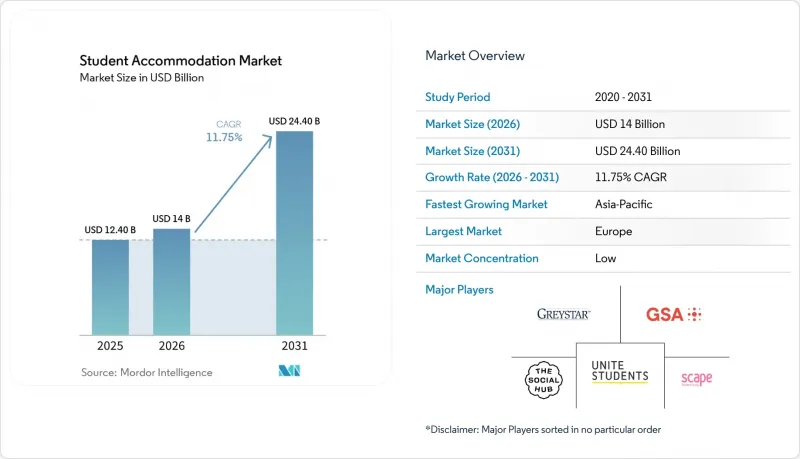
This report is Segmented by Room Type (Entire Place / Studio, Private Room, and Shared Room), Type of Institution (K-12, Higher Education, and Others), Type of Accommodation (On-Campus / University-Owned Accommodation and More), Student (Domestic and International), and Geography (North America, Europe, Asia-Pacific, South America, and More). The Market Forecasts are Provided in Terms of Value (USD).
Global Student Accommodation Market Trends and Insights
Rising International Student Mobility Increases Accommodation Demand
International enrollment remains the clearest demand engine for the student accommodation market across major education destinations. The United States hosted 1.18 million international students in the 2024-2025 academic year, which confirmed that global study demand remained strong even before the next intake cycle. Visa tightening in parts of North America created friction in 2025, but the broader pattern still points to redistribution across destinations rather than a collapse in student flows. Demand is instead shifting toward destination markets with more accessible visa pathways, established university ecosystems, and limited student housing supply, suggesting the student accommodation market is being reshaped by corridor shifts rather than weaker interest in overseas education. Operators near highly ranked universities are better protected in this environment because international students continue to prioritize academic reputation, safety, and housing certainty when selecting both destination and residence. This continues to support the student accommodation market through mobility growth, even when individual countries face temporary policy or enrollment disruptions.
Growth of Purpose-Built Student Accommodation Expands Market Supply
The student accommodation market continues to attract institutional capital because purpose-built stock offers scale, operating control, and stronger income visibility than fragmented private rentals. United Kingdom PBSA (Purpose-Built Student Accommodation) investment reached GBP 4.3 billion (USD 5.6 billion) in 2025, indicating that investor appetite remained strong despite a more challenging financing backdrop. JP Morgan Asset Management entered a joint venture with I Live to develop a EUR 1.5 billion (USD 1.65 billion) student apartment portfolio in Germany, showing that underpenetrated markets with low organized supply are attracting long-term institutional capital. In the United States, American Campus Communities and Northeastern University broke ground in February 2026 on a 1,200-bed residence hall, highlighting how public-private partnerships are expanding professionally managed student housing in major university markets. Greystar also expanded its presence through portfolio acquisitions in Ireland and Spain, which reflects a broader push to build multi-country platforms in supply-constrained university cities. This pattern matters because professionally managed purpose-built student accommodation is becoming the preferred route for both universities and investors seeking dependable delivery and operational performance. As a result, the student accommodation market is moving toward larger platforms with stronger development pipelines, better refinancing access, and wider geographic reach.
High Upfront Capital and Long Payback Periods Limit New Developments
High capital intensity remains one of the clearest limits on supply growth in the student accommodation market. In the United States, mid-2025 tariffs doubled the cost of steel and aluminum, affecting Heating, Ventilation, and Air Conditioning (HVAC) systems and machinery and raising development costs across new student housing projects. Rising insurance premiums, especially in coastal markets, and ongoing skilled labor shortages added further pressure to project viability and developer margins. United States student housing deliveries were projected to fall 42% to nearly 22,000 new beds in 2025, showing how quickly cost inflation can suppress new supply. This creates barriers for smaller developers who lack strong access to funding, established operating platforms, or existing land positions. For the student accommodation market, the result is slower bed creation but stronger economics for scaled operators that can still build or reposition assets.
Other drivers and restraints analyzed in the detailed report include:
- Urbanization of Higher Education Hubs Supports Student Housing Demand
- Preference for Safe and Secure Living Drives Premium Accommodation Adoption
- Regulatory and Zoning Complexity Delays Student Housing Projects
For complete list of drivers and restraints, kindly check the Table Of Contents.
Segment Analysis
Private rooms accounted for 52% of the student accommodation market in 2025, making them the largest room format by revenue. This lead reflects the strong preference for privacy, secure access, and predictable living conditions in professionally managed assets. A 2025 uForis survey found that private bedrooms were among the most important housing priorities for student residents, which supports continued demand for this format. In supply-constrained markets such as the United Kingdom, occupancy in premium student housing remained very high, reinforcing the case for private room formats in mature university cities. The student accommodation industry has therefore continued to place a structural premium on private rooms, especially in cities with strong international demand and limited bed availability.
Shared rooms are still the fastest-growing room format, with a 12.8% CAGR projected through 2031, suggesting a stronger affordability response in the student accommodation market. This growth is concentrated in markets where income levels, tuition burdens, and limited supply make single-occupancy formats harder to access. It suggests that room preferences are being shaped not only by lifestyle expectations but also by local price capacity and market maturity. Entire place or studio units remain a narrower premium option, with demand centered on postgraduate residents and international students seeking more independence. For operators, the room-type mix is becoming a portfolio decision rather than a single-format choice. The student accommodation market is therefore likely to sustain a dual model, with private rooms leading mature corridors and shared formats driving expansion in more price-sensitive locations.
Higher education held 88% of the student accommodation market in 2025, which shows how closely the sector still tracks university enrollment, campus reputation, and gateway-city demand. This dominance also reflects the scale advantage of degree-granting institutions, where student flows are larger and residence demand is more predictable from year to year. American Campus Communities highlighted this operating logic through its University of Michigan South 5th Residential project, a 2,300-bed development scheduled for Fall 2026 that shows the size and visibility of campus-linked demand in major university markets. In practice, higher education remains the core demand base because universities generate the deepest leasing pools, the strongest partnership pipelines, and the most financeable location profiles. This keeps the student accommodation market centered on established education hubs where institutional operators can scale efficiently.
The others segment is projected to grow at 13.2% CAGR through 2031, making it the fastest-growing institution category in the student accommodation market. This category includes vocational training, professional education, and hybrid learner groups that do not fit the traditional 4-year university model. Its rise matters because it broadens demand into cities and submarkets that are not defined only by flagship universities. It also supports flexible operating models where residents may include trainees, researchers, interns, or young professionals with education-linked housing needs. K-12 remains a smaller and more regulated category, which limits its influence on overall sector growth. The student accommodation industry is therefore gaining a wider demand base, even though higher education will remain the central anchor through the forecast period.
Complete Report Scope:
- By Room Type
- Entire Place / Studio
- Private Room
- Shared Room
- By Type of Institution
- K-12 (School Education)
- Higher Education (Colleges & Universities)
- Others
- By Type of Accommodation
- On-Campus / University-Owned Accommodation
- Off-Campus / Purpose-Built Student Accommodation (PBSA)
- By Student
- Domestic
- International
- By Geography
- North America
- United States
- Canada
- Mexico
- Europe
- United Kingdom
- Germany
- France
- Italy
- Spain
- Russia
- Rest of Europe
- Asia-Pacific
- China
- India
- Japan
- Australia
- South Korea
- SouthEast Asia (Singapore, Malaysia, Thailand, Indonesia, Vietnam, and Philippines)
- Rest of Asia-Pacific
- South America
- Brazil
- Argentina
- Rest of South America
- Middle East and Africa
- Saudi Arabia
- United Arab Emirates
- Turkey
- South Africa
- Nigeria
- Rest of Middle East and Africa
- North America
Geography Analysis
Europe held a 33% of the student accommodation market in 2025, making it the largest regional contributor by revenue. The region benefits from mature university systems, deep investor familiarity with purpose-built student accommodation, and persistent undersupply in several major cities. In the United Kingdom, occupancy in premium student housing remained at 97% to 98%, indicating strong leasing resilience in a highly constrained market. Europe also remains attractive because operators can scale across several countries while staying within well-established higher education corridors. Germany, France, Spain, and the Netherlands continue to gain strategic relevance as demand broadens beyond the oldest and most mature purpose-built student accommodation markets.
Asia-Pacific is projected to grow at 13.5% CAGR through 2031, making it the fastest-growing regional segment in the student accommodation market. India remains one of the clearest long-run opportunities because formal supply is still well below current demand, which keeps institutionalization room high. That direction became more apparent in 2026, when HDFC Capital Advisors and Curated Living Solutions launched India's first institutional rental housing platform with an initial corpus of INR 1,000 crore (USD 115 million). China is also showing an important supply response, with universities using residential acquisitions and conversions to add dormitory capacity in dense urban locations. Across the Asia-Pacific region, the student accommodation market is being supported by both rising enrollments and a clearer shift toward institutional capital and more formal operating models.
North America accounted for a material share of global revenue in 2025, as the United States combines large enrollment volumes with a well-developed base of specialized operators. The region remains attractive, but its growth is being shaped by supply constraints, development costs, and policy shifts that can alter student flows from one cycle to the next. Canada faced a more difficult intake setting after lower study permit limits in 2026, which redirected attention toward stronger institutions and better-located assets. South America, the Middle East, and Africa remain smaller in current scale. However, they continue to present long-run potential, with private education expanding and the organized student housing supply still limited.
- Greystar Real Estate Partners
- Unite Students
- Scape
- GSA Group
- The Social Hub
- American Campus Communities
- Campus Living Villages
- Host Students
- Nido Living
- Yugo
- Aparto Living
- iQ Student Accommodation
- Vita Group
- Urbanest
- Chapter Living
- Scion Group
- AvalonBay Communities
- Dwell Student Living
- Cardinal Group Management
- Stanza Living
Additional Benefits:
- The market estimate (ME) sheet in Excel format
- 3 months of analyst support
TABLE OF CONTENTS
1 Introduction
- 1.1 Study Assumptions & Market Definition
- 1.2 Scope of the Study
2 Research Methodology
3 Executive Summary
4 Market Landscape
- 4.1 Market Overview
- 4.2 Market Drivers
- 4.2.1 Rising International Student Mobility Increases Accommodation Demand
- 4.2.2 Growth of Purpose-Built Student Accommodation Expands Market Supply
- 4.2.3 Urbanization of Higher Education Hubs Supports Student Housing Demand
- 4.2.4 Preference for Safe and Secure Living Drives Premium Accommodation Adoption
- 4.2.5 Expansion of Private Higher Education Providers Boosts Student Enrollment
- 4.2.6 Rising Demand for Value-Added Amenities Enhances Premium Accommodation Uptake
- 4.3 Market Restraints
- 4.3.1 High Upfront Capital and Long Payback Periods Limit New Developments
- 4.3.2 Regulatory and Zoning Complexity Delays Student Housing Projects
- 4.3.3 Affordability Pressures in Major Cities Constrain Student Housing Demand
- 4.3.4 Seasonal Occupancy and Academic Cycles Create Revenue Volatility
- 4.4 Value / Supply-Chain Analysis
- 4.5 Regulatory Landscape
- 4.6 Technological Outlook
- 4.7 Porter's Five Forces
- 4.7.1 Bargaining Power of Suppliers
- 4.7.2 Bargaining Power of Consumers
- 4.7.3 Threat of New Entrants
- 4.7.4 Threat of Substitutes
- 4.7.5 Intensity of Competitive Rivalry
5 Market Size & Growth Forecasts (Value, USD)
- 5.1 By Room Type
- 5.1.1 Entire Place / Studio
- 5.1.2 Private Room
- 5.1.3 Shared Room
- 5.2 By Type of Institution
- 5.2.1 K-12 (School Education)
- 5.2.2 Higher Education (Colleges & Universities)
- 5.2.3 Others
- 5.3 By Type of Accommodation
- 5.3.1 On-Campus / University-Owned Accommodation
- 5.3.2 Off-Campus / Purpose-Built Student Accommodation (PBSA)
- 5.4 By Student
- 5.4.1 Domestic
- 5.4.2 International
- 5.5 By Geography
- 5.5.1 North America
- 5.5.1.1 United States
- 5.5.1.2 Canada
- 5.5.1.3 Mexico
- 5.5.2 Europe
- 5.5.2.1 United Kingdom
- 5.5.2.2 Germany
- 5.5.2.3 France
- 5.5.2.4 Italy
- 5.5.2.5 Spain
- 5.5.2.6 Russia
- 5.5.2.7 Rest of Europe
- 5.5.3 Asia-Pacific
- 5.5.3.1 China
- 5.5.3.2 India
- 5.5.3.3 Japan
- 5.5.3.4 Australia
- 5.5.3.5 South Korea
- 5.5.3.6 SouthEast Asia (Singapore, Malaysia, Thailand, Indonesia, Vietnam, and Philippines)
- 5.5.3.7 Rest of Asia-Pacific
- 5.5.4 South America
- 5.5.4.1 Brazil
- 5.5.4.2 Argentina
- 5.5.4.3 Rest of South America
- 5.5.5 Middle East and Africa
- 5.5.5.1 Saudi Arabia
- 5.5.5.2 United Arab Emirates
- 5.5.5.3 Turkey
- 5.5.5.4 South Africa
- 5.5.5.5 Nigeria
- 5.5.5.6 Rest of Middle East and Africa
- 5.5.1 North America
6 Competitive Landscape
- 6.1 Market Concentration
- 6.2 Strategic Moves
- 6.3 Market Share Analysis
- 6.4 Company Profiles (Includes Global Level Overview, Market Level Overview, Core Segments, Financials as Available, Strategic Information, Products & Services, and Recent Developments)
- 6.4.1 Greystar Real Estate Partners
- 6.4.2 Unite Students
- 6.4.3 Scape
- 6.4.4 GSA Group
- 6.4.5 The Social Hub
- 6.4.6 American Campus Communities
- 6.4.7 Campus Living Villages
- 6.4.8 Host Students
- 6.4.9 Nido Living
- 6.4.10 Yugo
- 6.4.11 Aparto Living
- 6.4.12 iQ Student Accommodation
- 6.4.13 Vita Group
- 6.4.14 Urbanest
- 6.4.15 Chapter Living
- 6.4.16 Scion Group
- 6.4.17 AvalonBay Communities
- 6.4.18 Dwell Student Living
- 6.4.19 Cardinal Group Management
- 6.4.20 Stanza Living
7 Market Opportunities & Future Outlook
- 7.1 White-Space & Unmet-Need Assessment

