PUBLISHER: Mordor Intelligence | PRODUCT CODE: 2097317

PUBLISHER: Mordor Intelligence | PRODUCT CODE: 2097317
Flexible Solar Cell - Market Share Analysis, Industry Trends & Statistics, Growth Forecasts (2026 - 2031)
According to Mordor Intelligence, the flexible solar cell market size is expected to grow from USD 0.64 billion in 2025 to USD 0.70 billion in 2026 and is forecast to reach USD 1.05 billion by 2031 at 8.5% CAGR over 2026-2031.
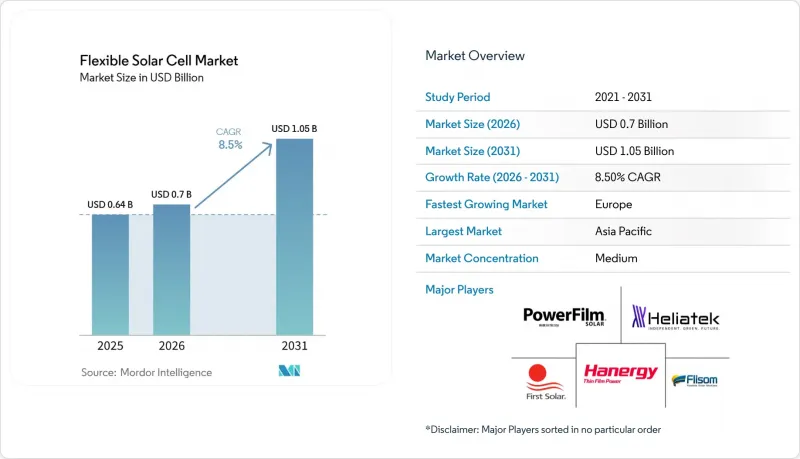
This report is Segmented by Technology (Organic Photovoltaics, CIGS, Amorphous Silicon, Perovskite, DSSC, Emerging Hybrids), Substrate Material (Plastic, Metal Foils, Ultra-Thin Glass), Application (BIPV, Consumer Electronics, Automotive, Aerospace, Wearables, Off-Grid), and Geography (North America, Europe, Asia-Pacific, South America, Middle East and Africa). Market Forecasts are Provided in Value (USD).
Global Flexible Solar Cell Market Trends and Insights
Roll-to-roll Cost Reductions in CIGS & a-Si Production
Capital outlays per gigawatt for new CIGS lines fell to USD 120 million in 2025, 33% below batch-processed rigid plants, trimming the levelized cost of electricity under high-irradiance conditions to USD 0.05 per kWh. A Poland-based 100 MW facility validated an 18-month tooling payback period after integrating in-line laser scribing, which removed 12% of legacy labor costs. EU-funded trials maintained 17.2% stabilized efficiency at 10 m/min web speed, confirming that throughput gains do not necessarily compromise performance. Slot-die coating with non-halogenated solvents reduced hazardous waste fees by 40%, which is significant as REACH restrictions continue to tighten. Amorphous silicon lines, operating below 200 °C, can now coat directly onto technical textiles, opening opportunities in wearable markets where rigid wafers are unsuitable.
Net-zero Building Codes Boosting BIPV Demand
The EU Energy Performance of Buildings Directive requires near-zero energy status for all new structures by 2030, pulling photovoltaic purchasing decisions into the construction supply chain. Germany's Gebaudeenergiegesetz requires a 65% on-site renewable share for heating, and France's RE2020 regulation caps embodied carbon, prompting architects to adopt lightweight, low-carbon flexible laminates. Spain and Nordic countries have extended mandates to warehouses and glazed facades, respectively, expanding the available roof and wall surface area significantly. Flexible laminates weigh 2-3 kg/m2 compared to 12-15 kg/m2 for framed glass, making them suitable for high-rise retrofits where costly structural modifications would otherwise be required. As a result, sales cycles are shifting from energy managers to facade engineers, increasing demand visibility while extending specification timelines.
Lower Efficiency Versus c-Si Panels
Field data show flexible CIGS efficiency at 15-20% compared to 22-24% for mono-silicon. On a Munich rooftop, this 22% energy shortfall extends payback from 8 years to 10.2 years under EUR 0.30/kWh tariffs. Perovskite tandems offer potential parity, but flexible variants remain below 20% due to low-temperature processing constraints. Organic cells are commercialized at approximately 12% efficiency, which is acceptable for indoor applications but limits outdoor use unless transparency premiums offset the reduction in kilowatt-hours generated. Bifacial coatings recover 8-12% through roof-albedo gains, but add USD 0.18/W in specialized backsheet costs. The efficiency gap is therefore narrowing slowly, which is tempering near-term rooftop penetration in the flexible solar cell market.
Other drivers and restraints analyzed in the detailed report include:
- Wearables & IoT Need Ultra-light Power Sources
- Tandem Perovskite-polymer Breakthroughs for HAPS & Drones
- Indium Supply Bottlenecks for CIGS Scaling
For complete list of drivers and restraints, kindly check the Table Of Contents.
Segment Analysis
CIGS held a 54.7% share of the flexible solar cell market in 2025, supported by established roll-to-roll production lines and IEC-61646 certification. Perovskites are projected to grow at a 28.1% CAGR through 2031, driven by tandem efficiencies exceeding 33% that surpass single-junction silicon. Organic photovoltaics remain the preferred option for building facades due to their transparency, with module-level efficiency of 10-13% that prioritizes aesthetics over power output. Amorphous silicon continues to be used in rugged chargers where deposition onto textiles at 200°C is required, despite first-year degradation now exceeding 20%.
Perovskite-CIGS tandem cells on 30 µm glass weigh 200 g/m2, a specification that supports pricing of USD 5/W in aerospace applications. However, bankability remains a challenge, as investors continue to favor CIGS due to its 20-year field record, despite risks associated with indium costs. Organic photovoltaic manufacturers are addressing area-scaling limitations through silver-nanowire electrodes that reduce series resistance by 15%, moving toward 15% commercial efficiency. Dye-sensitized cells are being removed from commercial roadmaps, as they lack the durability and efficiency required to remain competitive in the flexible solar cell market.
Complete Report Scope:
- By Technology
- Organic Photovoltaics (OPV)
- Copper Indium Gallium Selenide (CIGS)
- Amorphous Silicon (a-Si)
- Perovskite
- Dye-Sensitized Solar Cells (DSSC)
- Emerging Hybrid Architectures
- By Substrate Material
- Plastic (PET, PEN, PI)
- Metal Foils (Stainless Steel, Titanium)
- Ultra-Thin Glass
- By Application
- Building-Integrated Photovoltaics (BIPV)
- Consumer Electronics and IoT Devices
- Automotive and Transportation
- Aerospace and Defense
- Wearables and Portable Power
- Remote and Off-Grid Power
- By Geography
- North America
- United States
- Canada
- Mexico
- Europe
- United Kingdom
- Germany
- France
- Spain
- Nordic Countries
- Russia
- Rest of Europe
- Asia-Pacific
- China
- India
- Japan
- South Korea
- ASEAN Countries
- Rest of Asia-Pacific
- South America
- Brazil
- Argentina
- Colombia
- Rest of South America
- Middle East and Africa
- United Arab Emirates
- Saudi Arabia
- South Africa
- Egypt
- Rest of Middle East and Africa
- North America
Geography Analysis
Asia-Pacific accounted for 49.9% of 2025 revenue, driven by Chinese roll-to-roll CIGS lines and dominance in indium refining. Japan's Solar Frontier shipped 900 MW of CIGS in 2024, and South Korea's KRW 800 billion perovskite pilot is expected to begin production in 2027. India's 500 MW flexible line supports rural electrification, while ASEAN contract manufacturers are adding 400 MW of capacity, keeping regional module costs below USD 0.70/W.
Europe is the fastest-growing region at a 12.3% CAGR, supported by directives mandating near-zero-energy buildings by 2030. Germany installed 180 MW of flexible laminates in 2024, with KfW subsidies covering 30% of BIPV capital expenditure. France's lifecycle carbon regulations favor lightweight films, and Spain is adopting curved-roof warehouse installations that require no structural reinforcement. Nordic pilots are integrating transparent OPV into triple-glazed units to meet passive-house compliance standards.
In North America, U.S. Inflation Reduction Act tax credits support 250 MW of annual installations, concentrated in California and Texas. Canada is targeting off-grid indigenous communities, while Mexico remains a small market as utility-scale rigid installations continue to dominate. In the Middle East and Africa, notable projects include the UAE's 12 MW Masdar City facade and Saudi Arabia's 50 MW NEOM specification, though project execution remains delayed. In South America, the market is largely driven by off-grid kits deployed in Brazil's Amazon basin.
- Alta Devices, Inc.
- ASCA (ARMOR solar power films)
- Bruker Corporation (Bruker AFM - Flexible PV Equipment)
- eArc (Sunman Energy Co., Ltd.)
- First Solar, Inc.
- Flisom AG
- GCell (3G Solar Photovoltaics Ltd.)
- Global Solar Energy, Inc.
- Hanergy Thin Film Power Group Ltd.
- Heliatek GmbH
- MiaSole Hi-Tech Corp.
- NICE Solar Energy
- Oxford PV Ltd.
- P3 Solar
- PowerFilm Solar, Inc.
- Saule Technologies S.A.
- SoloPower Systems, Inc.
- Sun Harmonics
- Sunflare, Inc.
- Verditek plc
Additional Benefits:
- The market estimate (ME) sheet in Excel format
- 3 months of analyst support
TABLE OF CONTENTS
1 Introduction
- 1.1 Study Assumptions & Market Definition
- 1.2 Scope of the Study
2 Research Methodology
3 Executive Summary
4 Market Landscape
- 4.1 Market Overview
- 4.2 Market Drivers
- 4.2.1 Roll-to-roll cost reductions in CIGS & a-Si production
- 4.2.2 Net-zero building codes boosting BIPV demand
- 4.2.3 Wearables & IoT need ultra-light power sources
- 4.2.4 Tandem perovskite-polymer breakthroughs for HAPS & drones
- 4.2.5 Military procurement of foldable solar-battery hybrids
- 4.2.6 Recyclable substrate mandates (PET-free architectures)
- 4.3 Market Restraints
- 4.3.1 Lower efficiency versus c-Si panels
- 4.3.2 Accelerated UV / moisture degradation
- 4.3.3 Indium supply bottlenecks for CIGS scaling
- 4.3.4 Lack of global certification protocols for ultra-thin modules
- 4.4 Supply-Chain Analysis
- 4.5 Regulatory Landscape
- 4.6 Technological Outlook
- 4.7 Porter's Five Forces
- 4.7.1 Threat of New Entrants
- 4.7.2 Bargaining Power of Suppliers
- 4.7.3 Bargaining Power of Buyers
- 4.7.4 Threat of Substitutes
- 4.7.5 Industry Rivalry
5 Market Size & Growth Forecasts
- 5.1 By Technology
- 5.1.1 Organic Photovoltaics (OPV)
- 5.1.2 Copper Indium Gallium Selenide (CIGS)
- 5.1.3 Amorphous Silicon (a-Si)
- 5.1.4 Perovskite
- 5.1.5 Dye-Sensitized Solar Cells (DSSC)
- 5.1.6 Emerging Hybrid Architectures
- 5.2 By Substrate Material
- 5.2.1 Plastic (PET, PEN, PI)
- 5.2.2 Metal Foils (Stainless Steel, Titanium)
- 5.2.3 Ultra-Thin Glass
- 5.3 By Application
- 5.3.1 Building-Integrated Photovoltaics (BIPV)
- 5.3.2 Consumer Electronics and IoT Devices
- 5.3.3 Automotive and Transportation
- 5.3.4 Aerospace and Defense
- 5.3.5 Wearables and Portable Power
- 5.3.6 Remote and Off-Grid Power
- 5.4 By Geography
- 5.4.1 North America
- 5.4.1.1 United States
- 5.4.1.2 Canada
- 5.4.1.3 Mexico
- 5.4.2 Europe
- 5.4.2.1 United Kingdom
- 5.4.2.2 Germany
- 5.4.2.3 France
- 5.4.2.4 Spain
- 5.4.2.5 Nordic Countries
- 5.4.2.6 Russia
- 5.4.2.7 Rest of Europe
- 5.4.3 Asia-Pacific
- 5.4.3.1 China
- 5.4.3.2 India
- 5.4.3.3 Japan
- 5.4.3.4 South Korea
- 5.4.3.5 ASEAN Countries
- 5.4.3.6 Rest of Asia-Pacific
- 5.4.4 South America
- 5.4.4.1 Brazil
- 5.4.4.2 Argentina
- 5.4.4.3 Colombia
- 5.4.4.4 Rest of South America
- 5.4.5 Middle East and Africa
- 5.4.5.1 United Arab Emirates
- 5.4.5.2 Saudi Arabia
- 5.4.5.3 South Africa
- 5.4.5.4 Egypt
- 5.4.5.5 Rest of Middle East and Africa
- 5.4.1 North America
6 Competitive Landscape
- 6.1 Market Concentration
- 6.2 Strategic Moves (M&A, Partnerships, PPAs)
- 6.3 Market Share Analysis (Market Rank/Share for key companies)
- 6.4 Company Profiles (includes Global level Overview, Market level overview, Core Segments, Financials as available, Strategic Information, Products & Services, and Recent Developments)
- 6.4.1 Alta Devices, Inc.
- 6.4.2 ASCA (ARMOR solar power films)
- 6.4.3 Bruker Corporation (Bruker AFM - Flexible PV Equipment)
- 6.4.4 eArc (Sunman Energy Co., Ltd.)
- 6.4.5 First Solar, Inc.
- 6.4.6 Flisom AG
- 6.4.7 GCell (3G Solar Photovoltaics Ltd.)
- 6.4.8 Global Solar Energy, Inc.
- 6.4.9 Hanergy Thin Film Power Group Ltd.
- 6.4.10 Heliatek GmbH
- 6.4.11 MiaSole Hi-Tech Corp.
- 6.4.12 NICE Solar Energy
- 6.4.13 Oxford PV Ltd.
- 6.4.14 P3 Solar
- 6.4.15 PowerFilm Solar, Inc.
- 6.4.16 Saule Technologies S.A.
- 6.4.17 SoloPower Systems, Inc.
- 6.4.18 Sun Harmonics
- 6.4.19 Sunflare, Inc.
- 6.4.20 Verditek plc
7 Market Opportunities & Future Outlook
- 7.1 White-space & Unmet-Need Assessment

