PUBLISHER: Mordor Intelligence | PRODUCT CODE: 2097336

PUBLISHER: Mordor Intelligence | PRODUCT CODE: 2097336
Organic Solar Cell - Market Share Analysis, Industry Trends & Statistics, Growth Forecasts (2026 - 2031)
According to Mordor Intelligence, the organic solar cell market size is expected to increase from USD 244.46 million in 2025 to USD 275.92 million in 2026 and reach USD 540.88 million by 2031, growing at a CAGR of 12.41% over 2026-2031.
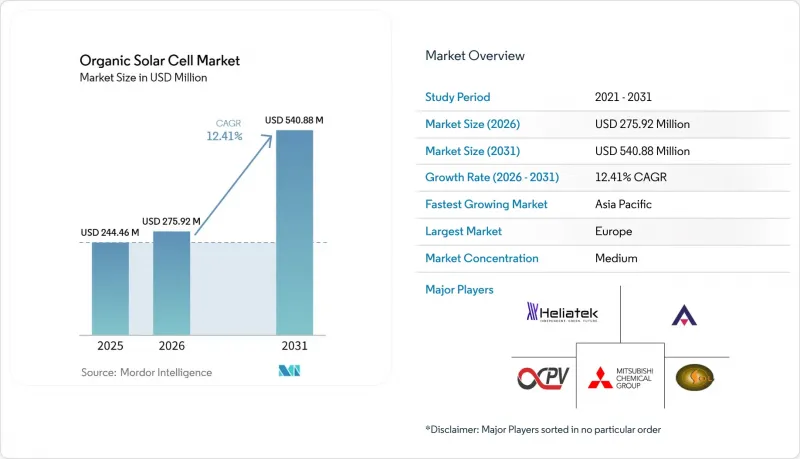
This report is Segmented by Type (Small-Molecule, Polymer, Hybrid, Emerging Structures), Application (BIPV, Consumer Electronics, Automotive, and More), End-User (Residential, Commercial & Industrial, Utilities, Government & Military), and Geography (North America, Europe, Asia-Pacific, South America, Middle East & Africa). Market Forecasts are Provided in Terms of Value (USD).
Global Organic Solar Cell Market Trends and Insights
Rapid Efficiency Gains via Non-Fullerene Acceptors
Certified single-junction efficiencies reached 20.82% in 2025, significantly reducing the gap with cadmium-telluride thin film technologies and establishing organic cells as viable for mainstream commercial applications. The Y6-family acceptors enhanced absorption into the near-infrared spectrum, reduced voltage losses to below 0.5 V, and improved thermal-cycle stability. Over 200 patent filings were recorded between 2024 and early 2026, highlighting China, Germany, and Japan as key centers of innovation. However, the higher synthesis complexity of non-fullerene acceptors (NFAs) continues to drive up raw material costs, making long-term competitiveness dependent on scaling roll-to-roll production beyond pilot-scale operations. Flagship initiatives, such as Heliatek's Flex16 line, aim to achieve module efficiencies exceeding 16% for building-integrated applications.
Demand for Ultra-Light BIPV Retrofits
Municipal near-zero-energy regulations and corporate LEED targets have driven an increase in BIPV retrofits, as organic modules weigh approximately 2 kg/m2, which is only one-fifth the weight of framed silicon panels. In July 2025, NEXT Energy Technologies installed a six-panel 40 X 60-inch facade, achieving 3.5% efficiency and 32% visible-light transmittance. This installation offset 20-25% of building plug loads without significantly reducing interior light levels. The EU Solar Standard, effective from 2026, mandates solar-ready roofs for large non-residential buildings. Additionally, France's VAT reduction to 5.5% for low-carbon modules in October 2025 created a 14.5-percentage-point price advantage for organic PV. Lightweight organic sheets also address structural-load limitations on heritage facades, enabling retrofit opportunities that silicon-based solutions often cannot meet.
Sub-10-Year Module Lifetime
Outdoor tests in 2025 showed 91% efficiency retention after seven months, but investors still require 25-year performance projections. The damp-heat IEC 61215 protocols demonstrated a 94% retention rate after 1,032 hours, equivalent to approximately three to five years in field conditions. However, issues such as moisture ingress and photodegradation continue to limit warranty durations. According to VDE's 2025 bankability review, lenders require at least two years of field data, a benchmark achieved by only a few suppliers, with Heliatek being a notable example. The lack of consensus on aging multipliers leads insurers to adopt conservative degradation rates, increasing the levelized cost of energy compared to silicon-based systems. Advances in encapsulation technologies, such as atomic-layer-deposited barriers, are targeting 15-year lifespans to align with commercial lease durations.
Other drivers and restraints analyzed in the detailed report include:
- EU Carbon-Footprint-Linked Subsidies
- Corporate Net-Zero Demand for Transparent PV
- Perovskite-Silicon Tandem Competition
For complete list of drivers and restraints, kindly check the Table Of Contents.
Segment Analysis
Small-molecule devices accounted for 47.1% of the organic solar cell market share in 2025, driven by the high-layer uniformity achieved through vacuum evaporation and the utilization of OLED toolsets. Hybrid structures, which combine polymer donors with small-molecule acceptors, address niche customer requirements by balancing absorption bandwidth and thermal resilience. Polymer variants are projected to grow at a compound annual growth rate (CAGR) of 14.4%, supported by slot-die and gravure printing technologies that offer 40% lower capital expenditure and faster scale-up potential.
Process reproducibility continues to favor small-molecule formats in automotive and defense applications. However, advancements in polymer chains have improved batch consistency, reducing previous reliability concerns. The market size for polymer-based organic solar cell modules is expected to grow significantly as encapsulation improvements address thermal-cycle instability. Certification pathways, such as Heliatek's IEC 61215 precedent, are being followed, with several polymer product lines anticipated to receive similar endorsements by 2027. Manufacturers focusing on polymer bulk supply are also pursuing backward integration into monomer synthesis to achieve cost efficiencies.
Complete Report Scope:
- By Type
- Small-Molecule Organic Solar Cells
- Polymer Organic Solar Cells
- Hybrid Organic Solar Cells
- Emerging Structures
- By Application
- Building-Integrated Photovoltaics (BIPV)
- Consumer Electronics
- Automotive
- Indoor Energy Harvesting
- Defense & Aerospace
- Others
- By End-user
- Residential
- Commercial and Industrial
- Utilities
- Government and Military
- By Geography
- North America
- United States
- Canada
- Mexico
- Europe
- Germany
- United Kingdom
- France
- Italy
- NORDIC Countries
- Russia
- Rest of Europe
- Asia-Pacific
- China
- India
- Japan
- South Korea
- ASEAN Countries
- Rest of Asia-Pacific
- South America
- Brazil
- Argentina
- Rest of South America
- Middle East and Africa
- Saudi Arabia
- United Arab Emirates
- South Africa
- Egypt
- Rest of Middle East and Africa
- North America
Geography Analysis
Europe accounted for 38.6% of the projected 2025 revenue, driven by the implementation of Energiewende policies, France's carbon-linked VAT rebates, and the EU Solar Standard, which together created a supportive regulatory framework. Germany's KfW green-loan incentives reduced financing costs for solar-plus-storage hybrids, which also benefited from the lower balance-of-system costs associated with organic modules. France's tax advantage for low-carbon modules redirected retrofit budgets toward organic sheets, and Nordic countries are piloting transparent facades in new zero-carbon schools.
The Asia-Pacific region is projected to exhibit the fastest growth, with a CAGR of 13.8%, driven by China's dominance in the specialty-chemical base for non-fullerene acceptor supply and India's planned 32% budget increase to INR 305.39 billion (USD 3.65 billion) by 2026, which mandates the use of locally manufactured cells for government projects. Japan's ALCA-Next consortium is focused on achieving efficiencies exceeding 20%, while South Korea's defense spending supports the development of early anchor customers. Although intellectual property disputes and export-control uncertainties present minor challenges, local roll-to-roll equipment manufacturers are accelerating factory ramp-ups.
North America accounts for a mid-teens market share, supported by California's Title 24 solar regulations and lightweight power tenders from the U.S. Department of Defense. Additional demand is generated by Canada's net-zero building code and Mexico's electronics near-shoring initiatives. In the Middle East, there is growing interest in transparent photovoltaic (PV) technology for iconic towers and shaded walkways. Meanwhile, Brazil is conducting agrivoltaic trials that integrate organic panels with shade-tolerant crops.
- Armor SA
- BASF SE
- BELECTRIC OPV GmbH
- DisaSolar SAS
- Draper Energy LLC
- Eight19 Ltd.
- Epishine AB
- FlexEnable Ltd.
- Heliatek GmbH
- Henkel AG
- InfinityPV ApS
- Mitsubishi Chemical Group Corporation
- NanoFlex Power Corporation
- Next Energy Technologies, Inc.
- ONYX Solar Group LLC
- Solarmer Energy, Inc.
- Solterra Solar Cells, Inc.
- Sumitomo Chemical Co., Ltd.
- Sunew S.A.
- Ynvisible Interactive Inc.
Additional Benefits:
- The market estimate (ME) sheet in Excel format
- 3 months of analyst support
TABLE OF CONTENTS
1 Introduction
- 1.1 Study Assumptions & Market Definition
- 1.2 Scope of the Study
2 Research Methodology
3 Executive Summary
4 Market Landscape
- 4.1 Market Overview
- 4.2 Market Drivers
- 4.2.1 Rapid efficiency gains via non-fullerene acceptors
- 4.2.2 Demand for ultra-light BIPV retrofits
- 4.2.3 EU carbon-footprint-linked subsidies
- 4.2.4 Corporate net-zero demand for transparent PV
- 4.2.5 Roll-to-roll printing cost parity by 2028
- 4.2.6 Defense need for foldable power
- 4.3 Market Restraints
- 4.3.1 Sub-10-year module lifetime
- 4.3.2 Non-fullerene acceptor feedstock bottlenecks
- 4.3.3 Lack of bankability standards
- 4.3.4 Perovskite-silicon tandem competition
- 4.4 Supply-Chain Analysis
- 4.5 Regulatory Landscape
- 4.6 Technological Outlook
- 4.7 Porters Five Forces Analysis
- 4.7.1 Threat of New Entrants
- 4.7.2 Bargaining Power of Buyers
- 4.7.3 Bargaining Power of Suppliers
- 4.7.4 Threat of Substitutes
- 4.7.5 Competitive Rivalry
5 Market Size & Growth Forecasts
- 5.1 By Type
- 5.1.1 Small-Molecule Organic Solar Cells
- 5.1.2 Polymer Organic Solar Cells
- 5.1.3 Hybrid Organic Solar Cells
- 5.1.4 Emerging Structures
- 5.2 By Application
- 5.2.1 Building-Integrated Photovoltaics (BIPV)
- 5.2.2 Consumer Electronics
- 5.2.3 Automotive
- 5.2.4 Indoor Energy Harvesting
- 5.2.5 Defense & Aerospace
- 5.2.6 Others
- 5.3 By End-user
- 5.3.1 Residential
- 5.3.2 Commercial and Industrial
- 5.3.3 Utilities
- 5.3.4 Government and Military
- 5.4 By Geography
- 5.4.1 North America
- 5.4.1.1 United States
- 5.4.1.2 Canada
- 5.4.1.3 Mexico
- 5.4.2 Europe
- 5.4.2.1 Germany
- 5.4.2.2 United Kingdom
- 5.4.2.3 France
- 5.4.2.4 Italy
- 5.4.2.5 NORDIC Countries
- 5.4.2.6 Russia
- 5.4.2.7 Rest of Europe
- 5.4.3 Asia-Pacific
- 5.4.3.1 China
- 5.4.3.2 India
- 5.4.3.3 Japan
- 5.4.3.4 South Korea
- 5.4.3.5 ASEAN Countries
- 5.4.3.6 Rest of Asia-Pacific
- 5.4.4 South America
- 5.4.4.1 Brazil
- 5.4.4.2 Argentina
- 5.4.4.3 Rest of South America
- 5.4.5 Middle East and Africa
- 5.4.5.1 Saudi Arabia
- 5.4.5.2 United Arab Emirates
- 5.4.5.3 South Africa
- 5.4.5.4 Egypt
- 5.4.5.5 Rest of Middle East and Africa
- 5.4.1 North America
6 Competitive Landscape
- 6.1 Market Concentration
- 6.2 Strategic Moves (M&A, Partnerships, PPAs)
- 6.3 Market Share Analysis (Market Rank/Share for key companies)
- 6.4 Company Profiles (includes Global level Overview, Market level overview, Core Segments, Financials as available, Strategic Information, Products & Services, and Recent Developments)
- 6.4.1 Armor SA
- 6.4.2 BASF SE
- 6.4.3 BELECTRIC OPV GmbH
- 6.4.4 DisaSolar SAS
- 6.4.5 Draper Energy LLC
- 6.4.6 Eight19 Ltd.
- 6.4.7 Epishine AB
- 6.4.8 FlexEnable Ltd.
- 6.4.9 Heliatek GmbH
- 6.4.10 Henkel AG
- 6.4.11 InfinityPV ApS
- 6.4.12 Mitsubishi Chemical Group Corporation
- 6.4.13 NanoFlex Power Corporation
- 6.4.14 Next Energy Technologies, Inc.
- 6.4.15 ONYX Solar Group LLC
- 6.4.16 Solarmer Energy, Inc.
- 6.4.17 Solterra Solar Cells, Inc.
- 6.4.18 Sumitomo Chemical Co., Ltd.
- 6.4.19 Sunew S.A.
- 6.4.20 Ynvisible Interactive Inc.
7 Market Opportunities & Future Outlook
- 7.1 White-space & Unmet-Need Assessment

