PUBLISHER: Mordor Intelligence | PRODUCT CODE: 2124337

PUBLISHER: Mordor Intelligence | PRODUCT CODE: 2124337
North America Fruits And Vegetables Juice - Market Share Analysis, Industry Trends & Statistics, Growth Forecasts (2026 - 2031)
According to Mordor Intelligence, the North America fruits and vegetables juice market size is projected to expand from USD 37.33 billion in 2025 and USD 38.59 billion in 2026 to USD 45.62 billion by 2031, registering a 3.4% CAGR between 2026 and 2031.
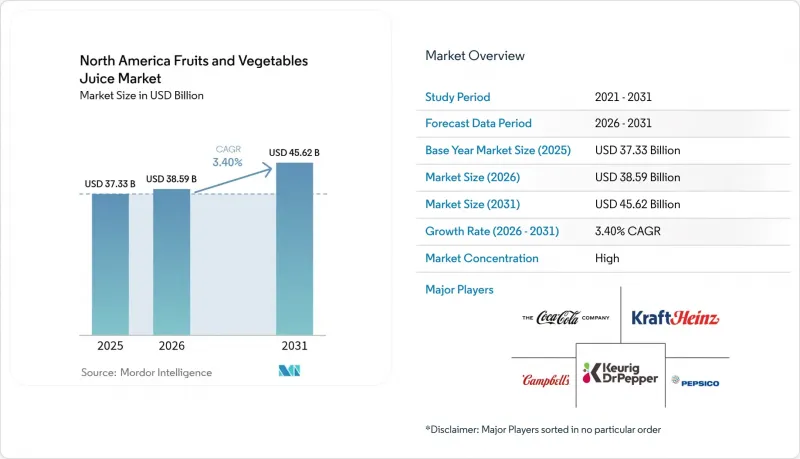
This report is Segmented by Product Type (Fruit Juice, Vegetable Juice, Nectar), Category (Conventional, Organic), Packaging Type (PET/Glass Bottles, Tetra Pack, Others), Distribution Channel (Foodservice, Retail), and Geography (United States, Canada, Mexico, Rest of North America). The Market Forecasts are Provided in Terms of Value (USD) and Volume (Liters).
North America Fruits And Vegetables Juice Market Trends and Insights
Growing Preference for Clean-Label and Natural Beverages
Consumer demand for ingredient transparency is reshaping formulation strategies across the juice category. The FDA's updated "healthy" claim, finalized in December 2024, permits 100% juice products to carry the designation if they meet limits on saturated fat, sodium, and added sugars, a regulatory shift that incentivizes reformulation away from concentrate-based blends toward not-from-concentrate (NFC) processing. This change directly addresses a long-standing paradox: juices with inherent fructose were previously excluded from "healthy" labeling, even when free of additives. Brands are now repositioning NFC lines to capitalize on the claim, with Tropicana and Simply leading reformulation efforts. The trend extends beyond sugar reduction; preservative-free cold-pressed juices processed via HPP are capturing shelf space in Whole Foods and Sprouts, where clean-label attributes command 15-20% price premiums over conventional pasteurized equivalents. This preference is particularly pronounced among millennials and Gen Z cohorts, who cross-reference ingredient lists via smartphone apps before purchase, effectively turning transparency into a competitive moat.
Rising Demand for Functional and Fortified Juices
Functional fortification is migrating juice from a hydration staple to a wellness delivery vehicle. Brands are embedding probiotics, collagen peptides, and adaptogens such as ashwagandha into vegetable juice blends to target immunity, gut health, and stress management. Campbell's V8 launched a "+Energy" line in 2025 fortified with green tea extract and B vitamins, positioning the product as a morning coffee alternative. This shift is driven by consumer willingness to pay USD 1.50-2.00 more per bottle for functional claims, a margin uplift that offsets rising ingredient costs. Regulatory frameworks under the FDA's Generally Recognized as Safe (GRAS) notification process allow the rapid introduction of novel botanicals, accelerating innovation cycles. However, the trend also introduces complexity: fortified juices must balance taste masking (probiotics can impart sourness) with label appeal, requiring co-investment in flavor encapsulation technologies. The functional segment is expanding fastest in urban U.S. markets where disposable income supports experimentation, but it remains nascent in price-sensitive Mexican retail channels.
Volatility in Raw Material and Agricultural Input Costs
Citrus supply chains are under acute stress, with orange juice concentrate prices reaching multi-decade highs in 2024-2025. Florida's orange production fell to 15.85 million boxes in the 2024-2025 season, down from 40 million boxes a decade prior, due to citrus greening disease (Huanglongbing) that has no cure and affects 90% of the state's groves, according to the USDA. This domestic shortfall has increased reliance on Brazilian imports, which accounted for 78% of the U.S. orange juice supply in 2024, exposing processors to fluctuations in the Brazilian real and geopolitical risks. FCOJ futures traded at USD 4.20 per pound in early 2025, up 25% year-over-year, directly compressing processor margins, according to the USDA. Apple and grape juice face similar pressures: drought conditions in Washington State reduced apple yields by 12% in 2024, while labor shortages in California's Central Valley delayed grape harvests, increasing spoilage. These input cost shocks are difficult to pass through to retailers, who resist mid-year price increases that disrupt promotional calendars, leaving processors to absorb margin hits or reformulate with lower-cost ingredients such as pear juice, which risks alienating purist consumers.
Other drivers and restraints analyzed in the detailed report include:
- Expansion of Premium and Cold-Pressed Juice Segments
- Technological Advancements Improving Shelf Life and Quality
- Packaging and Sustainability Compliance Costs
For complete list of drivers and restraints, kindly check the Table Of Contents.
Segment Analysis
Vegetable juices are expanding at a 4.21% CAGR through 2026-2031, outpacing the overall market as brands fortify carrot, beet, and tomato bases with functional ingredients such as turmeric, ginger, and probiotics. Campbell's V8 brand launched a "+Immunity" line in 2025 featuring elderberry and zinc, targeting cold-and-flu season demand. This functional pivot addresses a long-standing challenge: vegetable juices historically underperformed due to taste barriers, with earthy or bitter notes limiting appeal beyond health purists. Flavor masking technologies, including natural sweeteners such as monk fruit and stevia, are broadening the addressable market. Fruit juices, which held 60.82% market share in 2025, remain dominant due to entrenched breakfast consumption habits and superior taste acceptance, but the segment faces headwinds from sugar-reduction trends and pediatric consumption guidelines that restrict juice intake. Nectar products, blending juice with water and sweeteners, occupy a middle ground, offering lower price points that appeal to cost-conscious Hispanic consumers in the U.S. Southwest and Mexico. However, nectars are vulnerable to clean-label scrutiny, as many formulations include added sugars and preservatives to extend shelf life, attributes increasingly rejected by wellness-focused buyers.
The product type segmentation reflects a broader bifurcation: fruit juices are doubling down on premiumization (cold-pressed, organic, single-origin) to justify higher price points, while vegetable juices are pursuing functional differentiation to escape commodity status. Brands such as Suja and Evolution Fresh are launching "green juice" blends combining kale, spinach, and cucumber with apple or pineapple for palatability, targeting post-workout recovery and detox occasions. These products command USD 8-10 per bottle, versus USD 4-6 for conventional orange juice, demonstrating that vegetable-forward formulations can achieve premium positioning when tied to specific wellness benefits. The challenge lies in scaling beyond niche natural-channel distribution: vegetable juices accounted for only 12-15% of total juice volume in 2025, indicating significant headroom but also the need for sustained consumer education to shift perceptions.
Organic juices are growing at 5.03% CAGR through 2026-2031, driven by USDA National Organic Program (NOP) certification becoming a non-negotiable attribute for premium shelf placement in retailers such as Whole Foods, Sprouts, and Trader Joe's. Uncle Matt's Organic, a Florida-based producer, reported 30% revenue growth in 2024-2025, attributing gains to expanded distribution in conventional supermarkets where organic sections now occupy 15-20% of juice shelf space. The organic premium, typically 25-40% over conventional equivalents, is justified by supply-chain traceability, pesticide-free farming, and alignment with environmental values. However, organic juice faces structural constraints: certified organic citrus acreage in the U.S. remains below 5% of total citrus production, limiting domestic supply and necessitating imports from Mexico and Central America, which introduces currency and logistics risks. Conventional juices, holding 80.61% market share in 2025, benefit from scale economies and established supply chains, but the segment is under pressure to adopt "clean-label" attributes, non-GMO, no artificial ingredients, to compete with organic's halo.
The category split also reveals strategic divergence. Large incumbents such as Tropicana and Minute Maid are defending conventional share through reformulation and aggressive promotional spending, while organic specialists such as Lakewood Organic and Natalie's Orchid Island Juice are capturing margin-rich niches with artisanal positioning and direct-to-consumer (DTC) channels. DTC models, enabled by cold-chain logistics providers such as FedEx and UPS, allow organic brands to bypass retailer margin stacking and build direct relationships with consumers, though customer acquisition costs via digital advertising remain elevated. The organic segment's growth trajectory will depend on two factors: continued expansion of certified organic farmland, which requires 3-year transition periods and yield sacrifices, and consumer willingness to absorb price increases as input costs rise.
Complete Report Scope:
- By Product Type
- Fruit Juice
- Vegetable Juice
- Nectar
- By Category
- Conventional
- Organic
- By Packaging Type
- PET/Glass Bottles
- Tetra Pack
- Pouch
- Others
- Distribution Channel
- On-Trade
- Off-Trade
- Supermarkets/Hypermarkets
- Convenience Stores
- Online Retail Retails
- Others
- By Geography
- United States
- Canada
- Mexico
- Rest of North America
List of Companies Covered in this Report:
- PepsiCo, Inc.
- The Coca-Cola Company
- Keurig Dr Pepper
- Kraft Heinz Company
- Campbell Soup Company
- Ocean Spray Cranberries, Inc.
- Welch's
- Florida's Natural Growers
- Suja Life LLC
- Pressed Juicery, Inc.
- Lakewood Organic
- Natalie's Orchid Island Juice Co.
- SunOpta Inc.
- BluePrint
- Evolution Fresh
- Old Orchard Brands LLC
- Dole Food Company
- Bolthouse Farms
- Uncle Matt's Organic
- Reed's Inc.
Additional Benefits:
- The market estimate (ME) sheet in Excel format
- 3 months of analyst support
TABLE OF CONTENTS
1 INTRODUCTION
- 1.1 Study Assumptions and Market Definition
- 1.2 Scope of the Study
2 RESEARCH METHODOLOGY
3 EXECUTIVE SUMMARY
4 MARKET LANDSCAPE
- 4.1 Market Overview
- 4.2 Market Drivers
- 4.2.1 Growing preference for clean-label and natural beverages
- 4.2.2 Rising demand for functional and fortified juices
- 4.2.3 Expansion of premium and cold-pressed juice segments
- 4.2.4 Technological advancements improving shelf life and quality
- 4.2.5 Smart packaging and QR codes are enhancing product provenance
- 4.2.6 Growth of convenience-driven consumption formats
- 4.3 Market Restraints
- 4.3.1 Heightened regulatory and consumer scrutiny on sugar content
- 4.3.2 Packaging and sustainability compliance costs
- 4.3.3 Volatility in raw material and agricultural input costs
- 4.3.4 Competition from alternative healthy beverages
- 4.4 Consumer Behavior Analysis
- 4.5 Regulatory Outlook
- 4.6 Technological Outlook
- 4.7 Porter's Five Forces
- 4.7.1 Threat of New Entrants
- 4.7.2 Bargaining Power of Buyers
- 4.7.3 Bargaining Power of Suppliers
- 4.7.4 Threat of Substitute Products
- 4.7.5 Intensity of Competitive Rivalry
5 MARKET SIZE AND GROWTH FORECASTS (VALUE AND VOLUME)
- 5.1 By Product Type
- 5.1.1 Fruit Juice
- 5.1.2 Vegetable Juice
- 5.1.3 Nectar
- 5.2 By Category
- 5.2.1 Conventional
- 5.2.2 Organic
- 5.3 By Packaging Type
- 5.3.1 PET/Glass Bottles
- 5.3.2 Tetra Pack
- 5.3.3 Pouch
- 5.3.4 Others
- 5.4 Distribution Channel
- 5.4.1 On-Trade
- 5.4.2 Off-Trade
- 5.4.2.1 Supermarkets/Hypermarkets
- 5.4.2.2 Convenience Stores
- 5.4.2.3 Online Retail Retails
- 5.4.2.4 Others
- 5.5 By Geography
- 5.5.1 United States
- 5.5.2 Canada
- 5.5.3 Mexico
- 5.5.4 Rest of North America
6 COMPETITIVE LANDSCAPE
- 6.1 Market Concentration
- 6.2 Strategic Moves
- 6.3 Market Share Analysis
- 6.4 Company Profiles (includes Global level Overview, Market level overview, Core Segments, Financials, Strategic Information, Market Rank/Share, Products and Services, Recent Developments)
- 6.4.1 PepsiCo, Inc.
- 6.4.2 The Coca-Cola Company
- 6.4.3 Keurig Dr Pepper
- 6.4.4 Kraft Heinz Company
- 6.4.5 Campbell Soup Company
- 6.4.6 Ocean Spray Cranberries, Inc.
- 6.4.7 Welch's
- 6.4.8 Florida's Natural Growers
- 6.4.9 Suja Life LLC
- 6.4.10 Pressed Juicery, Inc.
- 6.4.11 Lakewood Organic
- 6.4.12 Natalie's Orchid Island Juice Co.
- 6.4.13 SunOpta Inc.
- 6.4.14 BluePrint
- 6.4.15 Evolution Fresh
- 6.4.16 Old Orchard Brands LLC
- 6.4.17 Dole Food Company
- 6.4.18 Bolthouse Farms
- 6.4.19 Uncle Matt's Organic
- 6.4.20 Reed's Inc.
7 MARKET OPPORTUNITIES AND FUTURE TRENDS

