PUBLISHER: Mordor Intelligence | PRODUCT CODE: 2097379

PUBLISHER: Mordor Intelligence | PRODUCT CODE: 2097379
GCC Ceramic Tiles And Sanitaryware - Market Share Analysis, Industry Trends & Statistics, Growth Forecasts (2025 - 2030)
According to Mordor Intelligence, the GCC ceramic tiles and sanitaryware market size stands at USD 9.74 billion in 2025 and is projected to reach USD 12.74 billion by 2030, expanding at a 5.52% CAGR.
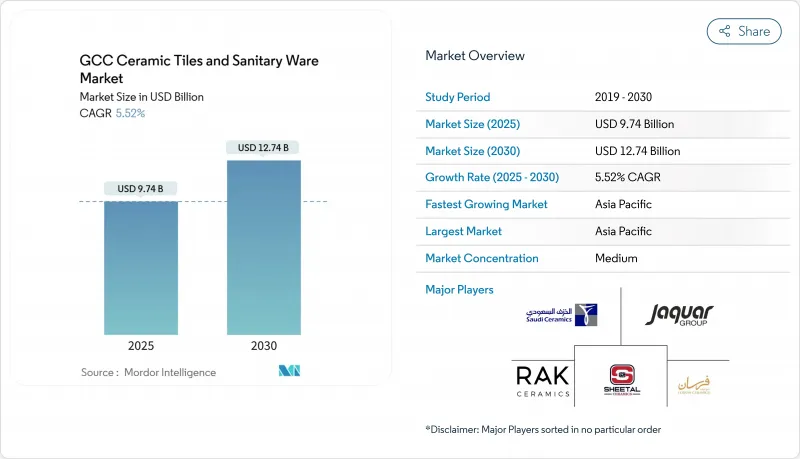
This report is Segmented by Product (Tiles and Sanitary Ware), Material (Ceramic, Porcelain, and More), End User (Residential, Commercial, and More), Construction Type (New, Replacement & Renovation), Application (Bathroom, Kitchen, and More), Distribution Channel (Offline Retail, B2B, and More), and Country (UAE, Saudi Arabia, and More). Market Forecasts are Provided in Value Terms (USD).
GCC Ceramic Tiles And Sanitaryware Market Trends and Insights
Government-Backed Mega-Projects Under GCC Visions
Saudi giga-projects such as NEOM, the Red Sea Project, and Qiddiya each specify millions of square meters of tiles and large volumes of advanced sanitary fixtures. The sheer scale stabilizes the GCC sanitary ware market by locking in multi-year purchase agreements and compelling manufacturers to localize capacity. Comparable diversification programs in the UAE and Qatar follow similar pathways, continually refreshing tender pipelines that support both commodity and premium product segments of the GCC sanitary ware market.
Rising Consumer Spend on Home Renovations & Luxury Bathrooms
The AED 90 billion First-Time Home Buyer Programme in the UAE triggered a surge in owner-occupied villas and apartments, where buyers prioritize smart toilets, freestanding tubs, and designer faucets. Shorter renovation cycles translate into recurring revenue opportunities, advancing the GCC sanitary ware market as homeowners seek status-oriented upgrades and water-efficient fixtures that satisfy new green codes.
Raw-Material and Energy Price Volatility
Natural gas feeds represent around half of the kiln operating costs. Saudi industrial gas rose from USD 0.75 to USD 1.25 per MMBtu, and further hikes remain plausible. Margin compression already reduced Saudi Ceramics' net profit in H1 2024 by 90% despite steady top-line sales. Similar exposure exists across local producers, placing a drag on near-term earnings and on reinvestment capacity within the GCC sanitary ware market.
Other drivers and restraints analyzed in the detailed report include:
- Tourism-Fueled Hotel Pipeline Enlarging Premium Demand
- Mandatory Water-Efficiency Labeling Accelerating Low-Flow Sanitary Ware
- Import-Driven Price Wars from Low-Cost Asian Tiles
For complete list of drivers and restraints, kindly check the Table Of Contents.
Segment Analysis
The segment generated 63% of overall revenue from tiles in 2024, yet sanitary ware is set to climb faster at 7.2% CAGR through 2030. Premium fixtures, including smart toilets with app-based hygiene analytics, lift margins and shorten replacement intervals. Continued hotel construction and owner-occupied home renovations bring steady volume. Large-format slabs still dominate lobby and facade finishes, but design-led bathrooms drive the most value for the GCC sanitary ware market. The product mix shift supports manufacturer moves up the price curve, thereby enhancing the resilience of the GCC sanitary ware market.
Rising investment in IoT-enabled faucets and touchless cisterns underscores a technology-first mindset among developers and homeowners. Economies of scale from new local lines reduce lead times for commodity tiles, allowing plant capacity to pivot toward value-added fixtures. This balance lets producers defend share even if anti-dumping duties expire. The sanitary ware uptrend therefore underpins sustainable long-term growth in the GCC sanitary ware market.
Ceramic retained 68.5% revenue in 2024 thanks to affordability and strength, yet lightweight acrylic bathtubs gained rapid adoption in spa-style bathrooms across luxury hotels. The 7.4% CAGR forecast for acrylic and perspex through 2030 stems from moldability that enables freestanding units, chromotherapy features, and lower transport costs. These attributes align with consumer preferences for wellness, pushing more orders toward higher-margin materials that elevate the GCC sanitary ware market size at the premium end.
Porcelain slabs, prized for low porosity and seamless visuals, maintain relevance in high-traffic zones. Manufacturers add recycled content to porcelain lines to meet green credits, mitigating raw-material volatility. This evolutionary portfolio preserves ceramic's mass-market presence while letting acrylic and porcelain chase upscale niches, jointly diversifying revenue streams inside the GCC sanitary ware market.
Complete Report Scope:
- By Product
- Tiles
- Floor Tiles
- Wall Tiles
- Decorative / Mosaic Tiles
- Outdoor / Anti-Slip Tiles
- Sanitary Ware
- Water Closets
- Wash Basins
- Cisterns
- Bidets
- Pedestals
- Urinals
- Tiles
- By Material
- Ceramic
- Porcelain
- Glazed Ceramic
- Unglazed / Vitrified
- Others (Stoneware, Acrylic, Metal)
- By End-User
- Residential
- Commercial
- Hospitality
- Industrial / Institutional
- By Construction Type
- New Construction
- Replacement & Renovation
- By Application
- Bathroom
- Kitchen
- Outdoor / Landscaping
- Pools & Water Features
- By Distribution Channel
- Offline Retail (Specialty Stores)
- Direct-to-Project / B2B
- Online / E-commerce
- By Country
- United Arab Emirates
- Saudi Arabia
- Qatar
- Kuwait
- Bahrain
- Oman
List of Companies Covered in this Report:
- RAK Ceramics
- Jaquar Middle East
- Saudi Ceramics
- Forsan Ceramics
- Seedal Ceramics
- General Ceramics
- Porcellan Co LLC
- Al Khaleej Ceramics Co LLC
- Riyadh Ceramics
- Al Anwar Ceramic Tiles Co
- Al Maha Ceramics SAOG
- Arabian Tile Company (ARTIC)
- Gulf Ceramics
- Sanipex Group
- Kohler Co.
- Roca Sanitario S.A.U.
- Geberit AG
- Grohe AG
- LIXIL (INAX / American Standard)
- Ideal Standard MENA
- Cera Sanitaryware Ltd.
Additional Benefits:
- The market estimate (ME) sheet in Excel format
- 3 months of analyst support
TABLE OF CONTENTS
1 Introduction
- 1.1 Study Assumptions & Market Definition
- 1.2 Scope of the Study
2 Research Methodology
3 Executive Summary
4 Market Landscape
- 4.1 Market Overview
- 4.2 Market Drivers
- 4.2.1 Government-backed mega-projects under GCC Visions
- 4.2.2 Rising consumer spend on home renovations & luxury bathrooms
- 4.2.3 Tourism-fuelled hotel pipeline enlarging premium demand
- 4.2.4 Mandatory water-efficiency labelling accelerating low-flow sanitary ware
- 4.2.5 Off-site modular bathroom pods multiplying factory-finished tile demand
- 4.2.6 Green-building credits (ESTIDAMA, QSAS) spurring recycled-content ceramics
- 4.3 Market Restraints
- 4.3.1 Raw-material & energy price volatility
- 4.3.2 Import-driven price wars from low-cost Asian tiles
- 4.3.3 High breakage/logistics risk for large-format slabs in desert transit
- 4.3.4 Slow contractor adoption of e-commerce procurement
- 4.4 Value / Supply-Chain Analysis
- 4.5 Regulatory Landscape
- 4.6 Technological Outlook
- 4.7 Porter's Five Forces
- 4.7.1 Bargaining Power of Buyers
- 4.7.2 Bargaining Power of Suppliers
- 4.7.3 Threat of New Entrants
- 4.7.4 Threat of Substitutes
- 4.7.5 Intensity of Competitive Rivalry
- 4.8 Impact of Supply-Chain & Energy Shocks
5 Market Size & Growth Forecasts (Value, 2024 Base)
- 5.1 By Product
- 5.1.1 Tiles
- 5.1.1.1 Floor Tiles
- 5.1.1.2 Wall Tiles
- 5.1.1.3 Decorative / Mosaic Tiles
- 5.1.1.4 Outdoor / Anti-Slip Tiles
- 5.1.2 Sanitary Ware
- 5.1.2.1 Water Closets
- 5.1.2.2 Wash Basins
- 5.1.2.3 Cisterns
- 5.1.2.4 Bidets
- 5.1.2.5 Pedestals
- 5.1.2.6 Urinals
- 5.1.1 Tiles
- 5.2 By Material
- 5.2.1 Ceramic
- 5.2.2 Porcelain
- 5.2.3 Glazed Ceramic
- 5.2.4 Unglazed / Vitrified
- 5.2.5 Others (Stoneware, Acrylic, Metal)
- 5.3 By End-User
- 5.3.1 Residential
- 5.3.2 Commercial
- 5.3.3 Hospitality
- 5.3.4 Industrial / Institutional
- 5.4 By Construction Type
- 5.4.1 New Construction
- 5.4.2 Replacement & Renovation
- 5.5 By Application
- 5.5.1 Bathroom
- 5.5.2 Kitchen
- 5.5.3 Outdoor / Landscaping
- 5.5.4 Pools & Water Features
- 5.6 By Distribution Channel
- 5.6.1 Offline Retail (Specialty Stores)
- 5.6.2 Direct-to-Project / B2B
- 5.6.3 Online / E-commerce
- 5.7 By Country
- 5.7.1 United Arab Emirates
- 5.7.2 Saudi Arabia
- 5.7.3 Qatar
- 5.7.4 Kuwait
- 5.7.5 Bahrain
- 5.7.6 Oman
6 Competitive Landscape
- 6.1 Market Concentration
- 6.2 Strategic Moves
- 6.3 Market Share Analysis
- 6.4 Company Profiles
- 6.4.1 RAK Ceramics
- 6.4.2 Jaquar Middle East
- 6.4.3 Saudi Ceramics
- 6.4.4 Forsan Ceramics
- 6.4.5 Seedal Ceramics
- 6.4.6 General Ceramics
- 6.4.7 Porcellan Co LLC
- 6.4.8 Al Khaleej Ceramics Co LLC
- 6.4.9 Riyadh Ceramics
- 6.4.10 Al Anwar Ceramic Tiles Co
- 6.4.11 Al Maha Ceramics SAOG
- 6.4.12 Arabian Tile Company (ARTIC)
- 6.4.13 Gulf Ceramics
- 6.4.14 Sanipex Group
- 6.4.15 Kohler Co.
- 6.4.16 Roca Sanitario S.A.U.
- 6.4.17 Geberit AG
- 6.4.18 Grohe AG
- 6.4.19 LIXIL (INAX / American Standard)
- 6.4.20 Ideal Standard MENA
- 6.4.21 Cera Sanitaryware Ltd.
7 Market Opportunities & Future Outlook
- 7.1 White-space & Unmet-need Assessment

