PUBLISHER: Mordor Intelligence | PRODUCT CODE: 2124180

PUBLISHER: Mordor Intelligence | PRODUCT CODE: 2124180
Thailand Ceramic Tiles - Market Share Analysis, Industry Trends & Statistics, Growth Forecasts (2026 - 2031)
According to Mordor Intelligence, the Thailand ceramic tiles market size was valued at USD 1.42 billion in 2025 and estimated to grow from USD 1.47 billion in 2026 to reach USD 1.75 billion by 2031, at a CAGR of 3.57% during the forecast period (2026-2031).
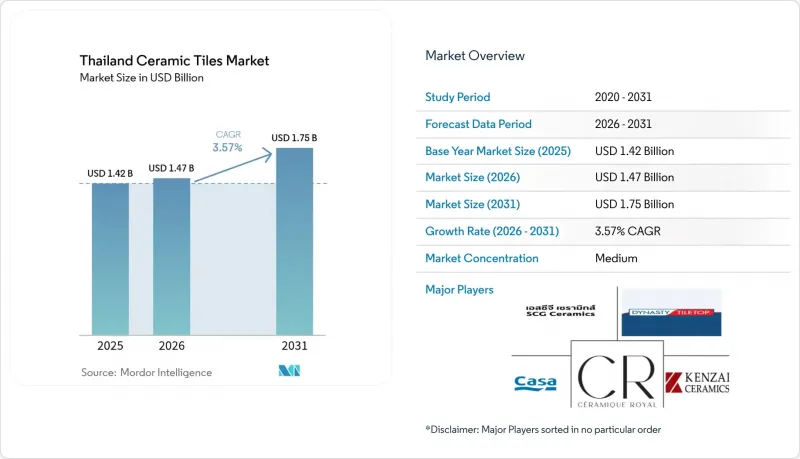
This report is Segmented by Product Type (Porcelain Tiles, Glazed Ceramic Tiles, and More), Application (Floor, Wall, Roofing), End-User (Residential, Commercial), Construction Type (New Construction, Renovation and Replacement), Distribution Channel (Specialty Tile & Stone Stores, Home Improvement & DIY Stores, and More), and Geography. The Market Forecasts are Provided in Terms of Value (USD).
Thailand Ceramic Tiles Market Trends and Insights
Rapid Urban Residential Construction Rebound
New-home launches are climbing as the government sustains mortgage incentives and transfers fees reductions to stimulate demand. In the EEC, developers unveiled 400 projects worth THB 157 billion, pushing land prices up more than 50% in Chon Buri and satellite provinces. Leading builders such as Pruksa Holding and Sansiri are accelerating groundbreaks, which amplifies tile procurement cycles for both mid-market and luxury units. Foreign investors from China and Japan are co-developing mixed-use estates, adding higher-spec finish schedules that favor premium porcelain. Policy support for first-time buyers and rapid mass-transit extensions underpin steady residential demand through 2027. The residential construction rebound represents a fundamental shift from the pandemic-era slowdown, with developers now focusing on quality and sustainability features that require advanced ceramic tile solutions.
Tourism-Led Expansion of Hospitality Projects
Thailand targets 40 million foreign arrivals in 2025, pressuring hotel pipelines to add keys and refurbish legacy stock. Central Pattana opened five new hotels in 2024 and reported revenue of THB 46.8 billion, signaling strong sector recovery. Boutique resorts are specifying antimicrobial, slip-resistant tiles that comply with international chains' brand standards. Large-format porcelain slabs are favored to craft seamless lobby aesthetics while reducing grout maintenance in high-traffic zones. The tourism upswing therefore channels incremental volumes into specialized commercial-grade tile categories. The hospitality construction boom is also driving demand for large-format tiles and sophisticated surface treatments that can create distinctive visual experiences while maintaining operational efficiency in commercial settings.
Surge of Low-Cost Imports from China & Vietnam
Imports captured share by undercutting local ex-factory prices by up to 30%, forcing several Thai kilns to halve output in 2024. E-commerce platforms expedite direct consumer access to cheaper foreign tiles, bypassing traditional distributor vetting. The Federation of Thai Industries lobbies for safeguard duties and quality audits to restore competitive balance. Domestic firms respond by emphasizing design complexity, faster logistics, and warranty service impossible to replicate for overseas sellers. The dispute accelerates industry consolidation as sub-scale producers exit. The government is considering policy interventions including review of tax waivers on low-value imports and enforcement of stricter quality standards to level the competitive playing field for domestic producers. The import pressure is forcing industry consolidation and efficiency improvements as smaller manufacturers struggle to achieve economies of scale necessary for competing against large-scale Chinese and Vietnamese producers.
Other drivers and restraints analyzed in the detailed report include:
- Government EEC Infrastructure Build-Out
- Shift Toward Premium Porcelain & Large-Format Tiles
- Volatile Natural-Gas & Electricity Kiln Costs
For complete list of drivers and restraints, kindly check the Table Of Contents.
Segment Analysis
Porcelain tiles claimed 41.40% of Thailand's ceramic tile market share in 2025 on the back of superior density, water absorption below 0.5%, and design versatility. Glazed ceramic remains relevant for budget-focused builds, whereas unglazed technical bodies fill industrial floors requiring R-12 slip standards. Mosaic variants enjoy a 4.33% CAGR tailwind as boutique hotels and high-end condos specify statement backsplashes and pool linings through 2031. Decorative "others" such as handmade terracotta gain visibility through social-media-driven interior trends. Investments pivot toward pressing technology capable of 1600-ton compaction and digital inkjet lines that widen aesthetic offerings, cementing porcelain's premium status.
Growing disposable income and imported design references accelerate consumer migration to large-format porcelain panels that slash grout lines and visually enlarge rooms. Thin-tile technology enables facade retrofits without adding excessive dead load, opening new commercial frontiers. Mosaic's growth benefits from customizable mesh-mounted sheets simplifying complex layouts. Unglazed bodies align with EEC factory expansions where abrasion and chemical resistance outweigh aesthetics. Altogether these dynamics propel Thailand ceramic tiles market toward higher value mix despite volume pressure from imports.
Floor installations represented 58.50% of the Thailand ceramic tiles market size in 2025 thanks to heavy commercial foot traffic and residential wear demands. Shopping malls, mass-transit hubs, and industrial corridors specify 600X600-millimeter porcelain pieces to balance load-bearing with cost. Wall cladding posts a 4.65% CAGR as designers push feature walls in living rooms and hotel lobbies that mimic marble and wood through 2031. Roofing applications, though niche, rely on traditional clay tiles for thermal insulation suited to tropical climates. The application split underscores diversification from purely functional flooring toward decorative vertical surfaces.
Wall expansion owes to technological leaps in inkjet realism, enabling stone-look veneers without maintenance burdens. Developers embrace full-height bathroom clads to reduce leak points and cleaning labor. Roofing sees incremental uplift in coastal resorts where salt-spray resistance is prized. Floor segments remain resilient via public-sector station builds and condominium corridors requiring PEI IV wear ratings. The evolving balance means manufacturers must tailor surface finishes, slip coefficients, and installation accessories per use case to sustain differentiation within Thailand ceramic tiles market.
Complete Report Scope:
- By Product Type
- Porcelain Tiles
- Glazed Ceramic Tiles
- Unglazed Ceramic Tiles
- Mosaic Tiles
- Others (Decorative, Patterned, Handmade)
- By Application
- Floor
- Wall
- Roofing
- By End-User
- Residential
- Commercial
- Hospitality (Hotels, Resorts)
- Retail Spaces
- Offices & Institutions
- Healthcare
- Educational Facilities
- Transport Hubs (Airports, Metro, Bus Terminals)
- Other Commercial Users
- By Construction Type
- New Construction
- Renovation and Replacement
- By Distribution Channel
- Specialty Tile & Stone Stores
- Home Improvement & DIY Stores
- Online Retail
- Direct Sales to Contractors
- By Geography
- Bangkok Metropolitan
- Central Thailand (ex-Bangkok)
- Northern Thailand
- Northeastern (Isan)
- Eastern Seaboard
- Western Thailand
- Southern Thailand
List of Companies Covered in this Report:
- SCG Ceramics (COTTO, Campana, Sosuco)
- Dynasty Ceramic Public Co.
- Royal Ceramic Industry (RCI)
- Kenzai Ceramic
- Casa Tiles
- Mogen Ceramic
- Tiger Ceramic
- RAK Ceramics Thailand
- Johnson Tiles (Thailand)
- Nitco (Thai distribution)
- Marazzi Group (Siam distribution)
- Kajaria Ceramics (Thai presence)
- Mohawk Industries (Daltile)
- Inax (LIXIL)
- Cera Cotto
- Thai Ceramic Coating
- Panthera Tiles
- Supreme Tile
- Campine Tiles
- STC Ceramic
Additional Benefits:
- The market estimate (ME) sheet in Excel format
- 3 months of analyst support
TABLE OF CONTENTS
1 Introduction
- 1.1 Study Assumptions & Market Definition
- 1.2 Scope of the Study
2 Research Methodology
3 Executive Summary
4 Market Landscape
- 4.1 Market Overview
- 4.2 Market Drivers
- 4.2.1 Rapid Urban Residential Construction Rebound
- 4.2.2 Tourism-Led Expansion Of Hospitality Projects
- 4.2.3 Government EEC Infrastructure Build-Out
- 4.2.4 Shift Toward Premium Porcelain & Large-Format Tiles
- 4.2.5 Adoption of Antimicrobial & Easy-Clean Glazes
- 4.2.6 Thin-Tile Overlay Solutions Boosting Renovation Demand
- 4.3 Market Restraints
- 4.3.1 Surge of Low-Cost Imports From China & Vietnam
- 4.3.2 Volatile Natural-Gas & Electricity Kiln Costs
- 4.3.3 Shortage of Skilled Tile Installers
- 4.3.4 ESG-Driven Kiln Decarbonisation Cap-Ex Burden
- 4.4 Industry Value Chain Analysis
- 4.5 Porter's Five Forces Analysis
- 4.5.1 Threat of New Entrants
- 4.5.2 Bargaining Power of Suppliers
- 4.5.3 Bargaining Power of Buyers
- 4.5.4 Threat of Substitutes
- 4.5.5 Competitive Rivalry
- 4.6 Insights into the Latest Trends and Innovations in the Market
- 4.7 Insights on Recent Developments (New Product Launches, Strategic Initiatives, Investments, Partnerships, JVs, Expansion, M&As, etc.) in the Industry
5 Market Size & Growth Forecasts (Value in USD)
- 5.1 By Product Type
- 5.1.1 Porcelain Tiles
- 5.1.2 Glazed Ceramic Tiles
- 5.1.3 Unglazed Ceramic Tiles
- 5.1.4 Mosaic Tiles
- 5.1.5 Others (Decorative, Patterned, Handmade)
- 5.2 By Application
- 5.2.1 Floor
- 5.2.2 Wall
- 5.2.3 Roofing
- 5.3 By End-User
- 5.3.1 Residential
- 5.3.2 Commercial
- 5.3.2.1 Hospitality (Hotels, Resorts)
- 5.3.2.2 Retail Spaces
- 5.3.2.3 Offices & Institutions
- 5.3.2.4 Healthcare
- 5.3.2.5 Educational Facilities
- 5.3.2.6 Transport Hubs (Airports, Metro, Bus Terminals)
- 5.3.2.7 Other Commercial Users
- 5.4 By Construction Type
- 5.4.1 New Construction
- 5.4.2 Renovation and Replacement
- 5.5 By Distribution Channel
- 5.5.1 Specialty Tile & Stone Stores
- 5.5.2 Home Improvement & DIY Stores
- 5.5.3 Online Retail
- 5.5.4 Direct Sales to Contractors
- 5.6 By Geography
- 5.6.1 Bangkok Metropolitan
- 5.6.2 Central Thailand (ex-Bangkok)
- 5.6.3 Northern Thailand
- 5.6.4 Northeastern (Isan)
- 5.6.5 Eastern Seaboard
- 5.6.6 Western Thailand
- 5.6.7 Southern Thailand
6 Competitive Landscape
- 6.1 Market Concentration
- 6.2 Strategic Moves
- 6.3 Market Share Analysis
- 6.4 Company Profiles (includes Global level Overview, Market level overview, Core Segments, Financials as available, Strategic Information, Market Rank/Share for key companies, Products & Services, and Recent Developments)
- 6.4.1 SCG Ceramics (COTTO, Campana, Sosuco)
- 6.4.2 Dynasty Ceramic Public Co.
- 6.4.3 Royal Ceramic Industry (RCI)
- 6.4.4 Kenzai Ceramic
- 6.4.5 Casa Tiles
- 6.4.6 Mogen Ceramic
- 6.4.7 Tiger Ceramic
- 6.4.8 RAK Ceramics Thailand
- 6.4.9 Johnson Tiles (Thailand)
- 6.4.10 Nitco (Thai distribution)
- 6.4.11 Marazzi Group (Siam distribution)
- 6.4.12 Kajaria Ceramics (Thai presence)
- 6.4.13 Mohawk Industries (Daltile)
- 6.4.14 Inax (LIXIL)
- 6.4.15 Cera Cotto
- 6.4.16 Thai Ceramic Coating
- 6.4.17 Panthera Tiles
- 6.4.18 Supreme Tile
- 6.4.19 Campine Tiles
- 6.4.20 STC Ceramic
7 Market Opportunities & Future Outlook
- 7.1 Expansion of Exports to ASEAN and Global Markets
- 7.2 Boost in Renovation-Driven Tile Consumption Nationwide

