PUBLISHER: Mordor Intelligence | PRODUCT CODE: 2115102

PUBLISHER: Mordor Intelligence | PRODUCT CODE: 2115102
United Kingdom Ceramic Tiles - Market Share Analysis, Industry Trends & Statistics, Growth Forecasts (2026 - 2031)
According to Mordor Intelligence, the United Kingdom ceramic tiles market size is expected to grow from USD 1.27 billion in 2025 to USD 1.3 billion in 2026 and is forecast to reach USD 1.49 billion by 2031 at 2.66% CAGR over 2026-2031.
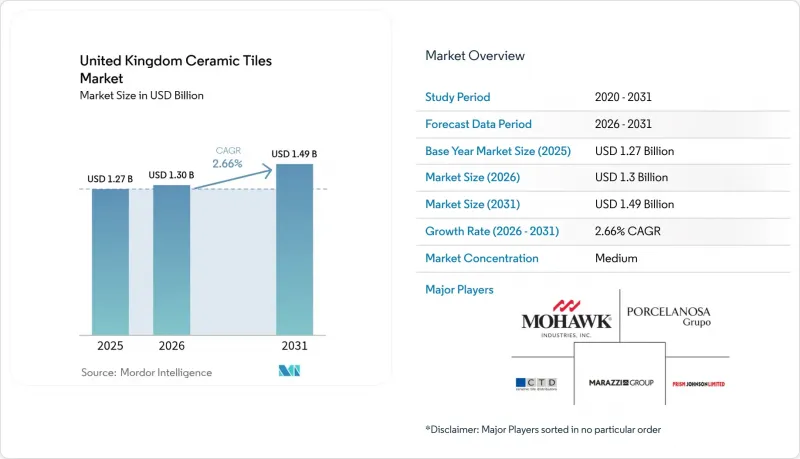
This report is Segmented by Product Type (Porcelain Tiles, Glazed Ceramic Tiles, and More), Application (Floor, Wall, Roofing), End-User (Residential, Commercial), Construction Type (New Construction, Renovation and Replacement), Distribution Channel (Specialty Stores, DIY Stores, Online Retail, Direct Sales), and Geography. The Market Forecasts are Provided in Terms of Value (USD).
United Kingdom Ceramic Tiles Market Trends and Insights
Post-pandemic home-improvement boom sustains retail tile demand
Extended periods of home occupancy during 2020-2022 recalibrated household spending toward renovation, a pattern that has endured through 2025 despite macroeconomic uncertainty. Non-food retail volumes tied to home improvement rose 1.9% year-on-year in late 2024, and ceramic retailers with upgraded e-commerce sites captured a disproportionate share of that growth. Consumers increasingly prioritize durable, low-maintenance surfaces that add resale value, positioning ceramic tiles ahead of short-lived laminates in kitchen and bathroom upgrades. HD ink-jet lines commissioned at Johnson Tiles and British Ceramic Tile enable rapid roll-outs of marble- and wood-look collections that cater to bespoke interior themes. Together, these elements underpin a stable residential demand base that cushions cyclical swings in new-build activity.
Surge in large-format porcelain adoption for upscale commercial fit-outs
Flagship commercial refurbishments, airports, and premium retail chains now routinely specify 1,200 X 600 mm or larger porcelain panels to achieve monolithic aesthetics with lower maintenance outlays. The Gatwick Airport Station redevelopment demonstrated large-format tiles' ability to handle continuous footfall while simplifying cleaning regimes, reinforcing confidence among architects and facility managers. Hotels upgrading lobbies and spas prefer expansive slabs that emulate natural stone yet comply with hygiene and slip-resistance standards without sealing treatments. Precision-cut edges and minimal grout lines also shorten installation times on high-value projects where shutdown windows are tight. As corporate real-estate owners pursue statement interiors to lure employees back on-site, demand for premium porcelain is forecast to extend well into the next decade.
Volatile natural-gas prices inflating kiln firing costs
Spot natural-gas quotations more than doubled between late 2021 and mid-2023, inflating ceramic tile production costs because firing at 1,200 °C accounts for roughly 35% of factory operating expenses. The glass, ceramics, and stone sector's gross value added consequently sank 46.5% from Q1 2021 levels, eroding working capital for capex upgrades. Producers are piloting hybrid kilns that blend biomethane or hydrogen to curb gas dependency, yet commercial deployment remains hampered by infrastructure gaps and funding hurdles. Energy-cost uncertainty steers some buyers toward import sourcing, though anti-dumping duties on Chinese tiles limit substitution effects and keep domestic capacity relevant. Persistent volatility could delay investment in next-generation presses, slowing product innovation and marginally tempering the United Kingdom ceramic tiles market trajectory.
Other drivers and restraints analyzed in the detailed report include:
- UK-wide push for energy-efficient under-floor heating compatible tiles
- Digital ink-jet printing cuts design cycle and cost for niche producers
- Shortage of HGV drivers disrupting imports from Spain and Italy
For complete list of drivers and restraints, kindly check the Table Of Contents.
Segment Analysis
Porcelain tiles secured 38.12% United Kingdom ceramic tiles market share in 2025 owing to less than 0.5% water absorption, frost resistance, and high breaking strength that suit both external facades and heavy-traffic interiors. The United Kingdom ceramic tiles market size for porcelain reached USD 484.1 million in 2025 and is projected to expand at a 2.78% CAGR through 2031 as format enlargement drives value per square meter. Mosaic tiles, although only 4.6% of volume, register the fastest 3.04% CAGR as bathroom and kitchen designers favor personalized accent walls with recycled-glass mosaics that satisfy sustainability briefs. Glazed ceramic remains the workhorse for residential wall cladding, while unglazed variants dominate safety-critical floors where EN 16165 slip ratings are mandatory in healthcare and transport hubs.
Demand differentials reflect maintenance expectations and installation economics rather than unit price alone. Porcelain's life-cycle cost advantage over natural marble strengthens its appeal among commercial landlords who amortize interiors across long leases. Mosaic importers lean on just-in-time ordering from Italian producers; however, recent logistics bottlenecks spur interest in UK-made glass mosaics that cut lead times by 40%. Glazed wall tile consumption remains sensitive to fashion cycles, compelling manufacturers to roll out seasonal colorways every six months using agile ink-jet lines.
Flooring represented 62.54% United Kingdom ceramic tiles market share in 2025 because tiles outlast vinyl by up to 20 years under comparable foot traffic, reducing total facilities-management expense. Wall cladding, while smaller at USD 408.6 million, outpaces with a 2.94% CAGR due to expansion of open-plan living spaces that employ feature walls for zoning purposes. Roofing applications represent a specialized niche focused on traditional clay tiles for heritage and architectural restoration projects, though this segment faces pressure from modern roofing alternatives. The floor segment's dominance reflects ceramic tiles' technical advantages in commercial applications, where lifecycle cost considerations favor materials that withstand heavy use while maintaining aesthetic appeal. Residential floor applications benefit from ceramic tiles' compatibility with underfloor heating systems, aligning with energy efficiency trends that prioritize thermal conductivity and heat retention properties.
Within commercial refurbishments, facility managers increasingly convert carpeted lobbies into large-format porcelain for easier sanitation, a priority highlighted during the pandemic. Residential floors gain additional momentum from the under-floor heating boom, where ceramic rapid heat transfer improves comfort ratings in EPC assessments. Wall tile growth is bolstered by digital influencers showcasing full-height shower enclosures clad in marble-look slabs, spurring retail pickups among millennial homeowners. Installation innovations such as lightweight honeycomb-backed panels reduce structural loads, extending ceramic use to refurbishments previously deterred by weight constraints.
Complete Report Scope:
- By Product Type
- Porcelain Tiles
- Glazed Ceramic Tiles
- Unglazed Ceramic Tiles
- Mosaic Tiles
- Others (Decorative, Patterned, Handmade)
- By Application
- Floor
- Wall
- Roofing
- By End-User
- Residential
- Commercial
- Hospitality (Hotels, Resorts)
- Retail Spaces
- Offices & Institutions
- Healthcare
- Educational Facilities
- Transport Hubs (Airports, Metro, Bus Terminals)
- Other Commercial Users
- By Construction Type
- New Construction
- Renovation and Replacement
- By Distribution Channel
- Specialty Tile & Stone Stores
- Home Improvement & DIY Stores
- Online Retail
- Direct Sales to Contractors
- By Geography
- England
- Scotland
- Wales
- Northern Ireland
List of Companies Covered in this Report:
- Atlas Concorde
- Ceramica Marazzi
- Ceramica Saloni
- Craven Dunnill
- CTD Tiles
- Domus Tiles
- Grupo STN
- Interceramic UK
- Keraben Grupo
- Mohawk Industries
- Pamesa Ceramica
- Porcelanosa Grupo
- Porcelanosa Grupo
- Prism Johnson Limited (Johnson Tiles)
- RAK Ceramics
- Roca Tile
- Tile Giant
Additional Benefits:
- The market estimate (ME) sheet in Excel format
- 3 months of analyst support
TABLE OF CONTENTS
1 Introduction
- 1.1 Study Assumptions & Market Definition
- 1.2 Scope of the Study
2 Research Methodology
3 Executive Summary
4 Market Landscape
- 4.1 Market Overview
- 4.2 Market Drivers
- 4.2.1 Post-Pandemic Home-Improvement Boom Sustains Retail Tile Demand
- 4.2.2 Surge In Large-Format Porcelain Adoption For Upscale Commercial Fit-Outs
- 4.2.3 UK-Wide Push For Energy-Efficient Under-Floor Heating Compatible Tiles
- 4.2.4 Digital Ink-Jet Printing Cuts Design Cycle & Cost For Niche Producers
- 4.2.5 Growth Of Modular Off-Site Construction Using Lightweight Tile Panels
- 4.2.6 Mandatory Slip-Resistance Norms In Healthcare & Transport Hubs
- 4.3 Market Restraints
- 4.3.1 Volatile Natural-Gas Prices Inflating Kiln Firing Costs
- 4.3.2 Shortage Of HGV Drivers Disrupting Imports From Spain & Italy
- 4.3.3 Competition From LVT & Spc Rigid-Core Flooring Alternatives
- 4.3.4 Limited Domestic Clay Reserves Restricting Scale-Up Of Local Production
- 4.4 Industry Value Chain Analysis
- 4.5 Porter's Five Forces Analysis
- 4.5.1 Threat of New Entrants
- 4.5.2 Bargaining Power of Suppliers
- 4.5.3 Bargaining Power of Buyers
- 4.5.4 Threat of Substitutes
- 4.5.5 Competitive Rivalry
- 4.6 Insights into the Latest Trends and Innovations in the Market
- 4.7 Insights on Recent Developments (New Product Launches, Strategic Initiatives, Investments, Partnerships, JVs, Expansion, M&As, etc.) in the Industry
5 Market Size & Growth Forecasts (Value in USD)
- 5.1 By Product Type
- 5.1.1 Porcelain Tiles
- 5.1.2 Glazed Ceramic Tiles
- 5.1.3 Unglazed Ceramic Tiles
- 5.1.4 Mosaic Tiles
- 5.1.5 Others (Decorative, Patterned, Handmade)
- 5.2 By Application
- 5.2.1 Floor
- 5.2.2 Wall
- 5.2.3 Roofing
- 5.3 By End-User
- 5.3.1 Residential
- 5.3.2 Commercial
- 5.3.2.1 Hospitality (Hotels, Resorts)
- 5.3.2.2 Retail Spaces
- 5.3.2.3 Offices & Institutions
- 5.3.2.4 Healthcare
- 5.3.2.5 Educational Facilities
- 5.3.2.6 Transport Hubs (Airports, Metro, Bus Terminals)
- 5.3.2.7 Other Commercial Users
- 5.4 By Construction Type
- 5.4.1 New Construction
- 5.4.2 Renovation and Replacement
- 5.5 By Distribution Channel
- 5.5.1 Specialty Tile & Stone Stores
- 5.5.2 Home Improvement & DIY Stores
- 5.5.3 Online Retail
- 5.5.4 Direct Sales to Contractors
- 5.6 By Geography
- 5.6.1 England
- 5.6.2 Scotland
- 5.6.3 Wales
- 5.6.4 Northern Ireland
6 Competitive Landscape
- 6.1 Market Concentration
- 6.2 Strategic Moves
- 6.3 Market Share Analysis
- 6.4 Company Profiles (includes Global level Overview, Market level overview, Core Segments, Financials as available, Strategic Information, Market Rank/Share for key companies, Products & Services, and Recent Developments)
- 6.4.1 Atlas Concorde
- 6.4.2 Ceramica Marazzi
- 6.4.3 Ceramica Saloni
- 6.4.4 Craven Dunnill
- 6.4.5 CTD Tiles
- 6.4.6 Domus Tiles
- 6.4.7 Grupo STN
- 6.4.8 Interceramic UK
- 6.4.9 Keraben Grupo
- 6.4.10 Mohawk Industries
- 6.4.11 Pamesa Ceramica
- 6.4.12 Porcelanosa Grupo
- 6.4.13 Porcelanosa Grupo
- 6.4.14 Prism Johnson Limited (Johnson Tiles)
- 6.4.15 RAK Ceramics
- 6.4.16 Roca Tile
- 6.4.17 Tile Giant
7 Market Opportunities & Future Outlook
- 7.1 Increased Use of Sustainable and Recycled Materials
- 7.2 Expansion of Oversized and Slim-Slab Tiles

