PUBLISHER: Mordor Intelligence | PRODUCT CODE: 2124081

PUBLISHER: Mordor Intelligence | PRODUCT CODE: 2124081
Italy Ceramic Tiles - Market Share Analysis, Industry Trends & Statistics, Growth Forecasts (2026 - 2031)
According to Mordor Intelligence, the Italy ceramic tiles market size is expected to grow from USD 1.62 billion in 2025 to USD 1.69 billion in 2026 and is forecast to reach USD 2.13 billion by 2031 at 4.63% CAGR over 2026-2031.
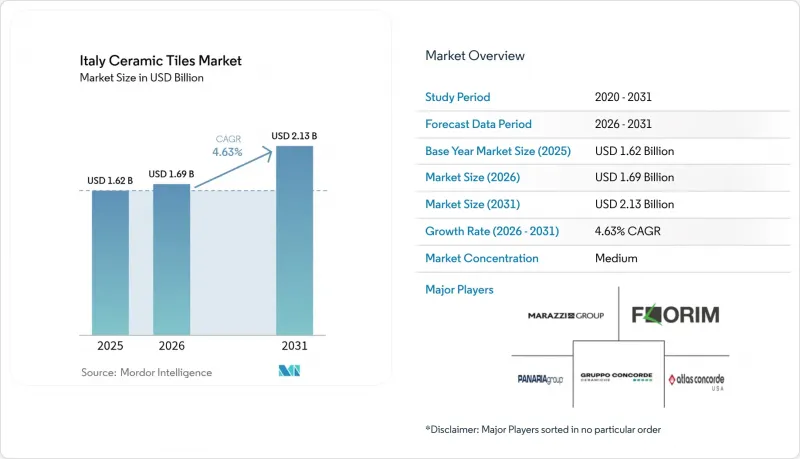
This report is Segmented by Product Type (Porcelain Tiles, Glazed Ceramic Tiles, and More), Application (Floor, Wall, Roofing), End-User (Residential, Commercial), Construction Type (New Construction, Renovation and Replacement), Distribution Channel (Specialty Stores, Home Improvement Stores, Online Retail, Direct Sales), and Geography. The Market Forecasts are Provided in Terms of Value (USD).
Italy Ceramic Tiles Market Trends and Insights
Government Incentives for Energy-Efficient Renovations
The Bonus Bagno 2025 program grants 50% tax deductions on bathroom upgrades up to EUR 48,000, directly lifting ceramic tile demand in renovation projects. Structured payment and documentation rules favor professional installers and formal retail channels. Uptake is strongest in Northern Italy where property values justify premium finishes and higher renovation budgets. The scheme's alignment with EU green-home directives further accelerates energy-efficient refurbishments that bundle thermal and aesthetic upgrades. As compliance processes grow more transparent, predictable cycles of bathroom remodeling underpin mid-term market stability. Property owners increasingly view ceramic tile installations as dual-purpose investments that satisfy both regulatory compliance and design enhancement objectives. The program's documentation requirements, including invoice retention and permit compliance, favor established tile retailers and professional installation services over informal market channels.
Aging Residential Building Stock Driving Renovation Activity
Italian housing completed during post-war reconstruction now hits its 15-20-year maintenance window, driving predictable replacement cycles for ceramic finishes. Urban centers combine older housing with higher disposable income, facilitating premium tile adoption despite economic headwinds. Homeowners increasingly elevate design quality alongside structural fixes, lifting average transaction values. Accessibility retrofits in multi-storey buildings enlarge bathroom surface areas, boosting square-meter demand. These factors extend growth momentum beyond new-build volatility. The shift from functional to design-driven renovations reflects changing homeowner priorities, favoring premium materials over basic replacements. Accessibility compliance requirements in aging buildings create additional tile replacement opportunities, particularly in bathroom and common area applications where slip resistance and maintenance considerations drive material selection.
Volatile Natural-Gas Prices Raising Kiln Operating Costs
Energy accounts for roughly 30% of production costs, exposing manufacturers to gas-price swings. Kilns must run continuously, limiting flexibility to throttle output during price spikes. Although 28 firms have installed cogeneration units to trim bills, capital intensity delays widespread adoption. Higher costs flow into selling prices, risking demand softness when home budgets tighten. Long-term hydrogen-fired kilns promise relief but need further validation. Regional energy price variations within Italy create competitive imbalances between manufacturing locations, potentially influencing long-term production geography. Alternative energy sources and hydrogen kiln technologies represent long-term solutions but require substantial infrastructure investments and technological validation. The correlation between energy costs and ceramic tile pricing creates consumer resistance during periods of rapid cost increases, potentially constraining demand growth during energy market volatility.
Other drivers and restraints analyzed in the detailed report include:
- Consumer Preference for Large-Format Porcelain Slabs
- Work-From-Home Trend Elevating Home-Improvement Spending
- Competition from Luxury-Vinyl-Tile (LVT) Alternatives
For complete list of drivers and restraints, kindly check the Table Of Contents.
Segment Analysis
Porcelain tiles held 45.55% of the Italy ceramic tiles market share in 2025, reflecting their <=0.5% water absorption and frost resistance. Digital printing delivers stone or wood aesthetics while preserving ceramic durability, pushing premium positioning. Large-format porcelain slabs expand architectural uses from floors to countertops, raising average selling prices. Mosaic tiles log the fastest 5.02% CAGR on design trends that favor textural detail in high-end bathrooms. Recycled-glass and thin-gauge innovations deepen sustainability credentials and open facade opportunities.
Glazed ceramics retain demand among budget-oriented buyers yet face LVT pressure in entry ranges. Handmade and decorative categories cater to luxury renovations that value artisanal heritage, supporting export success. Iron-rich clay formulations widen raw-material sourcing and mitigate reliance on Ukrainian supplies. Up to 63% recycled content collections signal progress toward circularity. Collectively, product diversity enables manufacturers to address mainstream renovation while extracting value from niche design projects. The handmade segment preserves traditional craftsmanship techniques that differentiate Italian products in global luxury markets. Regulatory compliance with crystalline silica content averaging 21% in porcelain stoneware drives research into alternative formulations that maintain performance while reducing health exposure risks
Floor coverings captured 61.02% of the Italy ceramic tiles market size in 2025 and are projected to grow at a 4.95% CAGR through 2031. Seamless large-format floors reduce grout lines and maintenance, increasing appeal for open-plan interiors. Slip-resistant finishes expand outdoor and hospitality deployment across Italy's varied climates. Wall applications rise on lightweight panels that simplify retrofits in historic buildings. Roofing retains niche relevance through terracotta traditions and preservation rules. Digital printing technologies enable floor tiles to achieve realistic wood, stone, and fabric textures that expand design possibilities while maintaining ceramic performance advantages. Installation efficiency improvements, including click-lock systems and adhesive innovations, reduce labor costs and installation time for floor applications.
Digital textures let floor tiles replicate hardwood while outperforming it on wear and moisture resistance. Ultra-thin panels ease wall overlays without structural reinforcement, lowering project costs. Hydronic floor heating pairs well with porcelain's thermal conductivity, boosting comfort upgrades. Antimicrobial glazes attract healthcare and food-service refurbishments seeking hygiene compliance. Together, these technical attributes secure flooring's lead while allowing cross-category spillovers. Outdoor flooring applications benefit from porcelain's frost resistance and low water absorption properties that ensure long-term performance in Italy's varied climate conditions. The integration of antimicrobial surface treatments addresses hygiene concerns in commercial floor applications, particularly in healthcare and food service environments.
Complete Report Scope:
- By Product Type
- Porcelain Tiles
- Glazed Ceramic Tiles
- Unglazed Ceramic Tiles
- Mosaic Tiles
- Others (Decorative, Patterned, Handmade)
- By Application
- Floor
- Wall
- Roofing
- By End-User
- Residential
- Commercial
- Hospitality (Hotels, Resorts)
- Retail Spaces
- Offices & Institutions
- Healthcare
- Educational Facilities
- Transport Hubs (Airports, Metro, Bus Terminals)
- Other Commercial Users
- By Construction Type
- New Construction
- Renovation and Replacement
- By Distribution Channel
- Specialty Tile & Stone Stores
- Home Improvement & DIY Stores
- Online Retail
- Direct Sales to Contractors
- By Geography
- Northwest Italy
- Northeast Italy
- Central Italy
- South & Islands
List of Companies Covered in this Report:
- Marazzi Group
- Florim S.p.A.
- Gruppo Concorde
- Panariagroup Industrie Ceramiche S.p.A
- Atlas Concorde
- Casalgrande Padana
- Italcer Group
- Emilgroup
- Ceramiche Refin Spa
- Ceramiche Caesar
- Lea Ceramiche
- Cooperativa Ceramica d'Imola
- ABK Group
- Ceramiche Keope
- RAK Ceramics
- Fincibec Group
- Ceramiche Gardenia Orchidea
- Rondine Group
- Kronos Ceramiche
- Mirage Granito Ceramico
Additional Benefits:
- The market estimate (ME) sheet in Excel format
- 3 months of analyst support
TABLE OF CONTENTS
1 Introduction
- 1.1 Study Assumptions & Market Definition
- 1.2 Scope of the Study
2 Research Methodology
3 Executive Summary
4 Market Landscape
- 4.1 Market Overview
- 4.2 Market Drivers
- 4.2.1 Government Incentives For Energy-Efficient Renovations
- 4.2.2 Aging Residential Building Stock Driving Renovation Activity
- 4.2.3 Export-Aligned Domestic Production Boosting Local Brand Equity
- 4.2.4 Consumer Preference For Large-Format Porcelain Slabs
- 4.2.5 Work-From-Home Trend Elevating Home-Improvement Spending
- 4.2.6 Digital-Printing Customization Enabling Premium Pricing
- 4.3 Market Restraints
- 4.3.1 Volatile Natural-Gas Prices Raising Kiln Operating Costs
- 4.3.2 Competition From Luxury-Vinyl-Tile (LVT) Alternatives
- 4.3.3 Skilled Tile-Layer Labour Shortages In Key Regions
- 4.3.4 Stricter Silica-Dust Regulations Increasing Installation Costs
- 4.4 Industry Value Chain Analysis
- 4.5 Porter's Five Forces Analysis
- 4.5.1 Threat of New Entrants
- 4.5.2 Bargaining Power of Suppliers
- 4.5.3 Bargaining Power of Buyers
- 4.5.4 Threat of Substitutes
- 4.5.5 Competitive Rivalry
- 4.6 Insights into the Latest Trends and Innovations in the Market
- 4.7 Insights on Recent Developments (New Product Launches, Strategic Initiatives, Investments, Partnerships, JVs, Expansion, M&As, etc.) in the Industry
5 Market Size & Growth Forecasts (Value)
- 5.1 By Product Type
- 5.1.1 Porcelain Tiles
- 5.1.2 Glazed Ceramic Tiles
- 5.1.3 Unglazed Ceramic Tiles
- 5.1.4 Mosaic Tiles
- 5.1.5 Others (Decorative, Patterned, Handmade)
- 5.2 By Application
- 5.2.1 Floor
- 5.2.2 Wall
- 5.2.3 Roofing
- 5.3 By End-User
- 5.3.1 Residential
- 5.3.2 Commercial
- 5.3.2.1 Hospitality (Hotels, Resorts)
- 5.3.2.2 Retail Spaces
- 5.3.2.3 Offices & Institutions
- 5.3.2.4 Healthcare
- 5.3.2.5 Educational Facilities
- 5.3.2.6 Transport Hubs (Airports, Metro, Bus Terminals)
- 5.3.2.7 Other Commercial Users
- 5.4 By Construction Type
- 5.4.1 New Construction
- 5.4.2 Renovation and Replacement
- 5.5 By Distribution Channel
- 5.5.1 Specialty Tile & Stone Stores
- 5.5.2 Home Improvement & DIY Stores
- 5.5.3 Online Retail
- 5.5.4 Direct Sales to Contractors
- 5.6 By Geography
- 5.6.1 Northwest Italy
- 5.6.2 Northeast Italy
- 5.6.3 Central Italy
- 5.6.4 South & Islands
6 Competitive Landscape
- 6.1 Market Concentration
- 6.2 Strategic Moves
- 6.3 Market Share Analysis
- 6.4 Company Profiles (includes Global level Overview, Market level overview, Core Segments, Financials as available, Strategic Information, Market Rank/Share for key companies, Products & Services, and Recent Developments)
- 6.4.1 Marazzi Group
- 6.4.2 Florim S.p.A.
- 6.4.3 Gruppo Concorde
- 6.4.4 Panariagroup Industrie Ceramiche S.p.A
- 6.4.5 Atlas Concorde
- 6.4.6 Casalgrande Padana
- 6.4.7 Italcer Group
- 6.4.8 Emilgroup
- 6.4.9 Ceramiche Refin Spa
- 6.4.10 Ceramiche Caesar
- 6.4.11 Lea Ceramiche
- 6.4.12 Cooperativa Ceramica d'Imola
- 6.4.13 ABK Group
- 6.4.14 Ceramiche Keope
- 6.4.15 RAK Ceramics
- 6.4.16 Fincibec Group
- 6.4.17 Ceramiche Gardenia Orchidea
- 6.4.18 Rondine Group
- 6.4.19 Kronos Ceramiche
- 6.4.20 Mirage Granito Ceramico
7 Market Opportunities & Future Outlook
- 7.1 Rise Of Modular Thin-Tile Systems For Facade Retrofits
- 7.2 Expansion Of Carbon-Neutral Tile Production Using Hydrogen Kilns

