PUBLISHER: Mordor Intelligence | PRODUCT CODE: 2097422

PUBLISHER: Mordor Intelligence | PRODUCT CODE: 2097422
Italy Pet Nutraceuticals - Market Share Analysis, Industry Trends & Statistics, Growth Forecasts (2026 - 2031)
According to Mordor Intelligence, the Italy pet nutraceuticals market size is estimated to increase from USD 166.72 million in 2025 and USD 185.41 million in 2026 to USD 291.15 million by 2031, growing at a CAGR of 9.45% during 2026-2031.
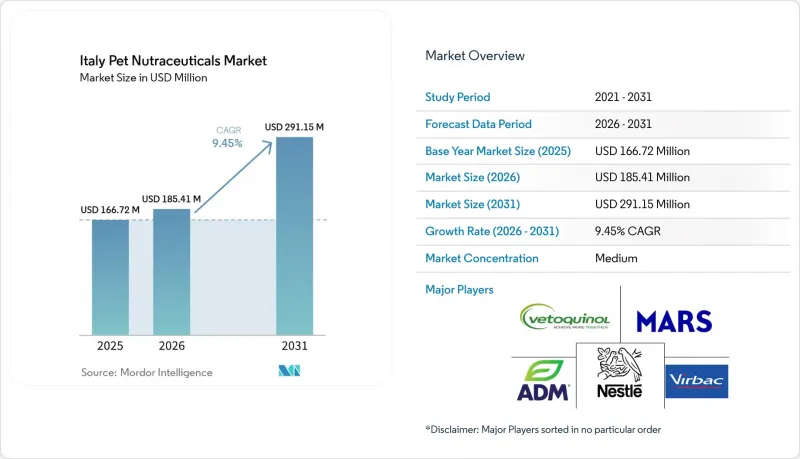
This report is Segmented by Sub Product (Milk Bioactives, Omega-3 Fatty Acids, Probiotics, Vitamins and Minerals, and More), by Pets (Dogs, Cats, and Other Pets), and by Distribution Channel (Online Channel, Specialty Stores, Supermarkets and Hypermarkets, and More). The Market Forecasts are Provided in Terms of Value (USD) and Volume (Metric Tons).
Italy Pet Nutraceuticals Market Trends and Insights
Rising Premiumization of Pet Health Spending
Italian pet owners are moving beyond basic care and are spending more on products linked to preventive wellness, which directly supports the Italy pet nutraceuticals market. The adoption rate is already broad, with nearly half of dog owners purchasing functional supplements, indicating that these products are no longer limited to a niche urban audience. This buying pattern aligns with a broader shift toward higher-value pet healthcare choices, where owners seek support for digestion, mobility, immunity, and daily condition management rather than just occasional treatment. Premium demand is strongest in Milan, Turin, and Bologna, where household income and access to specialist clinics make repeat supplement use more consistent. That pattern benefits categories with stronger clinical or ingredient storytelling, since owners in premium cohorts tend to pay more for products that look specific and credible. It also gives specialty stores and veterinary channels more room to defend premium pricing than mass retail formats usually can. As a result, premiumization is not only raising average selling prices but also widening the commercial space for differentiated formulas across the Italy pet nutraceuticals market.
Preventive Veterinary Supplement Adoption
Veterinary recommendations remain one of the strongest purchase triggers in the Italian pet nutraceuticals market, as owners tend to stick with products introduced in a clinic setting. Retail monitoring by GS1 Italy indicated robust sales of vitamins-labeled and prebiotics-related pet products in 2025, underscoring the growing consumer preference for health-oriented pet nutraceutical solutions. Products recommended by veterinarians usually retain stronger customer loyalty because the purchase is tied to a health plan rather than shelf comparison alone. This matters most in joint support, probiotics, omega-3 fatty acids, and digestive health, where clinical explanation plays a larger role in repeat buying. Northern urban areas have a denser clinic network, which gives brands stronger access to prescriptive influence and better follow-through on longer supplement regimens. Companies that invest in veterinary education, clinical data, and targeted practice outreach are, therefore, better placed to protect premium positions than brands that rely mainly on grocery visibility. This channel effect keeps preventive supplementation a durable demand driver rather than a short-lived retail trend in the Italy pet nutraceuticals market.
Fragmented Nutraceutical Claims and Label Compliance Burden
Regulatory compliance remains a significant barrier to the Italy pet nutraceuticals market, as supplement claims and labeling must comply with both European Union rules and Italy-specific practices. Products entering Italy must comply with feed additive and complementary feed rules, which makes wording on health support, usage, and ingredient presentation more sensitive than in standard consumer goods categories. A product statement that is commercially usable in another European market may still need relabeling or reformulation before it fits Italian expectations, which adds time and cost for cross-border launches. Large multinational groups can spread those costs across broader portfolios, but smaller challengers often cannot do so as efficiently. This difference slows the entry of innovations and can narrow the number of premium launches that reach veterinary or specialty shelves each year. Compliance pressure also favors companies that already have internal regulatory teams and documented ingredient dossiers, making the market harder for smaller domestic or digital-first entrants. For that reason, claim fragmentation acts as a commercial restraint on speed, margin, and scale across the Italy pet nutraceuticals market.
Other drivers and restraints analyzed in the detailed report include:
- E-Commerce-Assisted Trial of Functional Pet Formats
- Aging Companion Animal Demand for Mobility and Gut-Health Products
- Ingredient Cost Volatility in Marine, Probiotic, and Specialty Inputs
For complete list of drivers and restraints, kindly check the Table Of Contents.
Segment Analysis
Vitamins and minerals held 27.1% of Italy's pet nutraceuticals market share in 2025, making them the largest sub-product group because they combine high awareness, routine use, and wide distribution across grocery, specialty, and veterinary channels. Omega-3 fatty acids, proteins, and peptides followed as the next most commercially relevant groups, supported by stronger use in mobility, skin, and digestive support. Milk bioactives and other nutraceuticals remain on a smaller scale, but they are gaining attention as owners seek more targeted health positioning.
Probiotics are anticipated to record the fastest CAGR at 10.8% between 2026 and 2031, helped by growing veterinary acceptance and a stronger body of peer-reviewed evidence in both dogs and cats. Omega-3 fatty acids and proteins and peptides are also well-positioned for healthy growth because they align with joint care, inflammation support, and condition-specific management. Milk Bioactives are still at an earlier stage, but new science and more specialist positioning should gradually widen their relevance. The category mix shows that volume still sits in familiar formulations, while future growth is moving toward more evidence-based, biologically differentiated products in the Italy pet nutraceuticals market.
Complete Report Scope:
- By Sub Product
- Milk Bioactives
- Omega-3 Fatty Acids
- Probiotics
- Proteins and Peptides
- Vitamins and Minerals
- Other Nutraceuticals
- By Pets
- Dogs
- Cats
- Other Pets
- By Distribution Channel
- Online Channel
- Specialty Stores
- Supermarkets and Hypermarkets
- Convenience Stores
- Other Distribution Channels
List of Companies Covered in this Report:
- Mars, Incorporated
- Nestle S.A.
- Vetoquinol
- Virbac
- ADM
- Alltech, Inc.
- Dechra Pharmaceuticals PLC
- Nutramax Laboratories, Inc.
- Clearlake Capital Group, L.P. (Wellness Pet Company, Inc.)
- VAFO Group
- Elanco Animal Health
- H&H Group (Zesty Paws)
- Swedencare AB
- NBF Lanes Srl
- Candioli Pharma
Additional Benefits:
- The market estimate (ME) sheet in Excel format
- 3 months of analyst support
TABLE OF CONTENTS
1 Introduction
- 1.1 Study Assumptions & Market Definition
- 1.2 Scope of the Study
- 1.3 Research Methodology
2 Report Offers
3 Executive Summary & Key Findings
4 Key Industry Trends
- 4.1 Pet Population
- 4.1.1 Cats
- 4.1.2 Dogs
- 4.1.3 Other Pets
- 4.2 Pet Expenditure
- 4.3 Consumer Trends
5 Supply and Production Dynamics
- 5.1 Trade Analysis
- 5.2 Ingredient Trends
- 5.3 Value Chain & Distribution Channel Analysis
- 5.4 Regulatory Framework
- 5.5 Market Drivers
- 5.5.1 Rising Premiumization of Pet Health Spending
- 5.5.2 Preventive Veterinary Supplement Adoption
- 5.5.3 E-Commerce-Assisted Trial of Functional Pet Formats
- 5.5.4 Aging Companion Animal Demand for Mobility and Gut-Health Products
- 5.5.5 Microbiome-Driven Product Differentiation in Veterinary Channels
- 5.5.6 Sustainable Ingredient Sourcing as a Shelf-Access Advantage
- 5.6 Market Restraints
- 5.6.1 Fragmented Nutraceutical Claims and Label Compliance Burden
- 5.6.2 Ingredient Cost Volatility in Marine, Probiotic, and Specialty Inputs
- 5.6.3 Price Sensitivity in Mass Retail and Private Label Substitution
- 5.6.4 Formulation Complexity in Balancing Palatability and Efficacy
- 5.7 Porter's Five Forces Analysis
- 5.7.1 Bargaining Power of Suppliers
- 5.7.2 Bargaining Power of Buyers
- 5.7.3 Threat of New Entrants
- 5.7.4 Threat of Substitutes
- 5.7.5 Intensity of Competitive Rivalry
6 Market Size and Growth Forecasts (Value and Volume)
- 6.1 By Sub Product
- 6.1.1 Milk Bioactives
- 6.1.2 Omega-3 Fatty Acids
- 6.1.3 Probiotics
- 6.1.4 Proteins and Peptides
- 6.1.5 Vitamins and Minerals
- 6.1.6 Other Nutraceuticals
- 6.2 By Pets
- 6.2.1 Dogs
- 6.2.2 Cats
- 6.2.3 Other Pets
- 6.3 By Distribution Channel
- 6.3.1 Online Channel
- 6.3.2 Specialty Stores
- 6.3.3 Supermarkets and Hypermarkets
- 6.3.4 Convenience Stores
- 6.3.5 Other Distribution Channels
7 Competitive Landscape
- 7.1 Market Concentration
- 7.2 Key Strategic Moves
- 7.3 Market Share Analysis
- 7.4 Company Profiles (Includes Global Level Overview, Market Level Overview, Core Segments, Financials as Available, Strategic Information, Market Rank/Share, Products and Services, Recent Developments)
- 7.4.1 Mars, Incorporated
- 7.4.2 Nestle S.A.
- 7.4.3 Vetoquinol
- 7.4.4 Virbac
- 7.4.5 ADM
- 7.4.6 Alltech, Inc.
- 7.4.7 Dechra Pharmaceuticals PLC
- 7.4.8 Nutramax Laboratories, Inc.
- 7.4.9 Clearlake Capital Group, L.P. (Wellness Pet Company, Inc.)
- 7.4.10 VAFO Group
- 7.4.11 Elanco Animal Health
- 7.4.12 H&H Group (Zesty Paws)
- 7.4.13 Swedencare AB
- 7.4.14 NBF Lanes Srl
- 7.4.15 Candioli Pharma
8 Market Opportunities and Future Outlook

