PUBLISHER: Mordor Intelligence | PRODUCT CODE: 2098528

PUBLISHER: Mordor Intelligence | PRODUCT CODE: 2098528
Germany Pet Nutraceuticals - Market Share Analysis, Industry Trends & Statistics, Growth Forecasts (2026 - 2031)
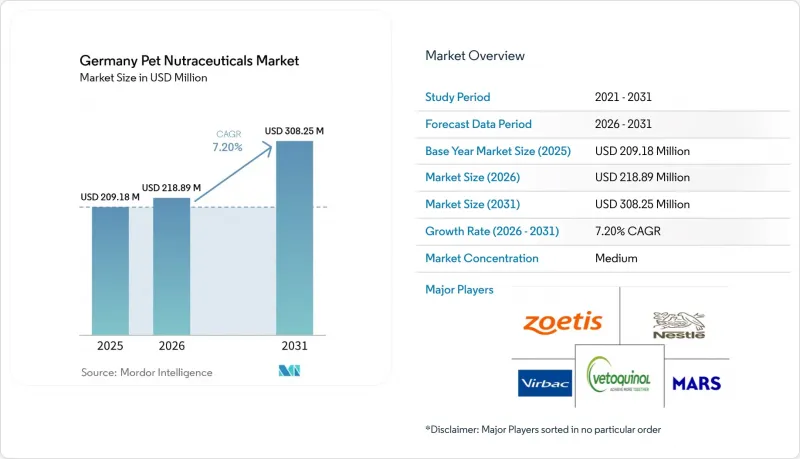
According to Mordor Intelligence, the Germany pet nutraceuticals market size is projected to increase from USD 209.18 million in 2025 to USD 218.89 million in 2026 and reach USD 308.25 million by 2031, growing at a CAGR of 7.2% over 2026-2031.
This report is Segmented by Sub Product (Milk Bioactives, Omega-3 Fatty Acids, Probiotics, Proteins and Peptides, Vitamins and Minerals, and Other Nutraceuticals), by Pets (Cats, Dogs, and Other Pets), and by Distribution Channel (Convenience Stores, Online Channel, and More). The Market Forecasts are Provided in Terms of Value (USD) and Volume (Metric Tons).
Germany Pet Nutraceuticals Market Trends and Insights
Pet Humanization and Preventive Wellness Spending
The Germany pet nutraceuticals market is benefiting from a steady shift in owner behavior toward preventive care rather than waiting for visible illness. According to the reports of Industrieverband Heimtierbedarf and Zentralverband der Heimtierbranche, in 2025, 43% of German households owned at least one pet, and 67% of families with children kept a pet, indicating a large, emotionally engaged base for daily wellness products. The same dataset also showed that 13% of households kept at least 2 different pet types, supporting repeat buying across multiple animals within the same home. That broad ownership pattern matters because preventive products are most likely to scale when demand does not depend on a narrow disease event or a single clinical trigger. It also explains why mainstream categories such as vitamins, digestive support, and coat health are holding attention in the Germany pet nutraceuticals market even when other pet-related purchases become more selective. As owners make pet care decisions more like family wellness planning, products with simple daily use and clear purpose are gaining the strongest traction.
Rising Veterinary Endorsement of Condition-Specific Supplements
Veterinary support is becoming a stronger commercial filter in the Germany pet nutraceuticals market, especially for products tied to mobility, skin condition, and gastrointestinal balance. Omega-3 fatty acids from fish oil have one of the strongest evidence bases for orthopedic support in dogs, providing practitioners with a clearer reference point when discussing supplement use with owners. This matters in Germany because products that enter the veterinary channel with a defined use case often move more smoothly into specialty retail and premium online listings afterward. The pattern favors companies that can support claims with clinical logic, dosing clarity, and traceable ingredient systems rather than broad wellness language alone. It also raises the bar for smaller entrants, since veterinarian-backed products are more likely to build trust across the Germany pet nutraceuticals market than generic formulations that look interchangeable on the shelf. Over time, this strengthens brands that invest early in practitioner relationships and scientific communication.
Regulatory and Claims Compliance Burden
The Germany pet nutraceuticals market operates under a strict regulatory setting, and that raises cost and timing pressure for companies that want to expand quickly. Germany's Federal Office of Consumer Protection and Food Safety, or Bundesamt fur Verbraucherschutz und Lebensmittelsicherheit, plays a central role in oversight of veterinary medicine and related compliance functions, making regulatory readiness a practical requirement rather than a back-office task. European Union feed additive rules add another layer, because product positioning and ingredient use must align with a wider regional framework rather than a single national interpretation. This does not stop growth in the Germany pet nutraceuticals market, but it does favor larger companies with dedicated regulatory teams and more experience in evidence-backed claims. The result is a category where speed to shelf is less important than compliance discipline and documentation quality.
Other drivers and restraints analyzed in the detailed report include:
- Premiumization of Dog and Cat Care Routines
- E-Commerce Reorder Behavior and Subscription Purchases
- Price Sensitivity for Long-Term Preventive Use
For complete list of drivers and restraints, kindly check the Table Of Contents.
Segment Analysis
Vitamins and minerals held 26.5% of the Germany pet nutraceuticals market share in 2025, and the same segment is also projected to post the fastest 7.7% CAGR through 2026 to 2031. That rare combination of largest and fastest status reflects how widely micronutrient products can be used across immunity, bone support, coat quality, and early cognitive support without needing a narrow condition-specific diagnosis. In the Germany pet nutraceuticals market, that flexibility makes the segment relevant across life stages and across both veterinary recommendations and self-directed owner purchases. It also keeps the category visible across multiple channels because the value proposition is easy to explain and repeat.
The market opportunity for milk bioactives, proteins, and peptides is expanding as product developers and pet owners increasingly seek specialized nutritional solutions beyond standard vitamins. Milk-derived bioactives are becoming more significant in early-life and recovery-focused applications, as they align with feeding strategies tailored to younger animals and households that prioritize life-stage-specific pet care over addressing occasional symptoms. Proteins and peptides are also benefiting from this trend, with companies like Kemin Industries, Inc., providing protein solutions designed to support immune and digestive health in premium pet nutrition formulations. Other nutraceuticals, such as botanical extracts and mobility blends, remain more fragmented. However, their positioning is improving as research on stress, behavior, and joint health continues to grow.
Complete Report Scope:
- Sub Product
- Milk Bioactives
- Omega-3 Fatty Acids
- Probiotics
- Proteins and Peptides
- Vitamins and Minerals
- Other Nutraceuticals
- Pets
- Cats
- Dogs
- Other Pets
- Distribution Channel
- Convenience Stores
- Online Channel
- Specialty Stores
- Supermarkets/Hypermarkets
- Other Channels
List of Companies Covered in this Report:
- Mars, Incorporated
- Nestle S.A. (Purina)
- Virbac SA
- Zoetis Inc.
- Vetoquinol S.A.
- DSM-Firmenich AG
- Kemin Industries, Inc.
- Archer Daniels Midland Company
- Nutri-Vet LLC
- Vets Plus, Inc.
- General Mills, Inc.
- Alltech, Inc.
- AniForte GmbH
- Dechra Pharmaceuticals PLC
- Boehringer Ingelheim International GmbH
Additional Benefits:
- The market estimate (ME) sheet in Excel format
- 3 months of analyst support
TABLE OF CONTENTS
1 INTRODUCTION
- 1.1 Study AssumptionsAnd Market Definition
- 1.2 Scope of the Study
- 1.3 Research Methodology
2 REPORT OFFERS
3 EXECUTIVE SUMMARY AND KEY FINDINGS
4 KEY INDUSTRY TRENDS
- 4.1 Pet Population
- 4.1.1 Cats
- 4.1.2 Dogs
- 4.1.3 Other Pets
- 4.2 Pet Expenditure
- 4.3 Consumer Trends
5 SUPPLY AND PRODUCTION DYNAMICS
- 5.1 Trade Analysis
- 5.2 Ingredient Trends
- 5.3 Value Chain And Distribution Channel Analysis
- 5.4 Regulatory Framework
- 5.5 Market Drivers
- 5.5.1 Pet humanization and preventive wellness spending
- 5.5.2 Rising veterinary endorsement of condition-specific supplements
- 5.5.3 Premiumization of dog and cat care routines
- 5.5.4 E-commerce reorder behavior and subscription purchases
- 5.5.5 Multipet household cross-selling of health products
- 5.5.6 Evidence-based formulations for mobility, digestive, and skin health
- 5.6 Market Restraints
- 5.6.1 Regulatory and claims compliance burden
- 5.6.2 Price sensitivity for long-term preventive use
- 5.6.3 Ingredient supply volatility for specialty inputs
- 5.6.4 Consumer skepticism from inconsistent product efficacy
6 MARKET SIZE AND GROWTH FORECASTS (VALUE AND VOLUME)
- 6.1 Sub Product
- 6.1.1 Milk Bioactives
- 6.1.2 Omega-3 Fatty Acids
- 6.1.3 Probiotics
- 6.1.4 Proteins and Peptides
- 6.1.5 Vitamins and Minerals
- 6.1.6 Other Nutraceuticals
- 6.2 Pets
- 6.2.1 Cats
- 6.2.2 Dogs
- 6.2.3 Other Pets
- 6.3 Distribution Channel
- 6.3.1 Convenience Stores
- 6.3.2 Online Channel
- 6.3.3 Specialty Stores
- 6.3.4 Supermarkets/Hypermarkets
- 6.3.5 Other Channels
7 COMPETITIVE LANDSCAPE
- 7.1 Key Strategic Moves
- 7.2 Market Share Analysis
- 7.3 Brand Positioning Matrix
- 7.4 Market Claim Analysis
- 7.5 Company Landscape
- 7.6 Company Profiles (Includes Global Level Overview, Market Level Overview, Core Business Segments, Financials, Key Information, Market Rank, Market Share, Products and Services, and Analysis of Recent Developments).
- 7.6.1 Mars, Incorporated
- 7.6.2 Nestle S.A. (Purina)
- 7.6.3 Virbac SA
- 7.6.4 Zoetis Inc.
- 7.6.5 Vetoquinol S.A.
- 7.6.6 DSM-Firmenich AG
- 7.6.7 Kemin Industries, Inc.
- 7.6.8 Archer Daniels Midland Company
- 7.6.9 Nutri-Vet LLC
- 7.6.10 Vets Plus, Inc.
- 7.6.11 General Mills, Inc.
- 7.6.12 Alltech, Inc.
- 7.6.13 AniForte GmbH
- 7.6.14 Dechra Pharmaceuticals PLC
- 7.6.15 Boehringer Ingelheim International GmbH
8 KEY STRATEGIC QUESTIONS FOR PET FOOD CEOS

